Mental Health Break

Where roads end:

Where the Road Ends from The Atlantic on Vimeo.

Using Google Street View, we “drove” thousands of miles around the world to find places where the road ends. Our virtual travels took us from the fields of Italy to the fjords of Norway and the tip of South Africa. This video was inspired by Alan Taylor’s In Focus photo gallery, “The Ends of the Road“. The Street View “hyperlapse” shots were made possible by the team at Teehan+Lax, who created an open source Street View hyperlapse script. Their original Street View hyperlapse video is here. Special thanks goes to Jonas Naimark and Peter Nitsch for all of their help. To create your own hyperlapse, visit the T+L hyperlapse site here.

Quote For The Day

“There must be a time of day when the man who makes plans forgets his plans, and acts as if he had no plans at all.

There must be a time of day when the man who has to speak falls very silent. And his mind forms no more propositions, and he asks himself: Did they have a meaning?

There must be a time when the man of prayer goes to pray as if it were the first time in his life he had ever prayed; when the man of resolutions puts his resolutions aside as if they had all been broken, and he learns a different wisdom: distinguishing the sun from the moon, the stars from the darkness, the sea from the dry land, and the night sky from the shoulder of a hill,” – Thomas Merton, No Man Is an Island.

“My Favorite Picture Of You”

That’s the title of a brief, brilliant documentary (above) by Oscar winners TJ Martin and Dan Lindsay. Paul Rosenfeld captions the film:

With simplicity and depth directors TJ Martin and Dan Lindsay bring us an emotionally charged documentary about family and the pains of old age. The film revolves around an audio conversation between Martin’s grandfather and grandmother, who was dying of cancer at the time. Featured alongside a selection of home videos and photos, the conversation is a portrait of the life the couple lived. But more than a simple celebration of those moments, the film challenges the viewer to grapple with the highs and lows of life, including age, decay, and death.

In an interview last February, Lindsay described the short film’s origins:

My filmmaking partner, TJ Martin, filmed a conversation between his grandfather and his grandmother almost a month before she passed away. She was dying of cancer, and her husband is reminiscing about their life, and she’s having a hard time remembering things. It just happened that they filmed a lot of footage of themselves and had a lot of great photographs, so one day we thought it would be interesting to take that conversation and tie in the idea of what memory means to identity.

An Ode To Joy

Pedro Blas Gonzalez plumbs the differences between happiness and joy:

While happiness is an outward expression of gratifying experiences, a moment of levity in life’s stages, joy is like smiling privately. Happiness is often attained from outside ourselves; joy takes the form of inner peace. Like fuel that feeds an engine, happiness propels us through the world of other people, things, and events without calling attention to itself. Happiness that is not self-conscious is more akin to joy than our popular conception of happiness. We can reflect on our state of being happy and cherish it, while not commanding it. However, more often than not, happiness is only noticed when it is lacking in our lives. This is the point when we realize that happiness has evaded us. …

One reason that happiness is often fleeting is because it attempts to take root in what can be described as moving targets. Happiness is the temporary culmination of emotional fulfillment. This makes our emotional and spiritual well-being transparent. Often it is during the noticeable absence of happiness in our lives, when we have become consumed by the idea of trying to attain happiness, that we realize how fleeting happiness truly is. We cannot cultivate the search for happiness, as we can joy.

Update from a reader:

Your excerpt from Pedro Blas Gonzalez left me feeling confused, because I thought he had it exactly backwards.

To me, happiness is a state better than contentment, in which I am pleased with my life in general. I considered myself a happy person for most of my life until my husband died at age 59; after that I was not happy very often. Even so, before and after his death I had moments of joy. Joy to me is an experience of exalted happiness, where the uplift of the moment, whether found in a transcendent view, inspiring music, intense pleasure, spiritual revelation, intellectual discovery, or some other personal experience, raises me above whatever ordinary feelings I have.

If Gonzalez is looking for a word, I would suggest the word “gladness” as used in some versions of the Bible, instead of the word joy as defined in his essay. Particularly in the spiritual sense, a feeling of gladness can underlay happiness and contribute to moments of joy. He might also wish to explore the various uses of the word mindfulness in contemporary culture.

Gonzalez complains that happiness is now a buzzword “equated today with the attainment of pleasure,” and his discussion of joy seems to ignore common definitions of the word. What I concluded is that in this essay, Gonzalez decides to reject the popular understanding of a vocabulary word and assert his superior ability to define it, in the process inverting the usual understanding of the definitions of “joy” and “happiness.” I would be more impressed with his essay if he didn’t try redefining words that have achieved an agreed-upon definition among the masses of English speakers. He may be writing perfectly good philosophy, but his redefinitions are yet another attempt, in the view of this experienced editor and follower of linguistics and Language Log, of an unscientific attempt to create rules for English that don’t exist.

Face Of The Day

dish_fotdsat25

Sahara Borja talked to photographer Souvid Datta about his series In the Shadows of Kolkata, which profiles mothers and children in Calcutta’s red-light district:

Can you speak a bit about the children you photographed? What was their day-to-day like? How did you interact with them?

“Children of prostituted women in the area lead varied lives. A few local NGOs run campaigns convincing mothers to send their children away to boarding schools outside the city run by religious bodies. This constitutes a small minority though. Most remain in the area, living within brothels or temporarily hired rooms, and dropping out of schools at a young age. Occasionally this is due to economic difficulties or from facing stigmatization and discrimination. The result however is commonly young women being picked up by local ‘madams’, pimps or traffickers, and young men giving into the area’s gang culture.”

More of Datta’s work here and here.

A Formula For Life?

Natalie Wolchover profiles Jeremy England, a scientist who has developed “a new physics theory of life”:

From the standpoint of physics, there is one essential difference between living things and inanimate clumps of carbon atoms: The former tend to be much better at capturing energy from their environment and dissipating that energy as heat. Jeremy England, a 31-year-old assistant professor at the Massachusetts Institute of Technology, has derived a mathematical formula that he believes explains this capacity. The formula, based on established physics, indicates that when a group of atoms is driven by an external source of energy (like the sun or chemical fuel) and surrounded by a heat bath (like the ocean or atmosphere), it will often gradually restructure itself in order to dissipate increasingly more energy. This could mean that under certain conditions, matter inexorably acquires the key physical attribute associated with life.

“You start with a random clump of atoms, and if you shine light on it for long enough, it should not be so surprising that you get a plant,” England said.

England’s theory is meant to underlie, rather than replace, Darwin’s theory of evolution by natural selection, which provides a powerful description of life at the level of genes and populations. “I am certainly not saying that Darwinian ideas are wrong,” he explained. “On the contrary, I am just saying that from the perspective of the physics, you might call Darwinian evolution a special case of a more general phenomenon.”

(Hat tip: 3QD)

Deathbed Prayers, Finally Deciphered

prayercode

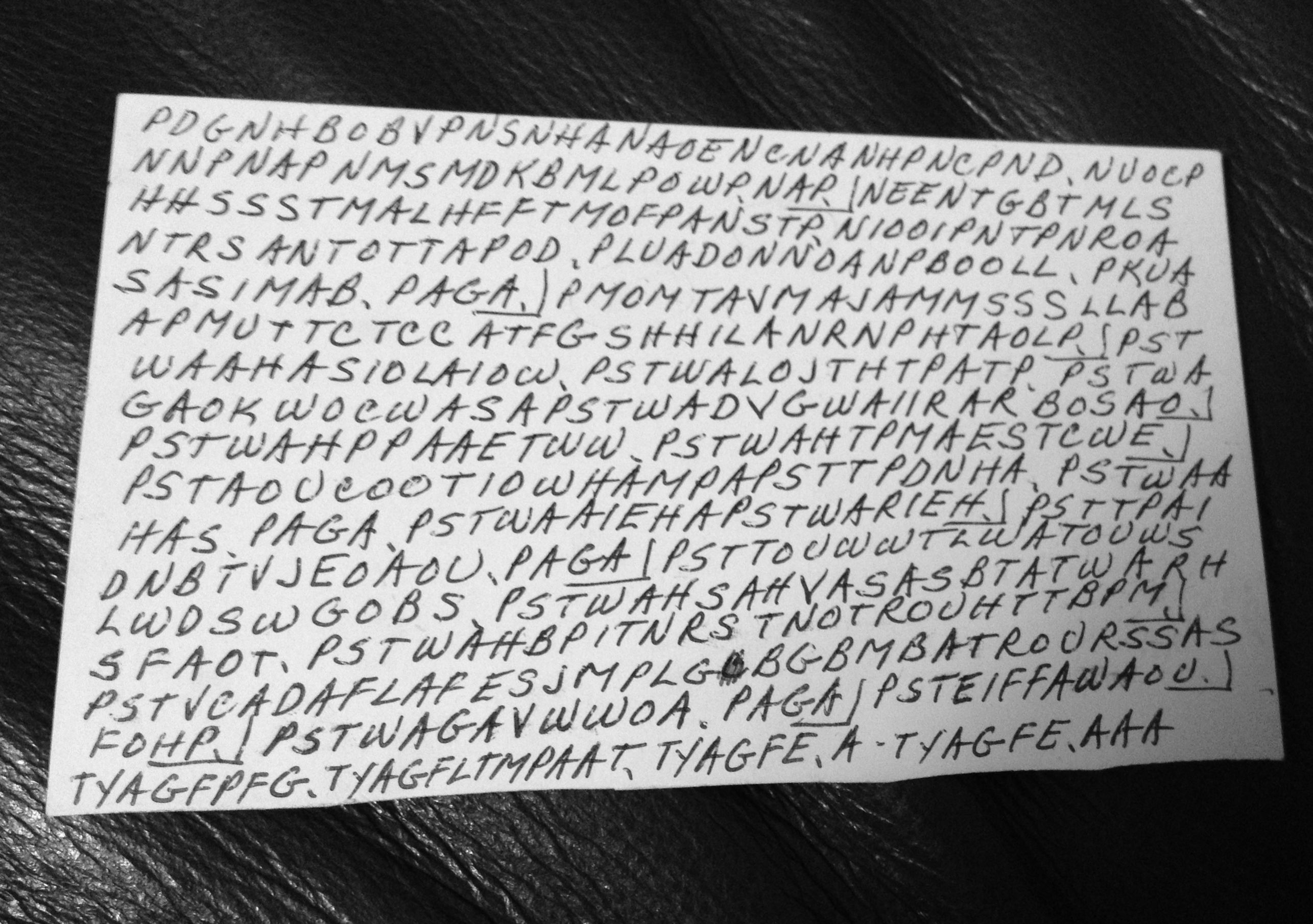
Last week, MetaFilter member Janna Holm posted a request for help to the online community:

My grandmother passed away in 1996 of a fast-spreading cancer. She was non-communicative her last two weeks, but in that time, she left at least 20 index cards with scribbled letters on them. My cousins and I were between 8-10 years old at the time, and believed she was leaving us a code. We puzzled over them for a few months trying substitution ciphers, and didn’t get anywhere. My father found one of the cards the other day and I love puzzles and want to tackle the mystery again.

Mario Aguilar summarizes what happened next:

Holy moly, wouldn’t you know it? The code turned out to be last prayers of a dying woman. Each letter stood for the first letter of the word in a prayer or message to God. The back of the card [here] was the easiest to decypher, revealing the pattern. As harperpitt noted, this is almost certainly the Lord’s Prayer:

Our Father who art in Heaven, hallowed be thy name… etc etc etc

Having recognized the pattern and the prayer-like sentiment, community members started piecing together the front side of the card bit by bit. It all appears to be a series of thank yous and requests to god; things like “Please see that we are all happy and safe in our lives and work” and “thank you Almighty God for listening to my prayers and answering them.”

Casey Cep comments:

Janna Holm, in one of her final posts on the thread, said that her father suspects her grandmother had not only lost the ability to speak but was losing her memory when she wrote out the cards. Perhaps, then, the code was not to disguise her prayers but a device by which she preserved and protected them. Realizing that, Holm wrote on Tuesday, “At this point, I don’t think much more can or should be deciphered …. I’m O.K. leaving a little mystery with this one.” Would that we all could live with such mystery, and not only in prayer.

(Photo via MetaFilter user JannaK)

Being There During Bad Times

Catherine Woodiwiss offers guidance for those who want to help a friend or loved one going through trauma or suffering. Among her suggestions? “Do not offer platitudes or comparisons. Do not, do not, do not”:

“I’m so sorry you lost your son, we lost our dog last year … ” “At least it’s not as bad as … ” “You’ll be stronger when this is over.” “God works in all things for good!”

When a loved one is suffering, we want to comfort them. We offer assurances like the ones above when we don’t know what else to say. But from the inside, these often sting as clueless, careless, or just plain false. Trauma is terrible. What we need in the aftermath is a friend who can swallow her own discomfort and fear, sit beside us, and just let it be terrible for a while.

David Brooks distills (NYT) her advice to one phrase – “the art of presence” – and puts it in context:

We have a tendency, especially in an achievement-oriented culture, to want to solve problems and repair brokenness — to propose, plan, fix, interpret, explain and solve. But what seems to be needed here is the art of presence — to perform tasks without trying to control or alter the elemental situation. Allow nature to take its course. Grant the sufferers the dignity of their own process. Let them define meaning. Sit simply through moments of pain and uncomfortable darkness. Be practical, mundane, simple and direct.

Todd Brewer appreciates the advice:

Woodiwess speaks repeatedly of the “presence” of those around her – how much it helped that people were simply there. But what Brooks aptly notes is that this presence is rarely, if ever, one that is aided by the speech of the console-er. When the world goes to hell, the last thing one needs is “a word” from the pastor. A cup of soup? Absolutely! A book on “why bad things happen…’? Not so much.

For many people – especially for pastors highly trained in preaching and teaching – this is incredibly disarming. It feels like resignation or irresponsibility not to say anything to the person in the midst of trauma. At best, we want to help. But so often “help” is just another word for “control” and a defense mechanism for feeling uncomfortable with another’s grief. Perhaps some might even think that a failure to talk about Jesus is un-Christian. And so we assault the grieving with misguided theological platitudes, congratulating ourselves that we’ve done our job.

Denominational Divorce

dish_divorcemap

A study indicates that “simply living in an area with a large concentration of conservative Protestants increases the chances of divorce, even for those who are not themselves conservative Protestants”:

According to researchers who took into account race, income and other factors, marriage and fertility trends that are common among conservative Protestants — younger marriage, more kids, less higher education — affect all people in areas most populated by conservative Protestants, no matter their personal religious affiliation.

“Conservative Protestant community norms and the institutions they create seem to increase divorce risk,” researchers say in the study. For example, those who are struggling in their marriage may feel discouraged to find help in communities where marriage is idealized or marital failure is viewed as shameful, the researchers suggest.

George Chidi adds:

The strongest correlation showed that early marriage and low income among religious conservatives factor into the higher divorce rates. “Unpacking these variations, [demographers Jennifer] Glass and [Philip] Levchak found that the high divorce rate among conservative religious groups is indeed explained in large part by the earlier ages at first marriage and first birth, and the lower educational attainment and lower incomes of conservative Protestant youth,” the authors wrote.