Democrats For War With Iran, Ctd

President Obama Departs The White House

A Colorado reader emailed Senator Michael Bennet’s office to ask why he was co-sponsoring the AIPAC bill that drastically moves the goalposts on the Iran negotiations whose terms have already been set, adds a whole range of non-nuclear issues into the bargaining, includes demands that both the president of the United States and Iran have already ruled out, and commits the US in advance to joining a pre-emptive war on Iran, led by Israel. Here’s the money quote from the letter he received from Bennet’s office:

I support the ongoing negotiations and the President’s efforts to engage Iran and its people through direct diplomacy; I am also cognizant of the security risks Iran poses to our allies in the region and the international community at large. That is why I am a co-sponsor of the Nuclear Weapon Free Iran Act of 2013 (S. 1881). The bill would impose economic sanctions against Iran only if it violates any interim or final agreement that is reached with respect to its nuclear program.

S.1881 has been placed on the Legislative Calendar but is not currently under consideration on the Senate floor. I will continue to follow the negotiations closely and will keep your thoughts in mind should this legislation be brought before the full Senate.

There are three possible conclusions to be drawn from this:

a) Bennet hasn’t read the full bill he is co-sponsoring, which includes several AIPAC-inserted poison pills for any realistic negotiation with Iran; b) Bennet has read the bill, knows it’s a poison pill that could only, if passed, end all negotiations and commit the US to an Israeli war, and believes war with Iran is the right course of action; or c) is deliberately misrepresenting the scope of the bill to his constituents, privately opposes it, won’t vote to bring it to the Senate floor, and is doing all this because he is shit-scared of AIPAC, and what crossing them might do to his political future.

At best that’s cowardly; at worst, it’s craven; in its entirety, it’s pure Washington – the kind of politicking that Bennet once promised he would oppose. In other words, Bennet is just another calculating Washington pol, prepared to sabotage his own president’s negotiations and provoke another Middle East war for his own careerist reasons.

Readers are encouraged to write their Senators, especially Democratic ones undermining their own president, to ask why they support the AIPAC bill. The Dish will publish the responses. It’s one way to get some accountability on this. And to get the Democrats who favor war with Iran on the record now. Let’s give the night-flower some sunlight, shall we?

(Photo: Senator Bennet with the president whose negotiations he is threatening to sabotage. By Mark Wilson/Getty.)
The Facts That Inform Great Fiction

In a review of Sarah Churchwell’s Careless People a “lavish excavation of the real-life milieu whose scandals, frolics and gaudy personalities gave F. Scott Fitzgerald the raw material for The Great Gatsby” — Tom Carson reflects on the utility of such literary history:

[H]ow much does this sort of whack-a-mole scholarship add to our understanding of dish_beacontowers either Fitzgerald or Gatsby?  A fair amount, I’d say.  Even when Churchwell’s specific guesses may be dead wrong, she’s given us a raft of plausible speculations on the interplay between a novelist’s mind and the hurly-burly around him, meanwhile reminding readers of one of Fitzgerald’s greatest gifts: selectivity. Nonetheless, it’s telling that one reason reviewers in 1925 couldn’t see past Gatsby‘s surface was that its plot struck them as little more than a pastiche version of the sort of sensationalistic, sordid affair they read about in the papers every day. Because Fitzgerald transmuted dross into gold and the dross has grown fairly obscure almost 90 years later, Churchwell has done us a favor by evoking how his imagination was stimulated by all sorts of trifling current events.  Better yet, her own writing is so spirited that you want her to be right about everything, even when you suspect otherwise—and come to think of it, that’s a kind of susceptibility Nick Carraway knew all about.

In another review of Careless People, Joanna Scutts observes:

Amid all the suggestive fragments of history that Churchwell uncovers, the most memorable are the counterintuitive details that remind us that nostalgia isn’t the same as memory. As asides to the main story, she tells us (often by means of illustrations and photographs) that in 1922 skirts were still ankle-length; that it was unlikely that anyone danced the Charleston at Gatsby’s parties; that the swastika was a benign symbol that a bootlegger could use to distinguish his fleet of taxicabs; and that the phrase “American dream” wasn’t invented until 1931, six years after “Gatsby” was published.

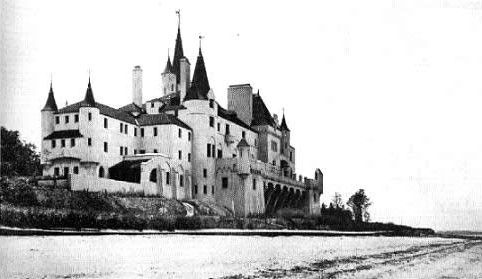
(Image of Beacon Towers in Sands Point, New York, 1920, the property that partly inspired the fictional Gatsby mansion, via Wikimedia Commons)

A Short Story For Saturday

A passage from the opening paragraphs of Nathaniel Hawthorne‘s 1843 story “The Birthmark“:

In those days when the comparatively recent discovery of electricity and other kindred mysteries of Nature seemed to open paths into the region of miracle, it was not unusual for the love of science to rival the love of woman in its depth and absorbing energy. The higher intellect, the imagination, the spirit, and even the heart might all find their congenial aliment in pursuits which, as some of their ardent votaries believed, would ascend from one step of powerful intelligence to another, until the philosopher should lay his hand on the secret of creative force and perhaps make new worlds for himself. We know not whether Aylmer possessed this degree of faith in man’s ultimate control over Nature. He had devoted himself, however, too unreservedly to scientific studies ever to be weaned from them by any second passion. His love for his young wife might prove the stronger of the two; but it could only be by intertwining itself with his love of science, and uniting the strength of the latter to his own.

Such a union accordingly took place, and was attended with truly remarkable consequences and a deeply impressive moral. One day, very soon after their marriage, Aylmer sat gazing at his wife with a trouble in his countenance that grew stronger until he spoke.

“Georgiana,” said he, “has it never occurred to you that the mark upon your cheek might be removed?”

Peruse Nathaniel Hawthorne: Tales and Sketches for more of his short fiction. Previous SSFSs here.

The View From Your Window Contest

vfyw

You have until noon on Tuesday to guess it. City and/or state first, then country. Please put the location in the subject heading, along with any description within the email. If no one guesses the exact location, proximity counts.  Be sure to email entries to contest@andrewsullivan.com. Winner gets a free The View From Your Window book or two free  gift subscriptions to the Dish. Have at it.

When Flu Shots Don’t Help

Kevin Hartnett points to a study from last August that demonstrated “that in some cases, flu shots can make an influenza epidemic worse, not better”:

The problem is two-fold: First, flu shots have a high failure rate (last year, nearly 4 in 10 flu vaccinations failed to confer the promised immunity); and second, once you think you’re protected, there’s a natural tendency to be a little more cavalier about germs—maybe washing your hands less, or venturing more boldly into crowded public places.

This dynamic—when safeguards like a vaccine or a condom lead people to act more recklessly—is called “moral hazard” by economists and “risk behavior” by epidemiologists, and it explains how public health interventions can have unintended negative consequences. The Northeastern study is based on a computer model that makes assumptions about vaccine effectiveness and behavior patterns, and simulates how diseases spread in a population. With the flu vaccine they find there’s a tipping point: At low-levels of vaccination, riskier health behavior outweighs the benefits of vaccination and actually fuels the spread of the disease.

Hartnett nevertheless recommends getting a flu shot this year.  Sy Mukherjee also favors vaccination, noting the hazards the flu still poses:

About 200,000 people are hospitalized and anywhere from 3,000 to 49,000 people die of the flu every year in the United States, according to the Centers for Disease Control. This year’s flu season is shaping up to be particularly harsh, thanks to the return of the H1N1 flu strain, popularly known as “swine flu.” Federal health officials have reported that at least 35 states currently have “widespread influenza activity.” While national numbers on flu-related deaths aren’t available yet, the virus has killed at least 45 people in California alone so far.

A Poem For Saturday

Dish poetry editor Alice Quinn writes:

This coming Monday, January 27th, will mark the fifth anniversary of the death, at age 76, of John Updike. Poetry had a special place in his life. He wrote a poem every time he took a trip, and by the time he published Collected Poems, 1953-1993, by his calculation, The New Yorker had “said yes” to his poems one hundred and thirty five times. After his death, in the March 16th issue, the magazine ran ten poems from his last, dazzling, and tremendously moving collection, Endpoint, with a sequence of poems about his diagnosis, hospitalizations, and approaching lift-off from the world he celebrated so abundantly in his more than sixty books. In the opening poem of the sequence, “Spirit of ’76,” he wrote,

Be with me, words, a little longer; you
have given me my quitclaim in the sun,
sealed shut my adolescent wounds, made light
of grownup troubles, turned to my advantage
what in most lives would be pure deficit,
and formed, of those I loved, more solid ghosts.

In Updike’s honor, we’ll post three of his poems in the coming days.

“Upon Shaving Off One’s Beard” by John Updike:

The scissors cut the long-grown hair;
The razor scrapes the remnant fuzz.
Small-jawed, weak-chinned, big-eyed, I stare
At the forgotten boy I was.

(From Collected Poems, 1953-1993 by John Updike © 1993 by John Updike. Used by permission of Alfred A. Knopf, an imprint of the Knopf Doubleday Publishing Group, a division of Random House LLC.  All rights reserved.)

Cross Examination

Crossdressing Harvard poetry professor Stephen Burt reviews William T. Vollmann’s The Book of Dolores:

Vollmann’s cross-dressing—unlike, say, the comedian and actor Eddie Izzard’s cross-dressing, or mine—is not an expression of deep identity (it is not something he has always done, nor something he always wanted to do) but something he seems to have done on a dare; having explored the mountains of Afghanistan, the red-light districts of Phnom Penh, and the polluted croplands of Calexico, Vollmann finds a new adventure in dresses and wigs. He cannot, he writes, “know what it is like to be a woman,” but he can “perform femininity for myself.” And why not? Like me, he won’t be fired, or even stigmatized, let alone physically harmed, for cross-dressing (though every year—as he must know—many people still are); like me, Vollmann works in a field where you can embarrass yourself without much professional penalty, as long as your audience still likes the language you use. There is nothing morally wrong—though nothing morally praiseworthy—in drag per se; when a man so invested in straight male desire as Vollmann tries it on, and describes how he feels with prolix honesty, the results may be creepy or charming, or both.

What’s sad here is how much he seems to have done it alone, without even trying to figure out how other cross-dressers or trans people, or their communities or their literary precursors, might help:

sometimes he talks without listening. When Vollmann is not explaining the processes by which he made Dolores into visual art, or explaining how “The Book of Dolores” interacts with the Mexican novel, he is explaining, or mansplaining, life in general: “People often get crushed to pieces between the grindstones of conflicting realities, as did the Poles during the Nazi-Soviet Pact.” Vollman has a thing for autodidacts and big thinkers: his prose here refers to Herbert Marcuse and to Gandhi, to Thoreau, to Dostoyevsky, to photographers from Man Ray to Steven Livick, but not (unless I missed it) to anybody before him who has spent any time thinking about what it means to reject the gender in which you grew up.

Do Babies Fake Tears?

According to a recent study, some do:

Just over 98 per cent of Baby R’s crying episodes were also preceded by negative affect, but there was a single instance at 11 months where her crying immediately followed positive emotion (indicated by smiling or laughing), and then positive emotion abruptly followed the bout of crying. The mother recognised this behaviour as fake crying, and the emotional analysis appeared to confirm this. “Infant R appeared to cry deliberately to get her mother’s attention,” said [researcher Hiroko] Nakayama, “[then] she showed smile immediately after her mother came closer.”

People might have a negative impression of “fake crying” said Nakayama, but they shouldn’t…. It attracts the attention of the care-giver, and “such individual interaction contributes greatly not only to an infant’s social development but also to their emotional development. Infants who are capable of fake crying might communicate successfully with their caregivers in this way on a daily basis. Fake crying could add much to their relationships.”