Where Are All The Black Atheists? Ctd

A reader writes:

Thanks for having the thread on black atheists. I feel like atheism is the third rail of black identity. I have spent most of my life not fitting in neatly with any particular group while getting along well with almost everyone. I’m a black Jamaican immigrant raised by parents who were intellectual and black power-y enough to give both their children African middle names and eschew organized religion. My parents were both raised in religious households but when it came to raising their own children they said they’d “let us decide for ourselves when we grew up.” Suffice it to say, that meant the default context was atheism and, no offense, but religious origin stories are a tough pill to swallow if they haven’t been ingrained long before one develops the capacity for reason.

I almost feel like being an atheist is something I have to hide so people don’t look at me funny.

Being black and atheist has really resulted in feeling fairly alienated from “mainstream” black American culture. I just flat out don’t get, don’t want to get and can’t relate to the level of Christian religiosity that is part and parcel of African-American culture.

That said, I’m not ignorant. I’ve been to black church services and appreciate the role the black church has played in sustaining African-Americans culturally, spiritually, and political throughout a brutal history steeped in white supremacy and black oppression. Still, I am not about that life.

Pretty much none of my close friends slides much past “spiritual” on the religious scale, and I don’t think it’s an accident that of my very closest friends, not one is African-American. I almost feel like a bad black person typing that, even though I know my expression of blackness is just as valid as the “praise Jesus, God is good” version of it. But there’s just so little room for expressing it, it feels taboo.

Long story long, what I’m trying to say is thank you for providing a venue for me to express myself and for showing me enough other people like me to normalize my experience. Like the attorney in the piece said, we need more images in popular culture – like a black atheist version of Will & Grace – to expand the perception of what blackness includes.

Quote For The Day

“To my infinite regret, we never asked anyone knowledgeable enough about transgender issues to help us either (a) improve the piece, or (b) realize that we shouldn’t run it. That’s our mistake — and really, my mistake, since it’s my site. So I want to apologize. I failed. More importantly, I realized over the weekend that I didn’t know nearly enough about the transgender community – and neither does my staff. I read Caleb’s piece a certain way because of my own experiences in life. That’s not an acceptable excuse; it’s just what happened,” – Bill Simmons, new media pioneer, editor-in-chief of Grantland.

For a more thorough piece on how those mistakes happened, read … Grantland’s Christina Kahrl.

Simmons’ account of how a piece came to be published is fascinating. (I have a question: is there anyone at Grantland who is gay and might have had a role in reviewing this piece? Being gay does not mean understanding the issues facing transgender people, but it helps a little. Diversity does have a point in journalism – and not because of lefty abstractions.) Otherwise, I’m struck by the thoroughness and integrity of the public accounting and the sincerity of the apology. I think it’s way better than would have once happened in legacy media. Because it’s personal and real.

Coding Toys For Girls And Boys

dish_toys

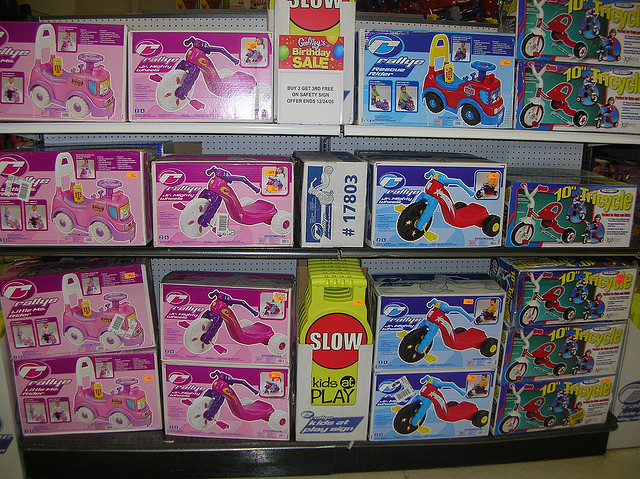
“It seems that the more progress we make toward less rigid gender roles,” observes Susan Bailey after visiting a kids’ toy store, “the more extreme the gender coding of toys becomes”:

The toys were far more color coded than four decades ago. Back then bikes, trucks, airplanes and even dolls sported a wide range of bright colors—red, green, yellow as well as shades of blue and rose.  The pink/lavender vs. black/dark navy dichotomy is a division that, among other things, probably helps sales. Teach children and parents the color-code and you double your market.  What little brother will want to settle for his big sister’s pink tricycle?

Earlier this month, C.J. Pascoe and Tristan Bridges argued that “the denunciation of all things pink should not really be our primary focus if we want to move toward a more gender equal world for girls and boys”:

The focus on the push back against pink and, by extension, princess culture is especially surprising when one looks at what is for sale in the boys’ aisle.

Take the first category of offerings for boys at the Toys R Us website for example – action figures laden with a variety of weapons who are designed to defeat the bad guys.  The closest offering for girls is a dolls category – featuring Barbies, the Little Mermaid, and Strawberry Shortcake. None of them are warriors.  None of them have weapons. We see a similar difference even when looking at the exact same categoryGirl’s Building Sets vs. Boy’s Building Sets. Girls apparently build houses, salons… and the occasional bridge. Boys? They build Super Star Destroyers and Monster Fighter Vampyre Castle… and the occasional bridge.  To be clear, the “pink aisle” of toy stores is deeply problematic. It encourages a narrow range of passive, primarily family-oriented and appearance-obsessed femininities.  But, as the toys on the (digital and physical) shelves indicate, we are encouraging equally restrictive and arguably more dangerous masculinities –  warriors, space fighters, and ninjas.

Rebecca Hains joins the discussion, saying she’d “like to see a movement that … challenges marketers to put an end to the incessant pink-washing”:

By “pink-washing,” I’m specifically referring to the instances where marketers or toy makers create a product that is pink for no reason other than to make it as girly as possible. After all, there’s nothing wrong with pink–it’s a perfectly nice color–but there IS something wrong when it’s a) promoting sex role stereotypes and b) basically the only color found in little girls’ worlds. They deserve a full rainbow of colors. …

The Let Toys Be Toys movement is doing terrific work challenging the status quo in the UK. By calling for toys to be desegregated–grouped by theme or interest type, rather than by gender—they’re empowering parents and children to think outside of the pink and blue boxes that marketers have been placing children into. I’d really love to see a comparable movement here in the U.S. and Canada.

(Photo of gender toy divide in Toys “R” Us by Brian Sawyer)

In Defense Of The 8-Hour Workday

Noting its disappearance among tech workers, Nathan Pensky advocates a return to form:

Since the “digital revolution” (we really need a better term), many entrepreneurs have adopted irregular hours. A concept sometimes cited in tech entrepreneur circles asserts that people are most productive and creative working according to Ultradian rhythms, in three-hour blocks, with a half-hour rest in between. Another popular concept, pioneered by Hungarian psychology professor Mihaly Csikszentmihalyi, known as “Flow,” describes optimal working conditions as a measure of attention. An interesting aspect of both of these concepts is that they designate how workers are most productive, not necessarily what workers need to be healthy. …

But isn’t the 8-hour day based on an arbitrary number? Perhaps. But the need for limitations on work hours has never more apparent. And it’s not just tech. According to a 2009 survey by the Harvard Business Review, 94 percent of professionals surveyed worked at least 50 hours a week or more. And the 2013 State of the American Workplace report conducted by Gallup found that up to 70 percent of the American workforce feels unengaged (read: demotivated and unsatisfied). Acknowledgement of the importance of the 8-hour workday, or at least some sort of limitation on work time, is not some ploy for lazy people, nor even one for compassion, really. It’s a humanist argument for productivity within the boundaries of reality.

Tracking Feathered Foes

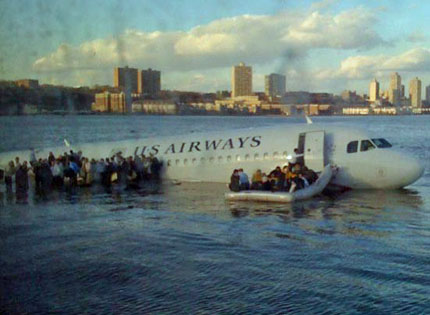
Aviation experts are turning to radar to prevent bird strikes like the one that brought down Flight 1549 into the Hudson River five years ago:

3199861367_6e292337fa_oAmerica’s Federal Aviation Administration (FAA) reports that there are about 10,000 such strikes a year to the country’s non-military aircraft, costing more than $957 million in damage and delays. The worldwide figure is estimated by the European Space Agency to be $1.2 billion. Moreover, though relatively few people have been killed in accidents caused by bird strikes (research by John Thorpe, former chairman of the International Bird Strike Committee, recorded 242 deaths between 1912 and 2004), the potential for something horrible to happen is real. …

At the moment, attempts to deal with the problem mostly involve efforts to cull flocks of the larger species – geese in particular – in the vicinity of airports, and also the use of bird scarers to try to drive off those actually sitting near runways. As the figures suggest, these approaches do not work well. There may, however, be a better way.

For a decade or more the air forces of several countries have used radar to track birds which might threaten their aircraft. Now, similar systems are being considered for civilian airports. If they work, the old methods of trying to scare birds away, or cull them, can be abandoned.

The longest-running study of the use of radar to prevent bird strikes was started three decades ago, in Israel, by Yossi Leshem of Tel Aviv University. It has helped the Israeli air force reduce the number of strikes it suffers by two-thirds. Dr. Leshem began his research using a mixture of powered gliders, drones, ground-based bird watchers and radar to build up data on the flocks that migrate over Israel in the spring and autumn. From these observations he has worked out the meanings of different sorts of radar blips, and can thus tell what is going on ornithologically from radar alone. The upshot is a system which can follow individual birds that weigh as little as ten grams and are as far away as 20 kilometers (12 miles). He can track birds the size of pelicans and geese at a distance of 90 kilometers (56 miles). Moreover, knowledge of the weather, and of how birds have behaved in previous years, allows him to predict what they will do next, so aircraft can be routed above them.

(Photo of US Airways Flight 1549 by Dan Iggers)

Rethinking Our Roads

Eric Jaffe highlights Marlon Boarnet’s argument that “that the Interstate Highway System should have been two distinct systems: one running between cities, and another running within them”:

Boarnet argues that one branch of the Interstate Highway System should have been reserved entirely for intercity roads. These would be highways running through remote areas with cheap land and sparse populations, so it would make sense to prioritize traffic flow and vehicle capacity. Paying for this branch with a pooled fuel tax would also make sense, because the benefits of low-cost transport and trade redound on everyone.

The other branch of the system would be made up of intracity roads, those running within the city limits. Given the high cost of land and density of population in cities, creating sufficient road capacity and swift vehicle flow would become a pipe dream, so the wiser aim would be transport balance. The logical way to finance these roads, given the great demand for space on them, would be with direct user fees — ideally priced to reduce congestion.

The two systems could even be governed separately. A national authority could oversee the intercity system, deciding on route location and managing maintenance programs. Meanwhile, the intracity system could be organized by metropolitan authorities capable of designing the network to fit local needs. Some level of coordination would be needed at the city limits, of course, but that partnership should give both systems equal importance.

A Sense Of Scents

Jessica Love observes “something of a lexical void when it comes to words for smells” in English.  She notes a new study that compares English with Jahai, a language spoken among certain Malaysian groups:

The researchers confirmed the Jahai olfactory lexicon by comparing the performances of Jahai speakers and English speakers on two different tasks: color-naming and scent-naming. Color-naming required individuals to describe 80 different colored chips as best they could, while scent-naming required them to sniff odors extracted from lemons, turpentine, smoke, and the like, and do the same. As a group, the English speakers all tended to agree—and pithily—on color terms, just as we’d expect given how strongly color terms are encoded in English. But they were stumped by scents, offering disagreeing, and long-winded, responses. Jahai speakers, on the other hand, experienced much less difficulty describing the odors, finding them just as codable as colors (though interestingly, they showed poorer agreement on color terms than English the speakers did).

Ben Thomas elaborates:

Just as English has precise color terms like “mauve” and “cerulean,” Jahai has highly precise terms for smells – such as cŋεs, “the smell of petrol, smoke and bat droppings,” itpɨt, “the smell of durian fruit, Aquillaria wood, and bearcat,” pʔus “a musty smell, like old dwellings, mushrooms and stale food,” and plʔεŋ, “a bloody smell that attracts tigers.” English speakers, meanwhile, tended to rely on broader smell terms like “smoky,” “sweet,” “piney” and so on.

Commemorating King

dish_mlk2

Gary May pays tribute:

Looking back on King’s life and career, some would say that he had died at the right moment, that martyrdom rescued him from an equally serious blow: irrelevancy. The Voting Rights campaign had clearly been his greatest achievement and, as it turned out, his last. But the 1964 Civil Rights Act and the 1965 Voting Rights Act are a testament to his leadership and commitment to achieving change through nonviolent protest. Nearly 50 years after his death it is King’s words and deeds that live on in the American memory — not that of the racists who hated him or the Black Power advocates who scorned him.

King left us a rich legacy. Nonviolence became an effective tool in the hands of reformers throughout the world as well as the United States, which experienced the end of segregation in a relatively bloodless revolution. Despite his self-doubts and the attacks of critics in his own camp, he persevered, committed always to nonviolence and to the fulfillment of American democracy however long it would take. That is what we should be celebrating on this day.

Jenee Desmond-Harris urges us to refrain from asking “What would MLK think?” when it comes to today’s politics, emphasizing that his views could be difficult to pin down during his own lifetime:

“He was constantly evolving in his thoughts, and that evolution would have continued to impact his politics,” says Hasan Jeffries, professor of history at Ohio State University.

Jeffries points to the way King “trailed his wife, who’d already participated in anti-war protests years earlier” before finally making the Riverside Church declaration against the Vietnam War, getting himself cut off from more-conservative civil rights activists. It’s evidence that neither King’s positions nor his alliances were static. … Naturally, as his reality and his adversaries changed, so did his positions and his goals.

And even when it comes to people who are living today, it’s not as if everyone on the left, everyone who was active in the civil rights movement or all black politicians or activists are of the same mind when it comes to contemporary issues. Where would he stand on education reform? The Affordable Care Act? What about President Obama’s responsibility to African Americans in an environment that could be seen as the embodiment of King’s dreams but that goes hand in hand with racialized political potholes he couldn’t have imagined? Scandal? Your guess is as good as mine.

Meanwhile, Aura Bogado casts a critical eye at The GAP’s “MLK Event” sale, adding that she never “lets the day go by without reading King’s ‘Letter from a Birmingham Jail.'” Drawing on Taylor Branch’s Parting the Waters, Paul Elie details the “strange circumstances” of how the “Letter” was written:

What strange circumstances?  That King, prompted to set out his views after reading a newspaper article in which white liberal clergymen denounced nonviolence as an incitement to “violence and hatred,” started to write the letter in the margins of the newspaper. That he developed his argument (Branch reports) among “pest control ads and garden club news,” drawing arrows and loops to connect one insight to another — such as the point that “time is neutral” and so “we must use time creatively.” That once he got some note paper from his SCLC associate Clarence Jones, he crafted a three-hundred-word sentence explaining “why we find it so difficult to wait” for justice. … That a New York publisher suggested that an expression from the letter, simplified, should be the title of a book, King’s third: Why We Can’t Wait.

Ellen Blum Barish recommends listening to a 1958 speech given at her synagogue in Evanston, Illinois.  MLK’s Nobel Prize acceptance speech can be viewed here. Update from a reader:

Your post missed what I thought would have resonated with you today: how much Pope Francis sounds like MLK.  From the 1956 sermon “Letter From St. Paul to American Christians“:

They tell me that one tenth of one percent of the population controls more than forty percent of the wealth. Oh America, how often have you taken necessities from the masses to give luxuries to the classes. If you are to be a truly Christian nation you must solve this problem. You cannot solve the problem by turning to communism, for communism is based on an ethical relativism and a metaphysical materialism that no Christian can accept. You can work within the framework of democracy to bring about a better distribution of wealth. You can use your powerful economic resources to wipe poverty from the face of the earth. God never intended for one group of people to live in superfluous inordinate wealth, while others live in abject deadening poverty. God intends for all of his children to have the basic necessities of life, and he has left in this universe “enough and to spare” for that purpose. So I call upon you to bridge the gulf between abject poverty and superfluous wealth.

Previous Dish on MLK here, here, and here.

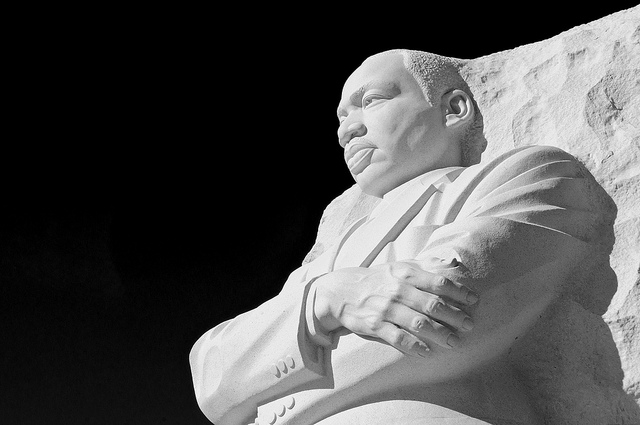
(Photo of Martin Luther King, Jr. memorial in Washington DC via Flickr user InSapphoWeTrust)
The Case For Small-Scale Science

This year’s Edge question is “What scientific idea is ready for retirement?”  From mathematician Samuel Arbesman’s response:

While the trends clearly point to the advent of team science, small and clever science—the realm of the tiny budget or the elegant experiment, or sometimes even the hobbyist—is by no means over.

To be clear, small science is not necessarily the lone underdog working against the establishment. More often it is simply one or two underfunded scientists doing their best. But it seems that they can still survive even in this modern era of big science. For example, several years ago, a paleontology graduate student made a discovery that cleared a dinosaur of cannibalism charges that began with a very simple observation: by looking at one of the fossil casts on the wall of the American Museum of Natural History’s subway station. Or take the scientists who examined the space of possible ways to tie a necktie, and whose research was published in Nature. Little science is still possible. …

You can even still do science on the cheap. Several decades ago, Stanley Milgram measured the well-known Six Degrees of Separation using little more than postcards. While science has become bigger since then, in some ways it has become even easier to conduct large-scale science by the scientist who operates at a small scale: due to massive computational advances and widespread data freely available (not to mention easier data collection online), now any scientist can do big science cheaply and in a small and easy way. Technology has allowed research scientists to leverage a tiny budget in astonishing ways. And each of us can now even easily contribute to science as an amateur, through the growing prevalence of citizen science, where the general public can help—often in a small incremental way—to collect data or otherwise help with science. From categorizing galaxies and plankton to figuring out how proteins fold, everyone can now be a part of the scientific process.