A Poem For Thursday

camera222

“An Archival Print” by William Stafford:

God snaps your picture—don’t look away—
this room right now, your face tilted
exactly as it is before you can think
or control it. Go ahead, let it betray
all the secret emergencies and still hold
that partial disguise you call your character.

Even your lip, they say, the way it curves
or doesn’t, or can’t decide, will deliver
bales of evidence. The camera, wide open,
stands ready; the exposure is thirty-five years
or so—after that you have become
whatever the veneer is, all the way through.

Now you want to explain. Your mother
was a certain—how to express it?—influence.
Yes. And your father, whatever he was,
you couldn’t change that. No. And your town
of course had its limits. Go on, keep talking—
Hold it. Don’t move. That’s you forever.

(From Ask Me: 100 Essential Poems by William Stafford © the Estate of William Stafford. Reprinted by kind permission of Graywolf Press. Photo by Ethan R.)

Faces Of The Day

UKRAINE-POLITICS-PARLIAMENT

Pro-Russian majority MPs argue with pro-EU opposition MPs during a parliament session to debate the 2014 state budget in Kiev on January 16, 2014. The Ukrainian government approved a programme of cooperation with former Soviet states that have joined the Customs Union, although rapprochement with the Russia-led bloc has fuelled continuing pro-Europe protests in Kiev. By Sergei Supinsky/AFP/Getty Images.

The Football Settlement Gets Blocked

On Tuesday, a federal judge tentatively rejected the NFL’s traumatic brain injury settlement.

She says that even with the NFL promising up to $914 million for compensation, research, and other purposes, the pact could run out of money over the six decades it’s supposed to cover. At a minimum, she wants more economic analysis proving that it’s sufficient.

Lester Munson explains what this means:

[U.S. District Court Judge Anita] Brody’s ruling is significant in two ways. First, it is an embarrassing setback for the players’ attorneys who have submitted the proposal.

These lawyers included in their proposal a request for $112 million in fees for themselves. It is difficult to imagine how the lawyers could have done $112 million in legal work and not submitted the expert reports to the judge. After spending more than four months preparing these legal papers, the player-clients now learn that the lawyers omitted critical materials from the paperwork.

Second, the rejection, even if temporary, will add to the growing skepticism among players and their personal attorneys about the settlement terms. In addition to the demand for enormous fees and delays in preparing paperwork, the judge’s concerns about the adequacy of the settlement funds will fuel player concerns that their representatives have settled for too little. It could add to the number of players who will opt out of the settlement and take their chances in the litigation process.

Marc Tracy thinks the judge made the right decision but for the wrong reason:

One leaps to agree: Yes! It’s far too small! It should be billions and billions! But while Brody indeed left herself room, in her decision, to decide that it should eventually be billions, she would not be sharing the reasoning of an observer who believes the players are not getting a fair shake. Her objection is to whether the settlement amount is consistent with the internal logic of the settlement itself. Specifically, she is concerned that the $675 million that is actually set aside to pay players—according to a complicated, tiered scheme agreed to by both sides—simply will not be enough. “It is difficult to see how the Monetary Award Fund would have the funds available over its lifespan to pay all claimants at these significant award levels,” she wrote.

Is the problem that the players deserve more? No. That the NFL need not admit a scintilla of guilt, culpability, or wrongdoing? Nope. That there won’t be discovery as a result of the settlement? Nunh-unh. Even sniping among various plaintiff factions—ESPN’s Fainauru brothers have a good rundown—has been centered around the question of whether the allotted funds are enough to fulfill the settlement’s own parameters, not whether the settlement’s parameters are all wrong.

Read the whole Dish thread on this case here.

The Right’s New Attack On Obamacare

National Review decries Obamacare’s “bailouts” for insurance companies:

The bailout provisions of Obamacare are found in Sections 1341 and 1342 of the Affordable Care Act, both of which should be repealed. Doing so will be difficult, but it is not impossible. The first provision bails out insurance companies for costs associated with individual patients when they exceed $45,000. Under this so-called reinsurance program, insurers will be able to push off 80 percent of costs between $45,000 and $250,000 onto a fund financed by a fee of $63 per head on customers of insurance companies and workers covered by self-insuring companies. Given that most of the associated costs will almost certainly be passed on to consumers by insurers, that fee is in effect a tax. And in the event that the fund does not generate revenue sufficient to cover its costs — far from an unlikely scenario — then taxpayers will be explicitly on the hook.

This preemptive bailout was included in the law as a deal-sweetener to induce more insurance companies to participate in the program. It is a good deal for insurers, for whom any opportunity to reassign risk to somebody else is a welcome profit opportunity, but it is a terrible deal for consumers and taxpayers.

The second and potentially even more troubling bailout provision is the one for so-called risk corridors, which asks the insurance company to project their total costs and then picks up most of the difference if losses should exceed those targets. The potential for gaming the system here is obvious and dire, and the potential costs are enormous. Senator Marco Rubio already has introduced a bill to repeal this provision, though it is unlikely to pass. At the very least, Republicans should ensure that the provision, scheduled for sunsetting in 2016, dies on schedule.

Cohn pushes back:

Bailouts typically start with companies taking egregiously irresponsible actions and end with the government forking over mind-boggling sums of money to save them. Think of the savings and loans institutions misleading the public about the state of their finances in the 1980s—or the financial industry making those bad home loans and risky investments a decade ago. Each of those involved grievous management errors, frequently skirting the limits of legality. The federal outlays to save those banks were in the hundreds of billions of dollars.

With Obamacare, the situation is different. Projecting future insurance costs inevitably involves a little guesswork. With a brand new program like Obamacare, it inevitably involves a lot of guesswork. Even the smartest, most responsible actuaries might not get the numbers right … Truth is, no insurer will be sure about its beneficiaries for many months, until the open enrollment period ends and the newly insured have a few months in which to file claims. That makes it impossible to know what kinds of losses, if any, insurers will take. But even if the losses are significant, the taxpayers won’t be in for another Wall Street-style bailout.

Ditch The Rock, Ctd

You can catch up on the entire thread on engagement rings here. Readers offer more alternatives to the traditional diamond:

A few years back, I heard a stand-up routine about how women get an expensive ring but men get ryansword 2nothing. The comic (I can’t remember who) suggested a sword as a perfect gift from a wife to her husband. On our wedding day, while I was slapping on my warpaint and my husband-to-be was on the other side of the venue with his retinue, I sent my maid of honor’s husband over with a package. As soon as he saw the long, narrow box he knew exactly what it was.

Let’s just say I won major wife points with the “wedding sword.” It’s currently hanging over our front door, in case of zombie attack.

Another unconventional pick:

My husband and I met in graduate school for forestry. We’re both passionate about our work and have devoted much of our lives to the conservation of forest resources and the responsible use of forest products, so when it came time to get married, I wanted this important part of our lives reflected in our union.

Our engagement was relatively casual, but my husband did give me his mother’s engagement ring. I had the diamond reset in a ring that I happily wore until our wedding. However, since I’m frequently in the woods for work and often working in tropical forests in developing countries, a big diamond ring didn’t fit my everyday life. So for our wedding, I bought us wooden wedding bands. I worked with a carpenter in the US and was able to choose the species of tree for each ring, and ensure the forest of origin was managed to my standards. The rings are gorgeous, reflective of our lives and relationship, and a great conversation piece.

Another reader:

My boyfriend was the marrying type.  I wasn’t.  He went to Japan for a week.  I changed my mind. I realized that because I was the one with the cold feet, I was the one who had to propose. But do you have any idea how hard it is to find a MALE engagement ring?  (Oh wait, I guess you do.)  I finally settled on a silver AIDS bracelet as a “promissory note” and then we could go shopping for a ring later.  Well, he loved being proposed to and loved the bracelet.  He wore the bracelet every single day for years until he lost it when a paragliding line snapped it off of his wrist.

Meanwhile, I have a simple gold wedding band on my finger.  When I see it or play with it, it reminds me of him. I don’t need a big rock to feel sentimental.

Another:

If you really do want a physical symbol of undying affection and joint devotion, how about getting your own rock, and doing it together?

Before getting married, you should take a vacation trip together to western Montana. Near Philipsburg, in beautiful mountain scenery, there is a place called Gem Mountain Sapphire where you can pan for sapphires without much physical effort and with a very high chance of success. They dig up the stream sediments for you, run them through a sluice box to get rid of the muddy stuff, and present you with a big box of fine gravel. You pick through the gravel with a pair of tweezers and pick out the good ones, which are really obvious. It’s a very pleasant activity, and the surroundings are just gorgeous. My wife and I have several stones from our two visits, ranging from pale green to ruby red, all of them far larger than anything we could have afforded at a jewelry store.

Not to go all geological on you here, but contrary to the De Beers slogan, diamonds really aren’t forever. They’re combustible. Sapphires really are forever – they’re made of aluminum oxide, one of the most insoluble and heat-resistant materials known, and only a little bit softer than diamond. Even if the flame of passion fades, and even if real flames claim your house, these stones will survive.

Another did the same thing at “one of those tourist-trap mines that are all over the Georgia/North Carolina border.” Another reader:

Four years ago, I gave my then-partner a ring I had purchased in Provincetown in 1975. I had never removed it from my finger until then. But it was a few months later that I proposed. We sort of thought of that ring as an “engagement” ring.

photo 2We were going to get married in Connecticut – he lived in Oklahoma, I in Florida – several months later, but I got a job offer that meant a move to Las Vegas, thwarting that plan (although it did mean he could join me). Work and busyness meant postponing again – to this past August in San Francisco – but then, again, “stuff” got in the way and we had to cancel, losing our money for the license and ceremony we paid up front.

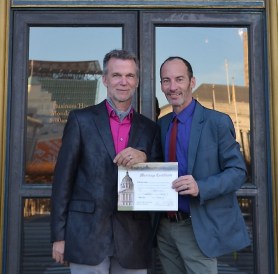
In October, I made new license and ceremony appointments and paid the fees again. We had once found rings online that we both quite liked, but finances didn’t allow their purchase. As this was turning out to be a rather low-budget affair (a good friend was giving us a hotel room for three nights and we were driving to the city from Vegas), I found discount online jeweler and selected only rings on their clearance page. We chose $12 titanium rings which you can see in the picture below, taken in front of San Francisco’s City Hall moments after we were married on December 24, just three weeks ago.

I don’t care one whit about the value of the ring. As a 55-year-old man who grew up never thinking of marriage as ever being a possibility, our $12 rings are priceless.

It will be interesting, however, to see how this evolves, whether younger gay men and women who can imagine marriage for themselves try to fit into the “established” norms of engagement and wedding rings (and other marriage traditions), or if new paths will be forged.

Don’t Count Christie Out?

Ponnuru isn’t:

I’m amazed by how many people are writing off Christie’s chances in 2016. The party establishment still thinks he’s a winner, his defects from the point of view of the conservative base of the party are a lot smaller than those of the last two nominees, and the latest poll numbers suggest this scandal isn’t obsessing voters as much as it is the press. I still think he’s got a better shot than anyone else for the Republican presidential nomination.

The Fix crew agrees:

Our case for Christie as front-runner — or, maybe, more accurately first among almost-equals — is built around the idea that there is no perfect/electable conservative in the race and that Christie has a decent chance of beating out Jindal, Rubio and Walker in the battle to be the establishment candidate. (There is a whole other primary — where Rand Paul is the front-runner — that will pick the outsider candidate to battle the establishment pick.) Of that quartet of credible establishment conservatives, Christie is the one who, at first glance, could most easily put together the tens (and probably hundreds) of millions of dollars needed to run real operations in a series of states in short order.

Yglesias throws cold water:

The relevant things about the 2016 primary are that it’s happening right now and that it’s really hard to win. It’s happening right now in the sense that in order to win, any candidate needs to first gain the allegiance (or at least nonhostility) of a wide range of elites outside his immediate political circle. House members from South Carolina. State senators from Iowa. Anti-abortion activists in New Hampshire. Talk radio hosts. Fox News executives. Donors. Lobbyists. State-level Chamber of Commerce chiefs. These people are paying attention right now, and they’re thinking about who they want to back and who they want to bandwagon against. And there’s just no way this bridge thing is making any of those people more likely to support Christie than they were six months ago. Republican elites are mostly looking to find a candidate who is both conservative, effective, and electable and this makes him look less electable and less effective without making him look more conservative. It’s bad news.

Weigel highlights a new Christie poll, which contradicts the ones we flagged yesterday:

Christie’s strength among Republicans has waned. His overall approval is down, sure, from 68 percent last summer to 55 percent now. Much of the leakage is coming from Democrats (down 5 points) and independents (down 22 points). But he’s lost 15 points among Republicans—down from 96 percent approval to 81 percent approval. Not great.

Who’s To Blame For Benghazi?

Serwer summarizes the Benghazi report released Wednesday:

The report, which the committee approved by a voice vote, concluded that the attacks could have been prevented and makes several recommendations for improving security of U.S. diplomatic facilities in areas where U.S. personnel are likely to face threats. It also faults the State Department for not responding to repeated requests for increased security at the facility, and for ignoring incidents prior to the Sept. 11, 2012 attack that indicated Americans there were at risk. The report also states that Stevens himself rejected two offers from General Carter Ham, the head of the U.S. military’s Africa command, for military protection the month before the attacks. The report concludes that the attacks were “likely preventable” had warnings about the “deteriorating security situation” been heeded.

He points out a few notable debunks. Such as:

Various versions of the talking points do not suggest the White House edited them to cover up references to Al Qaeda or to manufacture evidence of a protest.

Amy Davidson notes that the Benghazi tragedy “was more than a single misjudgment”:

The talking-points controversy was always strangely misdirected—in part because, as this report makes clear, there is a lot that was substantively wrong with the way things were managed in Benghazi.

That is true particularly if the subject of discussion is Hillary Clinton. She does not come out well in this report, in any part, although the Republican minority is more florid in its criticisms. The State Department made mistakes when she was its leader. One of the findings is that nothing changed even when “tripwires” meant to prompt an increase in security or suspension in operations had been crossed, and people in the Department knew it.

Aaron Blake interprets what the report means for Hillary:

The p-word — “preventable” — is what stings most for Clinton. The report says, conclusively, that State’s failures contributed to the deaths of four Americans on Sept. 11, 2012. And Republicans can and will say that people died because of those failures.

At the same time, the report doesn’t detail whether any of these warnings or requests actually reached Clinton’s desk. Had it done so, then she really would have been in trouble. While Clinton was, ultimately, the buck-stopper at State, she is more able to distance herself from the problems identified by the Senate report if it doesn’t specify that she was directly aware of them.

First Read doubts Benghazi will hurt Clinton as much as Bridgegate hurts Christie:

Hillary Clinton has 20 years on the national stage (including a thoroughly litigated presidential bid in ’08) to balance out a bad story, while Christie is still making his first impression on the national stage. And of course, a third difference is that no Democrats believe the worst about Hillary (and might try to take advantage of it) when it comes to Benghazi, while the same isn’t true for Christie. Plenty of Republicans, particularly conservatives who were never enamored with Christie in the first place, do believe the worst about Christie and the bridge.

Eli Lake focuses on the report’s criticisms of Gen. Dempsey, chairman of the Joint Chiefs of Staff, :

An addendum to a scathing report from the Senate Select Committee on Intelligence on Benghazi signed by six of seven Republicans on the committee singles out Dempsey for “failures in leadership.” Specifically, the six Republicans fault Dempsey for failing to have a plan to respond to an attack on Benghazi given the ample intelligence showing the desire of terrorists to attack Americans there, and for allowing General Carter Ham, who was the combatant commander for Africa Command, to not know the CIA maintained an annex in Benghazi near the U.S. temporary mission.

The Republicans slam Dempsey for failing to send more military support from the region as the attack was unfolding. “General Dempsey’s attempts to excuse inaction by claiming that forces were not deployed because they would not have gotten there in time does not pass the common sense test,” the senators write. “No one knew when the attacks against our facilities in Benghazi would end, or how aggressive the attacks would be.”

And Benen finds that the GOP hasn’t changed its tune:

Given the latest report, which reinforces the previous reports, are Republicans finally prepared to move on to some other alleged conspiracy? Of course not.

Rep. Steve King (R-Iowa) saw the findings of the Senate Intelligence Committee and said, “It should be clear, even to my critics by now, that Benghazi is bigger than Watergate.”

Sen. James Inhofe (R-Okla.) added, “I’m familiar with cover-ups throughout history, the Pentagon Papers, Iran-Contra, all of them. This is gonna go down as the greatest cover-up in history because the president and Susan Rice both knew it was an organized terrorist attack and deliberately sent Susan Rice to tell the American people it was not.”

It doesn’t matter that they’re wrong; they don’t care. They start with the conclusion and try to work backwards to find evidence that satisfies their goal.

The Dems’ Montana Maverick

Benjy Sarlin profiles Brian Schweitzer, the former governor preparing to run against Obama’s record in the next presidential primary:

Schweitzer’s scorn for Obama has led him to hatch a surprising plan. After turning down a run for Senate this year and settling into a new job as a mining executive, the ex-governor surprised observers by announcing his interest in a possible run for president in 2016. He’s since visited Iowa, the kickoff caucus state, to rail against Obama’s “corporatist” health care law and to criticize Hillary Clinton, the presumed Democratic frontrunner in 2016, for voting to authorize the Iraq war when she was a New York senator.

A Schweitzer presidential candidacy would be a long shot by any measure. He has no national profile and a heterodox political persona that’s served him well in rural, libertarian, and energy rich Montana but doesn’t necessarily sync with the average Democratic primary voter. Clinton, while still undeclared, is such an overwhelming favorite that donors-in-waiting are already competing for territory. But what Schweitzer does have is a message that’s unique in the likely Democratic field. The former governor is gambling that Democrats won’t just want an alternative to Clinton in 2016–they’ll want a complete and total rejection of the Obama presidency.

Ezra questions Schweitzer’s strategy:

More interesting than Schweitzer’s lack of praise for Obama are his extremely specific criticisms.

He loathes Obamacare and believes it should be replaced by a single-payer health-care system. He calls the NSA revelations “un-effing-believable.” He says the Obama administration “just haven’t been very good at running things.” It’s an outline of where one extremely savvy politician thinks the left might be unhappy with Obama — and, by extension, Hillary Clinton.

But Schweitzer didn’t become governor of right-leaning Montana by accident. He’s skeptical of gun control and likes to shoot at things in campaign ads. He’s a big believer in coal production and expanded oil drilling. He’s the sort of red-state Democrat that the party thought was key to its future in 2005 but whose political appeal has been diminished by the rise of Obama’s younger, more multicultural majority.

Bouie adds:

If Schweitzer is an unlikely choice for the Democratic nomination, it has less to do with his low national profile, and everything to do with his pronounced Obama-skepticism. Black voters have their concerns with the Obama administration, but the president is held in high esteem. Which is to say that, if you’re going to distance yourself from the administration, you have to do so without without attacking Obama as a figure. Otherwise, you’ve alienated African Americans and crippled your bid for the nomination.

Kilgore sees Schweitzer alienating the entire party:

At a time when Democrats are frantically trying to hold onto control of the Senate, Schweitzer talked about running for Max Baucus’ seat and then bailed. Next thing you knew, he was talking about running for president. Most Democratic activists think they need a viable Senate candidate in Montana more than they need an openly anti-Obama presidential candidate. From that perspective, Schweitzer looks narcissistic, and that’s not a personality trait likely to ignite a crusade.

Maybe I’m just wrong. I met Schweitzer back when he was running for the Senate in 2000—before he had any national ideological profile at all—and thought he was an odd but intense man afire with self-regard. Some fans out West have long thought he had some personal magic along with the right positioning to win red states. If he keeps going to Iowa, we’ll soon know if that activist-rich state gives him traction—or a strong heave-ho.

Recent Dish on Schweitzer here