“It’s not in America’s interests to have troops in the middle of every conflict in the Middle East, or to be permanently involved in open-ended wars in the Middle East,” – Ben J. Rhodes (NYT), a White House deputy national security adviser.
Author: Andrew Sullivan
About Those Obamacare Disaster Stories
It’s always a good idea to double-check the details.
Is Emotional Intelligence A Business Asset?
Recently, psychologists Dana Joseph of the University of Central Florida and Daniel Newman of the University of Illinois comprehensively analyzed every study that has ever examined the link between emotional intelligence and job performance. Across hundreds of studies of thousands of employees in 191 different jobs, emotional intelligence wasn’t consistently linked with better performance. In jobs that required extensive attention to emotions, higher emotional intelligence translated into better performance. Salespeople, real-estate agents, call-center representatives, and counselors all excelled at their jobs when they knew how to read and regulate emotions—they were able to deal more effectively with stressful situations and provide service with a smile.
However, in jobs that involved fewer emotional demands, the results reversed.
The more emotionally intelligent employees were, the lower their job performance. For mechanics, scientists, and accountants, emotional intelligence was a liability rather than an asset. Although more research is needed to unpack these results, one promising explanation is that these employees were paying attention to emotions when they should have been focusing on their tasks. If your job is to analyze data or repair cars, it can be quite distracting to read the facial expressions, vocal tones, and body languages of the people around you. In suggesting that emotional intelligence is critical in the workplace, perhaps we’ve put the cart before the horse.
‘Tis The Season To Pop The Question
Olga Khazan has the numbers:
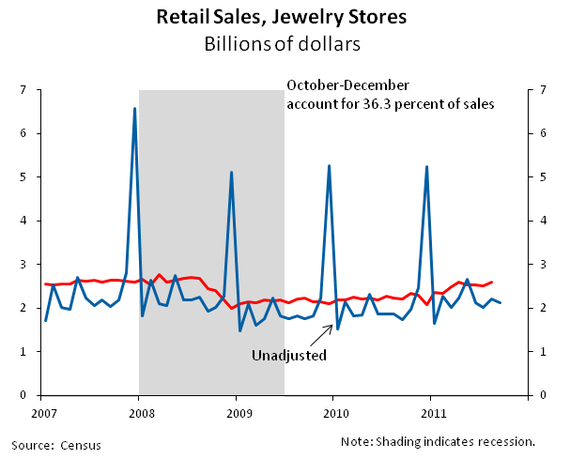
“Doesn’t it feel like everyone is getting engaged right now?” a friend from home asked the other night. It feels that way, it turns out, because they are. According to WeddingWire, 33 percent of engagements happen between Thanksgiving and New Year’s Day, making every January look a lot like Christmas for wedding planners, venue owners, and bridal shops facing a rush of newly engaged couples. Jewelers, too, love the end of the year: They make 36 percent of their yearly sales from October through December, according to the Commerce Department.
How Long Before A New Habit Takes Hold?
Popova quotes a passage from psychologist Jeremy Dean’s book Making Habits, Breaking Habits:
In a study carried out at University College London, 96 participants were asked to choose an everyday behavior that they wanted to turn into a habit. They all chose something they didn’t already do that could be repeated every day; many were health-related: people chose things like “eating a piece of fruit with lunch” and “running for 15 minutes after dinner.” Each of the 84 days of the study, they logged into a website and reported whether or not they’d carried out the behavior, as well as how automatic the behavior had felt. …
The simple answer is that, on average, across the participants who provided enough data, it took 66 days until a habit was formed. As you might imagine, there was considerable variation in how long habits took to form depending on what people tried to do. People who resolved to drink a glass of water after breakfast were up to maximum automaticity [acting without thinking] after about 20 days, while those trying to eat a piece of fruit with lunch took at least twice as long to turn it into a habit. The exercise habit proved most tricky with “50 sit-ups after morning coffee,” still not a habit after 84 days for one participant. “Walking for 10 minutes after breakfast,” though, was turned into a habit after 50 days for another participant.
Mapping Our Emotions
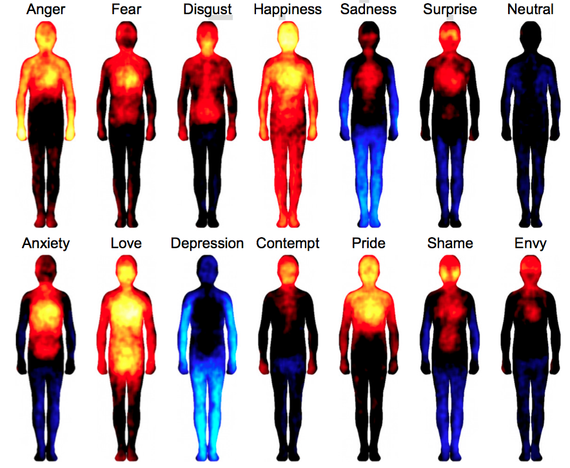
A new set of experiments asked participants to read short stories or watch movies and then “color in the areas of their body where sensations became stronger (the red and yellow) or weaker (blue and black) when they felt a certain way”:
The mapping exercise produced what you might expect: an angry hot-head, a happy person lighting up all the way through their fingers and toes, a depressed figurine that was literally blue (meaning they felt little sensation in their limbs). Almost all of the emotions generated changes in the head area, suggesting smiling, frowning, or skin temperature changes, while feelings like joy and anger saw upticks in the limbs—perhaps because you’re ready to hug, or punch, your interlocutor. Meanwhile, “sensations in the digestive system and around the throat region were mainly found in disgust,” the authors wrote. It’s worth noting that the bodily sensations weren’t blood flow, heat, or anything else that could be measured objectively—they were based solely on physical twinges subjects said they experienced. The correlations between the subjects’ different body maps were strong—above .71 for each of the different stimuli (words, stories, and movies). Speakers of Taiwanese, Finnish, and Swedish drew similar body maps, suggesting that the sensations are not limited to a given language.
So what are we seeing in these illustrations? The authors note that, measured physiologically, most feelings only cause a minor change in heart rate or skin temperature—our torsos don’t literally get hot with surprise. Instead, the results likely reveal subjective perceptions about the impact of our mental states on the body, a combination of muscle and visceral reactions and nervous system responses that we can’t easily differentiate. Feeling jealous may not truly make us red in the face, for example, but we certainly might feel like it does.
“The First Great Account Of The Digital Age”
That’s how James Santel describes Saul Bellow’s Humboldt’s Gift, a novel published in 1975:
[Narrator Charlie Citrine’s] insights into 1970s America feel especially calibrated to our hyperconnected world: he understands both the wages of overstimulation (“I knew that it took too much to gratify me. The gratification-threshold of my soul had risen too high”) and the paradox of endless information (“I knew everything I was supposed to know and nothing I really needed to know”). Moreover, he recognizes, and is preoccupied by, the difference between activity and meaningful work: “Sloth is really a busy condition, hyperactive,” he meditates. “This activity drives off the wonderful rest or balance without which there can be no poetry or art or thought—none of the highest human functions. These slothful sinners are not able to acquiesce in their own being, as some philosophers say. They labor because rest terrifies them.”
And from what does all this distract us?
Humboldt’s Gift makes it clear that it’s the ultimate question of mortality: the novel ends with Humboldt’s reinterment in a proper cemetery after a long exile in a potter’s field, and Bellow renders Charlie’s graveside thoughts with muted poignancy. Humboldt, he reflects, “had opened his mouth and uttered some delightful verses. But then his heart failed him. Ah, Humboldt, how sorry I am. Humboldt, Humboldt—and this is what becomes of us.”
The Best Of The Dish Today
Another remarkable statement from the Pope – urging new perspectives on how to deal with children being brought up by gay or divorced parents:
“On an educational level, gay unions raise challenges for us today which for us are sometimes difficult to understand,” Francis said in a speech to the Catholic Union of Superiors General in November, extracts of which were published on Italian media websites on Saturday. “The number of children in schools whose parents have separated is very high,” he said, adding that family make-ups were also changing. “I remember a case in which a sad little girl confessed to her teacher: ‘my mother’s girlfriend doesn’t love me’,” he was quoted as saying. The pontiff said educational leaders should ask themselves “how can we proclaim Christ to a generation that is changing?”
“We must be careful not to administer a vaccine against faith to them,” the 77-year-old added.
A “vaccine against faith”: the legacy of too many Catholic upbringings in the past (but mercifully not my own).
This weekend, we launched into the new year with our usual eclectic mix: why walking is good for thinking; are TED talks “middlebrow megachurch infotainment“?; is anti-evolution claptrap forcing Millennial evangelicals to lose their faith altogether?; the man with two dicks; dolphins who get high; and the origins of the funny pages.
The most popular post of the weekend? Time For A TED Takedown? Runner-up? Converting to belief in evolution.
See you in the morning.
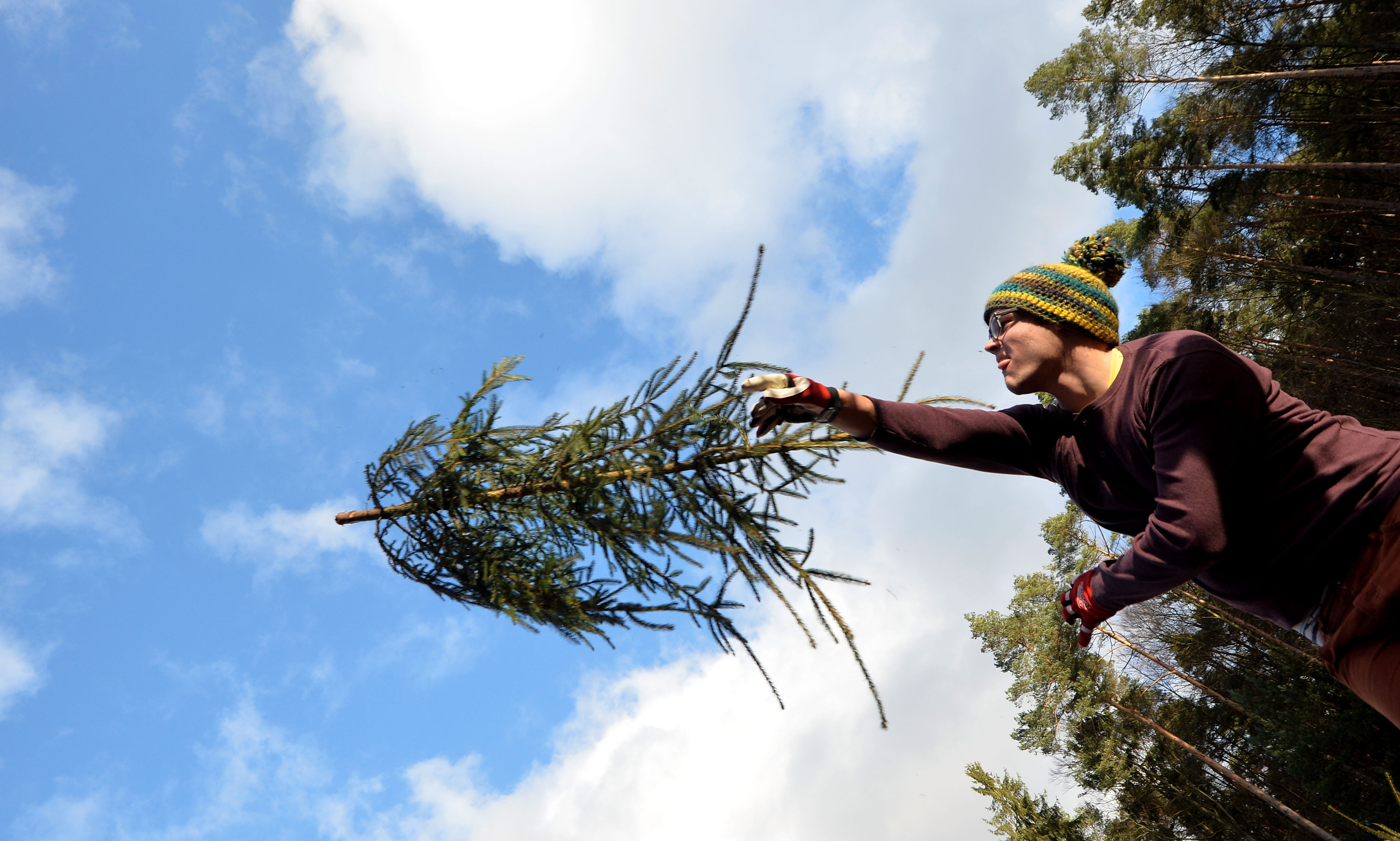
(Photo: A contestant launches a Christmas tree in the distance discipline of the Christmas Tree Throwing World Championships on January 5, 2013 in Weidenthal, Germany. The less-than-serious annual event is now in its eighth year and features competitions in distance throwing, height throwing and flinging of Christmas trees. By Thomas Lohnes/Getty Images.)
Let The Great Pot Debate Begin
It appears that the boomer punditocracy has just woken up to the fact that this is a live and vital debate – probably the most significant social change since marriage equality in this country. David Frum and I had it out recently (and found some common ground as well), moderated by Mike Kinsley, and set up by Bob Wright. Above is a highlight reel. We’ll post a few clips over the coming days, and the full discussion is here.
Traffic Analysis
The travel writer Colin Thubron elaborates on his claim that “[t]he choice to travel on foot is a transforming one”:
Many people have remarked on the curious relationship between walking and thinking. The rhythm of the body seems to free the mind, just as the rhythm of a mother’s walk (it is imagined) puts at rest her babe-in-arms. Solvitur ambulando, declared the ancients: “it is solved by walking”. Wordsworth wrote many of his poems on the move, as did John Clare. Nietzsche claimed to have made all his philosophical discoveries while walking, and Kierkegaard wrote that “I have walked myself into my best thoughts.”
Emma Duncan, however, prefers to travel by bike, calling cycling “a great equaliser”:
Other types of traveller can, if they spend enough, set themselves apart from their fellows. Train-lovers can take the Orient Express; drivers splash out on slick sports cars; a private jet allows air travellers to avoid the hell of the airport terminal. But cyclists are all on a level; all have to meet each other’s eyes. Even the priciest bike cannot make cycling glamorous. However much a cyclist spends, he will still look faintly ridiculous—crouched over the handlebars, pedalling furiously, weaving round obstacles, determined to get somewhere, rather as man travels through life.
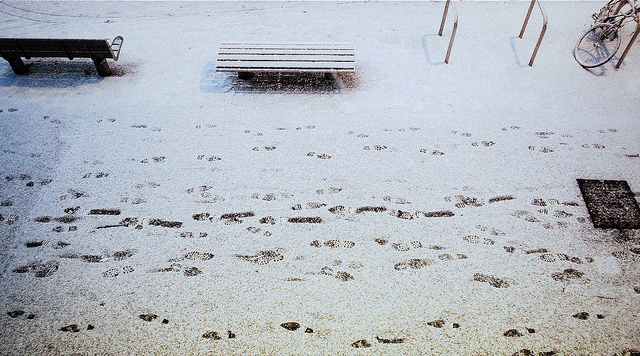
(Photo by Flickr user KJGarbutt)
 The Dish