“We should round up all the gays, send them to an island, and then nuke it until it glows,” – Special Teams Coach Mike Priefer of the Minnesota Vikings, according to Chris Kluwe, a straight player who was fired after he spoke out for gay equality.
Author: Andrew Sullivan
Because Who Has Time To Read An Abstract?
Being pregnant and giving birth in sixteenth and seventeenth century England sucked – History, Glendon… http://t.co/3K74JIuThJ
— Lol My Thesis (@lolmythesis) January 2, 2014
Miles Klee is delighted by the tumblr LOL My Thesis, where students share bite-sized summaries of their scholarship:
A young lady of the history and gender studies departments at Smith, for example, delivered hard proof of this claim: “Basically, Beyoncé can do anything.” A cognitive scientist at Boston University, meanwhile, discovered that people “don’t like electrodes stuck to their head while you flash epilepsy-inducing lights at them.” As banal and depressing as these synopses seem, there are also plenty of profound statements to mull over. An student of English at the University of Victoria summed up an immersive literary experience in a fairly incredulous tone: “You can write a 120-page thesis on a 119-page book.” …
Thankfully, for the doggedly curious among us, some posts now include a link to the actual thesis. We just wish that were the case for one brave individual’s treatise on dinosaur poop.
Update from a reader:
LOL My Thesis is OK, but there’s a more refined version that’s existed for years: Dissertation Haiku. I think you have to work a little to get a haiku with more than 140 characters.
Face Of The Day
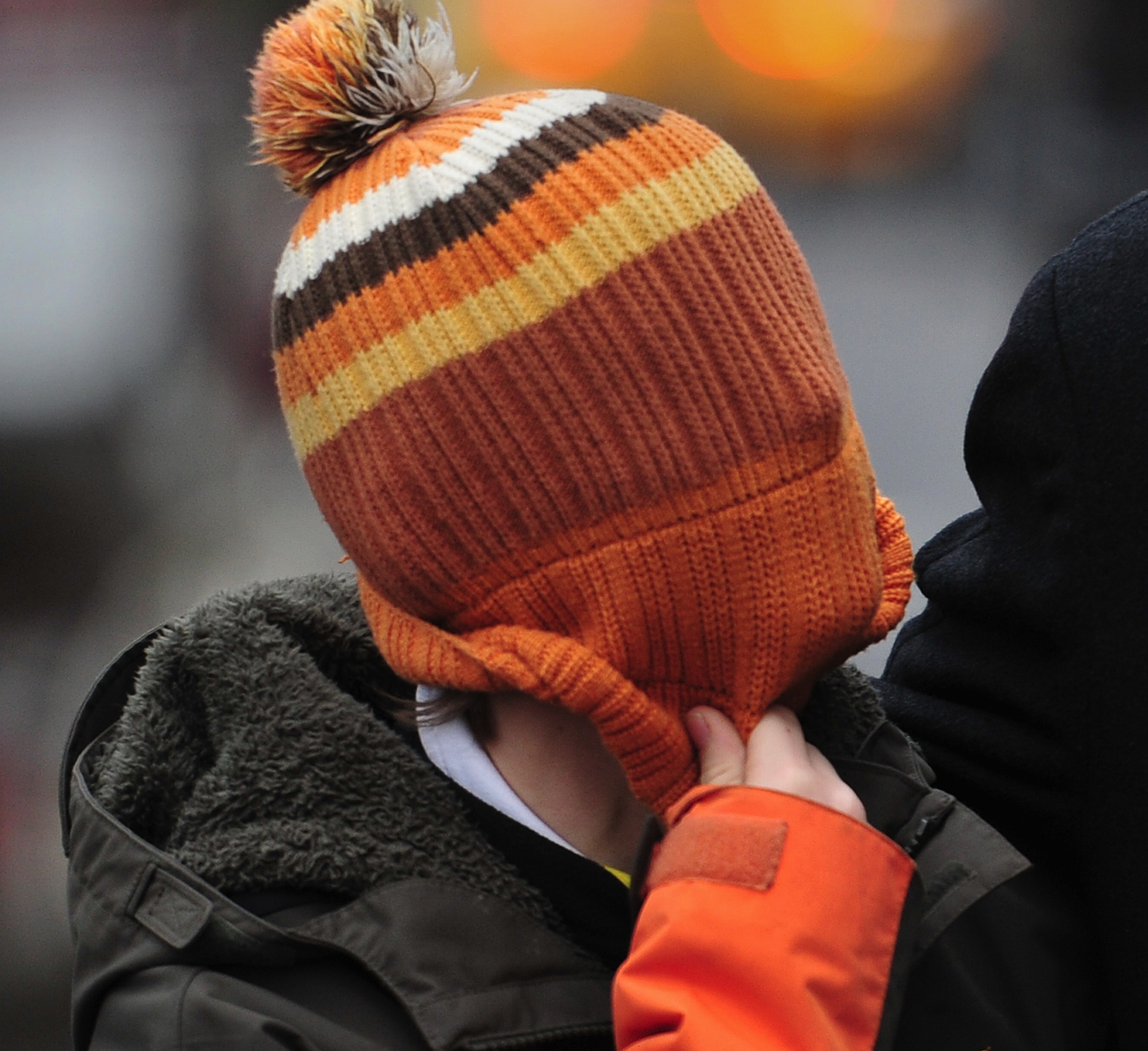
A boy pulls his cap over his face as he walks near Central Park bundled against the cold in advance of a winter storm on January 2, 2014. The northeastern United States prepared Thursday for snow, high winds and frigid temperatures, as a gust of wintry weather bore down on New England and surrounding states, cancelling flights. Temperatures in New York were expected to drop to 10 degrees Fahrenheit with a windchill factor of minus nine degrees Fahrenheit, according to national weather forecasts. By Stan Honda/AFP/Getty Images.
Death By Mental Ilness
“[Mentally ill patients] don’t die from drug overdoses or commit suicide—the kinds of things you might suspect in severe psychiatric illness,” said Sarah M. Hartz, the study’s lead author. “They die from heart disease and cancer, problems caused by chronic alcohol and tobacco use.”
The study looked at about 20,000 people, split down the middle between a healthy control population and people suffering from schizophrenia, bipolar disorder, schizoaffective disorders, and/or major depression. Probably the most striking numbers have to do with smoking: over 75 percent of patients with major mental illness smoke cigarettes, compared to 33 percent in the general population.
Continuing on down the line, 50 percent of the mental illness pool smoked pot, compared to 18 percent in the general population, while 50 percent of the mental illness group used other illicit drugs, compared to 12 percent in the control group. Binge drinking: 30 percent vs. eight percent.
Mental Health Break
The Peanuts go hardcore punk:
Condi And Colin: War Criminals Too
Steve Coll leafs through the new memoir by John Rizzo, a former CIA lawyer familiar with the Bush administration’s torture program. I noted earlier how Rizzo claims the president had no idea what was being done to prisoners, which gives us a whole new level of presidential negligence in the Bush years. But so many others were briefed in detail. Coll is most interested in how “Rizzo provides an eyewitness account of how the early brutal interrogation sessions were described in detail to President George W. Bush’s leading national-security advisers in the Situation Room”:
As [CIA director George] Tenet described, case by case, how the C.I.A. used waterboarding and other harsh methods on its Al Qaeda detainees, the White House chief of staff Andy Card and General Richard Myers, the chairman of the Joint Chiefs of Staff, “would sit there stoically,” Rizzo writes. Attorney General John Ashcroft “was mostly quiet except for emphasizing repeatedly that the E.I.T.s were lawful.” Defense Secretary Donald Rumsfeld “was notable more for his frequent, conspicuous absences…. It was quickly apparent that Rumsfeld didn’t want to get his fingerprints anywhere near” the C.I.A.’s interrogation program. Condi Rice seemed “troubled by the fact that the detainees were required to be nude when undergoing some of the E.I.T.s. Colin Powell, on the other hand, seemed to view sleep deprivation as the most grueling of all the techniques.”
None of these senior Bush Administration decision-makers has yet provided a full or thoughtful account of their recollections, emotions, or practical analysis in endorsing the C.I.A.’s interrogations. This forgetting is a bipartisan phenomenon. Agency officials briefed Nancy Pelosi in September, 2002, about waterboarding that was then underway, notes of that meeting show, but Pelosi later claimed that she had heard no such thing. Other senior Democrats who were briefed about brutal C.I.A. interrogations in 2002 and 2003 have suffered from similar impairments.
At some point, we will find out how many of America’s leadership were fully apprised of and complicit in widespread war crimes that, if they had occurred in any other country, the US would now be prosecuting under the Geneva Conventions. Yes: Colin Powell sat there and was briefed on ending two centuries of the American prohibition of torture or anything even approximating it. And he, representing the finest traditions of the US military and its honor, did not resign. He, Pelosi and Rice are as deep in this as Rumsfeld, Cheney, and Addington. And one day, even if it’s posthumously, they will be brought to justice.
A New Era Of Freedom Begins Now

Two relatively muted stories – amid countless loud, alarmist, partisan distractions – shone through the new year’s haze for me, at least. They’re not “news” – both were highly expected. But they are what most will look back on in this period in history and take note of.
The first – and easily the most significant – is that millions of previously uninsured Americans can finally get some health insurance. Yes, there are going to be glitches; and yes, there are going to be costs, as well as benefits. Yes, the ACA is far from perfect. But for those without the ability to afford health insurance and not poor enough to be on Medicaid – i.e. the very struggling working poor both parties claim to care about – the relief must be simply overwhelming. One simple anecdote:
Kathy Hornbach of Tucson is not wasting any time before using her new health insurance coverage, which took effect on New Year’s Day. Ms. Hornbach, 57, has an appointment with a cardiologist on Thursday for a stress test. “I’ve had some heart palpitations, and my mom’s side has a history of heart problems starting early,” she said Wednesday in a telephone interview. “So it’s mostly just to double-check that everything is O.K.”
I may be biased, as I have long managed a chronic illness and know what it’s like to fear the loss of health insurance, especially if, like me, you’ve decided to go out on your own and start your own small business. So let me second that. The relief I personally feel as someone who is HIV-positive is overwhelming. I don’t want to put a price on it. Because it is actually a rare event that is priceless. The Obama administration has both repealed the HIV ban on travel and immigration – removing the most crippling psychological fear I labored under for close to twenty years – and also removed the chance that I could one day go bankrupt trying to stay ahead of a deadly virus.
But I’m also encouraged that I will no longer be punished for entrepreneurship with fear of losing health insurance, a punishment the Republican party apparently wants to restore indefinitely. I may also be biased, having grown up in a country with a once substandard and still far from ideal socialized system. But I love America’s free market in healthcare – and believe, despite Republican hostility, that this reform simply extends much of that to many, many more people. Why can we not celebrate that milestone? Politics does not always lead to a tangible increase in many people’s peace of mind, security and health. This time and this year – thanks to president Obama – it has.
Then we go to Colorado, which yesterday marked another astonishing step forward for humane sanity. Anyone can now walk into a dispensary and buy a plant less harmful than alcohol, far less dangerous than nicotine, and a boon to many people dealing with tough chronic illnesses. So fitting, I thought, that the first purchaser was a veteran of the Iraq War:
The first sale, orchestrated as a news media photo opportunity, was made to Sean Azzariti, an Iraq War veteran who has lobbied publicly for legalization and says pot helps mitigate problems stemming from his post-traumatic stress syndrome. Azzariti, who served six years in the Marine Corps and two tours in Iraq, spent about $60 at 3D Cannabis Center for an eighth of an ounce of “Bubba Kush” and a pot-laden truffle.
Now, of course, the Obama administration has next to nothing to do with this, and its reluctance to grapple with this issue has been Clintonian in its caution. But they have not stopped this, as a Romney administration would have. For me, both reforms mean a tangible increase, not decrease, in the freedom of Americans. Without your health, freedom to do anything is impossible. Without reliable health insurance, entrepreneurship is discouraged, job mobility is frozen, and economic dynamism is restrained.
And now, with Americans able to use a drug – already ubiquitous – without draconian, pointless and racially unjust prohibition, we have another small burst of freedom. Neither of these developments was inevitable. Both remain fragile. But if you care about real freedom – and not an abstract, ideological version of it – this is a day for celebration, not cynicism, for hope, not depression.
(Photo: Sam Walsh, a budtender, sets up marijuana products as the 3-D Denver Discrete Dispensary prepares to open for retail sales on January 1, 2014 in Denver, Colorado. Legalization of recreational marijuana sales in the state went into effect at 8am yesterday morning. By Theo Stroomer/Getty Images)
How To Repel Tourism
Looking at 188 countries around the world, [Robert] Lawson and [Saurav] Roychoudhury examined which ones require people to apply for a visa before they visit. Then they studied how many tourists travel from one country to another. Allowing for factors such as population, income, the size of bilateral trade, economic policies, a measure of democracy, and an indicator of world-class sites of cultural importance, they found that tougher visa requirements imposed on potential visitors from a given country are associated with considerably less tourism from that country. In short: Demanding a visa from a country’s travelers in advance is associated with a 70 percent lower level of tourist entries than from a similar country where there is no visa requirement. The U.S. requires an advance visa from citizens of 81 percent of the world’s countries; if it waived that requirement, the researchers estimate, inbound tourism arrivals would more than double, and tourism expenditure would climb by $123 billion.
This may seem trivial, but it isn’t with respect to American soft power. Most Dishheads are American citizens, so they don’t fully see what it is like to enter the US as a non-citizen. It’s a grueling, off-putting, frightening, and often brutal process. Compared with entering a European country, it’s like entering a police state. When you add the sheer difficulty of getting a visa, the brusque, rude and contemptuous treatment you routinely get from immigration officials at the border, the sense that all visitors are criminals and potential terrorists unless proven otherwise, the US remains one of the most unpleasant places for anyone in the world to try and get access to.
And this, of course, is a function not only of a vast and all-powerful bureaucracy. It’s a function of this country’s paranoia and increasing insularity. It’s a thoroughly democratic decision to keep foreigners out as much as possible. And it’s getting worse and worse. Since I first came here in 1984, it’s a different world. Clinton’s 1996 law made matters far worse; 9/11 did the rest; and the Obama administration hasn’t changed much of anything.
Hold The Mayo
While documenting the history of the anti-mayonnaise movement, David Merritt Johns considers the nature of taste and revulsion:
Mayonnaise contains an animal product, it is reminiscent of pus or semen, and it is remarkably slimy and jiggly. … But vanilla ice cream and pudding are also jizzlike slimes, and they arouse little animus; ketchup is cherished despite its likeness to blood. And scholars have long noted that revulsion can rarely be reduced to sensory factors alone. Charles Darwin commented on the social aspects of taste in his 1872 The Expression of the Emotions in Man and Animals: “In Tierra del Fuego a native touched with his finger some cold preserved meat which I was eating at our bivouac, and plainly showed utter disgust at its softness; whilst I felt utter disgust at my food being touched by a naked savage, though his hands did not appear dirty.”
Darwin’s observations hinted at an idea upon which revulsion scholars generally agree: Disgust is largely a cultural phenomenon. Infants don’t seem to experience it. Tiny children will tolerate unholy decay odors, and experiments show many will happily eat imitation feces (made with stinky cheese) or quaff glasses of juice in which (sterilized) grasshoppers bob like ice cubes. From centipedes to boogers, the grossout response is a learned one. Its latent purpose is often to distinguish friend from foe, and pass judgment on the habits of others. (To wit: As one informant bluntly told me, “Let’s be honest: Mayonnaise is a fat man’s food.” …
Journalism And Power
In an excerpt from his new book, The Watchdog That Didn’t Bark, Dean Starkman contrasts accountability journalism with access journalism. Perhaps the best way to distinguish between the two is that one form of journalism seeks access to power and the other kind of journalism seeks to make power uncomfortable. We all know which one is losing. Mike Allen loves the powerful and does all he can to broadcast their messages and stroke their egos. He is the icon of the new era of court stenographers masquerading as journalists. But if you’re looking for a journalism that holds the powerful accountable, you’ll have to look outside their circle of supine friends and suck-ups.
CJR’s editors chime in:
This debate is not about the use of hot words, like “torture.” It’s about whether journalism perceives as its core mission holding power to account. If it doesn’t, then the DealBooks and Playbooks of the world will always win the day. If it does, then the access-accountability polarity should be the defining measure of journalism’s merits.
Oh, for the days of disreputable hacks. No media elite dinners for them.

