
The NSA Wins A Round

A federal judge today dismissed an ACLU lawsuit to shut down the NSA’s phone metadata collection program:

Handing down an unusually sweeping ruling, Judge William Pauley III ruled that the NSA’s phone record database was fully lawful under section 215 of the Patriot Act. Beyond that, the judge ruled, “the question of whether that program should be conducted is for the other two coordinate branches of Government to decide. Judge Pauley opens the opinion with thoughts on the attacks of 9/11, which he describes as “a bold jujitsu.” The opening paragraphs detail the case of 9/11 hijacker Khalid al-Mihdhar, who the NSA mistakenly believed was living in Yemen at the time of the attacks because of insufficient data collection. (This anecdote, based on General Alexander’s congressional testimony, has been widely disputed.) The metadata collection program grew up in response to those intelligence failures, collecting more and more data so as to suss out the missed connections. Calling the program, “a wide net that could find and islolate gossamer contacts,” Pauley concludes, “this blunt tool only works because it collects everything.”

David Kravets fears that efforts to reform the program might end up making things worse:

Right now, the phone companies store phone metadata for varying times. Verizon and U.S Cellular store it for about a year; Sprint for 18 months. At the other end of the spectrum, T-Mobile maintains it for seven to 10 years, and AT&T for five, according to a congressional inquiry. While Obama’s review group’s recommendation was short on details, everybody familiar with the plan agrees it would require telcos to store metadata for some minimum amount of time, presumably for longer than many of them already do. That means the authorities would have access to this data for far longer than they otherwise might.

Meanwhile, although the NSA has maintained that metadata is anonymous, researchers have found that it can easily be used to identify people:

Armed with very sparse metadata, Jonathan Mayer and Patrick Mutchler found it easy—trivially so—to figure out the identity of a caller. Mayer and Mutchler are running an experiment which works with volunteers who agree to use an Android app, MetaPhone, that allows the researchers access to their metadata. Now, using that data, Mayer and Mutchler say that it was hardly any trouble at all to figure out who the phone numbers belonged to, and they did it in just a few hours.

Face Of The Day

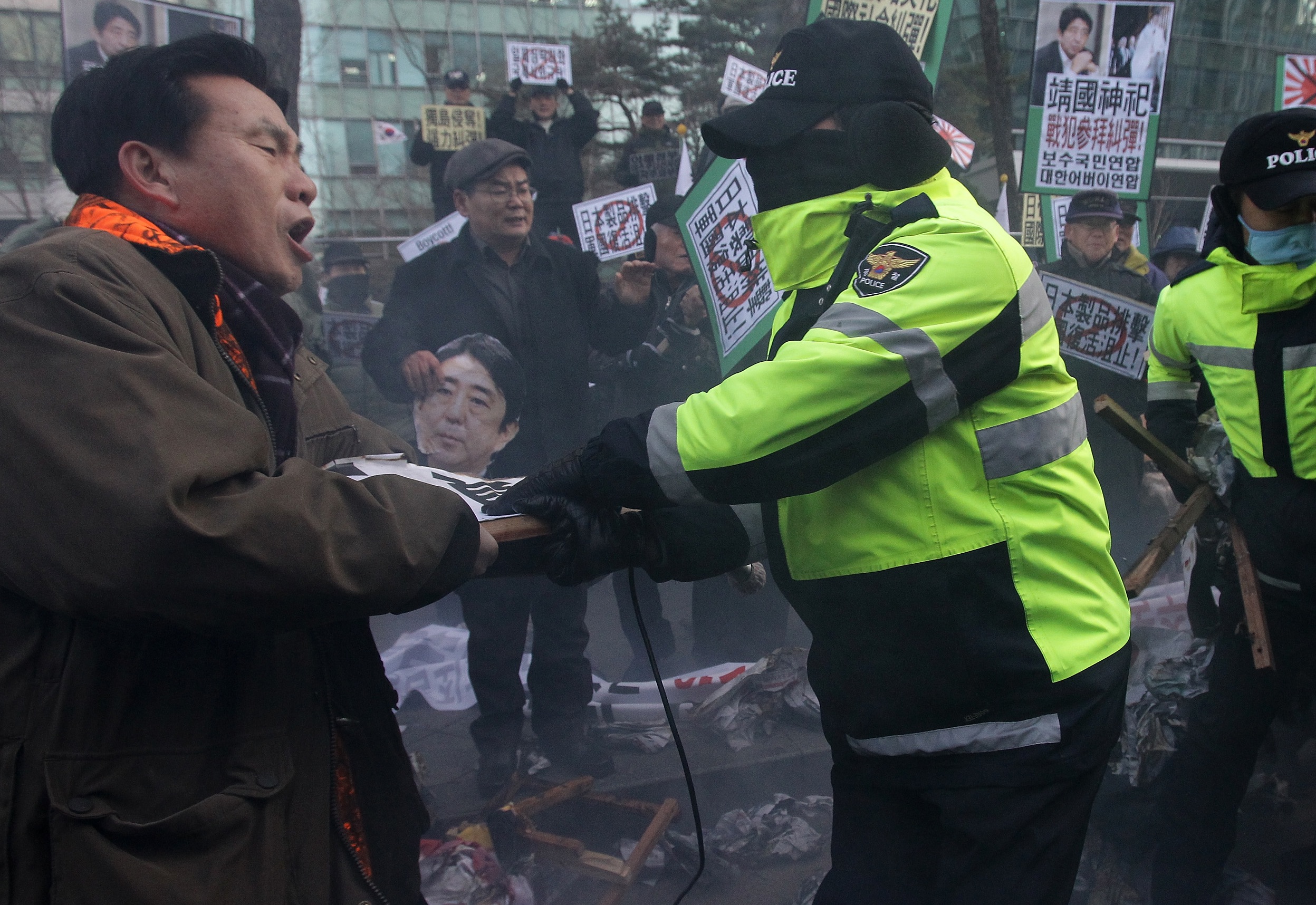
Anti-Japan Protestors Rally In Seoul Against Japan PM Abe's Visit To Yasukuni Shrine

South Korean conservative protesters scuffle with police during an anti-Japan rally in front of the Japanese embassy on December 27, 2013 in Seoul, South Korea. On December 26, 2013, Japanese Prime Minister Shinzo Abe visited the controversial shrine, which honors Japan’s war dead including war criminals during the period from 1867 to the end of the Second World War. By Chung Sung-Jun/Getty Images)

GOP Support For Reforming Obamacare

It may be increasing (NYT):

“It’s no longer just a piece of paper that you can repeal and it goes away,” said Senator Ron Johnson, Republican of Wisconsin and a Tea Party favorite. “There’s something there. We have to recognize that reality. We have to deal with the people that are currently covered under Obamacare.”

Ezra thinks Johnson’s “realization is how repeal-and-replace becomes criticize-and-reform”:

Republicans who want to reform Obamacare remain the (growing) minority. But in another sign that Republicans see the politics of Obamacare changing, there’s more talk of producing an actual Republican alternative before the 2014 elections. Rep. Paul Ryan (R-Wis.), for instance, plans to unveil the successor to his Patients’ Choice Act act early next year. That, too, is an admission that something like the Affordable Care Act is here to stay, and Republicans need to begin proposing policy for a post-health reform world rather than fantasizing about a return to a pre-health reform world.

Philip Klein wonders how GOP candidates will decide which reforms to support when “it’s very difficult to predict what the health care landscape will look like a few months from now, let alone several years from now when a potential Republican president would have a chance to make changes”:

Without knowing how much of Obamacare could be in play, it’s hard to settle on a policy. On the one hand, basing policy on the assumption that Obamacare can be entirely repealed is likely unrealistic, while on the other hand, treating Obamacare as mostly untouchable could cause Republicans to preemptively concede too much policy ground. Mounting failures of Obamacare could put more of the law in play than seemed possible just a few months ago.

Most likely, the future of Republican health care policy will be sorted out as its presidential candidates begin to lay out their plans during the 2015 primaries. But those candidates will have to adopt policies in an environment that’s largely a product of what happens in 2014.

Is The World’s Newest Country Falling Apart?

SSUDAN-UNREST-BOR

Over the past two weeks, South Sudan has come to the brink of civil war, with as many as 1,000 dead in fighting between forces loyal to President Salva Kiir and rebels led by former vice president Riek Machar. John Prendergast and Akshaya Kumar set the scene:

Tensions within the ruling Sudan People’s Liberation Movement have been simmering for years. That political power struggle among Juba’s elites has now shifted into open violence across the country. It is clear that there can be no purely military solution to this conflict. Neither forces aligned to sitting President Salva Kiir nor those aligned to former Vice President Riek Machar can seize control of the entire country. More importantly, continued violence undermines both men’s credibility. As a consequence, the initiation of an open and inclusive dialogue focused on negotiating a political settlement is essential.  South Sudan’s President Kiir has already evidenced a willingness to talk by sitting down with leading critic Rebecca Nyandeng de Mabior. Unfortunately, Riek Machar has been much more elusive, indicating that nothing short of President Kiir’s dismissal was acceptable.

Max Fisher explains how South Sudan got to this point just two and a half years after its creation:

The country’s path to independence was also a path to internal conflict. The decades before South Sudan’s independence are complicated but, in the simplest terms, it was defined by a half-century of fighting between the politically dominant, ethnically Arab north and the politically weaker, ethnically sub-Saharan south. Rebel groups in the south wanted more autonomy from the north. They had to fight very hard to get it (although they owe a lot to the north, which behaved so terribly that it galvanized world opinion in favor of the south).

The thing, though, is that South Sudan is actually pretty ethnically diverse. South Sudan, like a number of other countries in sub-Saharan Africa and particularly this region of it, is articulated by borders that have very little to do with the actual people there. The earlier, unified version of Sudan had been carved out, in part, by European and especially British colonialism. The long-running conflict between the country’s north and its south was, like many wars in post-colonial Africa, partly a consequence of European cartographers having forced disparate groups into artificial borders. Splitting Sudan in two helped to ease the tension created by these borders but didn’t solve it. The southern ethnic groups had been united by a common enemy — the north — but that’s no longer bringing them together.

Colum Lynch looks at the role of the US:

The stakes are high for the United States, as fighting threatens to upend one of the most important foreign policy initiatives of the last two decades in sub-Saharan Africa — one that unified Republicans, Democrats, African Americans, human rights advocates, and Christians. On Saturday, four U.S. troops were wounded when their V-22 Osprey came under fire during an aborted operation to evacuate U.S. nationals from the town of Bor. An additional 150 Marines have been sent to the region to prep for possible future evacuations. It’s an extraordinary and painful development, given America’s major role in securing independence for South Sudan. But the toughest part for Americans to swallow may be that it’s the U.S.-backed leaders of South Sudan — the supposed good guys — that are responsible for plunging the country into chaos and threatening to wreck America’s signature achievement in the region.

Larison is not surprised:

The “supposed good guys” happened to be the people in charge of the armed insurgency that the U.S. chose to support. Like many other insurgent groups over the years, their “goodness” was defined by their opposition to the government they were rebelling against. Like other cases of separatism gone awry, the new state that the U.S. helped to bring into being was plagued by so many political ills that its turn to authoritarianism, corruption, and internal conflict was practically guaranteed from the start. Given our recent experiences with ill-advised foreign interventions and the constant pleas to support “good” rebels in one conflict after another, Americans will have no trouble believing that the people that Washington anointed as “good guys” proved to be much less than that. They may begin wondering why our government thinks that it knows what it’s doing when it supports the creation of new states that always seemed almost doomed to fail.

Philip Roessler calls this an example of the “coup-civil war trap,” a common cause of state failure in post-colonial Africa:

The coup-civil war trap arises when political institutions are weak and ethnic groups are strong. Violence is dispersed among powerful Big Men who are embedded in and supported by different ethnic groups. And economic benefits are primarily derived from controlling the central government. Under such conditions, peace is often contingent upon power-sharing, in which the ruler strikes alliances with rival Big Men. These alliances allow the ruler to mobilize support and collect information from outside his own ethnic group, which in turn helps to secure peace and prevent civil war. But the potential danger is that in sharing real power with ethnic rivals, the ruler leaves himself vulnerable to a coup d’état. And there’s the rub: the policy solution to civil war in these weak states increases a rival group’s capabilities to win power in a coup. In more technical terms, ethnic power-sharing in the shadow of the coup d’état gives rise to a commitment problem, in which the ruler fears that rivals are supporting him only to better position themselves to take power in the future.

This commitment problem is a key source of bargaining failure and conflict in weak states because it prevents rulers from fully committing to peaceful power-sharing. Reluctant to strengthen their rivals, rulers don’t share enough power.  Fundamentally mistrustful, they pursue defensive safeguards, such as stacking the military and security organs with members of their ethnic group and other loyalists, in a bid to neutralize their rivals’ coup-making capabilities. But this only undermines confidence in the ruler. Regime partners question the ruler’s commitment to power-sharing and, even worse, fear that, having used his comrades to get to power, he is ready to dispose of them by purge or execution.

(Photo: The body of a man claimed to be a rebel lies on the ground in the market in the centre of Bor, on December 25, 2013. By Waakhe Simon Wudu/AFP/Getty Images.)

Democrats Against Peace

Senate Democrats are undermining Obama’s outreach to Iran. Beinart wants the anti-war left to wake up:

Among the senators who have cosponsored the new sanctions legislation are Charles Schumer and Kirsten Gillibrand from New York, Chris Coons from Delaware, Richard Blumenthal from Connecticut and Robert Menendez and Cory Booker from New Jersey. These are bright blue states where most Democratic voters would be appalled to know that their senators support a bill that both President Obama and U.S. intelligence believe increases the chances of a third Middle Eastern war. Indeed polls show that Democrats overwhelmingly back Obama’s Iran policy.  The more these senators are forced to publicly defend their positions on Iran, the more politically costly those positions will become. What we don’t know is whether the left can generate a movement strong enough to force that public debate.

W. James Antle III adds:

No sane political party should ever be generically pro- or antiwar. The justice and necessity of each military venture should be evaluated independently, in the context of the conditions and national interests at the time. But while the two parties advertise themselves as operating with different presumptions about the use of government at home, does either party start with a presumption of peace abroad?

An Enemy Of The Slave State

Abolitionist Biram Dah Abeid has faced police harassment, arrest, apostasy charges, torture, and death threats for fighting to end slavery in Mauritania:

The legal framework in Mauritania is very fluid. This fluidity contributes to the maintaining of slavery. There are two types of laws in Mauritania. You have the “slave code,” which legitimizes and codifies slavery, and which gives the law a sacred aspect. These are books that were written in the Muslim Middle Ages in the Maghreb area between the ninth and 16th century. These laws authorize the owning of black people. They decree that the black race is inferior. They allow for the selling of black people, the castration of black people, the rape of black women. These codes also state that women are legal minors for their whole lives and are not equal to men. …

Mauritania also has a modern law that it has codified, specifically a law against slavery. But these are not laws that are meant to be applied. The traditional law that decrees racial inequality and slavery and the inequality of women is considered superior and sacred. When there is a contradiction between the two, the traditional law trumps modern law each time. The judges are trained using these slave codes and the antiquated law. They’re brought up within this framework and believe that it comes from God. Other laws, modern laws and international conventions are considered in Mauritania to be from people who are non-Muslims and nonbelievers.

The Greatness Of That Girl

The Vermeer masterpiece The Girl With A Pearl Earring is on loan at the Frick, along with other Dutch art from the Royal Picture Gallery Mauritshuis. Daniel Gelernter explains why the painting still fascinates:

The composition is striking, but explains nothing: A bust-length portrait of a girl looking up at Johannes_Vermeer_(1632-1675)_-_The_Girl_With_The_Pearl_Earring_(1665)you over her left shoulder against a dark background is the exact same thing you’ll see in Vermeer’s Study of a Young Woman (ca. 1665-67) in the Met. But this is a great painting, and the one at the Met is not. This girl has an earring, of course—which is rather too much talked about. Suffice to say, it’s not a pearl; it’s probably a painted teardrop of glass. You can find the same earrings in at least five other Vermeers, including (most clearly) in the Frick’s very own Mistress and Maid (ca. 1666-67)…

In this Mauritshuis show, you’ll find pieces by contemporary inferior painters: the workmanlike Nicolaes Maes; the uninspiring Gerard ter Borch; and the fussy and generally awful Jan Steen. Of course, they didn’t have Vermeer’s technique. And, given a million years and the same exact subject matter (which they often had), they could not—and never did—approach Vermeer’s elegance in composition. Nor could they match the simple beauty of Vermeer’s palette. But the greatness of Girl with a Pearl Earring is elsewhere, beyond. In the final analysis, Vermeer is an artist, whereas Maes, ter Borch, and Steen are just photographers without cameras.

The art of the one-frame, super-short-story masterpiece by Vermeer—or by Velázquez, Homer, or Hopper—is truth. It was said of the great 1650 Velázquez portrait Juan de Pareja (ordinarily the greatest painting in our hemisphere) that it was truth itself. In the Frick exhibition, look at As the Old Sing, So Pipe the Young (ca. 1665) by Jan Steen: There are 10 figures in that painting and not a single real, true human. Then look into the eyes of Vermeer’s girl. She has a mind; she thinks. There is a wish on the tip of her tongue. You wish that you could talk to her and you know that, if you could, she’d have something to say to you. That makes a great painting. I think it’s what people mean when they say something “really speaks to” them.

(Image of The Girl with A Pearl Earring by Johannes Vermeer, 1665, via Wikimedia Commons)

The Hippie-Hacker Revolution

Walter Isaacson sheds light on the counterculture of tech innovators in the ’60s, when computing “went from being dismissed as a tool of bureaucratic control to being embraced as a symbol of individual expression and liberation”:

The person who best embodied and most exuberantly encouraged this connection between tech geeks and the Sixties counterculture was a lanky enthusiast with a toothy smile named Stewart Brand, who popped up like a gangly sprite at the intersection of a variety of fun cultural movements over the course of many decades. “The counterculture’s scorn for centralized authority provided the philosophical foundations of the entire personal-computer revolution,” he recalled in a 1995 Time essay titled “We Owe it All to the Hippies.” As he explained:

Hippie communalism and libertarian politics formed the roots of the modern cyberrevolution…. Most of our generation scorned computers as the embodiment of centralized control. But a tiny contingent — later called “hackers” — embraced computers and set about transforming them into tools of liberation. That turned out to be the true royal road to the future… youthful computer programmers who deliberately led the rest of civilization away from centralized mainframe computers. …

Not surprisingly life on that techno/creative edge led Brand to become one of the early experimenters with LSD. After being introduced to the drug in a pseudo-clinical setting near Stanford in 1962, he became a regular at Ken Kesey’s Merry Prankster gatherings. He also became a photographer-technician-producer at a performance art commune called the US Company, which produced what became known as “happenings.” These involved psychedelic drugs, acid rock music, technological wizardry, strobe lights, multimedia shows, projected images and words, and performances that required audience participation. Occasionally they would be accompanied by talks by Marshall McLuhan or Timothy Leary. A promotional piece on the group noted that it “unites the cults of mysticism and technology as a basis for introspection and communication.” It was a credo that could have been emblazoned on the posters of the personal computer pioneers. Technology was a tool for expression. It expanded the boundaries of creativity and, like drugs and rock, could be rebellious and socially transforming.