Commuting By Color

Christopher Jobson captions:

In this new video art clip from San Diego-based filmmaker Cy Kuckenbaker, we watch as a 4-minute shot from the Washington Street bridge in San Diego is deftly edited, sorted, and compressed resulting in perfectly color-coded traffic. Kuckenbaker notes:

The source footage for this video is a 4-minute shot from the Washington Street bridge above State Route 163 in San Diego captured at 2:39pm Oct 1, 2013. My aim is to reveal the color palette and color preferences of contemporary San Diego drivers in addition to traffic patterns and volumes. There are no CG elements, these are all real cars that have been removed from one sample and reorganized.

Have We Lost Our Offline Lives?

Soraya Roberts fears we have. Clive Thompson is far less bleak:

There’s been a flood of handwringing op-eds lately about how glassy-eyed mobile-phone zombies are ignoring each other at the restaurant instead of talking to another another. I think these pundits are somewhat overblowing the frequency of this behavior, frankly. Very similar alarms were raised about the wave of supposedly society-ending isolation that would wreaked by previous newfangled media — like the telephone in the late 19th century, and the Walkman in the 80s. We didn’t suffer a social apocalypse then, and I don’t think we’re going to suffer one now.

That said, I actually think the op-ed handwringing is useful in its own way. It’s part of how a society creates social codes around new technologies. When mobile phones inched into the mainstream in the 90s, people who bought them used to answer them, every single time they rang, whenever and wherever they rang: At the dinner table, at the funeral, while having sex. It took about a decade of this behavior peaking before society collectively began to realize this was kind of terrible behavior, and we starting poking fun at it — you saw lots of jokes about it, like that “inconsiderate cell phone man” ad that used to run before movies. And eventually we moved away from the behavior. We’re probably in the middle of this curve with social media.

The Best Of The Dish This Weekend

merrill

In writing and thinking about the first and last things, it’s often the turn of phrase that lingers.

And so Leonard Cohen on the saint: “He rides the drifts like an escaped ski.”

T. S. Eliot on Mary: “the hint half guessed, the gift half understood.”

Nathan Schneider on the real reason for faith among male philosophers: “the whispers of their mothers.”

Flannery O’Connor on writing religiously: “you can do whatever you can get away with, but nobody has ever gotten away with much.”

James Merrill on a breakup: “Love buries itself in me, up to the hilt.”

Or a tweet from the frontlines of a civil rights movement: “Husband and husband….in Utah. :)”

The most popular post of the weekend was A&E Cannot Bear Very Much Reality, followed by my essay on the meaning of Pope Francis: Untier of Knots.

See you in the morning.

(Photo by Jonas Bengtsson)

The Calamitous First Christmas

Reflecting on the first Christmas, Matt Emerson urges us to resist “sugary exhortations about love and goodwill” that usually accompany the holiday, adding that “so secure are our lives and fortunes, so long have we connected Christmas to parties and candy canes, we rarely wrestle with the reality of what happened”:

The news of Jesus’ arrival confused Mary; caused Joseph to consider divorce; and, in King Herod, commenced a genocidal fury. Once Jesus is born, Mary and Joseph have to flee Bethlehem to evade Herod’s assassins. The Holy Family wait there until an angel tells Joseph to return; but Joseph, fearful of Herod’s son, and warned by another angel, decides to head to Nazareth. That’s the first Christmas. It rattles a marriage. It exiles a family. It endangers lives. And it provokes a madman to murder. The brisk descriptions in the New Testament fail to capture what must have been, for Mary and Joseph and many others, a bewildering, terrifying ordeal.

Email Of The Day

VATICAN-RELIGION-CHRISTIANITY-POPE-UNITALSI

A reader writes:

My dear Andrew:

Knots woke me early this morning, as they often do. Knots of worry about my children, knots of stress about work, knots of perseveration about decay and death.

The house was still. The bed was dark. Sheets were twisted, pillows clumped. My love slept beside me.

I read your Francis piece.

As I read, the pre-dawn light filtered through the bedroom curtains. A sense of peace filtered through my brow. Unknotted it.

You’re right. You don’t have to be a believer to recognize a moment of grace.

The Groundwork For God

Kenan Malik breaks down what monotheists inherited from their Greek forebears:

In redrawing the line between humanity and God, monotheism both adopted and discarded major themes in Greek philosophy. Greek philosophers had recognized human dish_xenophanes moral frailties, but had also believed that through reason and education some individuals at least could overcome the lure of the baser aspects of the soul. It was in the use of reason to accommodate life to the exigencies of fate that human dignity lay. At the same time, there was a strand within Greek philosophy that helped make more profound the distinction between Man and God. The distaste for the idea of capricious gods, and the desire for naturalistic explanations, evident from the Presocratics onwards, led some, like Democritus, to dismiss the very idea of gods and to insist on a purely materialist universe. Others redefined the nature of godliness. …
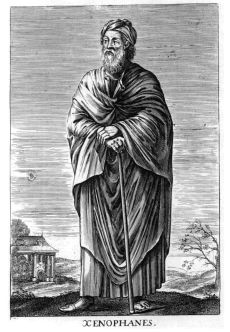
Xenophanes (c 570-476 BCE), one of the earliest of the Presocratics, savaged Homer and Hesiod for ‘attributing to the gods everything that men find shameful and reprehensible – stealing, adultery and deceiving one another.’

Humans possessed false ideas of gods because they fashioned them in their own image. So, ‘Ethiopians say their gods are flat-nosed and black, and Thracians that theirs have blue eyes and red hair.’ And if horses and cows possessed gods, they would undoubtedly be ‘horse-like gods, cow-like gods’.

There could only be one God, Xenophanes insisted, ‘since it is sacrilege for any of the gods to have a master’. This God could be ‘in no way similar to mortal men in body or in thought’. God must have always existed, for there is nothing superior that could have created Him, and He could not have been created by an inferior being. He is a living being but unlike like organic beings there are no parts in Him. He has no physical contact with anything in the world but ‘remains for ever in the same place, entirely motionless’ and ‘effortlessly, he shakes all things by thinking with his mind.’ This notion of a wholly simple God came to be important in both Islam and Christianity.

(Image of Xenophanes from Thomas Stanley’s The History of Philosophy, c. 1655, via Wikimedia Commons)


Hard-Wired For Hate

Allen Buchanan and Russell Powell look at it from an evolutionary standpoint:

Morality involves judgment, shame and exclusion as much as kindness. What is more, modelling work by the anthropologist Robert Boyd, the biologist Peter Richerson, the economist Samuel Bowles and their collaborators has shown that moralising punishment is likely to evolve only in the context of selection between groups. Which means that morality most likely evolved in an arena of intergroup conflict, in which violence and vigorous economic competition between groups was commonplace.

This conclusion is consistent with archaeological, ethnographic and ethological data, too. As the archeologist Lawrence Keeley, the psychologist Steven Pinker, the anthropologist Chris Boehm, the primatologist Richard Wrangham and others have observed, intergroup conflict is common in extant and prehistoric hunter-gatherer bands, and is well established in chimpanzees.

Given this picture, we should expect human beings to extend moral consideration to members of their own group, while at the same time ruthlessly exploiting people from other groups. In short, we should expect evolution to have produced a human moral psychology that is group-ish and strategic in nature — one that takes other individuals to be part of the moral community if they are part of one’s co-operative group, or otherwise capable of contributing to or disrupting co-operative goods. Extending moral consideration to outsiders — especially those who are not in a position to reciprocate or who could be exploited without fear of reprisal — is maladaptive in a moral system that arose from competition between groups. In other words, a conventional evolutionary view is that morality involved as a way of bolstering in-groups and excluding others – that we are ‘hard-wired’ for tribal loyalties and conflicts.

What Rights Do God’s Creatures Have?

HONDURAS-ZOO-MONKEY

Wesley J. Smith, a senior fellow at the Discovery Institute, which promotes intelligent design, is against granting apes human rights. A. Barton Hinkle suspects that religion informs Smith’s views:

Like evolution, the recognition of animal rights has the potential to undermine biblical literalism. So it is not particularly surprising that the Institute treats even limited recognition of some rights for chimpanzees as the first step on a slippery slope. The ultimate goal, Smith writes, is “to prohibit all domestication of animals” and “destroy human exceptionalism.”

Wrong. The panic over the possibility of safeguarding not merely animal welfare, but legal animal rights, fails to recognize that we already do just that. Humans, after all, are animals too. When we respect human rights, we therefore respect the rights of (some) animals. And if we respect the rights of some animals, then there is no reason in principle not to respect the rights of certain others. But just as not all humans have the same rights, recognizing certain rights for chimps would not require attributing those same rights to pigs, bluejays, and earthworms. Children enjoy no right to enter into contracts, for example, because they are deemed to lack the capacity for it. Adults generally may enter into contracts—but not all of them. We make exceptions for the mentally incompetent.

Earlier Dish on the case here.

(Photo: Orlando Sierra/AFP/Getty Images)

Illuminating The Christian Imagination

Aaron Cline Hanbury explores the enduring popularity of C.S. Lewis:

One of the few men who did attend Lewis’s funeral was the English theologian and philosopher Austin Farrer. In his eulogy that day, Farrer effectively described the combination of logic and emotion—of fact and imagination, of prose and poetry—that made Lewis’s writings resonate with many demographics of readers: Farrer said, “There lived in his writings a Christian universe that could be both thought and felt, in which he was at home and in which he made his reader at home.” In other words, readers found—and still find—that Lewis narratives both answer intellectual questions and satisfy spiritual longings; Lewis demonstrates the importance of images and stories for the life of faith, without forgetting the necessity of reasoned, coherent belief, as well.

But Lewis’s appeal clearly reaches further than his Christian audience and draws appreciation from adherents of other faiths and the non-religious. There’s a profound reason for that.

As the flamboyant, avant garde theater critic Kenneth Tynan, a proud proponent of amorality, wrote in his diary after reading Lewis’s novels, “How thrilling he makes goodness seem—how tangible and radiant!” And after reading a work of nonfiction, he wrote, “C.S.L. works as potently as ever on my imagination.”

In honor of his achievements as a writer, officials of Westminster Abbey announced last month that they will honor Lewis in the prestigious Poets’ Corner alongside literary figures such as Geoffrey Chaucer and Charles Dickens. The memorial stone displays Lewis’ famous summary of his faith: “I believe in Christianity as I believe the sun has risen. Not only because I can see it but because by it I can see everything else.” This vision for a Christian lens to the world permeates Lewis’s stories, because, for him, the best stories hinted at the deep structures of reality, helping humanity in the journey for truth and significance. Good stories point to an ultimate story. And as Farrer—but few else—might have predicted, Lewis appears more relevant today than ever.

Previous Dish on C.S. Lewis here, here and here.