A Timely Read

by Dish Staff

James Wood summarizes David Mitchell’s appeal in a review of his new book, The Bone Clocks:

He has a marvellous sense of the real and of the unreal, and his best work keeps these elements in nice tension—a balancing of different vitalities. One of the reasons he is such a popular and critically lauded writer is that he combines both the giddy, freewheeling ceaselessness of the pure storyteller with the grounded realism of the humanist. There’s something for everyone, traditionalist or postmodernist, realist or fantasist; Mitchell is a steady entertainer. Pleasing his readership, he has said, is important to him: “One of the questions I always try to keep in the front of my mind is to ask why would anyone want to read this, and to try to find a positive answer for that. People’s time, if you bought it off them, is expensive. Someone’s going to give you eight or ten hours of their life. I want to give them something back, and I want it to be an enjoyable experience.”

Derek Thompson hails the novel an “almost-masterpiece”:

For diehard Mitchell fans, The Bone Clocks is another six-part, globe-trotting, time-traveling performance in literary ventriloquism. For the unconverted, it offers everything you could possibly want from a conjurer at the height of his powers—a ludicrously ambitious, unstoppably clever epic told through a chorus of diverse narrators that is both outrageous in scope and meticulous in execution.

The story begins with Holly Sykes, a love-struck teenager gushing over her first boyfriend in 1984 England. After a vicious fight with her mother, Holly runs away from home and reveals that she has a history of hearing voices and seeing what may be ghosts. Wandering the countryside in self-exile, she encounters strangers whose clues, threats, and mystic wisdom hint at a fantasy universe that remains present but often unseen for the rest of the novel, coursing under the main narrative like an underground river.

Alan Jacobs recommends the book with more measured praise:

The Bone Clocks is a massive achievement, and allows us for the first time to see just how ambitious a writer David Mitchell is. He is not stylistically ambitious as, say, James Joyce was — as I’ve noted, Mitchell shares Joyce’s love of pastiche, but it’s fairly pedestrian vocabularies that he likes to imitate. His books don’t quite amount to novels of ideas, at least not in a conventional sense. In fact, it’s hard to describe Mitchell’s ambition. But while it has long been noted that Mitchell tends to recycle characters — people who appear as minor figures in one novel reappear as major ones in another — only with The Bone Clocksare we able to see that this is not just a little novelistic quirk but rather a central feature of Mitchell’s imagination. All of his books are starting to look like a single vast web of story, with each significant character a node that links to other nodes, across space and time. And the essential insight, or image, or hope that provides structure to the whole web is the immortality of the human soul.

Kathryn Schulz is also impressed:

You could call Mitchell a global writer, I suppose, but that does not quite capture what he is doing. It is closer to say that he is a pangaeic writer, a supercontinental writer. What is for geologists a physical fact—that the world is everywhere interconnected, bound together in a cycle of faulting and folding, rifting and drifting, erosion and uplift—is, for Mitchell, a metaphysical conviction. Immensity alone, he knows, is psychologically and morally risky; it makes our own lives so comparatively insignificant that it can produce fatalism, or depression, or unimpeded self-interest. To counter that, his fiction tries again and again to square the scale of the world with the human scale, down to its smallest and inmost components. The human conscience matters because it leads to action—a captain holds his fire, a free man saves a slave—and human action matters because, if everything is interconnected, everything we do tugs on the web of space and time.

But David Plotz finds the scope tiresome:

Mitchell hurls people, places, and ideas at us; so many that none stick. From a single page: Noongar, Moombaki, Ship People, Pablo Antay, Five Fingers, Lucas Marinus, Nagasaki, Whadjuk, Horology, Nineveh, Ur, the Deep Stream, the Schism, the genocide in Van Diemen’s Land, Xi Lo, Esther, spirit-walk, the oldest Atemporal, Freemantle, the Swan river, Shakespeare, Rome, and Troy.

Mitchell has written a book about immortality that mimics immortality itself. It feels like it takes forever.

And Emily Temple strikes a middle ground, remarking that though The Bone Clocks isn’t Mitchell’s best, “you should really read it anyway”:

The Bone Clocks suffers from the same essential problem that Cloud Atlas has, which is this: under all the language play and virtuosic storytelling, under all that delight, what is Mitchell really telling us? Surely not simply, in Cloud Atlas, that we are all connected; surely not simply, in The Bone Clocks, that life is precious, that death is scary and inevitable, or that good is preferable to evil. Big ideas, but not complex concepts, at least not as presented here.

For all its many characters and styles, Cloud Atlas wrapped itself up with a bow: we began where we started, having hit all the same steps on the way down, and it felt whole. The Bone Clocks feels somewhat more than whole — it feels exploded, or maybe like one very good novel that invaded the consciousness of another very good novel. Or four.

Face Of The Day

by Dish Staff

dish_leemississippi1935

The above is one of more than 170,000 portraits taken by the photographers of the government’s Farm Security Administration between 1935 and 1945. Alissa Walker spotlights a new project that makes the photos more accessible:

A team from Yale has collaborated on one of the most visually stunning interpretations of the era, called Photogrammar: 170,000 photos from the period, plotted on a map of the country. As part of FDR’s sweeping social policies of the New Deal, launched in 1935, photographers were dispatched to travel the nation, documenting the effects of the relief work. Most notable was the work of the Farm Security Administration—Office of War Information (FSA-OWI), which tapped now-legendary photographers to make most of the black-and-white photographs we’ve come to associate with the time. The archives were digitized and have now made accessible online by this group of historians, GIS experts, and data scientists.

Photogrammar not only allows you to easily search for all these gorgeous historic images, it places each of them on a map, color-coded by photographer. You can see how Dorothea Lange traveled throughout the rural South and then headed west to document the farmers of California’s Central Valley. I especially like how you can track Jack Delano’s path down Route 66. For historical relevance, you can add an overlay of a 1937 road map of the U.S., made by the Vico Motor Oil Company.

Explore the collection here.

(Photo: “Wife of Negro sharecropper, Lee County, Mississippi,” August, 1935, by Arthur Rothstein)

Going To The Grave Without God

by Dish Staff

Steve Holmes, a Baptist minister, shares what it was like to lead a funeral service for his grandmother, who requested that services include no religious content:

Inevitably, I looked around for help; I’ve done enough liturgical work to know that there are always riches from which to borrow. That said, the Humanist material I discovered surprised me – although on reflection the problem was predictable. Like most contemporary ‘humanism’, it all failed rather badly to be nonreligious. I looked at half-a-dozen or more published patterns for a humanist funeral; every one borrowed central Christian texts, deleted the obvious references to God, and then used the filleted remains to shape the service. (Even Scripture was not immune; Eccl. 3 was several times in evidence. John Donne’s Divine Meditation XVII was also referenced more than once.) This of course reflects the reality – and the tedious banality – of too much contemporary Western atheism: take a philosophically-rich account of things; delete surface references to the divine; and assume that what is left will be meaningful or coherent or interesting. Nietzsche, the world hath need of thee…

The experience itself was interesting; the defiant rebellious joy of a Christian funeral was of course absent (‘Where, death, thy sting? Where, grave, thy victory?’ (a phrase I recall Graham Tomlin describing as the liturgical equivalent of ‘You’re not singing, you’re not singing, you’re not singing anymore!’); ‘Thine be the glory, risen, conquering Son – endless is the victory thou o’er death hast won!’), but that did not feel like a huge problem. We came to say goodbye, and goodbye was said; if I personally could have said so much more, that was the absence of a wonderful bonus, not the presence of a yawning absence. I know the philosophical stuff on the obscenity of death, but my grandmother died old and full of years, and it did not feel like that.

The Evils Of Kitsch

by Dish Staff

Roger Kimball argues that there’s a moral component to the kind of bad taste we call “kitsch”:

[T]o say that something is kitsch is to utter a judgment that is moral as well as aesthetic. The failure of kitsch is not just an artistic failing. There is an ethical dimension dish_dogart as well. Hermann Broch identifies kitsch as “the element of evil in the value system of art” and notes that “kitsch” describes not only certain works of art but also a certain attitude towards life. … [T]he element of untruthfulness is key. “He who produces kitsch,” Broch writes, “is not someone who produces art of meager value. He is not someone of little or no talent. He is definitely not to be judged according to the standard of aesthetics but is ethically depraved; he is a criminal who wills radical evil.”

That may seem hyperbolic. We’ve certainly come a long way from corny genre scenes, paintings of puppies with big eyes, or pretentious, pseudo-classical hotel lobbies bedizened with colored lights. But Broch understands that kitsch rests on a fundamental refusal of reality, on an effort to counterfeit life, to replace reality with a species of narcissistic fantasy. The puppy with big eyes may seem innocent enough. But when extended to the whole of life and invested with the pathos of untrammeled fantasy, kitsch forms a brew that is toxic as well as infatuating. “Evil” is not too strong a word.

(Image via Flickr user Mark]

The Problems With Political Parties

by Dish Staff

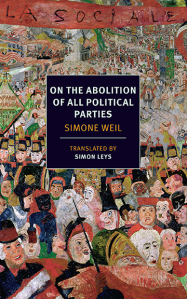
Adam Kirsch revisits Simone Weil’s 1943 essay, “On the Abolition of All Political Parties”:

“Political parties,” she writes, “are organizations that are publicly and officially designed forabolition political parties the purpose of killing in all souls the sense of truth and of justice.” The member of a party delegates his conscience to the party, accepting its verdict on all political and moral questions; a person will do “as a Communist” or “as a Nazi” things that he would never do as himself. Once again, Weil brings the discussion back to the question of truth. Independent thought, she writes, necessarily seeks the truth: “If … one acknowledges that there is one truth, one cannot think anything but the truth.” It is only when one stops searching for truth and starts calculating partisan advantage that one falls into what Weil calls “inner darkness.”

It is obvious that Weil’s argument against parties stands or falls by her definition of truth. Truth, as this deeply religious thinker sees it, is unitary and self-subsistent: it exists somewhere “out there,” and our job is to look for it. There is a right answer to every political question, which every individual, and society as a whole, would necessarily discover if we approached it with pure hearts. Parties, by intervening between the individual and the truth, frustrate this quest; they stifle the conscience and confuse the mind. “Mendacity, error,” she writes, “are the thoughts of those who do not desire truth, or those who desire truth plus something else. For instance, they desire truth, but they also desire conformity with such or such received ideas.”

But what, one might ask, is the “truth” about a question such as taxes? Is an income tax rate of 35 percent more in conformity with the truth than a rate of 40 percent? Is this the kind of question to which, as in mathematics or religion, there is only one correct answer?

Even Preachers Lust For Power

by Dish Staff

http://youtu.be/FxlTl60Eoa4

Alissa Wilkinson reflects on the Amazon pilot, Hand of God, pointing to the way the show grapples with “how the practice of religion … can be not just a place for people to meet God and seek salvation, but also a place for people to exercise corrupt power for their own ends.” Why she welcomes the realism:

There are lousy, manipulative, lazy, boneheaded portrayals of Christians on TV and in the movies—the conniving Bible-thumping vice president on Scandal springs to mind, for starters—but let’s be honest: there are many wonderful pastors and priests and ministers in the world, and there are also some real doozies out there who can cause a great deal of harm, and unfortunately they are the ones who get a lot of attention both before and after the fall.

If we have seen anything in the last year, in which a large number of formerly highly-respected celebrity pastors have taken a very public tumble (not that it’s anything new!), it’s that power is a dangerous, dangerous thing to handle. So while I hope we keep getting great portrayals of ministers who do God’s work well (here’s a few from the last ten years), let’s not be too quick to wish for these other characters to go away. Like the broader antihero type, who almost inevitably reach a gruesome end, the power-hungry minister serves as a reminder that power corrupts.

To those in positions of spiritual authority, they remind us to be careful. To Christians, they remind us that not everyone who cries “Lord, Lord” will enter the kingdom of heaven. And to those who are sitting in the pews, they remind us that things are not always what they seem.

Derrik J. Lang, talking with show’s cast and creators, emphasizes the show is about more than religion:

Despite the show’s subject matter and title, a reference to a fringe religious group led by [Julian] Morris’ smarmy soap star turned preacher, the creators of “Hand of God” are quick to note that Amazon isn’t moving into faith-based programming. The show’s conceit is more about characters grasping for power in the fictional town of San Vicente than it is about religion.

“The religion in the show is like the science in ‘Breaking Bad,’ ” said writer-producer Ben Watkins, who previously worked on “Burn Notice.” “It’s an important part, but it’s just a thread — a great one because there’s so many compelling themes to explore. For me, this is more about the contradictions of our lives and our ambivalence toward life in general.”

One Nation, Without Reference To God

by Dish Staff

A recent poll indicates that 34 percent of Americans support removing “under God” from the Pledge of Allegiance:

The study, conducted in May of 2014, responded to a 2013 poll by Lifeway Research, which stated that only 8 percent of American adults felt that “under God” should be removed from the Pledge. Unlike the Lifeway Research poll, the survey done by The Seidewitz Group included a brief description of the history of the Pledge of Allegiance, including the information that “under God” was only added as recently as 1954 in response to the Cold War and that some Americans feel that the Pledge should focus on unity rather than religion.

“The current wording of the Pledge marginalizes atheists, agnostics, humanists and other nontheists because it presents them as less patriotic, simply because they do not believe in God,” said Roy Speckhardt, executive director of the American Humanist Association. “We are encouraged by these findings, which suggest with even a small amount of education, more Americans are in favor of restoring the Pledge to its original wording.”

Noting, however, that “it’s pretty clear no court is going to rule the Pledge unconstitutional any time soon,” Ronald A. Lindsay suggests a way to accommodate those who object to the phrase “under God” – make saying it explicitly optional:

Bear in mind that the defenders of the Pledge, and many of the courts that have upheld its legality, have maintained that the Pledge is not only a patriotic exercise, but an important patriotic exercise: it’s considered a critical part of a student’s formation as a good citizen. Therefore–at least according to defenders of the Pledge–some students are being denied a critical component of their education merely because they refuse to abjure their religious beliefs. Students who want to obtain the benefit of participating in the Pledge exercise should not be denied this important aspect of their education merely because they cannot honestly affirm there is a God.

Frankly, it’s difficult to see how a request for making the religious avowal in the Pledge optional could be refused. Compare it to other situations where religious avowals were once employed as a pretext for barring atheists from participating in important civic activities. Until the mid-twentieth century, some states barred atheists from testifying, serving in public office, or serving on juries on the ground that they could not take a religious oath. All such provisions are now recognized as unconstitutional. Witnesses, for example, have the option of swearing on some sacred book to tell the truth “so help me God” or of simply making a solemn affirmation to tell the truth under penalties of perjury. If this country no longer requires witnesses, jurors, or public officials to affirm belief in God to participate in civic activities, how can a state require schoolchildren to affirm belief in God to participate in an important civic activity?

Spam Lit

by Dish Staff

Dan Piepenbring close-reads an automated blog comment with fascination:

If you give it your name it will call you by it when you start up the GPS. These incidences come about quite normally, showing that Peter dislikes his daughter. A huge clue that your ex boyfriend still has feelings for you. —geniadove

That swerve at “Peter dislikes his daughter”—whoa! Dissertations have been written about less. And to see a clinical phrase like “These incidences come about quite normally” next to a casual one like “A huge clue”: What does it all mean? The mind searches restlessly, somewhat desperately, for connective tissue, some semblance of conventional narrative. Like autostereograms, these comments always verge on resolving into a discernible whole; unlike autostereograms, they never do.

He goes on to consider spam as part of a literary tradition:

[T]here are a number of literary antecedents here: found poetry, Dadaist ready-mades, collage and bricolage, cutups, aleatoric poems, various Oulipo shenanigans. Most especially, there’s spoetryspam lit, and flarf, similar movements from the past two decades that have made poetic hay from the Internet’s endless detritus. Flarf descends from Gary Sullivan, who collaborated with other poets online, constructing abhorrently bland poems from the results of random Google searches, workplace memos, Associated Press stories, and the like. (“awe yea You see, somebody’s done messed up / my latvian women’s soccer team fantasy REAL bad, / oh pagers make of cheese,” goes a representative sample.) …

I admire the impulse behind spam lit, and I’ve read some of it with great interest, but I’d argue that any sort of human interference, even if only to “curate” the spam, dilutes its strength a bit—it’s best encountered in its natural environment, which is to say your inbox, where it can baffle, perturb, interrupt, and otherwise fuck with you.