The Road To Democracy May Be Literal

by Dish Staff

Christian Caryl makes an interesting argument to that effect:

In Rwanda, decent roads stand for the official commitment to provide everyone with equal access to the fruits of development – concrete evidence, if you will, of the determination to overcome the ethnic divides that led the country into mass slaughter just two decades ago. Every part of the country is relatively close to a good road; no group is excluded. (Nor do you have to have a car to get around; members of Rwanda’s growing middle class can simply hop on one of the country’s ubiquitous minibuses.) Northern Malians can only dream of such conditions.

Roads don’t just enable the movements of goods; they also enable the flow of ideas. … As such, roads are also crucial ingredients of state-building.

Soon after toppling the Taliban in 2001, the U.S.-led coalition that occupied Afghanistan set out to rebuild Highway 1, the ring road linking Kabul with the country’s major urban centers (including Kandahar, the Taliban’s unofficial capital). The idea was to restore a sense of unity to a country that had virtually fallen apart during the long years of civil war. Taliban insurgents immediately vowed to sabotage the project for just the same reason. Today, the dismal story of Highway 1, which is falling apart after $4 billion of Western investment, offers a perfect microcosm of Afghanistan’s roller-coaster struggle to reinvent itself. Afghanistan isn’t unusual in this respect. Take a look at many failed states around the world and you’ll probably be struck by how many of them have bad (or no) roads.

But building too many roads means, in the words of Mark Buchanan, that “wildlife habitats will suffer huge losses and ecosystems will be destroyed, ultimately undermining Earth’s capacity to support human life as well.” Buchanan’s advice on how to minimize the harm:

New research by a group of environmental scientists suggests that better coordination could go a long way toward avoiding this disaster. The key is that vast tracts of settled land, where ecological damage is already significant and probably irreversible, still aren’t very productive. Better access to fertilizers and modern farming technologies would greatly boost the productivity of such areas, thereby reducing the need for development in more sensitive areas.

The researchers have produced a global map showing places on Earth where new roads or road upgrades could have big human benefits, and others where little benefit would be expected despite large environmental costs.

Weighty Art

by Dish Staff

A Columbia student and alleged rape survivor has come up with an powerful way to dramatize the aftermath her assault:

[Emma] Sulkowicz has devised a senior thesis rooted in performance art that will allow her to protest the fact that her rapist continues to study on campus. She has committed to carrying around a twin-size dorm mattress everywhere she goes on campus, to classes and appointments, “for as long as I attend the same school as my rapist.”

“I was raped in my own dorm bed, and since then that space has become fraught for me,” she says in a video about the piece, called Mattress Performance or Carry That Weightpublished by the Columbia Spectator. “And I feel like I’ve carried the weight of what happened there with me everywhere since then.”

Katie Van Syckle interviews Sulkowicz:

How’s it going?
Rough. I just never really anticipated how big this would be, and I thought I was prepared, but I just wasn’t.

In terms of the response?
Physically, I’m really sore. The reporter response has been really aggressive and not what I expected. It is a sensitive subject, and I can’t be accosted in the middle of campus to talk about it. One guy, while I was carrying the mattress, he just opened up my backpack and threw his business card in, which was a real violation of my space and made me really upset and triggered a lot of memories of being raped.

Update from a reader:

I was surprised that you referred to Emma Sulkowicz as a “rape survivor”. I have noticed that several other media outlets have done the same. But her alleged attacker, whose name is readily available online, has never been convicted of the rape. There were only two people in the room when the incident happened, and they are giving completely polarized versions of what occurred.

There is a lot of murkiness in the story: she didn’t report the alleged rape until months later, at the urging of friends. Her allegations are being leveled at an ex-boyfriend (of course, boyfriends can rape, but the history of an ongoing relationship complicates the objective evaluation of the two opposing versions to the story, and of the dynamic in the room that day). And finally, the people who were charged with evaluating the two versions, i.e., the administration of Columbia University, came to the conclusion that there were not grounds for pursuing the charges. I understand that law enforcement officials came to the same conclusion.

In the absence of all the facts, my emotions tell me that Ms. Sulkowicz did indeed suffer being raped, and her story makes me feel terrible. But it’s important to recognize that due process must be followed before we tag somebody a “rapist”. Only Ms. Sulkowicz and the accused know what happened in that bedroom that day; you do not. She can refer to him as a “rapist”, but you, or I, or anyone else, cannot, until due process has been followed and the accused has been found guilty of what remains an allegation.

Thanks for the context; we updated the post with “alleged”.

What’s Not On The Syllabus?

by Dish Staff

Rebecca Schuman laments the sorry state of the college course syllabus, which, she says, has swelled to “10, 15, even 20 pages of policies, rubrics, and required administrative boilerplate, some so ludicrous (‘course-specific expected learning outcomes’) that I myself have never actually read parts of my own syllabi all the way through”:

The texts? The assignments? Unsurprisingly, these are still able to fit on a page or two. The meticulous explanations of our laptop policies, or why, exactly, it’s inadvisable to begin course-related emails with “heyyyyyyyyy,” or why we will not necessarily return said emails at 3:15 a.m.? A novel’s worth. Today’s college syllabus is longer than many of the assignments it allegedly lists – and it’s about as thoroughly read as an end-user license agreement for the latest update of MS Word. …

Syllabus bloat is more than an annoyance. It’s a textual artifact of the decline and fall of American higher education. Once the symbolic one-page tickets for epistemic trips filled with wonder and possibility, course syllabi are now but exhaustive legal contracts that seek to cover every possible eventuality, from fourth instances of plagiarism to tornadoes. The syllabus now merely exists to ensure a “customer experience” wherein if every box is adequately checked, the end result – a desired grade—is inevitable and demanded, learning be damned.

Why Do We Subsidize Mansions?

by Dish Staff

benefit_homeownership

Danny Vinik wants to know:

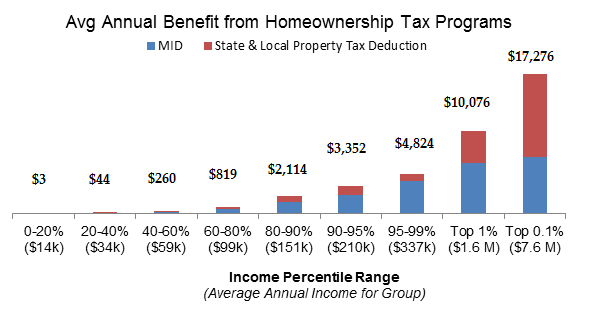
The traditional defense of these [homeowner] tax breaks is that they promote homeownership, which has been shown to have numerous additional benefits including improved health. But there’s a big problem with this argument: these deductions don’t actually subsidize homeownership. They subsidize bigger homes and more debt instead.

Consider the mortgage interest deduction that allows homeowners to deduct their interest payments on loans up to $1 million. The larger the debt (up to $1 million), the larger the interest paymentsand the more the homeowner can deduct in taxes. As Nick Bunker, a research associate at the Center for Equitable Growth, wrote Wednesday, “The deduction gets pitched as an effort to increase homeownership, but academic research finds that really it just increases the size of homes purchased.” At the Washington Post, Catherine Rampell shows how the median house size has increased over the past 40 years. It’s at a record-high, after a slight dip post-Great Recession. Homeowners are incentivized to build larger houses thanks to the mortgage-interest deduction.

In The Gaffe Business

by Dish Staff

Emma Roller profiles campaign trackers, individuals “employed by an opposing political party to follow a candidate on the campaign trail, documenting his or her every move, in hopes of capturing a slipup”:

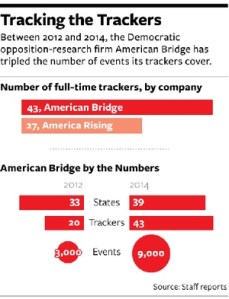
American Bridge [a Democratic organization] employs 43trackers trackers to cover 39 states. Since 2012, the organization has tripled the number of events its trackers cover. In 2012, Bridge’s 20 trackers recorded 3,000 events in 33 states. In 2014, they have tracked more than 9,000 events and traveled a cumulative 693,000 miles.

“When it’s a presidential campaign, you’re going from flight to flight to flight to event,” Farr said. “Their schedule is your schedule. So if you have a candidate that’s having eight events a day, you have eight events a day. And you’re obviously usually surrounded by people that have different opinions than you, and are definitely fighting for the exact opposite of what you are.”

Some trackers have been following the same candidate for years—around the state, around the country, on planes, on buses, in town halls, in swanky fundraisers—all on the off chance that they’ll get the candidate on tape saying something politically distasteful or flip-flopping on a position. A new “47 percent” or “Macaca,” if you will.

Obamacare Is Beating Expectations

by Dish Staff

Kaiser

Ezra heralds the news:

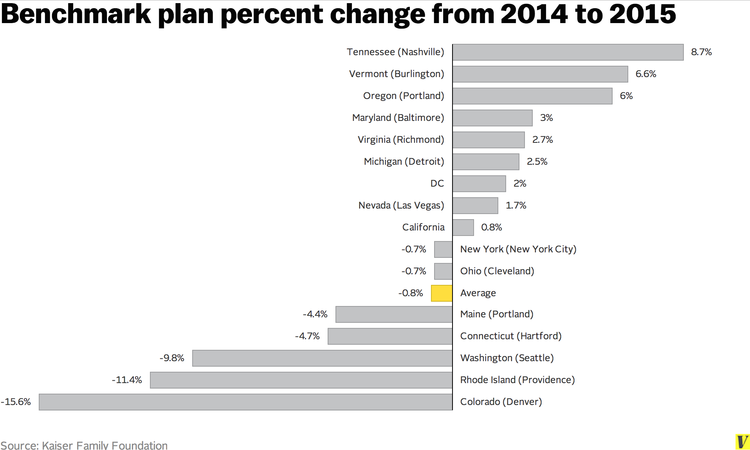
A new report from the Kaiser Family Foundation finds that in seven major cities that have released data on 2015 premiums, the price of the benchmark Obamacare plan — the second-cheapest silver plan, which the federal government uses to calculate subsidies —  is falling.

Yes, falling.

“Falling” is not a word that people associate with health-insurance premiums. They tend to rise as regularly as the morning sun. And, to be fair, the Kaiser Family Foundation is only looking at 16 cities in 15 states and the District of Columbia, and the drop they record is, on average, a modest 0.8 percent (though this is the same methodology they used in 2014, and to good results). But this data, though preliminary, is the best data we have  —  and it shows that Obamacare is doing a better job holding down costs than anyone seriously predicted, including Kaiser’s researchers.

Cohn weighs in:

To appreciate what that means, consider what the market for buying insurance on your own (rather than through an employer) was like before Obamacare came along. Between 2008 and 2010, premiums went up every year and they did so by at least 10 percent, according to an analysis that MIT economist Jonathan Gruber did for the Commonwealth Fund. And that was for insurance that might be sold only to healthy people or that had benefits far skimpier than the ones required by the Affordable Care Act. “There is variation, but so far, premium increases in year two of the Affordable Care Act are generally modest,” Drew Altman, Kaiser’s President and CEO, said in a press release. “Double digit premium increases in this market were not uncommon in the past.”

But it isn’t all good news. Jason Millman explains:

[I]n 12 of the 16 cities that Kaiser studied, at least one of the insurers that offered a benchmark plan in 2014 no longer has benchmark status for 2015. That means that insurer might have raised rates, or another insurer is offering lower prices in 2015. Either way, if a person remains enrolled in what used to be a benchmark plan, that person (assuming life circumstances haven’t changed) will have to pay more toward their premium.

That’s all to say that shopping around for insurance this year could be really important for the new Obamacare enrollees.

Expatriatism, Ctd

by Dish Staff

A reader addresses Jonah’s piece on living abroad for several years in Jordan:

Thank you for sharing your experience. I went to Beirut, Lebanon from my US university as a third-year student in 1974, interested in history and archaeology. During the ten months I spent in Lebanon I was forced to consider all sorts of new experiences: Palestinian dorm-mates, life experiences that were very different from mine; travels to “mysterious” (as it then was) Syria; and finally the outbreak of the Lebanese civil war in spring 1975. All of these experiences forced me to think in new ways about the US, about its role in the world, and about the lives of others who (in the US corporate media) were mostly overlooked or dismissed. And the more I began to dig into the causes of the Lebanese war, the more complex (and hitherto unknown to me) this world became. So began a lifelong quest to try to figure things out. After all these decades I have more questions than answers, but I suppose that is the point of a life’s journey.

Another reader:

I grew up in Beirut … well, sort of. My family moved there when I was 11 and I stayed until I graduated, and my folks stayed another 4 years until July 4, 1976. Yes, as we were watching the Boston Pops and fireworks, they were in a convoy leaving Lebanon because of the civil war. I am definitely a “3rd Culture Kid”. I rarely feel 100% at home with anyone except others who have lived abroad and understand that phenomena.

Another shares some great insights from his time abroad:

My husband and I packed up our cat and moved to Asia in 2008. We lived in Kuala Lumpur, Malaysia for five years, then moved to Ulaanbaatar, Mongolia in September 2013. Being an expat means about a million things, but I’ll try to focus on a few. We Americans develop a strange sense of our own importance that life overseas corrects. Americans on both the left and right are wrong when they assume people from other countries automatically don’t like us.

From people on the left, the assumption is based on the Iraq war and the George W. Bush administration, plus various CIA/Central America/Vietnam War activities, depending on their age. From the right, we hear this assumption about Muslims (especially because we lived in Muslim Malaysia) and any/all others presumed to disagree with US foreign policy. But as you described in your post, people focus primarily on their own day-to-day lives. Expat life teaches that people go about their daily lives doing what they do without thinking about the US all the time. And we make individual relationships to move past the stereotypes.

That said, the US is a model for democratic governance, and people outside the US pay attention to how our democracy works. I work in international development and have been in many meetings where civil society leaders reference the Bill of Rights when discussing how to expand civil and human rights in their countries. The US Constitution serves as a very real example, as freedom of press, religion, assembly (or rule of law generally) and the judiciary are still aspirations in many places that are grappling with democracy. Before moving overseas, I had no idea that people in other countries actually talk about the US Constitution.

Which is why it’s so painful when we slip, as in Ferguson. We can be a model on paper, but when police kill unarmed citizens, then dress in combat gear to break up a protest AND arrest journalists, we look like hypocrites. And this is why it gets up people’s noses when we tell them to do what we say. Andrew has pointed out many times how we lose our moral authority when we torture; it’s the same problem when we violate the Constitution in other ways as well.

Another reader:

A great post by Jonah Shepp. In 1987, my husband and I and our two sons, aged 2 and 5, relocated to Melbourne, Australia, from Chicago.  We went because my husband got a great job offer, and we had always wanted to live abroad (the job offer to go to Sudan five years prior was not quite the same).  At any rate, we lived a privileged life there, and not because we were on expat salary and benefits.  We actually became permanent residents of Australia, and now have dual citizenship, something that the US tolerates with countries like Australia (would we ever really go to war with them?), and Australia doesn’t mind at all.  Typical of the Aussies.

We loved living in Melbourne and we made friends who are with us forever.  At first glance, many think that Australia is a lot like California (my native state), and the point of this piece is that it’s not – not at all.  And it’s not like England either.  And I would not know this if I had not lived there.  So many little things: an Aussie telling me that an Australian politician would be laughed out of office if he dared invoke God, or Jesus, or made any sort of religious comment, in a speech.  That their version of peanut butter is a disgusting thing called Vegemite, but they love it with a passion – the ultimate comfort food – because of course, they all grew up with it.

And another: no country wants to be controlled by another country.  This seems so obvious to an American, and I’d never given it much thought, until I went to Australia, and learned first-hand about England’s domination of that country, and how England just expected Australian men to fight and die for Mother England, in far off places.  This didn’t hit home to me, despite having seen movies like Breaker Morant, until at a dinner party one evening, when another guest bitterly talked about it.

And another:

I spent a couple years in the Peace Corps, so allow me to give a plug to the incredible benefits of the program. Yeah, yeah, sure, it helps others and makes the world a better place, blah blah (and that is all very true, and the program is wonderful). But don’t be fooled by that gloss of altruism. Most Peace Corps volunteers GET a heck of a lot more than they put in. How could it be otherwise? The volunteer offers an individual’s insights and hard work, but receives an entire culture in return. And back home in a United States that offers a large helping of praise to those who serve in the military, may I suggest that Peace Corps volunteers give more and get less recognition for it? (But once again, no sour grapes here, because we volunteers received more than we gave.)

Even for a socially backward nerd like me, fresh out of college, with basically no social skills and a profound reluctance to interact with any people from my host country aside from the students to whom I taught science, it was an eye-opening and amazing experience. The States did not look the same when I returned. I can tell you exactly when brake lights started appearing in the back windshields of cars … they were not there when I left, but when I returned, every car looked to me like a Cylon from Battlestar Galactica (original series, of course). More profoundly, I had a feeling of accomplishment after my service that saw me through some tough bouts of self-doubt. And I had a sense of how lucky I was, because I knew that I was, like most Americans, a child of privilege.

Thanks for the post and the memories.