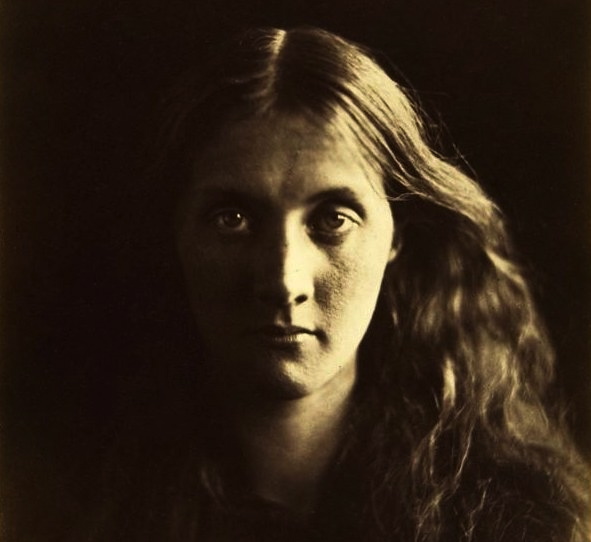
Putting Women In A Light Box

by Dish Staff

Cameron_julia_jackson

Alex Heimbach suggests that books such as Women Photographers: From Julia Margaret Cameron to Cindy Sherman perpetuate a “gender ghetto”:

The book collects the work of 55 practitioners, from pioneers of the form to contemporary photojournalists. [Author Boris] Friedwald also includes short bios of each artist as part of his goal to present “the variety and diversity of women who took – and take – photographs. Their life stories, their way of looking at things, and their pictures.” Sounds admirable enough. Yet it’s impossible to imagine an equivalent book titled Men Photographers: From Eugène Atget to Jeff Wall. Male photographers, like male painters, male writers, and male politicians, are the default. The implication, intentional or not, is that no matter how talented, female photographers are women first and artists second.

Ideally, endeavors like Friedwald’s serve to illuminate lesser-known artists, who may have been discounted because of their gender (or race or sexual orientation or class). But more often such exercises become a form of de facto segregation, whether it’s a BuzzFeed quiz on how many of the “Greatest Books by Women” you’ve read or a Wikipedia editor isolating female novelists in their own category. These projects are often undertaken in a spirit of celebration, but their thoughtlessness generally renders them pointless at best and misogynistic at worst.

(Photo: Julia Jackson by Julia Margaret Cameron, 1867, via Wikimedia Commons) Update from a reader:

Lovely post.  What your readers may not know is that Julia Jackson was the mother of Virginia Woolf, one of four children from her second marriage.  Julia died in 1895 at the age of 49, when Woolf was 13, precipitating the first of Woolf’s terrible battles with what was probably a severe a bipolar disorder.  Before she became the perfect “angel in the house” Victorian wife to two husbands and the mother of seven, Julia was famous for her beauty and frequently photographed by her illustrious and pioneering aunt, Julia Margaret Cameron.  Needless to say, Woolf, author of A Room of One’s Own, would have been the first to object to relegating the work of women to a separate (but equal?) category.

Writing Tip: Don’t Write

by Dish Staff

Overcoming writer’s block took years for Bill Hayes, who advises that “not writing can be good for one’s writing; indeed, it can make one a better writer” (NYT):

Then I woke one day, and a line came to me. It didn’t slip away this time but stayed put. I followed it, like a path. It led to another, then another. Soon, pieces started lining up in my head, like cabs idling curbside, ready to go where I wanted to take them. But it wasn’t so much that pages started getting written that made me realize that my not-writing period had come to an end. Instead, my perspective had shifted.

Writing is not measured in page counts, I now believe, any more than a writer is defined by publication credits. To be a writer is to make a commitment to the long haul, as one does (especially as one gets older) to keeping fit and healthy for as long a run as possible. For me, this means staying active physically and creatively, switching it up, remaining curious and interested in learning new skills (upon finishing this piece, for instance, I’m going on my final open-water dive to become a certified scuba diver), and of course giving myself ample periods of rest, days or even weeks off. I know that the writer in me, like the lifelong fitness devotee, will be better off.

The Game Of Life

by Dish Staff

Simon Parkin appreciates Spermania, a video game in which “players assume the role of a plucky sperm that must navigate the kinks and curves of an undulating fallopian tube,” as a “good joke that’s well told.” He describes how the game’s creators at the Ramallah-based PinchPoint, Inc. had to overcome the barrenness of the gaming industry in Palestine:

PinchPoint is, according to the company’s co-founder and C.E.O., Khaled Abu Al Kheir, the first venture-capital-backed Palestinian video-game studio. Despite recent efforts to grow the I.T. sector in the Palestinian territories with incubators, accelerators, and venture-capital firms, there are only a handful of video-game developers in the area. Partly, this is due to the unique challenges of establishing a startup in a turbulent region. “Local events here definitely affect our focus and stress us out,” Basel Nasr, one of the game’s developers, told me. “We have no airport or control over our land borders, so travel costs extra time and money. This makes it more challenging to plan overseas trips, as well as to connect with foreign video-game studios around the world in order to learn and share our experiences.” Likewise, the lack of a vibrant industry in the region makes expanding the studio a tremendous challenge. “There’s an almost non-existent talent pool in Palestine for video-game development,” Kheir said.

As for whether the game has proven controversial in Palestine:

Contrary to the team members’ expectations, most of their friends and families supported Spermania’s subject matter. “The theme itself might be a bit controversial,” [developer Basel] Nasr, who designed the game’s cartoonish aesthetic, said. “But the art style gives the game a light and humorous feel. Most people laugh about the idea, and we haven’t received any threats. My two sons, who are five and two, enjoy the game, although they don’t know what it’s really about.”

Face Of The Day

by Dish Staff

AFGHANISTAN-SOCIETY

An Afghan girl look through the door of her house in an old section of Kabul on September 2, 2014. Afghanistan’s economy has improved significantly since the fall of the Taliban regime in 2001 largely because of the infusion of international assistance. Despite significant improvement in the last decade, the country is still extremely poor and remains highly dependent on foreign aid. By Wakil Kohsar/AFP/Getty Images.

Eric Cantor Cashes In

by Dish Staff

He’s got a plum job at Moelis, an investment bank:

Since he was elected Majority Leader in 2011, Cantor earned $193,400 a year, around $20,000 more annually than a rank-and-file member. But as Vice Chairman and Managing Director at Moelis, he will receive a $1.4 million signing bonus, $1.6 million in incentive compensation next year and a $400,000 base salary — plus reimbursement for the reasonable cost of a New York City apartment for his first 12 months, and a hotel equivalent rate thereafter.

Annie Lowrey talks about the move with Dennis Kelleher, “a former corporate lawyer and longtime Senate staffer who now heads the nonprofit Better Markets, the banking lobby’s lonely public-interest opposition in Washington.” How Kelleher understands the hire:

“Wall Street is after what it’s always buying in Washington: access, influence, and unfair advantage. And Cantor is a big catch for anybody who wants access.

Look, if you’re in congressional leadership for X number of years, you know plenty that’s worth a lot of money. If you’re the majority leader, who’s in charge of the agenda and vote counting? One of your jobs is to make sure you’re doling out favors to people. There are dozens and dozens of House members indebted to Eric Cantor for the things he’s done for them. You’re worth a lot.

“In addition, Eric Cantor knows why some things got done and other things didn’t get done. He knows why someone voted for or against a bill or amendment. He knows how to strategically target everybody in the House on the issues that anybody cares about in a way that’s close to unique. He’s not going to crudely do it in a way that puts the scarlet-L lobbyist on his lapel. He and the rest of the influence peddlers at the highest level of government work the shadows and do indirectly what the law prohibits them from doing directly.”

But Matt Levine doubts that this was primarily about avoiding regulation. He notes, “Regulatory life is already pretty easy for Moelis”:

Cantor is there as a show of importance. Important people like to deal with other important people, and every important person Moelis hires makes it more likely that other important people will deal with them. Important people with important piles of money to be spent on important advisory fees.3 It’s a simple business, but it’s the business they’ve chosen.

Beyond the importance peddling, is there influence peddling? Ehh sure probably. “Hire us for your merger because our vice chairman is important” is a perfectly reasonable sales pitch. “Hire us for your merger because our vice chairman knows a lot of people in Washington and can probably get you through antitrust approval” is … also a good pitch, no? That’s probably some part of what “advise clients on strategic matters” means.

Patrick Caldwell remarks that such career moves are commonplace for politicians of all stripes:

Democrats sell out, too. In 2010, former Indiana Sen. Evan Bayh announced his plans to retire in 2010 in a New York Times op-ed that bemoaned the the lack of bipartisan friendships in the modern Senate and attacked the influence of money in politics. Yet shortly after he left Congress, Bayh signed up with law firm McGuireWoods and private equity firm Apollo Global Management and began acting as a lobbyist for corporate clients in all but name. Less than a year later, he joined the US Chamber of Commerce as an adviser. Sen. Chris Dodd (D-Conn.) pulled a similar trick, promising “no lobbying, no lobbying,” before taking a $1-million-plus job as the head of the Motion Picture Association of America, Hollywood’s main lobbying group.

According to the Center for Responsive Politics, 417 ex-lawmakers hold lobbyist or lobbyist-like jobs.

Dogs vs Cats: The Great Debate, Ctd

by Dish Staff

In response to this post, a reader writes:

Domestic cats are very diffident companions indeed, but they are still the most popular pet in the world. Probably because they require less maintenance than dogs both psychically and physically. This makes them one of the most successful mammalian species on Earth in terms of population. They are thought to be the only animal to self domesticate. As a predator small enough to be prey they scoped the opportunity represented by humans early on and some of the Felis genus threw in their lot with us. Some behaviorists have said that cats hang around humans simply because we have better food and we share it.

Some see total opportunism in all a cat’s actions. Manipulations masked as affection so we give them what they want. It is a highly successful strategy. They probably work and/or sacrifice the least for their standard of living than any other creature on Earth. The best last word on cats was summed up by a refrigerator magnet that said “Dogs have Owners, Cats have Staff”. Cats are wired differently than dogs for sure but, in spite of their obvious temperamental differences, are also known to defend a human when retreat would be the wiser course. Maybe they value us for something more than the obvious food, warmth and safety we offer after all.

To underscore that point, the reader sends the above video of a badass cat confronting a despicable dog. Another cat lover:

Rilke was describing a cat that was also an outside hunter.  Those who have indoor cats enjoy a completely different experience.  I’ve shared the last 25 years of my life with two separate felines.

Although having completely different personalities (and I consciously do not put quotation marks around that word), they were and have been nothing but completely devoted.  It’s been very easy to read their their “emotions”, and it is very clear that most of the time they have been very attuned to mine.  My first cat, Charcot, could easily tell when I was displeased and gave me plenty of verbal sass.  In fact, it got to the point that a simple gesture on my part would result in back talk.  I even thought of trying to get her in commercials, because I could elicit that talk with a simple hand movement.

My current cat, Merlot, is the most affectionate cat I have ever met.  Upon my arrival home she greets me with a loud and extensive welcome.  When I retire at night, she is quickly up on the bed after verbally announcing her intent to jump up and join me.  And then, every night, upon arrival, she pussy-foots up to my face and starts licking the tip of my nose until I start to giggle from the “tough love” from her rough tongue.  EVERY night!  When she awakens from what I call one of her “night terrors” after a daytime nap, she begins to make crying sounds, and crawls toward me while still half-asleep, then jumps up into my arms for comfort.  Where did she learn these behaviors/responses?  While they have obviously been reinforced, they had to start on their own from somewhere.  (BTW, my ex knew better than to try and take this cat from me when we split.)

Today, people who denounce cats for their “aloofness” have no one to blame but themselves.  It’s obvious to cat lovers that these people have taken very little, if any, time and effort in creating a bond.  Dogs will bond with their owners in spite of horrendous treatment.  They are a species whose behavior very easily demonstrates the Stockholm Syndrome.  Blind loyalty, or loyalty earned?  While many appreciate the former, I’ll take the latter every time.

Blue Suede Yarmulke

by Dish Staff
https://twitter.com/jetpack/status/506072863481528320

J.J. Goldberg recalls something he learned about Elvis during a tour of Graceland back in the mid-’90s:

The very last display case, before you left the building to roam the grounds, featured the things Elvis was wearing the night he died. Included were his religious paraphernalia, which he “always wore,” the docent told me: a cross and a Chai pendant (visible [here]). Curiouser and curiouser.

When I got back to my hotel I called Memphis blues historian Robert Gordon, whom I knew vaguely, to find out what the heck this was all about. He said there were stories about Elvis having had some Jewish ancestry, but I would do well to call disc jockey George Klein, the elder statesman of Memphis rock ’n’ roll. It seems Klein had been lifelong friends with Elvis, starting in junior high. He was a member of the Memphis Mafia, the gang of childhood buddies who surrounded Elvis, traveled and partied with him and handled his affairs on the road.

I got Klein on the phone right away. He couldn’t have been nicer. He explained to me that Elvis’s great-great-grandmother had been Jewish and Elvis was very proud of it. Oh, I said, you mean his father’s father’s …

“No,” Klein said. “His mother’s mother’s mother’s mother.”

“So Elvis was —“

He cut me off. “You said it, bubba, not me.”

He told me that Elvis had put a Star of David on his mother’s gravestone. You can see it [here]. You won’t see it on her grave at Graceland, though. She was originally buried at Memphis’ Forest Park Cemetery, but after Elvis died in 1977 there was an attempt to rob his grave, and so he and his mother were reinterred at Graceland. The new gravestone, lacking Elvis’s active attention, didn’t get a star. According to Sid Shaw, the controversial British Elvisologist who runs the Elvisly Yours fansite, it was Elvis’s father Vernon who saw to it that there wouldn’t be a star on the new, elaborately Christian stone. One of Elvis’s closest lifelong friends, Marty Lacker, claimed in an interview years later that Vernon was “anti-Semitic.” …

Another Jewish member of the Memphis Mafia was Marty Lacker, sometimes described as his personal sounding board and, along with Elvis’s cousin Billy Smith, the closest Elvis had to “true friends.” Yet another member was Larry Geller, Elvis’s hairdresser and spiritual guru in the study of Zen Buddhism and Kabbalah.

Apparently Elvis’s manager and image-maker, Colonel Tom Parker, didn’t think much of Elvis surrounding himself with Jews, particularly with Larry Geller’s Kabbalah teachings. Unlike Vernon, Colonel Tom had nothing against Jews, I’ve been told. It was just that the colonel didn’t think it would help Elvis’s image as an American idol in the heartland if it were known that he identified himself in some fashion as Jewish.

A Half-Baked Idea For A Half-Baked Planet?

by Dish Staff

The famed evolutionary biologist E.O. Wilson has a plan to save biodiversity – but it will take about 50 percent of the planet:

Throughout the 544 million or so years since hard-shelled animals first appeared, there has been a slow increase in the number of plants and animals on the planet, despite five mass extinction events. The high point of biodiversity likely coincided with the moment modern humans left Africa and spread out across the globe 60,000 years ago. As people arrived, other species faltered and vanished, slowly at first and now with such acceleration that Wilson talks of a coming “biological holocaust,” the sixth mass extinction event, the only one caused not by some cataclysm but by a single species—us.

Wilson recently calculated that the only way humanity could stave off a mass extinction crisis, as devastating as the one that killed the dinosaurs 65 million years ago, would be to set aside half the planet as permanently protected areas for the ten million other species. “Half Earth,” in other words, as I began calling it—half for us, half for them. A version of this idea has been in circulation among conservationists for some time.

How might that work? Wilson envisions “a chain of uninterrupted corridors” connecting “core” national biodiversity parks and other sanctuaries:

The new challenge, as Wilson sees it, is to link up national parks and wilderness reserves and restored landscapes to “protect in perpetuity entire faunas and floras.” He has high praise for several such projects out West—especially the Yellowstone-to-Yukon initiative to join vast areas of the U.S. and Canada, and the even more extensive Western Wildway vision, a tri-national arc of land along the length of the Rockies from Mexico to Alaska sponsored by the Wildlands Network, a consortium of biologists and activists headquartered in Seattle.

The Passing Of A Pigeon

by Dish Staff

The last passenger pigeon died 100 years ago yesterday. Elizabeth Kolbert mulls over the mystery of the bird’s extinction:

In his recent book “Lost Animals: Extinction and the Photographic Record,”MarthaErrol Fuller, a British author, argues that an “additional factor” must have been at work in the species’ extinction, because “in a land as vast as the United States there can be no mopping-up hunting for a species as small as a pigeon.” (Fuller’s book contains a grainy and not particularly flattering photo of Martha standing in her cage in Cincinnati.)

Some have argued that the “additional factor” was deforestation; by this account, it’s no coincidence that the passenger pigeon went extinct right about the same time that land clearing in the eastern U.S. reached its maximum extent. Others speculate that the passenger pigeon was one of those animals that require great densities to survive.

She adds that, whatever the answer, “the mystery should give us pause” because “species that seem today to be doing fine may be sensitive to change in ways that are difficult to foresee.” Carl Zimmer is on the same page:

[David Blockstein, a senior scientist at the National Council for Science,] sees many lessons in its disappearance that apply to protecting threatened species today.

It’s a mistake to assume that a species with a big population is immune to extinction, for example. “The endangered species category is really all based on numbers, rather than biology,” he explains. Even a species with billions of members may have a biological Achilles’ heel that makes it vulnerable to human pressure.

To appreciate a species’ true risk, we have to understand not just its biology, but also our own technological advances. In the 1800s, the new technology included the telegraph and trains. Now it includes global positioning systems, cell phones, and huge fishing vessels. “We have factory ships that can vacuum up the ocean,” says Blockstein.

Mark Fischetti highlights efforts to resurrect the species:

The hundredth anniversary of Martha’s death is a sad occasion but it is also marked by an intriguing possibility. Ben Novak, a researcher at the University of California, Santa Cruz, is trying to use genetics to bring them back from the dead. As a recent article by my colleague David Biello explains, Novak has sequenced the genomes of 32 birds that are preserved at various museums and labs and is inserting edited version of those genomes into living band-tailed pigeons, a close relative.

If he succeeds—and that’s a big if—Martha’s newly created kin could one day darken the skies again.

Update from a reader:

Just last week I heard Joel Greenberg, author of A Feathered River Across the Sky, speak about extinction at the Field Museum in Chicago.  I have no idea why anyone would be confused about the factors that combined to lead to the extinction of what was once the most numerous vertebrate on the planet.  Its forests were indeed diminished, but human predation did the species in (as we probably did in prehistoric megafauna across the Americas and Eurasia).  And to relate it to our contemporary world:

The passenger pigeon went extinct in part due to … lack of government regulations for hunting.  They were hunted relentlessly (and hunters used technology like telegraphs to locate the flocks), because they were so numerous.  They laid one egg a year per nesting pair, but were not allowed time off from hunting to breed, and so billions became zero.  Their extinction, along with the near-extinction of the American bison (aka buffalo) was one of the leading causes of laws regulating hunting and habitat in the US.

The Guardian review of Greenberg’s excellent book is here.

(Photo: The last passenger pigeon, Martha, named after George Washington’s wife, died in her cage at the Cincinnati Zoo in 1914. From Wikimedia Commons)