The Economics Of Superhero Flicks

by Dish Staff

Erika Olson recommends Harvard Business School professor Anita Elberse’s Blockbusters: Hit-Making, Risk-Taking, and the Big Business of Entertainment:

Her statistics-driven approach shows that no matter what facet of the entertainment industry you’re talking about – and no matter how contrary to common sense it may seem – those who make the biggest financial investments in a select few products are actually taking the least risky path to success. Perhaps that’s why 40 (!!!) big-budget superhero movies will be hitting theaters between now and 2020. Or why 1998 was the last year that stand-alone (versus sequel/trilogy/universe) films made up the majority of an annual “top-ten highest-grossing movies” list. In 2011, the entire top 12 were franchise titles.

Now, as Scott Tobias of The Dissolve recently pointed out, it’s not like “blockbuster” always equates to “awful.” But for anyone who still enjoys – or wants to make – an indie or otherwise original film, Elberse’s findings are important to understand.

Kicking The Torture Habit

by Dish Staff

In an interview about her new book, Mainstreaming Torture, Rebecca Gordon unpacks the way she uses virtue ethics to show why we should resist the use of torture:

The torture that I am concerned with is institutionalized state torture – the kind of organized, intentional program carried on by governments. It’s not Jack Bauer saving Los Angeles on 24. It’s not some brave person preventing a ticking time-bomb from going off by torturing the one person who can stop it. We must stop thinking of torture as a series of isolated actions taken by heroic individuals in moments of extremity, and begin instead to understand it as a socially embedded practice. A study of past and present torture regimes suggests that institutionalized state torture has its own histories, its own traditions, its own rituals of initiation. It encourages, both in its individual practitioners and in the society that harbors it, a particular set of moral habits, call them virtues or vices as you prefer. …

I think that my approach to the ethical problem of institutionalized state torture is based on a more accurate representation of what torture is. If torture were simply a set of isolated actions, then consequentialist or deontological approaches might be adequate for judging each act. Torture is, in a sense, more than the sum of individual actions, each of which can be assessed de novo, weighed by an ethical calculus of costs and benefits, or through the mental testing of the effects of universalizing a maxim. Actions create habits. We become brave, as Aristotle says, by doing brave acts. And, in the case of allowing other people to be tortured as the price of an illusory guarantee of our own personal survival, we become cowards by doing cowardly ones.

I think that most of the time in real life, people act first and identify their reasons for acting later. If most of the time we act out of habit, shouldn’t those habits be good ones?

Where The Drivers Drive You Away

by Dish Staff

dish_trafficinmiami

Brian Palmer determined the worst places to drive in the US:

No. 5: Baltimore. Baltimoreans just can’t keep from running into each other. They were outside the top 10 in fatalities, DWI deaths, and pedestrian strikes, but their rate of collision couldn’t keep them out of the top five overall.

No. 4: Tampa, Fla. Tampa doesn’t do any single thing terribly, but it is consistently poor:

18th worst in years between accidents, fifth in traffic fatalities, tied for 11th in DWI fatalities, and 10th in pedestrian strikes. If the city had managed to get outside the bottom half in any individual category, Tampa residents might have avoided this distinction.

No. 3: Hialeah. The drivers of Hialeah [Florida] get into a middling number of accidents, ranking 11th among the 39 candidates. But when they hit someone, they really mean it. The city finished third for fatalities. They also have a terrifying tendency to hit pedestrians.

No. 2: Philadelphia. Drivers in the city of brotherly love enjoy a good love tap behind the wheel. Second-places finishes in collisions and pedestrian strikes overwhelm their semi-respectable 16th-place ranking in DWI deaths.

No. 1: Miami. And it’s not even close. First in automotive fatalities, first in pedestrian strikes, first in the obscenity-laced tirades of their fellow drivers.

So basically avoid Florida. Update from a reader:

Finally an article that supports what I have been saying for years: Miami has the worst drivers. I’ve driven in Thailand, Taiwan and China, to name a few of the most stressful ones in Asia, as well as Paris, Barcelona and Madrid in a right-hand drive car, and Chicago, Philadelphia and Los Angeles. But Miami is by far the worst. How on earth some of the drivers get their licenses I will never know – perhaps they don’t.

Last year I was stopped in a parking, and in the 10 minutes I was there, I witnessed three fender benders and saw two people nearly knocked over. And no, none of them were due to the weather. Seems to me the major element is the combination of laid back island mindset mixed with American hustle and a whole lot of FU.

Another notes:

I am not defending Florida drivers here; I live in the middle of the state, and was surprised not to see Orlando on the list. But this is a reprint of a year-old article based on data from at least the year before that. And if you link to the Allstate survey that prompted the reprint (which we’ll discredit because it doesn’t fit the desired conclusion), it ranks three Massachusetts cities in the top four (the other city being Washington, D.C.). But, hey, nobody ever misses a chance to take a shot at Florida.

At least it’s refreshing to have a city-comparison post on the Dish where Andrew isn’t talking shit about NYC.

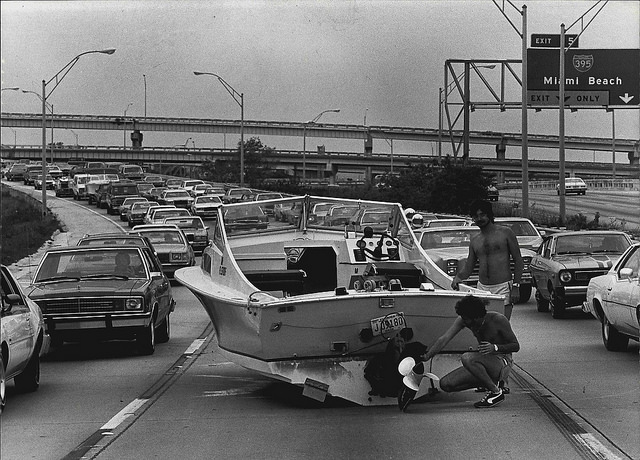
(Photo of boat blocking traffic on I-95 in Miami via Flickr user That Hartford Guy)
Letting Students Hit The Snooze Button

by Dish Staff

A new report indicates that science agrees with teenagers everywhere – school should start later:

Seeing the mounting evidence, the American Academy of Pediatrics [last week] released a new policy statement recommending that middle and high schools delay the start of class to 8:30 a.m. or later. Doing so will align school schedules to the biological sleep rhythms of adolescents, whose sleep-wake cycles begin to shift up to two hours later at the start of puberty, the policy statement says. The conclusions are backed by a technical report [pdf] the academy also released yesterday, “Insufficient Sleep in Adolescents and Young Adults: An Update on Causes and Consequences,” which is published in the September 2014 issue of Pediatrics.

The “research is clear that adolescents who get enough sleep have a reduced risk of being overweight or suffering depression, are less likely to be involved in automobile accidents, and have better grades, higher standardized test scores and an overall better quality of life,” said pediatrician Judith Owens, lead author of the policy statement, titled “School Start Times for Adolescents.”

The debate over whether to start school later has run for years, but a host of new studies have basically put it to rest. For one thing, biological research shows clearly that circadian rhythms shift during the teen years. Boys and girls naturally stay up later and sleep in later. The trend begins around age 13 or 14 and peaks between 17 and 19. The teens also need more sleep in general, so forcing them to be up early for school cuts into their sleep time as well as their sleep rhythm, making them less ready to learn during those first-period classes.

“The Lingering Stain Of Slavery”

by Dish Staff

slavery-610

Stephen Mihm studies it at length:

In 2002, two economic historians, Stanley Engerman and Kenneth Sokoloff, published an influential paper that tried to answer a vexing question: why are some countries in the Americas defined by far more extreme and enduring levels of inequality—and by extension, limited social mobility and economic underdevelopment—than others? The answer, they argued, lay in the earliest history of each country’s settlement. The political and social institutions put in place then tended to perpetuate the status quo. …

Harvard economist Nathan Nunn offered a more detailed statistical analysis of this “Engerman-Sokoloff hypothesis” in a paper first published in 2008. His research confirmed that early slave use in the Americas was correlated with poor long-term growth. More specifically, he examined county-level data on slavery and inequality in the United States, and found a robust correlation between past reliance on slave labor and both economic underdevelopment and contemporary inequality. He disagreed with Engerman and Sokoloff’s claim that it was only large-scale plantation slavery that generated these effects; rather, he found, any kind of slavery seemed to have begotten long-term economic woes.

Nunn also offered a more precise explanation for present-day troubles.

In Engerman and Sokoloff’s narrative, slavery led to inequality, which led to economic underdevelopment. But when Nunn examined levels of inequality in 1860—as measured by holdings of land—these proved a poor predictor of future problems. Only the presence of slavery was a harbinger of problems. “It is not economic inequality that caused the subsequent development of poor institutions,” wrote Nunn. “Rather, it was slavery itself.”

This finding was echoed in a study by Brazilian economists Rodrigo Soares, Juliano Assunção, and Tomás Goulart published in the Journal of Comparative Economics in 2012. Soares and his colleagues examined the connection between historical slavery and contemporary inequality in a number of countries, largely in Latin America. The authors found a consistent correlation between the existence—and intensity—of slavery in the past and contemporary inequality. Moreover, this relationship was independent of the number of people of African descent living there today. As Soares said in an interview, “Societies that used more slavery are not more unequal simply because they have relatively more black people.”

The question, then, is how exactly did slavery have this effect on contemporary inequality? Soares and his colleagues speculated that limited political rights for slaves and their descendants played a role, as did negligible access to credit and capital. Racial discrimination, too, would have played a part, though this would not explain why whites born in former slaveholding regions might find themselves subject to higher levels of inequality. Nunn, though, advanced an additional explanation, pointing to an idea advanced by Stanford economic historian Gavin Wright in 2006.

In lands turned over to slavery, Wright had observed, there was little incentive to provide so-called public goods—schools, libraries, and other institutions—that attract migrants. In the North, by contrast, the need to attract and retain free labor in areas resulted in a far greater investment in public goods—institutions that would, over the succeeding decades, offer far greater opportunities for social mobility and lay the foundation for sustained, superior economic growth.

Wining And Opining

by Dish Staff

Charles Simic muses about the best philosophy to take toward wine:

I remember a story about President Nixon habitually guzzling rare vintage Bordeaux during state dinners without sharing it with his guests, having it poured into his glass by a trusted servant from a bottle wrapped in a white napkin to conceal the label. A part of me understands his reluctance to share. As Jesus said, “Do not give what is holy to dogs, and do not throw pearls before swine, lest they trample them under their feet.” But when it comes to wine I can’t follow our Lord’s advice. I would die of shame in my own eyes were I to open a long-treasured bottle of wine when there’s no one at home, decant it into a decanter, let it breathe for a while before pouring it into a glass, swirl it a bit and, raising it to the light, gaze at it lovingly, then take that first, never to be forgotten sip. Drink of the best stuff, is my advice, because you never know what tomorrow may bring, and do so in the company of friends.

Simic also links the grape to the birth of philosophy as a discipline:

Years ago I read in a work of some Byzantine historian the claim that Greeks became philosophers once they started watering their wines. Before they did that their wines were so high in alcohol that one was good for nothing after drinking them, except to pick up a shield and a spear and look for someone to have a fight with. Then one day a miracle occurred. A little rain fell into the wine cups left outdoors by a party of friends and when they returned to resume their drinking and tasted the watered wine they were astonished by how pleasant it was to drink and how clear their heads were afterwards. The news of their discovery spread far and wide and in no time there was a philosopher in every village in Greece.

A Double Negative

by Dish Staff

Ivan Kreilkamp entertainingly tears down the practice of titling polemics “Against [X]”:

The crankily oppositional intellectual journal N+1 has made a regular diet of “Against [X]” in the past decade: “Against Exercise,” “Against the Rage Machine,” “Against Reviews.” The formula’s quality of brashly counterintuitive overstatement is well suited to twenty-first-century online publishing. When someone throws down the gauntlet against something as seemingly benign, necessary, or positively good as interpretation, happiness, exercise, or young-adult literature, who can resist taking a peek? Here lies a problem with “Against [X].” Its contrariness can seem contrived or ginned up for effect, aiming, with an excess of self-congratulation, for a outraged or scandalized response: Yes, folks, I’m dismissing happiness itself in a two-word title. Can you handle it?

But the contemporary manifestations of the form can appear weakly liberal when considered within the longer history of this genre. For the early “Against [X]” polemics by the likes of Augustine, Athanasius, or Tertullian (“Adversus Marcionem”), nothing less than the fate of the Church was at stake; their scorching blasts were designed to shore up correct orthodoxy against a heretical enemy whom they aimed to drive into exile. The contemporary, post-Sontagian polemics adopt a posture of provocation in faintly echoing such forebears, but they are, in their hearts, pluralistic, and in fact suggest only a slight revision in perspective. Lawrence Lessig isn’t really against transparency, of course: rather, his claim is that “we are not thinking critically enough about where and when transparency works, and where and when it may lead to confusion,” and so on.

Faces Of The Day

by Dish Staff

dish_fotdmonsep1

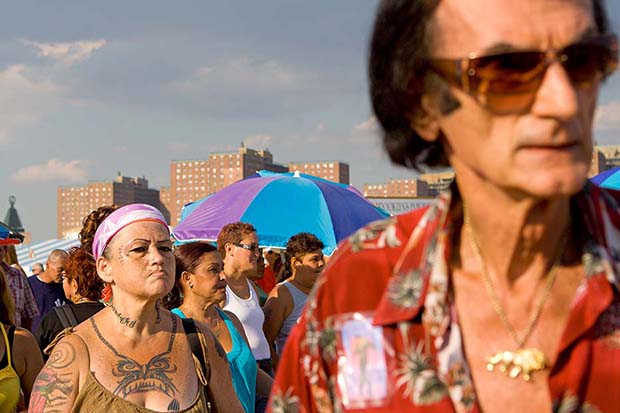
Photographer Laura Glabman emails us the background on the above pic:

That party took place exactly 5 years ago, Labor Day weekend on the boardwalk at Coney Island in 2009. I happened to be walking by this group of partiers and I wound up staying for two hours photographing them. By the time I left they were hugging and kissing me goodbye. These people loved the camera and they loved to dance. I took about 300 photographs that day and I really enjoyed how uninhibited they were and how much fun they were having. The late afternoon light was perfect and so was the music.

See more work from the series here. Update from a reader:

I know that guy! His name’s Tony Ferrante, he cuts my hair at New Street Barbershop right near Wall Street. He was on “America’s Got Talent” and every summer he goes to Coney Island every weekend to dance on the boardwalk. He’s like 78 but he still LOVES dancing and is in good shape. There are a couple of videos of him on Youtube, and the audition tape is especially tight. Here he is just chilling on the boardwalk.

I don’t know if he uses e-mail but, the next time I go there, I will show him that he was on the Dish.

(Hat tip: Jenna Garrett)

Confessions Of A BBQ Critic

by Dish Staff

“Since Texas Monthly named me the nation’s first and only full-time barbecue editor in March 2013,” Daniel Vaughn sighs, “my health has been a topic of international discussion”:

My job requires that I travel from one end of the state to the other eating smoked brisket, one of the fattiest cuts on the steer. And I can’t forget to order the pork ribs, sausage, and beef ribs. Of course my diet is going to raise eyebrows. Including those of my doctor. During one of my semiannual visits to see him, when my blood work showed an elevated cholesterol level, he gave me a scrip for statins and a helpful catalog of high-cholesterol foods to avoid. First on the list? Beef brisket. Second? Pork ribs. When I told him about my role as barbecue editor, he just said, “Maybe you could eat a little less brisket.” I promised to focus more on smoked chicken, but the pledge was as empty as the calories in my next order of banana pudding. …

All jokes aside, I do understand the long-term perils of my profession. I’ve taken those statins religiously for several years, and I’m doing my part to keep the antacid market in business. But I’m usually more worried about the acute health concerns I face. I judged the “Anything Goes” category at a cookoff in South Texas and spat out a submission mid-chew that featured some severely undercooked lobster tails. At a barbecue joint in Aubrey, I took a bite of beef rib that I had reasonable suspicion to believe had been tainted with melted plastic wrap. And the most gastrointestinal discomfort I’ve ever had came from the 33 entries of beans I judged in one sitting at an amateur barbecue competition in Dallas.

But my health is my concern. To anyone who asks if I’m worried about an early grave, I just say I’ve pre-humously donated my body to barbecue.

Let’s just hope he doesn’t start hawking cholesterol medication. As one chef put it regarding Paula Deen’s dubious deal with diabetes meds: