Why Not Open Up To Cuba? Ctd

by Dish Staff

Perhaps the most persuasive argument from skeptics of Obama’s historic opening with Cuba is that he didn’t extract enough concessions on democratization from the Castro regime. That’s the reason why Yoani Sánchez isn’t celebrating just yet:

What we have yet to hear is a public timeline that commits the Cuban government to a series of gestures in support of democratization and respect for differences. We must take advantage of these announcements to extract a public promise from the government, which must include, at a minimum  four consensus points that civil society has been developing in recent months: The release of all political prisoners and prisoners of conscience; the end of political repression; the ratification of the United Nations covenants on Civil, Political, Economic, Social and Cultural Rights, and the consequent adjustment of domestic laws; and the recognition of Cuban civil society within and outside the island.

Extracting these commitments would begin the dismantling of totalitarianism. As long as steps of this magnitude are not taken, many of us will continue to believe that the day we have longed for is still far off. So, we will keep the flags tucked away, keep the corks in the bottles, and continue to press for the final coming of D-Day.

Morrissey wonders why Obama didn’t demand more reforms:

It’s true that our 52-year embargo has failed to do anything to deflect the Castros from their oppression. The price signals from the American embargo may not have had the impact we hoped, but changing policies sends a signal, too. In this case, the signal seems to be weakness, or at least indifference to the regime’s continued oppression. We didn’t get very much out of this except our own people out and a handful of dissidents momentarily let out of prison. For that kind of shift, we should have demanded more reform from Cuba. Instead, we got an embassy and a likely return of Cuban cigars to American tobacco shops. With that in mind, small wonder most Republican contenders to replace Obama reacted negatively.

Chuck Lane expresses similar sentiments:

The one thing [Raúl Castro] does have is a clear goal, keeping himself and Cuba’s Communist elite in power, and a time-tested approach for doing so: permitting the minimum economic and political liberalization consistent with total control, and nothing more.

Greater engagement with the United States does indeed pose risks to the regime, not the least of which is that incoming tourists and businessmen will start to erode a pervasive system of social and political control. But Cuba’s authorities have years of experience manipulating foreign investors from Latin America, Canada and Europe, and with controlling Cubans’ interactions with foreign visitors, who tend to be more interested in exploiting the local population than liberating it.

Continetti, brimming with unreconstructed neocon absolutism, takes that criticism to the next level, calling Obama “a dictator’s best friend”:

The China option—foreign direct investment from America—is Raul and Fidel’s only play to sustain power over the society they have impoverished. And Obama says yes, yes to everything: an embassy, an ambassador, diplomatic relations, travel and exchange, status among nations, removal from the list of state sponsors of terror, and a serious opportunity to lessen the embargo that has kept the dictators caged for decades. In return, the Castro brothers give up … well, what? Alan Gross, a political prisoner and persecuted religious minority who shouldn’t have been imprisoned in the first place? A second man who has been in captivity for decades? Thin gruel. …

This isn’t giving away the store. This is giving away the shopping mall, town center, enterprise zone. And it is entirely in character with President Obama’s foreign policy.

But Drezner pushes back hard on this line of criticism:

[A]nyone who tells you that the sanctions just needed more a little time to work is flat-out delusional. After more than a half-century, they were never going to work.

By switching course, the United States reaps a few benefits. First, the odds of orderly liberalization and democratization in Cuba have increased. Not by a lot — maybe from 2 percent to 10 percent. But that’s still an improvement. Even if full-blown regime transition doesn’t happen, economic liberalization does make a society somewhat more free. Today’s Post editorial points to Vietnam as the worst-case outcome for the Cuba policy. But Vietnam now has a considerably more liberal climate than before the US opening, so I don’t think that’s the best example.

Moisés Naím offers another obvious counterpoint – i.e., that political reform doesn’t always happen by proclamation, and that the Castros may have a hard time maintaining their vice-grip on a more open economy and society:

Cuba is unlikely to embark on a political opening any time soon, unless the current regime suddenly implodes. Cuba’s dictatorship has proven very resilient to political pressures, and systematically and brutally clamps down on dissidents. The government will surely try to maintain its chokehold on the population; at times, the repression may even become harsher as the need to reassert the regime’s power mounts.

But in the long run, it will be hard for the Castro regime to maintain a tightly controlled political system if it allows more freedom of communication, travel, commerce, and investment. It’s easier to keep a lid on politics when a country is closed, hungry, and isolated than when it’s more open to the world.

In the aftermath of the agreement, the Cuban government will no longer be able to blame the island’s bankruptcy on U.S. policies. Throughout Latin America, the embargo has been perceived as a relic of heavy-handed U.S. intervention in the region. But that symbol is now fading for critics of the United States.
Email Of The Day

by Dish Staff

A reader writes:

I live in the very small town of Pendleton, SC, which means I see Lindsey Graham on the reg. We both frequently go to 1826, a tiny little restaurant in the center of town (it was built in 1826 – clever, no?) I am a stand-up comedian. My dad was my comedic mentor from the get, even though he was a special agent with the IRS and therefore his stand-up was constrained to toasts and such … the man is a brilliant comic. We are all loud, very, very loud Irish Catholics, with zero ability to whisper.

The first time I saw Butters in town, he was seated very close to me in the Pendleton Cafe and I didn’t yet know he lived in town. I said, in a very loud voice in that very loud restaurant, “That man looks like Lindsey Graham. That IS Lindsey Graham. Oh, my gosh! They put so much make-up on him on TV!” I turned to my dining companions, all of whom stared at me with their mouths wide open. I said, in the same voice, “Did I say that in a normal voice?” And then I realized Butters was sort of cringing, and I was mortified. MORTIFIED.

Cue five years later.

Dinner at 1826 with my parents. My dad is a cheery sort, and oblivious of a lot of things. He watches the evening news and takes it as gospel, votes Republican, etc. (Benedict had a very negative impact on my parents political thinking, FYI.) Lindsey Graham comes in and my dad’s just real, real excited to see somebody from the TV and he’s all, “Senator Graham! Here are some of your constituents!” Lindsey glad hands around, then sits down.

This restaurant is TINY. I mean to say, TINY. Ten tables, tops. Now, I no longer have any recollection of how we got to this point in conversation – it’s like alien abduction, I suffer missing time. I just know my memory kicks in with my dad, in his very loud normal voice, saying, “Of course Lindsey Graham is gay.” To which I say, “Dad, shut up.” But for some reason, my dad misinterprets the shut up and says, “Everybody knows Lindsey Graham’s gay!” And I’m like, SHUUUUT UUUUP! As I’m saying shut up, I’m meaning shut up, Lindsey Graham is five feet behind you and is listening, but my dad hears something else, and says, “Carrie, just because a man is homosexual does not in any way affect his performance as a senator or anything else!” And I’m like, “I AGREE WITH THAT, PLEASE SHUT UP.” But no, my dad is on the warpath, there to defend Lindsey Graham’s sexual orientation against all attackers, completely oblivious to the fact that literally every single person – including Lindsey Graham – can hear him in this tiny restaurant.

My mom just sat with her face in her hands the entire time.

But it’s progress, right? Defending a possibly gay man in public life … in South Carolina.

Would You Report Your Rape? Ctd

by Dish Staff

Several more readers open up:

To echo the sentiments of those before me, thank you so much for continuing this discussion. It has been one year since my rape. I have made a conscious decision not to report the incident and I don’t regret that decision for a minute.

I was 100% sober and many years removed from university.  It was about three weeks into a new romance with someone in the same professional field. Earlier in the evening we had engaged in consensual sex. This time, though, he stood up and said “my turn” before forcing me to perform oral sex. I violently tried to pull back but he yanked my hair so hard that each time I tried to fight him he grabbed even harder to the point where there were clumps on my sheets. Paralyzed with fear, my body went limp as he eventually finished.

I rushed to my bathroom, sat on the floor and choked down sobs in my for what felt like hours.

I got dressed and went to the movies. (A couple of days later he acknowledged and referred to it as “a lesson in understanding each other sexually.”) Despite the sexual assault – and subsequent emotional abuse and manipulation – I dated this individual for another two months while suppressing the night’s events for about six months.

After finally acknowledging the rape and emotional abuse that followed and then slowly telling my parents and my circle of friends, they kept asking the same question: “Why didn’t you press charges?” 

While I know that my ordeal is not uncommon, justice doesn’t reward gray areas. I knew that if I pressed charges, it wouldn’t be my attacker on trial. It would be me: my sexual past, my relationship, my life. There are days where the anger is palpable. There’s anger at him for his attempt to strip me of my self, my strength. There’s anger at myself for feeling responsible for what happened. There’s also anger at the idea that he could do this again … rape again under the guise of a relationship.

I’ve confronted my attacker. And every day I’m regaining more of the my self-worth he stripped from me. The one thing I don’t regret is not reporting it. In not doing so, I’ve spared myself further self-doubt and humiliation that is heaped upon survivors.

Another reader:

I attended a party on my dorm hall and was accosted by the drunken roommate of a friend. I barely knew the guy. He grabbed me and forced his tongue in my mouth while there were a dozen or more people standing around watching. I had only just arrived at the party. I had almost zero interaction with anyone I knew and none with this guy.

I pushed him off. He grabbed me again and tried to kiss me. I pushed him away and he then tried to drag me into a nearby room. All while people – my friends some of them – were watching.

It wasn’t until I was able to push him hard enough that he fell down, and I then went to kick him, that my BFF’s boyfriend and his roommate intervened. They pulled the guy up and away from me. But only, in my opinion, because I was about to hurt the guy, not because they thought he was doing anything wrong.

He was hustled off to his room (to sleep it off as he was quite drunk) and my friends attempted to get me to laugh it off but I simply went back to my own room. Furious.

It took a while mend some of the damage done to my friendships with a few people (who to their credit did apologize later, though the males involved never did understand why I’d been angry). Granted, both incidents were years ago, but the stories that I read that are much more recent lead me to believe that not all that much has changed.

I wanted to report the guy to the Head RA of the dorm in the days that followed, but I was eventually talked out of it. My BFF pointed out – correctly – that I would be the one moved to another dorm not the guy who attacked me and where was the justice in that?

Another:

I have never been raped, but I was once lured by a stranger into a semi-private place where the man then groped me. It was awful and creepy. I blamed myself for being stupid enough to follow him. For a while after it happened, I did not want to be touched by anyone, including my husband. I know it is not as horrible as rape, but just typing about it now gives me anxiety.

One reason I was lured by this man was that I thought I could trust him because he had gotten out of a car with a current-year parking sticker for the law school I was attending. The school was quiet and small, and you could seemingly trust everyone because you seemingly knew everyone. I have to believe a big reason campus rape gets all the headlines is that campuses can seem so safe.

I was able to get away from this man before anything worse happened. Before I left I took note of the make and model of the man’s car and the number on his parking sticker. I went straight to campus police because I figured they would have the parking records to look up the man. I gave them the car description and the parking number. They showed me an array of photos, and I identified the man. They said he did not work or attend the school, but that his wife worked at the school and that other female students had complained about similar incidents from him. They immediately set to work to get a restraining order banning him from university property.

I wanted to write in to share a story of someone whose immediate reaction to an assault was to report the guy. Maybe that was the lawyer part of me at work, knowing that my memory might fade, but I have to say I am happy to have done it. Of course, I didn’t have to go through any high-profile slut-shaming, and I wasn’t raped. I realize it is different. But having the brains to collect enough information on the guy to report him is about the only thing I am proud of from that day.

Update from a reader:

Like the woman who shared her molestation story, I too was once lured to a semiprivate place by a man who groped me. I was 15 at the time, on a cruise with my family, and the man was our room steward. He pressed his tongue into my mouth, something I had never experienced before, which was terrifying and gross. I managed to get away, and told my parents, who reported the incident to the captain. My molester spent the rest of the voyage in the brig.

When we returned home, an attorney for the cruise line called to ask my father if we intended to press charges, and he said that another crew member had come forward as an alibi witness for the steward. My father answered that I had been traumatized enough, and the matter was dropped.

What we didn’t know until years later was that my younger sister – only 10 – was raped on that cruise, perhaps by the same man, perhaps by his friend and alibi witness. She and I shared a stateroom. When I found her bloody underwear, we assumed she had begun her menses and gave her sanitary supplies! (I was 11 when I had my first period, so it didn’t seem unreasonable.) What a horror show.

Happy ending: my sister and I both ended up with loving husbands and channeled our early experience into work with abused women.

What Choice Did Sony Have?

by Dish Staff

Frank Rich feels that that Sony’s hand was forced:

We are witnessing, in Alan Dershowitz’s phrase, the “Pearl Harbor of the First Amendment.”

But this story is far bigger than the threat to the First Amendment. And the vituperation being aimed at Sony for canceling the film’s release — coming from both the left and the right — is a sideshow that misses a bigger point. Before Sony capitulated, every major movie theater chain in the country had pulled out of showing The Interview. The Wall Street Journal reported that the nation’s largest cable company, Comcast, would have refused to show the film — and no doubt would have been joined in this veto by all the other cable and satellite providers if Sony had considered such a distribution alternative. So if Sony canceled a film that couldn’t be shown anyway, was that a cancellation or just a certification of reality? If Sony is a coward, they all are.

Stephen Carter defends Sony and the theaters:

Despite all the calls for Sony to stand up to the blackmail in the name of artistic freedom, it seems to me that the criticism is misdirected. Nothing will detect and respond to the reality of fear as swiftly as a market, and here the market has spoken. The relevant market actors are moviegoers. Theater owners are guessing that with “The Interview” in their multiplexes, holiday audiences will stay away in droves. From everything.

I’d like to think the owners are mistaken. I’d like to think that were “The Interview” in the theaters, millions of us would flock to the mutiplex and watch a movie – any movie – as an act of protest, to show the world we aren’t afraid. But I can’t say that in predicting the opposite the theater owners have made a wrong call. And if they’re right, so is Sony.

Douthat fears that such financial incentives will hurt movie-making:

[F]or studios already inclined to recycle comic book villains and reboot Reagan-era properties and resurrect Captain Jack Sparrow from here to eternity, the fate of Sony — whose post-hack problems go well beyond the lost revenue from “The Interview” — will offer just one more reason to stick with the tentpoles, one more reason to play it safe with superheroes, one more reason to pause before greenlighting an original story and say, “okay, but maybe if the villains were neo-Nazis instead?” (And that’s just until the neo-Nazis find a hacker of their own …)

Alyssa Rosenberg wonders “whether we’re just offloading responsibility for our increasingly violent and polarized conversations about media on to a convenient villain.” She contends that “Guardians of Peace just took advantage of a style of conversation about culture that too often devolves into threats of violence”:

[A]ggrieved groups of any type don’t even need a tech genius. Even if Sony is mainly canceling “The Interview” primarily out of hopes that it will stop the Guardians of Peace from releasing more stolen data rather than about specific fears of an attack, “exhibitors are worried about legal liability if violence breaks out at one of the film’s screenings,”Brent Lang explains in Variety. White supremacists show up as villains everywhere, from action movies like “White House Down” to prestige television dramas like “Breaking Bad.” They also plot real-world violence, like a 2008 plan to assassinate Barack Obama during his campaign for the presidency. If someone out there wants to push back against racists’ status as bogeyman of the moment, they just need to threaten to shoot up a movie screening or a premiere.

Putin’s Pugnacious Presser

by Dish Staff

Dish alum Katie Zavadski graciously watched Putin’s annual three-hour press conference (yes, the above video is a trailer for a press conference) so the rest of us don’t have to:

Putin denied accusations that he is inciting a major international conflict in Ukraine, accusing the West — particularly the U.S. — of being in a pot-calling-the-kettle-black situation. “Our budget is $50 billion — the Pentagon budget is 10 times higher. Does anyone listen to us at all? Does anyone have a dialogue with us? No,” he said. “All we hear is ‘mind your own business.’ In the Ukrainian crisis I believe we are right and our Western partners are wrong.” …

But weighing most heavily on the minds of everyone in attendance was the ruble’s recent downward spiral. At the Wednesday low, one U.S. dollar was buying 79 rubles, though the free-fall appears to have stabilized. For some, Tuesday’s value drop called to mind a similar incident 20 years ago, now known as Black Tuesday. He attributed a significant portion of these ongoing economic woes to Western sanctions, introduced in part because of his annexation of Crimea. But the president also told Russians not to worry, assuring them that the economy would rebound. (Indeed, the ruble was up to 61 to a dollar during his address.) “Our economy will overcome the current situation. How much time will be needed for that? Under the most unfavorable circumstances I think it will take about two years,” he said.

Cassidy sizes up that forecast:

Insofar as Russia’s fate depends on what happens to the oil price, Putin’s guess that things will pick up by the end of 2016 is as legitimate as anybody else’s. While he was speaking, the Saudi oil minister, Ali al-Naimi, was also saying, in Riyadh, that the current collapse would prove to be temporary. But Putin’s claim that, by the end of 2016, Russia will have successfully diversified its economy beyond energy is hopeful, to say the least. Indeed, a bit later in his press conference, when a reporter from Pravda asked about the country’s “oil addiction,” he acknowledged as much. “We are trying to create more favorable conditions for the development of production, but it is moving forward with difficulty,” Putin said.

Nemtsova sees right through Putin’s show of optimism:

A prominent political observer and professor of National Research University Higher School of Economics, Vladimir Ryzhkov, summarized Putin’s statements for The Daily Beast: no plans for new reforms, no radical changes of staff or re-appointments. Not a word mentioned about the crazy growth of prices and public poverty. Why did Putin not give Russians any comforting promises? “Because he is waiting for oil to become expensive again, and everything to go back to normal soon. He does not have a clear understanding of how deep the crisis is—that’s why he is afraid to make any abrupt moves,” Ryzhkov said. Meanwhile, Russia is sinking ever deeper into its economic morass.

Morrissey is also skeptical:

If OPEC continues to support the oil glut — and they’re probably going to keep up pressure on Iran, now that the West has backed away from sanctions — the ruble won’t recover for years, and in the meantime Russians will have to live with stagflation at best. Putin gets job-approval ratings in the 80s now because he’s seen as responding to Western aggression, and because the conditions haven’t dragged out for very long yet. Eventually, Russians will start asking themselves whether Crimea and eastern Ukraine are worth the dissipation of their life savings, and the answer will increasingly become no.

Putin wants two years for Russians to wait for a light at the end of the tunnel. That’s a very long time, even for an oligarchical autocrat, to keep the hoi polloi in line, let alone the oligarchs themselves.

Matt O’Brien, meanwhile, sees more signs that the Russian economy is in a bit of a death spiral:

The latest news is that Russia’s banks are about to get bailed out to the tune of $16.5 billion. That became inevitable once the interest rate they charge each other on short-term loans—which shows how much they believe in each other’s solvency—shot up to 28.3 percent on Thursday, higher than it was even during the 2008 crisis. And, to give you an idea how big the black hole in Russian bank balance sheets must be, this is all happening despite the fact that the central bank just said that banks could pretend that they don’t have losses. Okay, it didn’t exactly say that, but close enough. Specifically, Russian banks can stop marking their losses to market, and use the old exchange rate to calculate the “value” of the assets on their books. Potemkin balance sheets, though, aren’t enough to fool the bankers themselves. They know how broke their banks are, so they don’t trust any others. The Russian government hopes that injecting this $16.5 billion into the banks will be enough to end this credit crunch. We’ll see. That’s money that Russia is going to start running out of.

“The most interesting message in Putin’s hours-long bravado, however, may have been on Ukraine,” Marc Champion observes:

Beyond his usual accusations that Russia’s neighbor got into trouble because it invaded itself, he called for a quick political settlement that would restore Ukraine as “a single political space.” Later in the speech, Putin — prefacing his comments with “I’ll say an important thing. Look, I’d like everyone to hear this” — said that the rebels were part of the problem. He said that at the last peace deal in Minsk, they refused to sign crucial protocols the defining cease-fire lines. He also said he believed Ukrainian President Petro Poroshenko genuinely wants a deal. So Russia’s leader, not for the first time, is offering himself as peacemaker. (In his words, an intermediary.) The question for Ukraine, the U.S. and Europe is whether he means it.

What Does Cuba Mean For 2016?

by Dish Staff

Cuba Parties

Rand Paul came out in support of President Obama’s historic opening with Cuba yesterday, putting him at odds with his putative primary competitors:

“The 50-year embargo just hasn’t worked,” Paul said. “If the goal is regime change, it sure doesn’t seem to be working, and probably, it punishes the people more than the regime because the regime can blame the embargo for hardship. “In the end, I think opening up Cuba is probably a good idea,” he said.

The senator’s approach separates him from several potential Republican presidential hopefuls, including former Florida Gov. Jeb Bush, Govs. Scott Walker of Wisconsin and Bobby Jindal of Louisiana and Paul’s Senate colleagues Marco Rubio of Florida and Ted Cruz of Texas. His more libertarian outlook could win him support in agricultural states like Iowa, which holds the nation’s first presidential caucuses. Paul’s comments also parallel those of Democrat Hillary Rodham Clinton, who wrote in her book “Hard Choices” that the embargo was a failure that gave the Castro regime “a foil to blame for Cuba’s economic woes.”

Kilgore expects Paul to pay a political price for that position:

Perhaps Paul is calculating that no one will care about Cuba policy by the time the 2016 nominating contest gets serious, and that could be true. But if, say, Marco Rubio is in the field, I don’t think Paul will be able to avoid the issue.

And I’ll betcha the other candidates will gang up on him just as they did on Ron about Iran, even as they largely refused to challenge his crazy monetary policy ideas or his long association with extremists. Conservative mistrust of the Paul family on national security issues hasn’t gone away by any means, and it’s surprising he’s giving it new life, even if he’s absolutely right on policy grounds. I’m quite sure Jennifer Rubin is writing a blog post on this fresh evidence of his “isolationism” as we speak.

Indeed, Rubio was quick to swat back that Paul “has no idea what he’s talking about”, to which Paul replied in a series of tweets, including this zinger:

Larison doubts that Rubio’s black-and-white approach to Cuba will win over very many voters:

It’s hard to see how Rubio benefits by becoming the leading opponent of a policy change that most Americans, most Floridians, and most Cuban-American Floridians support. He will win more applause from other hard-liners in his party, but that’s not something that a candidate running for re-election in a “swing” state normally wants. If it has an effect, it probably does more to hurt him in Florida, especially because of the positive effects that restored relations will likely have on Florida.

I fail to see how becoming the leading defender of an outdated and failed policy that most of his constituents reject improves Rubio’s chances of re-election. Yes, it raises Rubio’s national profile and it will get him a lot more attention in the coming year, but it’s not clear that Rubio benefits from being identified primarily with his hard-line foreign policy views. It is conceivable that Rubio could end up losing his Senate re-election bid because he becomes so closely identified with trying to block a change in policy that most people in his state say they want.

Waldman agrees:

On this issue, [Marco Rubio] is kind of like the teenager who wears a bow tie to school and agrees fervently with the senior citizens who are so fond of him that kids today have no respect, and ought to shut off that awful hip-hop and listen to some real music, like Tommy Dorsey or Glenn Miller. … But I don’t think he’s going to run anyway. He’s up for re-election to his Senate seat in 2016, so he’d have to give it up to run for president—and if he didn’t get the nomination, he’d be left with nothing. He’s only 43 years old, so he could run in 2020, 2024, or pretty much any time in the next quarter-century. He’s a pretty good politician, but he’s not so spectacularly skilled that he can reasonably look over the field and say, “I can take all of these bums.” So it’d probably be best for him to sit it out. And when he does run, Cuba probably won’t be an issue anymore.

But Greg Sargent isn’t so sure:

I would like all of this to be true. But here’s an alternate possibility: There may be no downside for Rubio here, particularly given what he needs to accomplish in the short term if he is running for president. After all, if Obama’s move does produce some successes in “accelerating change and democracy” in Cuba or in any other ways, it seems unlikely that they will be even acknowledged at all  inside the Conservative Entertainment Complex or among the GOP primary voters Rubio is apparently trying to reach. So where’s the gamble in getting this wrong?

Then, of course, there’s the money. As Kenneth Vogel and Tarini Parti discover, wealthy opponents of normalization are already lining up to line the pockets of the “right” candidates:

Since Obama’s announcement, top Cuban-American donors have been reaching out and offering support to the U.S.-Cuba Democracy PAC, a leading opponent of normalization, according to the group’s director Mauricio Claver-Carone. “You’re definitely going to see a boon,” predicted Claver-Carone. “It will carry through the next cycle and will translate over to Jeb and Marco,” said Claver-Carone, whose group has hosted both Bush and Rubio at recent events, including a gala headlined by Bush last month in Miami that raised $200,000. …

And there’s an even deeper-pocketed group on the same side of the issue backed by the Koch brothers’ political operation. The LIBRE Initiative, which courts Latino voters with a conservative economic message, is registered under a section of the tax code – 501(c)4 – that allows it to shield its donors’ identities and requires only bare-bones financial disclosure and only well after Election Day. From July 2012 through June 2013, the group raised $5 million, according to its tax filings, and sources say it spent millions in this year’s midterms attacking Democrats in Texas, Arizona and Florida. The sources expect it to increase its spending in 2016, including potentially on ads opposing normalization.

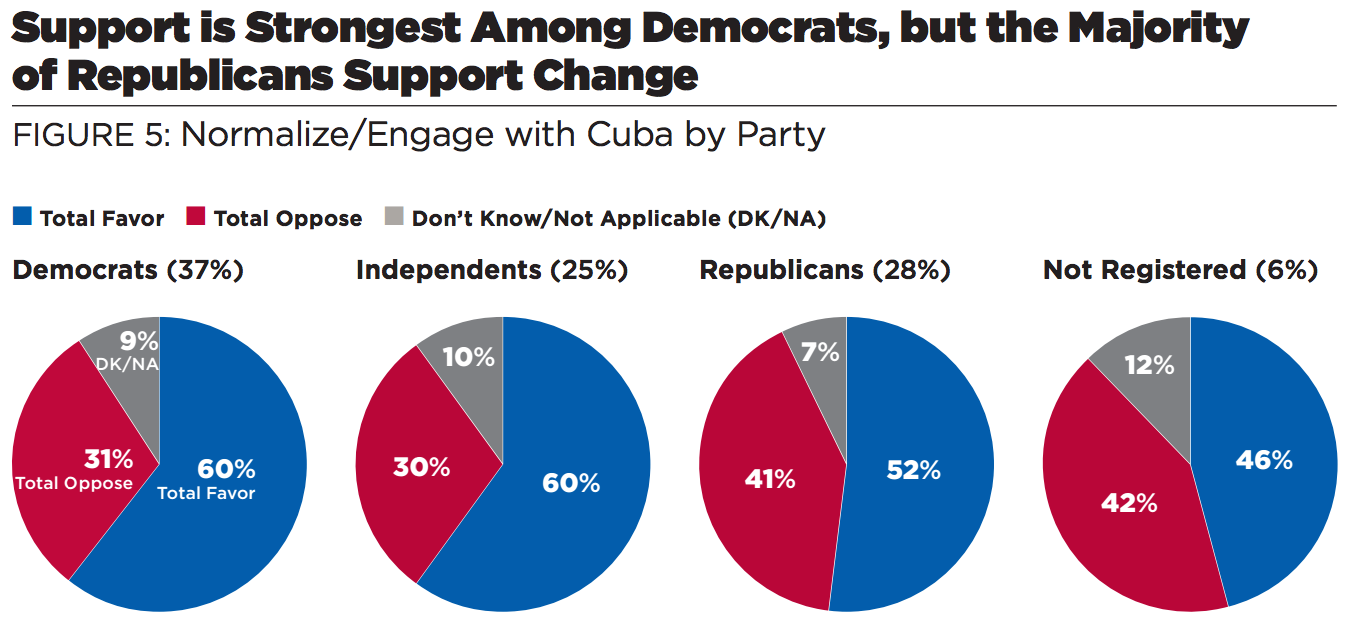
(Chart showing majority Republican support for normalizing relations with Cuba from a February Atlantic Council report (pdf).)

Losing Your Faith In Santa, Ctd

by Dish Staff

Readers join Dish staffers in sharing their stories:

Around age 5, my father took me to the mall for some shopping and the ritual Santa visit. Whatever it was he needed to buy, the journey was unsuccessful on that front, and we traveled enhanced-buzz-13665-1354006755-0 directly to another mall to try again. Of course, there was at this second mall another Santa, one with somewhat different facial features and proportions. I quickly deduced these could not both be Santa, and, QED, Christmas was a fraud.

Pinned with the sudden outburst of my doubts, Dad didn’t miss a beat. “Well of course Santa can’t be at every mall,” he said nonchalantly.  “He’s a busy guy, making toys. He has a lot of helper Santas he sends out to find out what people want for Christmas. They’re called ‘subordinate Clauses.'”

Maybe he’d been waiting his whole adult life to make that pun. Maybe it came to him in a brilliant flash. Needless to say I didn’t get it for many more years. But I bought the substance when it counted, and the benevolent illusion was preserved.

Not for this reader:

I believed in Santa until I was five or six. Then I learned about gravity, and I wasn’t sure how the sleigh could fly, since reindeer don’t have wings or jets. The more I thought about the logistics of Santa, the more they bothered me. How did Santa get around the world in one night? The Polar Express, which I loved, implied that he didn’t even get started until after midnight, and that made the whole thing seem even more implausible.

This story has an unexpected twist:

I have an older brother, by 3 years. As with most older brothers, mine delighted in ruining anything I believed in or liked.

Knowing this, one year my dad took my brother aside and told him, “I know you don’t believe in Santa anymore, but don’t ruin it for your brother.” As my dad tells it, my brother’s bottom lip started quivering, and with tears in his eyes, he looked up at my dad and said, “There’s no Santa??” He was certain my brother no longer believed and felt so guilty for ruining his eldest son’s Christmas that year.

Another reader:

Santa was revealed to me as an empty suit the Christmas I was 5. We were at my grandparents house when the adults informed me that Santa had decided that I should open my presents before Christmas morning (I have no idea why other than they just wanted open presents early) so he was making an express delivery. This announcement was followed by a big ho ho ho on the porch that sounded just like my uncle and my gifts magically appeared. I got suspicious.

But I still wanted to give him the benefit of the doubt, so the next year I wrote my Santa letter and asked him for a Dancer Ballerina doll, which I got, only to have her twirl one time and break. My mother told me that they must have made a mistake in Santa‘s workshop, so Rudolph would probably fly back in a day or two to take it back so the elves could repair the ballerina’s twirl. But the next day I found the box she came in – in my mother’s bedroom hidden under some quilts, and the sticker on it didn’t say North Pole; it said Sears. And I was done.

Weird thing though: I didn’t tell my parents for another year or two. They seemed to get such a kick out of Santa that I didn’t want to ruin it for them.

Another:

I don’t have any recollection of losing my faith in Santa, but I do have a quick anecdote about my daughter, now eight. Mid-October, as we are eating dinner, she asks, “So, when are you and Mom going to give KJ (older brother) and me The Talk“? The capital letters were quite clear in her speech. Having already explained to her how she arrived on this world, I was a little confused.

“What talk?”

The talk where you tell us there is no Santa Claus, you’ve been buying all the presents, and then lying to us so we wouldn’t ask you for more?”

“Oh. Next year.”

“Cool.”

Another got both Talks at once:

I believed in Santa for an almost embarrassingly long amount of time. I was 13 years old when my mother sat me down and informed me that if I was going to start learning about sex, I might as well learn the truth about Santa. The problem for me was a combination of too clever parents (I was regularly required to put toys and clothes  out on the porch in early December for Santa to “recycle” so that when my younger siblings or cousins received them it wouldn’t be weird), and a stubborn need to believe in magic that has unfortunately followed me into adulthood. Well, that, and as I repeated told my classmates, “My parents are way too poor to buy that stuff, so Santa has to be real.”

Another older believer:

I was relatively late to the game of realizing Santa wasn’t real (I think I defended his existence to numerous doubtful friends).  But my realization happened as a result of just thinking too hard one car ride with mom.  I started to think that if Santa were real, my capacity to receive presents would be limitless – I could have not only a Nintendo, but every game they ever produced.  I mean, if he’s got these elves making toys and magical powers, why couldn’t I receive everything I possibly wanted?

I realized that deep down I knew this was impossible, that there were economic restraints on Christmas.  So I just turned to my mom and said “there’s no Santa is there,” and she replied “no.”  And that was the end of it.

(Image via Cess Padilla)

What Can We Do To North Korea?

by Dish Staff

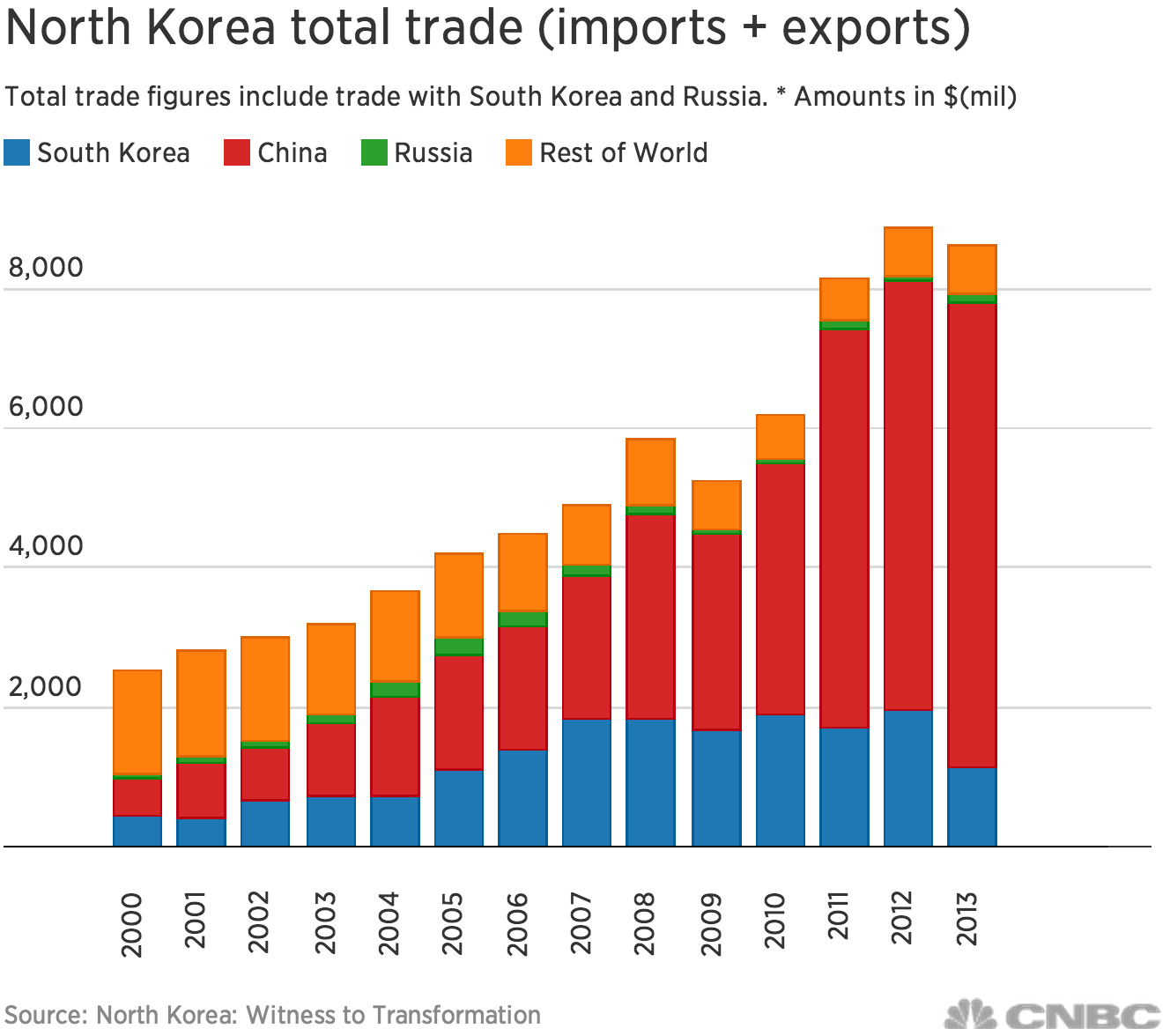
Given how little trade most of the world does with North Korea, further economic sanctions aren’t really an option:

Trade North Korea

Peter Singer, mercifully, rules out war:

We didn’t go to war with North Korea when they murdered American soldiers  ​in the 1970s with axes. We didn’t go to war with ​North Korea when they fired missiles over our allies. We didn’t go to war with ​North Korea when one of their ships torpedoed an alliance partner and killed some of their sailors. You’re going to tell me we’re now going to go to war because a Sony exec described Angelina Jolie as a diva? It’s not happening.

As Will noted, Chait recommends that the government make Sony whole. Ambinder disagrees:

I wondered online if Sony could argue somehow that it is too big to fail — that if the attack is tied to a country, then perhaps the company can be indemnified from lawsuits arising from its own alleged neglect. The answer is no.

Going forward, Congress might consider some sort of risk pool for companies that meet strict standards and still find themselves the victim of state-sponsored hacking. Sony does not seem to have met those standards. It was low-hanging fruit. Sony will have to eat its losses, because saving Sony from embarrassment is not in our national interest. But securing open access to the internet for American companies is now considered to be a critical national security issue.

Bloomberg View’s editors think “Sony and other corporations can’t expect the U.S. government to respond to every attack on their behalf”:

However embarrassing and costly to the studio, the hacking represents a cybercrime, not an act of cyberterrorism directed at civilians or vital national infrastructure. (By the same token, threats against theaters showing a Hollywood comedy that mocks Kim Jong Un hardly compare with the vows of annihilation that constantly pour out of North Korean state media.) Companies need to improve their own defenses.

They ask, “What level of attack would prompt a U.S. counterstrike?”

There’s no need for any new red line to be drawn here. It would only help the Kim regime calculate the risk-reward ratio for its cybermischief. Ambiguity can help deter North Korea from attempting anything more serious, such as an attack on the U.S.’s critical infrastructure.

It’s worth keeping in mind that certain individuals, like Kim Zetter, still have doubts that North Korea is responsible for the attack:

Nation-state attacks aren’t generally as noisy, or announce themselves with an image of a blazing skeleton posted to infected computers, as occurred in the Sony hack. Nor do they use a catchy nom-de-hack like Guardians of Peace to identify themselves. Nation-state attackers also generally don’t chastise their victims for having poor security, as purported members of GOP have done in media interviews. Nor do such attacks involve posts of stolen data to Pastebin—the unofficial cloud repository of hackers—where sensitive company files belonging to Sony have been leaked. These are all hallmarks of hacktivists—groups like Anonymous and LulzSec, who thrive on targeting large corporations for ideological reasons or just the lulz, or by hackers sympathetic to a political cause.

Barbara Demick listens to another skeptic:

“There is such a level of vindictiveness toward Sony that it feels more like an ex-employee or a business dispute,” Martyn Williams, a long-time North Korea watcher, who has taken a contrarian view on the attack, said. Williams believes that the hackers could be using North Korean software, or possibly imitating North Korean tactics, to cover their own tracks. He notes that the Guardians of Peace hackers didn’t mention “The Interview” before this week. He also believes that a recent message on a text-sharing Web site that threatened moviegoers and invoked 9/11 was unlikely to have come from North Korea. “North Korea is definitely capable of annoying its neighbors, but to make these kind of threats, saying ‘Remember 9/11,’ I don’t think North Korea is so stupid,’’ Williams said.

On the other hand, today the FBI officially blamed North Korea for the hack.

Obama Scraps Our Failed Cuba Policy, Ctd

by Dish Staff

Previous input from the in-tray here. Another reader gives a shoutout to Francis: “For the pope to be a broker for the deal makes the whole story even more interesting.” Another looks at the opening of Cuba with realist eyes:

There is no hypocrisy in maintaining normal relations with China, Saudi Arabia, and other violators of human rights while denying that status to Cuba. Saudi Arabia has lots of oil and a strategic position in the world producing world. It is a relationship of economic convenience, and both sides understand that. China offers huge trade opportunities, and in the beginning of our relationship, a counter to the Soviet Union. You have diplomatic relations with states when it is necessary and prudent.

Cuba offers nothing to the USA or its citizens other than another tourist destination, cigar, and rum. There are practically no consequences to US citizens for not normalizing relations other than opening up yet another Caribbean tourist destination, and providing access to cigars, and rum. Just because Cuba has not liberalized its society doesn’t make our foreign policy a “failure” any more than other nations who have diplomatic relations with Cuba “failed” to effect an opening.

I’m not opposed to ending the travel ban, but we should have gotten a lot more out of Cuba for normalizing relations. At a minimum, Obama should have required Castro to lift all restrictions for Cubans to have Internet access.

Update from a reader:

Normalizing relations doesn’t give us anything in terms of security? Really? Here’s a simple thought experiment: is it better to have friendly relations with neighbors or antagonistic relations with neighbors?

Another relates to Will’s criticism:

Just amazes me how the left romanticizes Cuba, even as it attempts skepticism. I just got off the phone with a friend from Cuba. Her family is sending a blood pressure machine to a relative in Cuba because none are to be found.

Another provides some family history:

Nothing steams me up more than one of the comments from your reader:

We all know the real reason: political posturing. Castro stripped Cuban aristocrats of their wealth. They fled to Florida and have been propping up anti-Castro policy ever since. There are no principles here.

Well, here is a story about one such “aristocratic” family. My mother’s mother, with her eight children between the ages of 15 and 1, left Cuba in 1960 with nothing but a tiny suitcase and the clothes on their backs.  She would meet her husband in Miami, where they would begin a new life.  They left family, friends, their homes, their country.  Slowly, many of her family and friends also left for Miami and elsewhere after thinking that Fidel would be the answer to all of Batista’s corruption.  My grandmother never saw her mother again, who passed away in 1977.

My grandfather was the son of a middle-class family in Havana, nicknamed Barbarito because he was born on Sta. Barbara’s Saint Day.  During the time Batista was in power, my grandfather was imprisoned for six months for, in his words, “Conspirando” (conspiring).  After their emigration from Cuba, he remained active in conspiring, but to overthrow the Castro regime and to return home.  He always believed he’d return. My grandfather passed away in 1990, my grandmother passed away in 1992, never having returned to Cuba.

My mother, who left Cuba when she was 10, visited Havana in the mid-nineties. She was allowed to go to her grandmother’s home, though only allowed in the front salon. The man who lived in the lower part of house kept many of her grandmother’s items, including photos of her and her family.  They were little snapshots of their daily life in Cuba, remembrances of what they left.  She was able to take them back to her brothers and sisters.

I am also part of the diaspora, having been born in England to a Guyanese father, coming to Miami in 1980, now living in Los Angeles.  I consider myself Cuban. In memory of my grandparents, I have chosen not to go to Cuba until conditions change and the Castro regime topples.  This week’s news is part of that change, though I am undecided as to my feelings about it and am still processing what that means for my uncles, aunts and friends.

When I read the comment above, as well as all the jokes about McDonalds and the Americanization of Cuba, I am shocked at the disregard for the suffering millions of people have had on both sides of the Florida Strait for the past fifty plus years.  This week’s news should not be about making jokes, making blanket statements about what one thinks happened in the fifties and sixties, about Republicans and Obama, or about one’s vacations plans.  The news is about peoples homes and loved ones, regardless of political leanings.

Another reader is also “thrilled by the news”:

Cuba is the most depressing place I’ve ever been. I flew from Merida to Havana as part of my trip around the world in my mid 20s. Everyone I met was in their mid-late 20s and very attractive but short due to protein deficiency (they talked about eggs once a week). They all had masters. None of them worked. The highlight of their day was meeting up with me to get a Coke and an ice cream in the park using the dollar line (I happily treated).

I still recall one conversation I had with the guys I met up with every day. They couldn’t believe that there were poor people in Mexico. That got me thinking. Mexicans can’t believe there are poor people in the United States. Both a simple and extremely complicated concept to consider.

Another dissents:

Your blog fails to mention the gross human violations the Castro brothers have committed over the past 50 years.  The alacrity and glee your blog has greeted the diplomatic opening with a government comprised of thugs is breathtakingly hypocritical and disappointing.

Details of that despotism from Raúl Castro here. Another reader thinks of the birds:

Far more worrisome than Golden Arches spoiling all those picturesque Havana ruins is the prospect of Cuba‘s coastal areas, some of the most pristine in the hemisphere, getting turned into resorts. The jailing/isolation of Cuba has been a blessing for birds and wildlife, which enjoy nearly pre-Columbian conditions in some spots. I am eager for theCuban people to enjoy more freedom, and I think it’s all but certain they would embrace an more American-like lifestyle very quickly if given chance. That’s one of the things the people griping about Obama’s “betrayal” forget or ignore – the allure of the bonuses of our system. But Cuba‘s coasts are a rare world treasure.

And another disparages one of the main conduits of commentary this week:

Hard to feel much sympathy for anyone feeling his comments maligned after posting them on Twitter, e.g., the funky Cuba vs McDonalds kerfuffle.  If Twitter is inherently inadequate for in-depth analysis, then don’t use it to express your views and then expect to be cut slack because there was no space to get at an issue more profoundly.  Best, I would imagine, to confine oneself to pith and snark, or otherwise accept the likelihood of being misunderstood, willfully or not.