The Path To Legalization In DC

by Dish Staff

Jon Walker finds a silver lining to gridlock on the Hill:

[L]ast month the House approved the Financial Services and General Government Appropriations bill with a policy rider from Rep. Andy Harris (R-MD) which would prevent D.C. from using funds to implement marijuana reform. It was designed to stop Initiative 71, a local marijuana legalization ballot measure which is expected to win with strong support from D.C. voters this November.

Because of this historic level of dysfunction in Congress this particular appropriations bill is likely to die and all its policy riders will die with it. Instead Rep. Paul Ryan (R-WI) expects that when Congress briefly returns next month they will just pass a clean (meaning policy rider-free) continuing resolution to cover all funding issues until after the election. Professional budget watcher Stan Collender expects that continuing resolution to be followed by yet another one in November to maintain the status quo well into 2015.

He adds that, “At minimum, pushing any final fight about Congress interfering in D.C.’s marijuana laws until after the election should make it politically more difficult to do so.” In a post from earlier this month, Walker laid out why he’s looking forward to DC’s legalization fight:

Racial justice will be front and center – “The overarching theme of the campaign is Legalization Ends Discrimination,” Dr. Malik Burnett, the D.C. Policy Manager from the Drug Policy Alliance told me. “We are looking to have Washington D.C. be the first jurisdiction to legalize marijuana in a racial justice context.”

The huge racial disparity in marijuana arrests has helped galvanize support for reform across the country, but while the issue has played a role in the other legalization initiative campaigns so far it hasn’t been the top message other places for a simple reason. In Colorado (4.4%), Washington State (4.0%), Oregon (2.0%) and Alaska (3.9%) the African-American population is well below the national average of 13.2%. By comparison roughly half the people living in D.C. are black. In addition D.C. has a history of some of the worst racial disparity in marijuana arrests anywhere in the country. The ACLU found that nationally Blacks were 3.73 times more likely to be arrested for marijuana than whites, but in D.C. the disparity was an incredible 8 to 1.

The Plight Of The Yazidis Isn’t Over, Ctd

by Dish Staff

While the White House views the operation to break the siege on Mount Sinjar in northwestern Iraq as a success, Spencer Ackerman, Mona Mahmood and Kenton Powell report that as many as 4,000 displaced Yazidis remain on the mountain and are looking for help in driving out the ISIS militants who still threaten their homeland:

The Pentagon estimated two weeks ago that 4,000 to 5,000 people remained on the mountain, and says it cannot offer a more current estimate. The US Agency for International Development assesses that perhaps 2,000 people do not intend to leave. The United Nations mission to Iraq pegged the residual population at “a few hundred who did not want to leave,” said spokeswoman Eliana Nabaa. Although Barack Obama said US warplanes and Kurdish forces “broke the siege of Mount Sinjar,” Isis fighters remain, confronted by a small and desperate Yazidi force. “We need weapons now more than food or water,” Salim Hassan, a Yazidi fighter on Mount Sinjar, told the Guardian.

Ford Sypher provides a grim update on the Yazidi women who were kidnapped by ISIS, who are reportedly being sold as sex slaves or subjected to gang rape in the Mosul prison where they are held:

Survivors who managed to escape from ISIS say the women held in its prison in Mosul face two fates: Those who convert to Islam are sold as brides to Islamist fighters for prices as low as $25, and ranging up to $150. Those who do not convert face daily rape and a slow death.

Accounts of the prison have come from women who managed to hide their cellular phones, calling relatives to describe their plight. Some imprisoned women have been forced by militants to call their families. The mother of one woman still held captive told The Daily Beast about the call she received from her daughter. She was forced to listen as her daughter detailed being raped by dozens of men over the course of a few hours. Still other women testified that multiple children had been born under these conditions, with the newborns ripped away from their mother’s arms to fates unknown.

Nine-Year-Olds And Uzis Don’t Mix

by Dish Staff

Uzi

Dish alum Katie Zavadski brings us up to speed on a tragic story:

A young girl sporting pink shorts and a long braid fatally shot her gun instructor on Monday, after the weapon she was firing recoiled in her hands. Charles Vacca, 39, died at a Las Vegas hospital that night. The 9-year-old child, whose name has not been released, was on vacation with her parents when they stopped by a gun range. The range allows children as young as 8 to shoot weapons, provided that they are accompanied by an adult.

Charles Cooke, no enemy of the second amendment, observes that normally “smaller people — especially children — are restricted to smaller weapons that are commensurate with their size”:

When American children used to go to school with a rifle slung over their back, it was almost certainly a low-powered .22. There weren’t many Tommy Guns in American classrooms. An Uzi, on the other hand, seems to be the worst of both worlds – especially when it is chambered in a larger caliber. Because their recoil tends to push the weapon upwards, handguns are inherently more difficult for young people to control. This is especially so when they keep firing upon a single trigger pull. Frankly, it is difficult to imagine a gun less suited to a small girl.

Paul M. Barrett joins the conversation:

Does the Arizona episode mean we live in a whacko gun culture? Those saying yes are going to remind you of a 2008 case in which an 8-year-old Massachusetts boy—under adult supervision at a gun club—accidentally shot himself in the head with an Uzi and died. Those saying no, guns are as American as apple pie, will point out, accurately, that for years, the number of accidental shootings has been declining, along with overall gun deaths. By those measures, we’re becoming a safer country, even as some parents defy common sense and put machine guns in the hands of little kids.

The range in question is now considering (yes, merely considering) a height requirement:

Arizona has no age restrictions on firing guns, and Scarmardo’s Last Stop shooting range typically allows kids 8 and older to fire its array of automatic weapons. “It is pretty standard in the industry to let children shoot on the range,” the owner told the Times. “We are working with the Mohave County Sheriff’s Office, and we’ll make a decision if we’ll make any changes after we review all the facts.” The Guardian reports that children are temporarily barred from shooting during the investigation.

(Screenshot from a video released by the police “of shooting instructor Charles Vacca, of Lake Havasu City, moments before he was accidentally shot by a 9-year-old girl he was teaching.”)

The Media’s Racial Slant

by Dish Staff

Alexis Sobel Fitts highlights evidence of it:

In a study of the Chicago broadcast media, a research team found that black defendants were more likely than defendants of other races to be shown through a mugshot rather than a personal picture or none at all. Another study of television coverage found black suspects are twice as likely as white suspects to be shown on camera under police restraint. While it’s difficult to pinpoint whether a particular suspect is being covered more harshly because of their race, taken in tandem this data points to a dangerous precedent: Black men are easily perceived as criminals, disproportionately to the rate they may be committing crimes.

It’s a similar framing to “Missing White Girl Syndrome,” a name coined to reflect the deluge of coverage when a young, affluent, white female goes missing—and the dearth of coverage when children of color disappear. Entities like the “Black and Missing Foundation” and shows like TVOne’s Find Our Missing are attempts to fill in the gap publicizing missing children who are not white. Scanning the faces of the missing children on these sites comes closer to the reality of the racial breakdown of missing persons: About 34 percent of missing persons overall, and 37 percent of missing minors, are black, according to FBI statistics from 2013. Who media coverage chooses to cast as victims, and what victims—like Brown—don’t fit neatly into the role, has a powerful effect on the mindset of the public who watch these reports and take with them a subliminal idea of what someone who might be victimized looks like.

Yep, This Sure Looks Like An Invasion, Ctd

by Dish Staff

image_thumbnail

Evidence is mounting that Russia has launched an outright invasion of Ukraine:

In Brussels, a Nato military officer told Reuters that the alliance believes there are now more than 1,000 Russian soldiers fighting in Ukraine. Russia has repeatedly denied it is fighting in Ukraine, and speaking after the Minsk negotiations, Putin said that a solution to the crisis in east Ukraine is “not our business; it is a domestic matter for Ukraine itself”. He said all Russia could do was “support the creation of an environment of trust”. … Russia’s denials appear increasingly flimsy.

When the Guardian saw a Russian armoured column cross the border two weeks ago, the foreign ministry and local security services denied any incursion had taken place, saying it was a border patrol that had not strayed into Ukrainian territory. Earlier this week, when Russian paratroopers were captured well inside Ukraine, sources in the defence ministry also said they had been part of a border patrol that had got lost and entered Ukraine “by accident”. The head of the self-declared Donetsk People’s Republic, Alexander Zakharchenko, admitted on Thursday that there are serving Russian soldiers among his fighters, but claimed they were volunteers who were taking a holiday in the region.

The Interpreter’s live blog flags a NATO release of satellite imagery purporting to show Russian artillery in Ukrainian territory a week ago:

Dutch Brigadier General Nico Tak, director of the Comprehensive Crisis and Operations Management Centre (CCOMC), Allied Command Operations said the images confirmed what NATO and its Allies had been seeing for weeks from other sources. “Over the past two weeks we have noted a significant escalation in both the level and sophistication of Russia’s military interference in Ukraine,” said Brigadier General Tak. “The satellite images released today provide additional evidence that Russian combat soldiers, equipped with sophisticated heavy weaponry, are operating inside Ukraine’s sovereign territory,” he said. These latest images provide concrete examples of Russian activity inside Ukraine, but are only the tip of the iceberg in terms of the overall scope of Russian troop and weapons movements.

Lest anyone forget, Ilya Somin stresses that Russia already invaded Ukraine a while ago:

In the discussion over whether Russia has “invaded” eastern Ukraine in recent months, few mention that it already invaded Ukraine in a more blatant way months ago, and continues to occupy a large swath of Ukrainian territory. While Putin’s efforts to aid the brutal separatists in Eastern Ukraine are reprehensible, at least the West continues to oppose them, and Ukrainian forces may well defeat the separatists before Russia is willing or able to provide them enough assistance to save them. By contrast, little effort is being made to challenge Putin’s annexation of Crimea -a much more flagrant invasion that has largely become a fait accompli. It may be that nothing can be done to reverse it, at least in the short term. But we should at least remember the true nature of what has happened, and look for opportunities to change it in the future.

Dmitri Trenin hopes a peace deal is in the offing sooner rather than later:

Any future settlement would probably have to include Kiev engaging in a serious political dialogue with the eastern regions, and adjusting its nation-building policies to take into account Ukraine’s diversity. Wide-ranging amnesty would be granted to the participants in the conflict. It would also need to include Russia’s acceptance of Ukraine’s European choice, and specifically its association with the EU. NATO membership for Ukraine, by contrast, would remain out of reach to Kiev—more as a result of a German veto than a product of Ukraine’s federalization. Ukraine would not become a formal federation, but the “unitary nature” of its state would allow a significant degree of decentralization, including in economic, financial and linguistic issues. At some point, Russia and Ukraine would settle for a mutually acceptable gas price, with the EU guaranteeing the gas transit across Ukraine, and the case against Gazprom would be withdrawn from the Stockholm arbitrage.

A deal along the lines described above may look too unpalatable to many people. However, the absence of any deal deemed minimally acceptable to all sides would steer Europe toward an abyss.

The Safety Divide

by Dish Staff

Neighborhood Safety

A recent poll measured it:

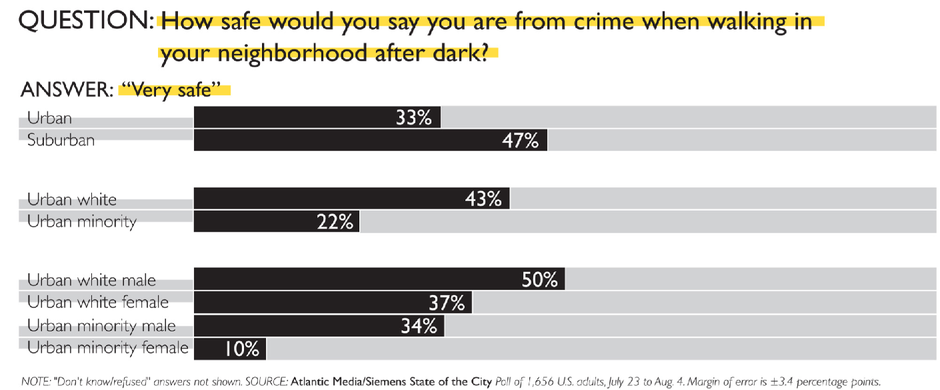
Only 22 percent of those who identified themselves as nonwhite and live in urban settings said that they feel “very safe” on the streets near their homes at night, compared with nearly twice as many urban whites, some 43 percent. Thirty-four percent of urban minorities said they feel “not too” or “not at all” safe, compared with just 14 percent of urban whites who feel the same way.

The stark disparity in feelings of personal safety was further heightened along gender lines. A mere 10 percent of minority urban women said they felt safe in their neighborhoods after dark, compared with 34 percent of minority urban men, 37 percent of white urban women, and a full 50 percent of white men living in cities.

Will The ISIS War Come To A Vote? Ctd

by Dish Staff

Jay Newton-Small doubts an authorization would pass Congress in the run-up to midterm elections. For that reason, she argues, Obama probably won’t bother asking for one:

“Congress does not have the political will to approve a War Powers Resolution when the American people have very little appetite for war,” said Ron Bonjean, a former senior Republican congressional aide. “Getting the approval of Congress before the November elections to bomb ISIS targets in Iraq would likely require an attack on American soil or a very imminent threat of danger. Members of Congress want to secure their own re-elections and this type of vote could be the defining factor in several tight Senate races across the country.” …

The most likely path here is that Obama will continue to do what he’s been doing, and probably expand attacks into Syria, using the Article II justification. As the White House has argued, he’s protecting Americans in Erbil, the Kurdish capital in northern Iraq. By that measure, wherever America has an embassy, or citizens in peril, Presidents in the future will now have the precedent to engage in hostilities to protect them.

Damon Linker is dismayed, if not exactly surprised, that members of Congress are putting political considerations before Constitutional duty here:

Bombing a nation — even when it’s mainly to attack substate actors operating within it — is unquestionably an act of war. And debates about whether to go to war should be taking place in Congress, with our elected representatives taking a stand one way or another. The refusal to take that stand is a monumental evasion of Congress’s constitutionally delineated responsibility. That this shirking of responsibility is a product of abject cowardice and self-protectiveness makes it especially contemptible.

Serving in Congress has become so cushy that our representatives would rather protect their jobs than take a risk in defense of the public good or the prerogatives of their branch of government. Sure, they’ll support demagogic partisan stunts, like House Speaker John Boehner’s lawsuit against President Obama. But actually take responsibility for war and peace? Nah. Much better to stay silent now and then reserve the right to attack the president if military action goes badly — or benefit from the outpouring of national good will if it goes well.

Conor Friedersdorf lists some more reasons why a Congressional authorization would be a good idea, other than, y’know, how it’s required by law and all:

• The legislature is in a better position than the executive branch to carry out the will of the American people, which ought to dictate United States foreign policy.
• A congressional debate can help to test the arguments for intervention, which may well be wanting given the dearth of public scrutiny they’ve gotten.
• Every two years, Americans decide whether to keep or oust their representatives in the House. Knowing where they stand on hugely consequential matters of national policy is integral to the American system functioning.
• A war to defeat ISIS would be a huge undertaking. Embarking without the support of the citizenry casts doubt on whether the country would see the effort through.
• It is dangerous to give a single man the power to take a nation to war without anyone being able to do a thing to stop him. It is, in fact, anti-Madisonian.

A Less Than Visionary Foreign Policy

by Dish Staff

After listening to Obama’s recent interview with Tom Friedman, Greg Djerejian wishes the president’s foreign policy showed “more transformative greatness”:

It is very easy to take cheap pot-shots at Obama. We must recall the alternatives would have been tragically worse. Even within his own party, as Hillary Clinton’s recent comments to Jeffrey Goldberg make clear, breezy certitudes around play-pretend muscularity are meant to showcase greater foreign policy gravitas, but actually too often indicate precisely the opposite. Indeed, we should commend Obama his caution, his rationality, his use of scalpels rather than hammers. By this I mean that a period of American retrenchment was well needed—almost inevitable—after the gross excesses of the post 9/11 Bush years. But Obama’s tragedy is that he has not accompanied a period of American retrenchment, even decline, with strategic panache (for instance, Nixon and Kissinger’s opening to China on the heels of the disastrous Vietnam War). He does not seem seized of the possibilities his office affords.

Due to his lack of an overarching strategy, Paul Saunders objects to those who would label Obama a “realist”:

The principal reason that Obama’s critics and defenders considered him a realist for so long has been his administration’s generally pragmatic policies. But realism is much more than pragmatism; confusing the two is one of the most fundamental and enduring errors in America’s foreign-policy debates. Realism is pragmatism rooted in awareness of international anarchy, infused with a deep understanding of American power and in service of a strategy based on American national interests. Obama is not a realist because his policies typically start and stop with the pragmatic and even the opportunistic. He appears to have excessive faith in international norms, little real appreciation of power’s uses and limits, and minimal interest in foreign policy, much less American international strategy.

In The Mood To Procrastinate

by Dish Staff

Doom Loop

Derek Thompson examines why we put things off:

In the last few years …  scientists have begun to think that procrastination might have less to do with time than emotion. Procrastination “really has nothing to do with time-management,” Joseph Ferrari, a professor of psychology at DePaul University, toldPsychological Science. “To tell the chronic procrastinator to just do it would be like saying to a clinically depressed person, cheer up.”

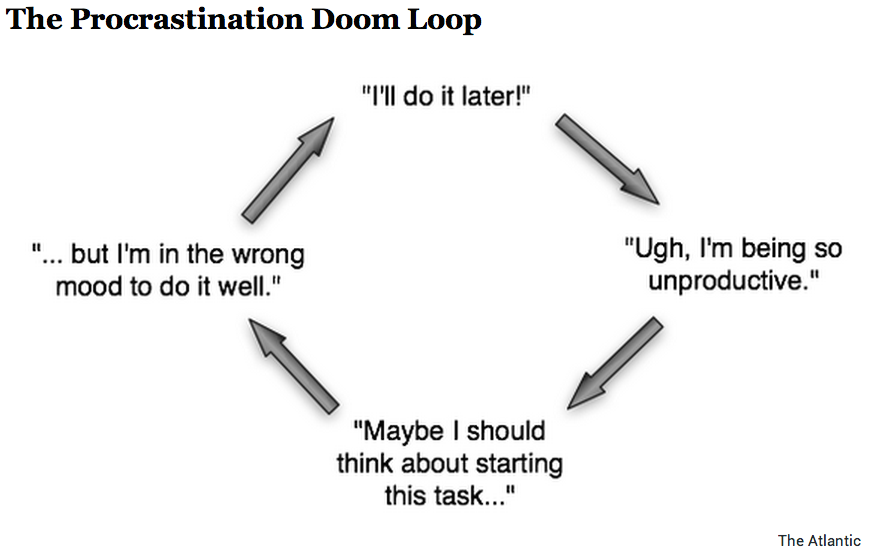
Instead, Ferrari and others think procrastination happens for two basic reasons: (1) We delay action because we feel like we’re in the wrong mood to complete a task, and (2) We assume that our mood will change in the near future.

So, how does one become more productive?

To hack your way to productivity, you could schedule one-shot reminders as late as possible—even slightly after you were supposed to start the project. Not only will the last-second reminder and looming deadline break the doom loop and shock you into action, but also it won’t give you time to put off—and, potentially, forget about—the task.

For pathological procrastinators, recognizing that we need deadlines to bind ourselves to our responsibilities is the first step. The second step is recognizing that our own deadlines are less effective than other people’s deadlines.

“Africa Is Where The Future Is”

by Dish Staff

And that’s what Pascal-Emmanuel Gobry believes is missing from most analyses of China’s involvement in the continent:

For sure, China’s drive into Africa is mainly motivated by natural resources. But this is merely the catalyst of a broader phenomenon, which is really driven by the frustration of so many Chinese with the unbearably stifling and corrupt Chinese system.

From a slow-growth West myopically hypnotized by China’s largely meaningless growth figures (and a bizarre envy of authoritarianism), we don’t actually see China for what it is, which is a very unhealthy society. The limitation on births. The ruthless and ineffective education system, which now no longer provides the jobs it promised. The omnipresent corruption and inflation. The stifling (literally) pollution. No wonder everyone who can is running for the exits.

For Chinese who cannot find advancement or fulfillment in a tottering system, Africa is actually enticing. Chinese are more at home than Westerners in cultures where clientelism (understood non-judgementally as a system where networks of interpersonal reciprocal relations are very important) is more important than legalism, and in Africa they can find a world where opportunities are more available for the taking for the driven and hard-working who are shut-out of the best networks in China. And, of course, we cannot discount the fact that most of the Chinese doing business in Africa are men coming from a country with an increasing shortage of women to a continent where there is not. It is this social phenomenon which is driving China’s scramble for Africa, more than “neo-colonialism” or a mere geopolitical grab for oil and soybean fields.