Is Obama Due For A Comeback?

by Dish Staff

Earlier this week, Beinart made the case that Obama is bouncing back:

This year’s dominant storyline was about Obama and the midterm elections. Most key Senate races took place in red and purple states where Democratic candidates distanced themselves from Obama, thus magnifying the media’s perception that he was a political pariah.

Next year, however, the story won’t be 2014 but 2016. And the Democratic story, in all likelihood, will be Hillary Clinton’s march toward her party’s nomination. While Obama was certainly unpopular this fall in states like Kentucky, he remains quite popular among the liberal activists who play an outsized role in Democratic primaries. In fact, Obama retains a connection to many them that Hillary Clinton has never enjoyed. The closer she comes to the nomination, the more nostalgic some of those grassroots liberals will become about Obama. And this new context—Obama versus Hillary among Democratic activists—rather than Obama versus Alison Lundergan Grimes among Kentucky midterm voters—will cast him in a more favorable light.

That may be true, but Waldman isn’t expecting Obama to win the approval of many Republicans:

[P]artisan identification has sorted and sharpened, and people on both sides are even less willing to give the other side’s guy credit for anything. Bush’s approval among Democrats was in the single digits for most of the last three years of his presidency, and Obama’s approval among Republicans has hovered around 10 percent (sometimes even lower) since 2010.

What that means is that if Obama has a revival in approval, it’ll look not like the 65 percent Clinton had at the end of his term or Reagan had just before Iran-Contra, but more like 50 or 55 percent. That represents most everyone from his party, and a little over half of independents. There are actually very few true independents; most lean to one party or another. Obama won’t get approval from the Republican-leaning ones, but he can get the Democratic-leaning ones, and if things are going well, most of the true independents (who represent maybe 10 percent of the population). Add that all up and it’ll come out to something like that 55 percent number.

“Stephen Colbert” Signs Off

by Dish Staff

A reader writes:

I didn’t know before I saw the episode last night that Andrew was going to be in the star-studded finale of the Colbert Report.  When I saw him there, it felt like a friend had made it into the inner circle.  I was more excited to see him than any of the other guests, like he was “one of us”.  Just sending this because I wonder if other Dishheads felt the same way.

In his review of the series finale, James Poniewozik calls Colbert “America’s greatest, most genuine phony”:

That Colbert was able to be “Stephen Colbert” at such a high level for some nine years was the 56-game-hitting-streak of American comedy, a feat we may not see equalled again. He kept it up in part by taking the show on the road. He brought his act to the White House Correspondents’ Association Dinner, got Doritos to sponsor his favorite-son run in the 2008 South Carolina primary, and — in what was probably his high-water mark — in 2011 went through the process of founding a real SuperPAC. It was simultaneously an epic work of performance-art satire and genuine public-service education.

Before the finale, Colbert was already in the process of letting go of “himself”; on Wednesday’s show, he held a yard sale of Report memorabilia, unloading a copy of his correspondents’ dinner speech to a crying baby, selling a bottle of “Ass Juice” to a lucky bargain hunter. He seemed at peace, and why shouldn’t he be? He’s going on to something new, taking over for David Letterman at CBS. And while that’s generated much interest in what Colbert will do as himself, I’m not too concerned.

Update: A reader flags this post of Andrew’s from October 18, 2005, titled “Pure Genius”:

Last night’s Colbert Report, of course. O’Reilly fileted. My only worry is: how can he keep it up?

A Legal Threat To Legalization

by Dish Staff

Marijuana Colorado

Nebraska and Oklahoma are suing Colorado for legalizing marijuana:

Two of Colorado’s neighboring states, arguing that the legalization of marijuana for Coloradans is causing crime problems across state borders, asked the Supreme Court on Thursday to allow them to file a lawsuit directly before the Justices.  If the suit goes forward, Nebraska and Oklahoma’s filing said, the Court should rule that the commercial part of the Colorado scheme is unconstitutional and could no longer be enforced.

Josh Harkinson explains the states’ grievances:

Evidence has been mounting that Colorado can’t contain all of its weed. In June, USA Today highlighted the flow of its marijuana into small towns across Nebraska. Since 2011, the paper reported, felony drug arrests in Chappell, Nebraska, a town just seven miles north of the Colorado border, have jumped 400 percent.

Colorado has vowed to defend its laws:

Colorado Attorney General John Suthers isn’t backing down. In a statement, he said he intends to defend the state’s marijuana laws. “Because neighboring states have expressed concern about Colorado-grown marijuana coming into their states, we are not entirely surprised by this action,” Suthers said. “However, it appears the plaintiffs’ primary grievance stems from non-enforcement of federal laws regarding marijuana, as opposed to choices made by the voters of Colorado. We believe this suit is without merit and we will vigorously defend against it in the U.S. Supreme Court.”

Sullum doubts the prohibitionists will prevail:

As Deputy Attorney General James Cole explained to the Senate Judiciary Committee last year, the Justice Department decided against trying to block marijuana legalization in Colorado and Washington after concluding that there was no viable legal strategy to stuff the buds back into the jar. It is well established that Congress cannot compel states to punish activities they decide should not be treated as crimes. Although the federal government might have more success in challenging a state’s licensing, regulation, and taxation of marijuana businesses, Cole said, the upshot of such a victory would be a legal but completely unregulated market. Given the way the Supreme Court has interpreted the Commerce Clause with reference to the ban on marijuana, the feds might force Colorado and Washington to scrap their rules for growing and distributing marijuana. But they cannot constitutionally force Colorado and Washington to arrest, prosecute, and imprison marijuana growers and distributors.

(Photo: A tourist purchases marijuana at La Conte’s Clone Bar & Dispensary during a marijuana tour hosted by My 420 Tours in Denver on December 6, 2014. By Craig F. Walker / The Denver Post)

Obama Gives The Gift Of Clemency, Sparingly

by Dish Staff

Obama Pardons

Maya Rhodan passes along news of Obama’s “Christmas clemency”:

Obama granted 12 pardons to people convicted of various crimes from 1964 to 1997: possession of an unregistered distillery, counterfeiting, and conspiracy to transport a stolen car. Obama also commuted the sentences of eight federal prisoners serving lengthy sentences for drug crimes. None claim to be innocent, but they argued that they’ve served their time. In many cases, the crimes would not have received the same punishment if they were committed today. …

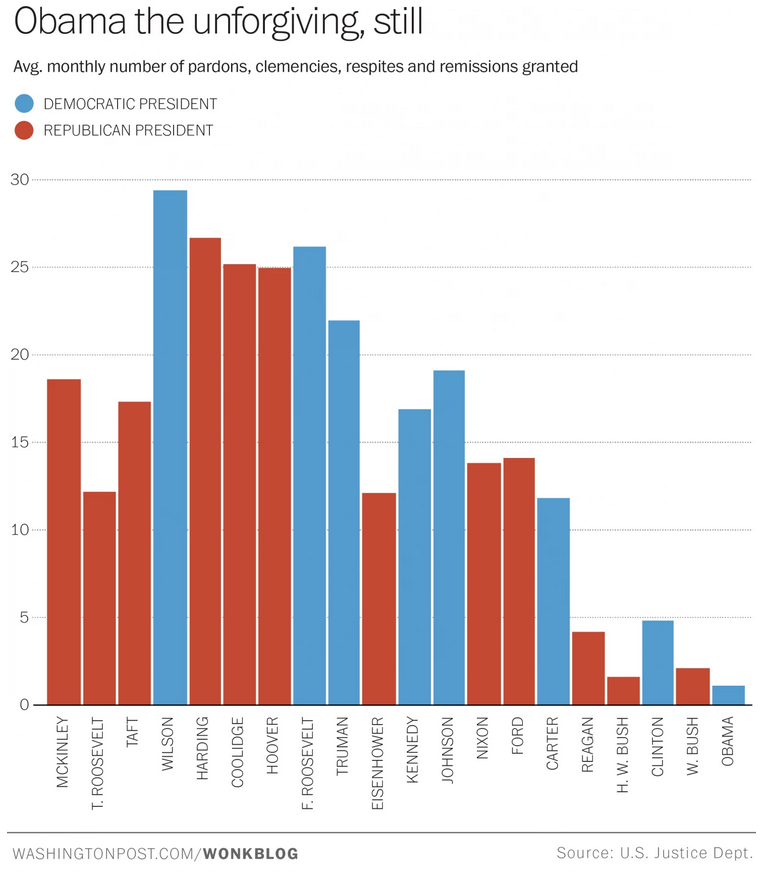
Matt Ford highlights Obama’s reluctance to exercise his pardoning power:

Presidential pardons have declined since World War II, excluding cases of mass amnesty like Jimmy Carter and the Vietnam draft-dodgers, but Obama’s sparing use still stands out: Until Wednesday, one in seven of his pardons had beenissued for Thanksgiving turkeys.

A 2012 investigation by ProPublica found that an applicant’s chance of receiving a pardon under Obama was only one in 5,000, compared to one in 1,000 under George W. Bush and one in 100 under Ronald Reagan. Obama seldom grants pardons beyond the traditional holiday-season batch. His April 15 commutation of Ceasar Huerta Cantu’s sentence is a rare exception. A typo had accidentally lengthened Cantu’s sentence by 42 months, and a court ruled that only presidential clemency could correct the error.

Christopher Ingraham chimes in:

[C]lemency reform has never been a truly comprehensive approach to fixing the problems of our justice system. The president is unlikely to grant relief to tens of thousands of inmates. Rather, true reform will only happen by reworking sentencing rules so that we’re not locking people up for low-level crime to begin with.

The Smarter Sentencing Act would have been a modest step in this direction. It would have reduced, but not eliminated, mandatory minimum sentences for drug offenders. But despite bipartisan support, Congress left it on the table unfinished this year.

Torturing Her Way To The Top

by Dish Staff

Matthew Cole reports on a key torture apologist at the CIA who “repeatedly told her superiors and others – including members of Congress – that the ‘torture’ was working and producing useful intelligence, when it was not”:

The expert was not identified by name in the unclassified 528-page summary of the [torture] report, but U.S. officials who spoke with NBC News on condition of anonymity confirmed that her name was redacted at least three dozen times in an effort to avoid publicly identifying her. In fact, much of the four-month battle between Senate Democrats and the CIA about redactions centered on protecting the identity of the woman, an analyst and later “deputy chief” of the unit devoted to catching or killing Osama bin Laden, according to U.S. officials familiar with the negotiations.

Jane Mayer comments:

Her story runs through the entire report.

She dropped the ball when the C.I.A. was given information that might very well have prevented the 9/11 attacks; she gleefully participated in torture sessions afterward; she misinterpreted intelligence in such a way that it sent the C.I.A. on an absurd chase for Al Qaeda sleeper cells in Montana. And then she falsely told congressional overseers that the torture worked.

Had the Senate Intelligence Committee been permitted to use pseudonyms for the central characters in its report, as all previous congressional studies of intelligence failures, including the widely heralded Church Committee report in 1975, have done, it might not have taken a painstaking, and still somewhat cryptic, investigation after the fact in order for the American public to hold this senior official accountable. Many people who have worked with her over the years expressed shock to NBC that she has been entrusted with so much power. A former intelligence officer who worked directly with her is quoted by NBC, on background, as saying that she bears so much responsibility for so many intelligence failures that “she should be put on trial and put in jail for what she has done.”

Instead, however, she has been promoted to the rank of a general in the military, most recently working as the head of the C.I.A.’s global-jihad unit. In that perch, she oversees the targeting of terror suspects around the world. (She was also, in part, the model for the lead character in “Zero Dark Thirty.”)

Will That Cohiba Taste The Same Without The Mystique?

by Dish Staff

27976290_c0a57df452_b

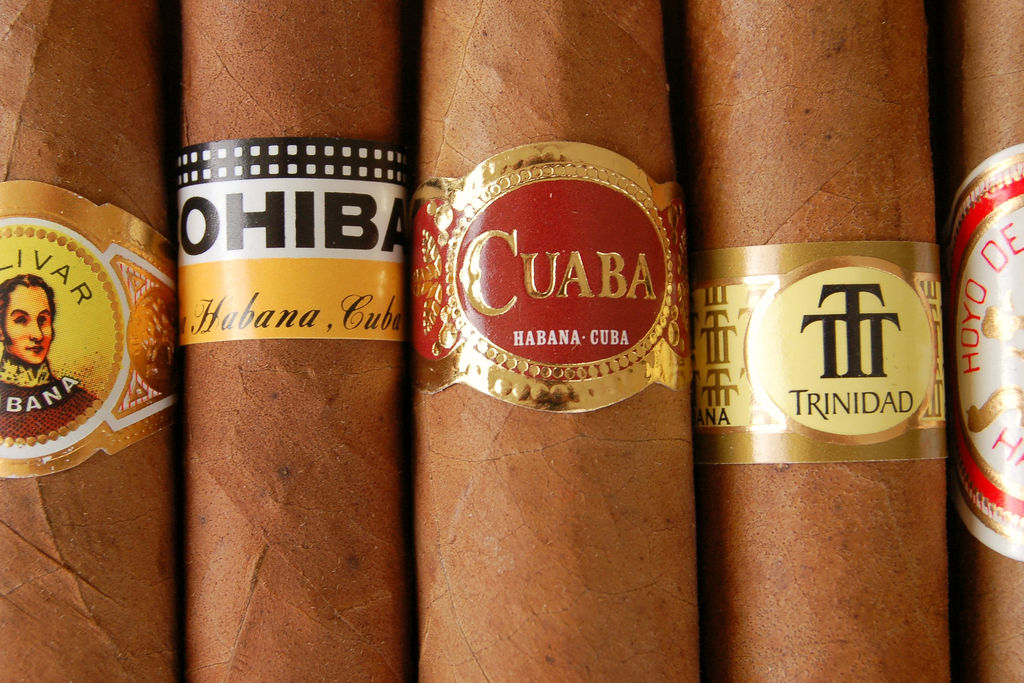
Roberto Ferdman deflates some of the hype surrounding Cuban cigars, which Americans will soon be able to buy more easily:

Each year, Cigar Aficionado, the leading industry magazine, publishes a list of the top 25 cigars in the world. Last year, the number one cigar was the Montecristo no. 2, which is made in Cuba. But only two of the remaining 24 also came from the country. By contrast, 11 were from the Dominican Republic, and 10 were made in Nicaragua. The magazine has yet to reveal its top pick for 2014, but among the remaining 24 the vast majority are once again from countries other than Cuba. And a similar pattern can be seen in virtually every year that the publication has issued its rankings. “The playing field has been leveled,” said David Savona, executive editor of Cigar Aficionado.

Alison Griswold suspects that the storied tobacco derives its reputation from scarcity as much as from anything else:

“It’s a forbidden fruit,” explains Eric Newman, president of Tampa, Florida-based J.C. Newman Cigar Company, a cigar manufacturer. “The biggest market in the world prohibits them from entering the marketplace.” Rather than deterring U.S. consumers, that ban may have in fact proved the biggest selling point for Cuban cigars over the last 50 years. People in the industry compare their allure to that of Coors beer before it became easily available beyond the American west. So great was the East Coast’s unrequited love for Coors in the 1970s that the quest to bring the beer from West to East was depicted in the popular 1977 film Smokey and the Bandit.

With both Coors and Cuban cigars, the question has been whether the product is ultimately worth the hype surrounding it. “Coors isn’t a bad beer, but is it the best beer in the world?” [president of Corona Cigar Company Jeff] Borysiewicz asks. “Cuban cigars are kind of the same way.”

But Dylan Matthews relays some evidence that Cubans really are superior:

So Cuba produces some excellent cigars. But do they, on average, surpass those of other countries? A 2003 paper in the Quarterly Journal of Economics and Finance suggests yes. The University of Virginia’s David Freccia and Wesleyan’s Joyce Jacobsen and Peter Kilby collected Cigar Aficionado quality ratings and price data for 689 different cigars, and sought to identify determinants of both high prices and high ratings. They took into account a battery of subjective factors — did the Cigar Aficionado review describe the cigar as mild? as well built? as smooth? was it nutty or cocoa-y or creamy? — as well as national origins.

They found that the single most important determinant of both prices and ratings was whether or not the cigar originated from Cuba. Being from Cuba bumped up a cigar’s rating by 4.05 points on a 100-point scale, on average; by contrast, being described as “well built” only gained a cigar 1.28 points, and being “leathery” only resulted in a 1.87 point gain.

(Photo by Alex Brown)

Cast Away

by Dish Staff

3659766107_f3252d36e7_b

Chris Mooney flags a troubling new study finding that the world’s oceans now contain more than five trillion pieces of plastic, weighing more than 250,000 tons:

With a global population of about 7.2 billion, that’s nearly 700 pieces per person.

The study, published in the journal PLOS One by Marcus Eriksen of the Five Gyres Institute in Los Angeles and a large group of colleagues, is based on data from 24 separate ocean expeditions, conducted between 2007 and 2013, to sample plastic pollution. Plastic was either observed from boats, or hauled up from the ocean by nets, in 1,571 locations. The data were then used to run an ocean model to simulate the amount and distribution of plastic debris.

The result not only yielded the estimate of over 5 trillion pieces of plastic in the global ocean — it also cast light on how plastic changes within the ocean (breaking down into smaller pieces) and circulates around the globe. Pieces between 1 millimeter and 4.75 millimeters in size were by far the most prevalent class of plastic in the ocean. However, by weight, really large pieces of plastic, greater than 200 millimeters in size, were the most significant.

Katy Steinmetz touches on efforts to rein in microbeads – the tiny bits of plastic found in exfoliating body washes and face scrubs – which contribute significantly to this problem:

These little orbs, introduced to replace harsher exfoliants like pumice, are so small that after they’re washed down the sink or tub, they sneak through sifters at water treatment plants and end up in the ocean and other bodies of water. Once in the ocean, researchers have found, these plastics act like sponges for toxins, and can be accidentally ingested by fish, thus ending up in the food chain. Several states considered bills to ban microbeads last session, but only Illinois passed a law, becoming the first state to do so. Now lawmakers in at least three states are gearing up for another go in 2015.

“We were outgunned,” says Stiv Wilson, associate director at 5 Gyres, a non-profit dedicated to fighting plastic pollution. In California, the industry group Personal Care Products Council—which represents companies like Johnson & Johnson and Clinique—lobbied members to oppose a bill that would have banned the use of microbeads, saying it was “overly aggressive and unrealistic.” The bill failed by one vote. The same state assemblyman who proposed that bill, Richard Bloom, plans to try again, with what Wilson says will be a “much broader coalition” of supporters.

Previous Dish on microbeads here and plastic more generally in the oceans here.

(Image via Antonio Foncubierta)

The Simpsons, Eternal

by Dish Staff

Marking the show’s 25th birthday yesterday, Todd VanDerWerff pens an appreciation:

Yes, the show repeats itself a fair amount, but it would be hard for it not to. And, yes, the show has sort of lost a point-of-view character, as its writers have aged past first the Simpson kids and then even the Simpson parents. Many stories in its later years tend to be along the lines of “Can you believe things are this way?!” and have the tone of a particularly perturbed anecdote in the “Life in These United States” feature in Reader’s Digest. All of these things mean it’s hard for the program to create classic episodes week in and week out now.

But what the [recent Simpsons] marathon underlined for me, more than anything, is that the series has attempted to stay true to its characters, and that it still takes chances, especially in its visuals. Both of these things are immensely important to its longevity, and the fact that it remains a pretty reliable form of entertainment from week to week. Seeing all of the episodes one after the other made the continuum that much more apparent: the show started great, became absolutely brilliant, then declined back to just great, before taking a few seasons to find a plateau of better than average.

Listening For The Voice Of God

by Dish Staff

In an interview about his new book, A Mess of Help: From the Crucified Soul of Rock’n’Roll, David Zahl notices that many of the artists he profiles – who range from ABBA to Morrissey to Axl Rose – “point to some sense of strength being found in weakness, of inspiration being bound up with suffering rather than apart from it.” Still, he’s wary of the didactic approach Christians too often bring to their cultural commentary:

That phrase “Christian approach” often implies that religious people should approach things with trepidation and/or suspicion, and measure them against the standard of our religion. There seems to be an agenda, sometimes an unspoken or unconscious one, that culture is valuable only insofar as we can harness it in some way. But I’m convinced that, to quote someone I admire, “any goodness, beauty, truthfulness, or enlivening candor we have the wit to discern is something for which we have God to thank.” That is, that it’s already been harnessed. So this isn’t a Christian “take” on secular music, at least as I see it. The artists I wrote about are the ones that have spoken and continue to speak to me rather than vice versa; I talk more about what I’ve learned from them than how their work filters through a religious framework. I gave myself plenty of room to explore, though, so who knows (“preacher brain” is not the easiest thing to shut off). Again from the introduction:

“It wasn’t that I set out to write about the intersection of Christianity and culture; it was simply that music was the most honest language available to me—the lingua franca of my inner life, my immediate vocabulary for understanding what was happening to me. In fact, so immersed in it was I, that to avoid pop culture would have been to embrace precisely the kind of phoniness that permeates so much religious ‘engagement’ with it these days.”

Why Not Open Up To Cuba?

by Dish Staff

Screen Shot 2014-12-18 at 12.43.00 PM

Aaron Blake flags one argument that won’t get much traction – that Cuba is a genuine national security threat:

Despite Cuba’s proximity to the United States (about 90 miles from Florida) and its alliance with other antagonistic countries like North Korea and Russia, Americans have grown progressively less and less concerned that the island country actually poses a threat to the United States. A CNN/Opinion Research poll earlier this year, in fact, showed that just 5 percent of people viewed Cuba as a “very serious threat” and 21 percent said it was a “moderately serious threat.” Another 72 percent said it wasn’t a threat at all or “just a slight threat.” Back in 1983, two-thirds of Americans viewed Cuba as at least a “moderately serious threat,” but that numbers has fallen steadily since then.

Zack Beauchamp notes that another favorite talking point of anti-Cuba hardliners – calling the country a state sponsor of terrorism – is a bit outdated:

The US government designated Cuba a state sponsor of terrorism in 1982, which imposed financial penalties on the Cuban government. At the time, the US accused Cuba of supporting the Spanish Basque terrorist group ETA and the FARC militants in Colombia. Though the US continues to label Cuba a terrorism sponsor, that’s just transparently untrue. According to the State Department‘s most recent annual review of terrorism worldwide, “there was no indication that the Cuban government provided weapons or paramilitary training to terrorist groups.”

“Cuba’s ties to ETA have become more distant, and that about eight of the two dozen ETA members in Cuba were relocated with the cooperation of the Spanish government,” the report reads. And “throughout 2013, the Government of Cuba supported and hosted negotiations between the FARC and the Government of Colombia aimed at brokering a peace agreement between the two.” That doesn’t sound much like a state sponsor of terrorism.

In fact, FARC announced a unilateral ceasefire yesterday, possibly (though not necessarily) pointing the way to peace in Colombia. Richard McColl wonders whether these two events were connected:

How much influence Cuba had in the decision taken by the FARC is up for speculation since Colombian President Juan Manuel Santos has been making conciliatory overtures in his statements to the press in recent weeks. Now the question in Colombia, is, will a bilateral ceasefire be announced in coming days? In the past, Santos has been stubbornly opposed to a bilateral ceasefire, but his position on the issue may be shifting. In an interview with W Radio in Bogota on Wednesday morning before the news about Cuba broke, he said that he was waiting for concrete actions from the FARC that would enable a deceleration of the conflict. Less than six hours later, the FARC potentially came good on the challenge.

Larison pushes back on the notion, per Elliott Abrams, that Obama’s opening to Cuba will embolden other enemies of the US:

Restoring diplomatic relations with Cuba isn’t going to have negative “repercussions” around the world. For one thing, persisting in a useless policy towards Cuba doesn’t tell us anything about Washington’s willingness to back up its guarantees elsewhere in the world. It does hint that the U.S. is eventually capable of recognizing policy failure when it is staring it in the face, and that has to be modestly reassuring to our allies and regional neighbors. If there are any repercussions from this decision, they are all likely to benefit America. Latin American governments will have less of a reason to fault U.S. policy towards Cuba. The U.S. will be able to demonstrate that it is still capable of resuming relations with states that it has previously treated as pariahs, and that might make U.S. diplomacy more effective in other places.

Ishaan Tharoor finds it odd that Republicans who tout the benefits of trade liberalization everywhere else don’t extend the same optimism to Cuba:

It’s a strange irony that some of Washington’s biggest proponents of free trade don’t want to see the United States enable such liberalizing changes in Cuba. Closer ties to Cuba, including trade links, will ideally lead to a deepening of Cuba’s own curtailed civil society. That, at least, is the current message of the Obama administration. The more open Cuba gets, the more access its people may have to the Internet and to outside channels of information. That, the hope goes, may speed political reform in Havana.

Critics may point to countries like China and Vietnam, where decades of economic development and free enterprise have yet to yield any real liberal, democratic dividend. But Cuba is fundamentally different; it exists in the U.S.’s shadow and its links to the American mainland, including some 1.5 million Cuban Americans, mean that even the most dogged authoritarian leader will struggle to inoculate the regime from American influence — that is, once Washington finally chooses to engage with Cuba.

Joe Klein makes a similar argument:

Those who favor a continuation of our failed Cuba policy are a reflexive lot with a muddled argument. They’re the usual myopic tough guys–John McCain and Lindsey Graham immediately jumped on the President after his Cuba announcement today–who have no idea of the seductive power of the American way of life in the rest of the world. I can understand why the corroding Iranian regime would want to keep us out (a sign in Tehran: “When the Great Satan praises us, we shall mourn”). I’ve always thought: then let’s recognize the hell out of them. Let ‘em mourn. Let the Revolutionary Guard try to fend off Kanye West and Star Wars. Good luck with that.

Rich Lowry, however, insists that easing trade restrictions won’t spur the growth of free enterprise in Cuba, but rather will only enrich the Castro regime:

Consider tourism. The Cuban military has a enormous holding company called GAESA. One of its companies, Gaviota, operates an extensive network of hotels and resorts from which it earns a bonanza of foreign exchange, according to the strategic consultancy Stratfor. Imagine if the Pentagon owned the Radisson, Marriott and Hilton hotel chains. That is the Cuban tourism industry in a nutshell. If tourism were the key to empowering and eventually liberating the Cuban people, the country would be a robust democracy by now. About a million Canadian tourists go to Cuba every year. In total, more than 2 million tourists visit annually, and yet the Castro regime is still standing.

Michael Daly, meanwhile, points out that Cuba still harbors a number of American fugitives, including the infamous Assata Shakur:

Among the roughly 80 other American fugitives in Cuba is Ishmael Ali LaBeef, who hijacked an airplane after he and four buddies murdered eight innocents during a robbery at a Virgin Islands golf course in 1972. There is also Victor Gerena, who is wanted in connection with a $7 million armored car robbery in Connecticut in 1983. And then there is William Morales of the Puerto Rican independence group the FALN. He lost most of both hands while assembling a device in an FALN bomb factory in 1979, but managed to escape from a hospital ward where he was being fitted for prosthetic hands after being convicted of weapons charges and sentenced to 99 years.