Obama’s Coming Showdown With Congress

by Dish Staff

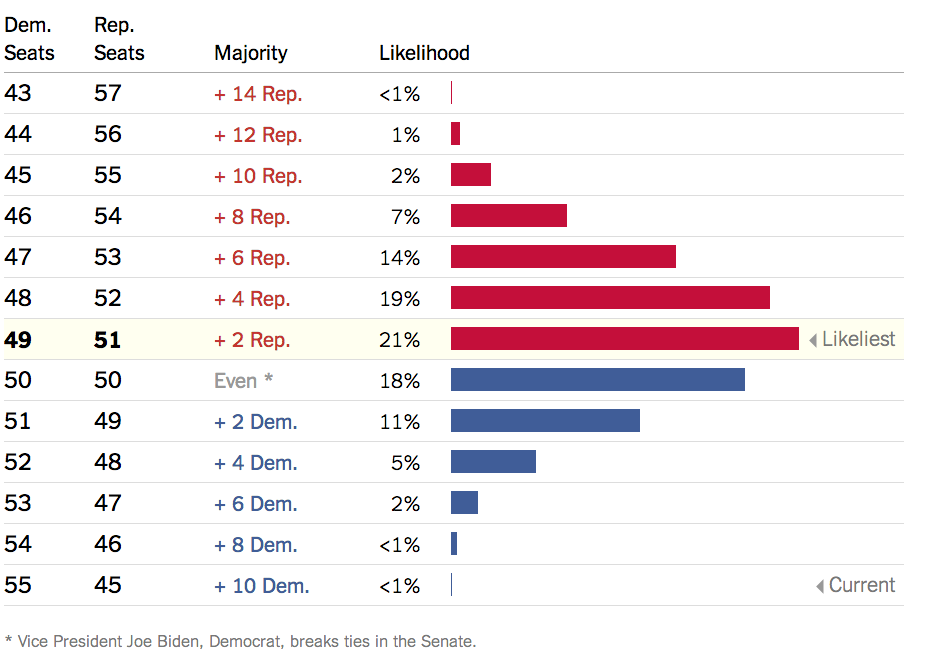
How will the midterms change the balance of power in the Senate? The NYT calculates the odds of various scenarios:

Senate Odds

This week McConnell previewed how a Republican Senate would function:

Mitch McConnell has a game plan to confront President Barack Obama with a stark choice next year: Accept bills reining in the administration’s policies or veto them and risk a government shutdown.

In an extensive interview here, the typically reserved McConnell laid out his clearest thinking yet of how he would lead the Senate if Republicans gain control of the chamber. The emerging strategy: Attach riders to spending bills that would limit Obama policies on everything from the environment to health care, consider using an arcane budget tactic to circumvent Democratic filibusters and force the president to “move to the center” if he wants to get any new legislation through Congress.

In short, it’s a recipe for a confrontational end to the Obama presidency.

Beutler doubts his strategy will work:

[W]hat McConnell’s promising makes very little sense. Even if you assume he and the House Speaker can unite their fractious conferences tightly enough to round up majorities for legislation, McConnell would still have a filibuster to contend with. And even if you ignore that obstacle, the political play is a known loser. Republicans controlled both the House and Senate when they shut down the government in 1995, and they lost the fight. Bill Clinton was a bit more popular at the time than Obama is now, but that’s not really what drove the dynamic. It’s just a losing ask to condition basic government services on weakening pollution restrictions or cutting health care spending or whatever. McConnell might be able to extract modest concessions in an appropriations tussle, but nothing big, and nothing along the lines of what conservative members will expect.

Ezra agrees that such tactics would be self-defeating:

McConnell intends to unleash a tactic that will almost inevitably end with shutdowns — whether he wants them or not. This might make sense if Barack Obama were running for reelection in 2016: the shutdown hurt his popularity, too, and perhaps it would make sense for congressional Republicans to mount a kamikaze mission against his third term.

But Obama isn’t up for reelection in 2016. These shutdowns will be a disaster for the Republican Party that will help elect Hillary Clinton — and help Harry Reid retake the Senate. Republicans will end up backing controversial positions with wildly unpopular tactics and the Democrats will take full advantage when they face the friendlier presidential electorate.

Foley’s Impossible Ransom

by Dish Staff

Before deciding to murder captive American journalist James Foley, ISIS had attempted to extort an enormous ransom from the US government in exchange for his release:

Long before the dark bluster behind ISIL’s rationale for killing an American civilian, there had reportedly been a call for a ransom. Philip Balboni, Foley’s boss at GlobalPost, told The Wall Street Journal that the captors demanded 100 million euros in exchange for Foley’s release. The New York Times reported the figure as $100 million USD, and says the captors also added other demands, including an exchange of prisoners being held by the United States. … Balboni also told WCVB, that the family received an email last week — after the U.S. began its bombing campaign against ISIL — indicating that they were going to kill Foley. That email made no demands and was “full of rage,” making no suggestion that he could be spared with a payment.

This revelation has left some people wondering why the administration was willing to trade with the Taliban for Army Sgt. Bowe Bergdahl, but not with ISIS for Foley. Joshua Keating makes the case for why those were the right calls:

As counterterrorism scholar Peter Neumann argued in a 2007 Foreign Affairs article, governments must at times negotiate and even grant concessions to groups it considers to be terrorists. The decision about whether to do so should be made less on the basis of the group’s relative odiousness than on whether such a deal could help stop violence. …

As I argued after the Bergdahl swap, the deal should be seen less in terms of what the U.S. was willing to give up for one soldier than as the Obama administration settling unfinished business before it pulls troops out of Afghanistan and gets out of the business of fighting the Taliban entirely. But a truce, or even a de-escalation of hostility, between the U.S. government and ISIS or any of its former affiliates in al-Qaida is hard to imagine. While the payment of a ransom could secure the release of a prisoner, it can do little beyond that except provide the group with much-needed funding. It would also encourage more kidnappings, both by ISIS and other groups that would be inspired by its example.

Will Saletan agrees that we were right to reject the ransom demand for Foley:

If you pay the ransom, you’re not just fueling the kidnap market. As Slate’s Josh Keating notes, you’re also funding ISIS’s war and its atrocities against civilians. Callimachi found that al-Qaida and its affiliates reaped a minimum of $125 million in ransoms in the last five years, and $66 million just last year. It’s now al-Qaida’s main revenue stream. And the demands won’t end with money. In addition to Sotloff, ISIS reportedly has at least three more American hostages it’s threatening to kill. It also has some Brits. The New York Times says ISIS “has sent a laundry list of demands for the release of the foreigners, starting with money but also prisoner swaps.” Altogether, according to the Committee to Protect Journalists, ISIS and other extremists in Syria have about 20 foreign journalists. I fear for those reporters. I’m horrified by Foley’s death, and I know Sotloff is probably next. But we have to think about the next 20 hostages, and the 20 after that. Every time we ransom a reporter, we put a price tag on the next one.

Adam Taylor explores the practices of European countries that do pay ransoms for civilian hostages, and why those decisions are controversial:

In countries that may pay ransoms, there appear to be mixed feelings about the practice: Last year French President François Hollande told families of hostages being held in Africa’s Sahel region that no more ransoms would be paid, though a few months later there were reports in French media of more money paid out. Germany also has questioned its own payments to terrorists. “We need to ask ourselves whether or not we can live with the fact that the money we are paying in ransom for hostages,” a German government security expert said in a 2007 newspaper interview“could be used to buy weapons that could kill our soldiers in Afghanistan.” Countries where hostages are taken have sometimes complained about ransoms, too. “Yemen constantly rejects handling the release of kidnapped hostages through the payment of ransoms to kidnappers,” Yemen’s foreign minister, Abu Bakr al-Qirbi, said in an interview with Saudi Arabia’s Asharq al-Aswat newspaper last year. “We do not want this conduct to expose many foreigners in Yemen to abduction as other kidnappers would seek to receive a ransom,” Qirbi explained.

Gary Sick offers his take in an interview with the Wire:

[A] live hostage is actually worth something. A dead hostage is really not worth anything. If they kill the second hostage, which they have suggested that’s what they’re going to do, they just lost the last of their bargaining effort. They have to ask themselves what they’re going to do. … I would say, in a cold-blooded way, that the second hostage’s value has gone up in their eyes unless they think something really significant could come from it. If they kill him and the bombing goes on, they’ve lost it.

Although this is all done with great bravado, I remember my good friend Danny Pearl, he was at the Wall Street Journal and al-Qaeda beheaded and killed him. One man was already hung for that. Another has admitted he carried out the beheading. If he ever comes to trial, he will be sentenced to death. Eventually, and it might be surprising, justice does catch up with these guys, and it is clearly a war crime. Killing an innocent civilian you are holding as a hostage is a war crime, period. If they ever get captured, they will be interrogated and they’re likely to be hanged for it. Now, in battle, they don’t think on it.

Teen Pregnancy Is Way Down, Ctd

by Dish Staff

Douthat contends that a “cultural consensus” is to thank for the decline in teen pregnancy, because “the idea that we should (and, just as importantly, can) reduce the teen birth rate unites just about every faction in American politics and culture”:

This possibility makes a case for being relatively optimistic that today’s trend will, in fact, persist, and that tomorrow’s teen birth rate could be lower still than today’s. At the same time, it leaves room for pessimism about whether our culture’s success in this area can be easily translated to the broader problem of adult out-of-wedlock births, adult family instability, and the cultural and socioeconomic problems associated with those trends. …

Delaying irresponsibility till adulthood makes it, well, less irresponsible, and not having a kid at 17 by itself suffices, for obvious reasons, to raise your chances of a stable family life, as does every delay thereafter. But to date, in the big picture, the strides we’ve made in reducing teenage pregnancy and births haven’t translated into a reversal of working and middle class family life’s slow disintegration; quite the opposite, in fact. Perhaps that will change; the out-of-wedlock birth rate finally stopped rising in the last couple of years, and it’s possible that the teenage birth rate’s recent decline will start to have major positive follow-on effects as today’s teenagers move through their life cycles. But for now, what’s happened with teen pregnancy is both a real and welcome success and one whose ripple effects have been more limited than we might have hoped.

A Party Past Its Prime

by Dish Staff

Despite serious misgivings about the current state of the GOP, David Frum hasn’t given up on the party. But he understands just how big the GOP’s problems are:

Three big trends have decisively changed the Republican Party over the past decade, weakening its ability to win presidential elections and gravely inhibiting its ability to govern effectively if it nevertheless somehow were to win. First, Republicans have come to rely more and more on the votes of the elderly, the most government-dependent segment of the population — a serious complication for a party committed to reducing government. Second, the Republican donor class has grown more ideologically extreme, encouraging congressional Republicans to embrace ever more radical tactics. Third, the party’s internal processes have rigidified, in ways that dangerously inhibit its ability to adapt to changing circumstances. The GOP can overcome the negative consequences of these changes and, in time, surely will. The ominous question for Republicans is, How much time will the overcoming take?

Why he still believes conservatism will be reborn:

For every action, whether in physics or in politics, there is an equal and opposite reaction. The liberal surge of the Obama years invites a conservative response, and a multiethnic, socially tolerant conservatism is waiting to take form. As the poet T. S. Eliot, a political conservative, once gloomily consoled his readers, “There is no such thing as a Lost Cause because there is no such thing as a Gained Cause.” The message reads better when translated into American vernacular: “It ain’t over till it’s over. And it’s never over.”

However, it’s unclear to Chait how the GOP will find its way:

The Republican Party constructed a geriatric trap for itself. Just how it will escape is hard to see. It is a small-government party whose base is wedded to the programs that constitute a large and growing share of government. The inability to touch the benefits of any old person, in combination with its still-extant support for defense and fanatical opposition to tax hikes in any form, have driven Republicans to propose massive cuts to the small share of government that benefits struggling workers. This priority has, in turn, saddled the GOP with the (correct) image of hostility toward the unfortunate.

A Blow To The Head For Hamas

by Dish Staff

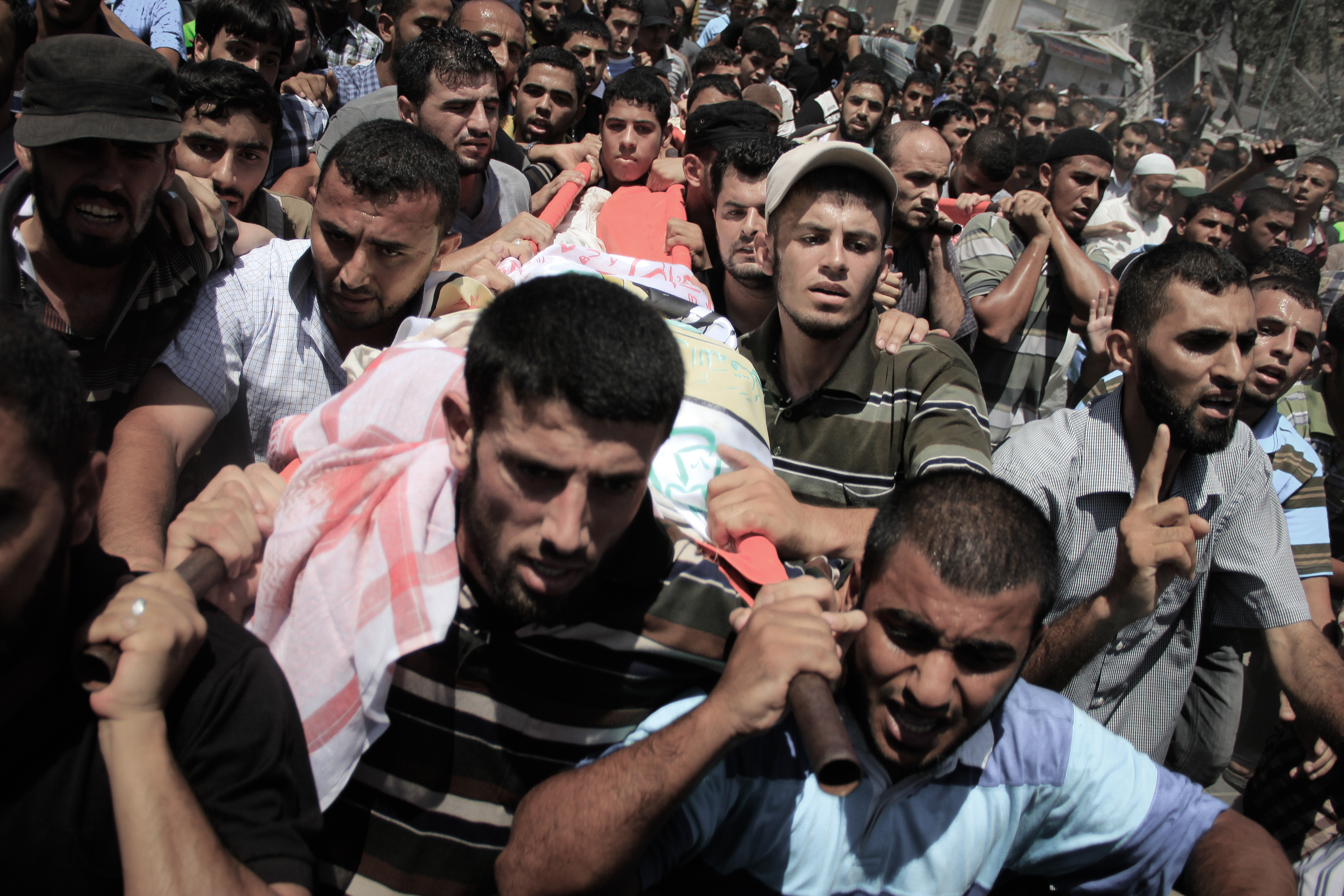
Palestinians carry the body of Mohammed Abu Shammala, one of

The IDF assassinated three Hamas commanders in a strike on a building in Gaza yesterday:

Israeli forces had a day of successful air strikes Thursday, killing three senior Hamas officials just a day after the organization claimed responsibility for the kidnapping of three Israeli teens. The strikes targeted leaders of Hamas’s armed wing, the al-Qassam Brigades. According to Hamas, the strikes killed Mohammad Abu-Shamalah, Raed al-Attar, and Mohammed Barhoum, all highly sought by Israeli forces. The IDF initially only confirmed the deaths of Abu-Shamalah and al-Attar, but later confirmed that Barhoum had been killed as well. … These triumphs against the Qassam Brigades leadership came just a day after Hamas’s Saleh al-Arouri claimed responsibility for the kidnapping and deaths of Israeli teens Eyal Yifrach, Gilad Shaer, and Naftali Fraenkel.

Morrissey thinks these assassinations are particularly significant:

The target selection sends a big message, too. For the past several weeks, the Israelis had for the most part resigned themselves to a continuing Hamas presence, in part over fear of what might follow in its place. One need look no farther than the northern Iraqi desert to contemplate the answer to that question. Now, though, Israel seems more committed to decisively breaking Hamas rather than the “mowing the lawn” strategy early in this war. The tunnels may have convinced them, or more likely the large plot for a coup against the Palestinian Authority, but either way the specific targeting of top leadership sends a message that Israel has dispensed with worrying about the pessimistic options and now want Hamas out of the way entirely. The futility of the latest round of talks can’t have helped, either.

But Rami Khouri argues that Israel’s strategy of assassinating Hamas leaders has always been counterproductive and remains so today:

Palestinians have responded to the loss of their militant leaders by developing much more secure, smaller and more secretive leadership structures that cannot be easily penetrated by Israeli intelligence agents. Groups such as Hamas have established more decentralized and localized operational units that continue to function in war or peace if the leadership is hit. More sophisticated command-and-control systems have evolved that don’t rely on a single decision-maker. Support among the Palestinian community for the long-term struggle has increased. And the resistance itself has turned to technologies and strategies — such as rockets and tunnel-building — that are more deeply embedded in Palestinian communities than reliant on the skills or charisma of a handful of individual commanders.

In an apparent response to the assassinations, Hamas executed 18 Gazans suspected of being informants for Israel:

One witness said masked gunmen lined up the seven men in a side street and opened fire on them. He spoke on condition of anonymity, fearing for his own safety. Other witnesses told AFP that six of the victims were grabbed from among hundreds of worshipers leaving the city’s largest mosque, by men in the uniform of Hamas’s military wing. They were pushed to the ground. One of the masked men shouted: “This is the final moment of the Zionist enemy collaborators,” then the gunmen sprayed them with bullets.

On Friday morning, a Gaza security official said that 11 suspected informers were killed at the Gaza City police headquarters, noting that they had previously been sentenced by Gaza courts. The killings of the first 11 were also reported by al-Rai and al-Majd, two websites linked to Hamas.

(Photo: Palestinians carry the body of Mohammed Abu Shammala, one of three senior Hamas commanders during his funeral in Rafah in the southern Gaza Strip. By Ahmed Hjazy/Pacific Press/LightRocket via Getty Images)

Why Is No One Running Against Hillary?

by Dish Staff

Beinart blames the Clintons’ tendency to hold grudges:

The winning-by-losing strategy works best when it gains you some influence over the person who defeats you for the nomination. Sometimes that means earning a place alongside them on the presidential ticket, as Edwards did in 2004. Sometimes it simply means convincing their supporters that you have a bright future and may be worth supporting down the line. The strategy works less well if the person who defeats you becomes your sworn enemy, committed to doing you political harm. It’s the fear that the Clintons may do exactly that that is limiting the pool of willing challengers.

And for good reason. Throughout their careers, Bill and Hillary Clinton have shown a willingness to remember, and punish, political betrayals.

Pivoting off Beinart, Carpenter worries about Hillary’s “self-formulated bubble”:

Histories of her healthcare fiasco are fraught with tales of insider paranoia and Gothic intrigue; her Iraq war vote was cast in willing ignorance of contrary or at least questioning national-security briefs; and her 2008 campaign was a superlative study in managerial cluelessness–all this, in large part, because aides were afraid to tell “her early and bluntly enough that things were veering badly off course.”

Well, that is indeed history; a rather harmless history of when Hillary was just a candidate, or First Lady, or merely one of 100 senators. Which is to say, she wasn’t president of the United States, with countless executive agencies and all of America’s firepower at her bubbled disposal. Yikes.

Fighting The Islamic State In Iraq And Syria?

by Dish Staff

SYRIA-CONFLICT

The border between Iraq and Syria is meaningless to ISIS, and may soon become meaningless to the US as well, with administration officials dropping hints right and left that the air campaign against the “caliphate” might eventually cross it. The hints began with deputy national security advisor Ben Rhodes on NPR early yesterday morning:

“We don’t rule anything out when it comes to the protection of Americans and the disruption of terrorist plotting against the United States. So we would not restrict ourselves by geographic boundaries when it comes to the core mission of U.S. foreign policy, which is the protection of our people.” … When Kelly McEvers floated an idea put forth by Ryan Crocker, former American ambassador to both Afghanistan and Iraq, that the U.S. work with Syrian dictator Bashar Assad against ISIL, Rhodes dismissed the idea out of hand. Citing a “vacuum” caused by Assad’s policies and “barbarism against his people,” Rhodes explained that ISIL was able to grow because of Assad, not in spite of him.

Joint Chiefs of Staff Chairman Gen. Martin Dempsey rounded out the suggestion in a press conference:

So far the airstrikes against ISIS have been successful, but the New York Times notes that the military’s current strategy is to contain the group, not destroy it. ISIS has been building up its base in Syria for more than a year, and General Dempsey said the threat would eventually have to be “addressed on both sides of what is essentially at this point a nonexistent border.”

That isn’t necessarily happening anytime soon. “That will come when we have a coalition in the region that takes on the task of defeating ISIS over time,” Dempsey said. “ISIS will only truly be defeated when it’s rejected by the 20 million disenfranchised Sunni that happen to reside between Damascus and Baghdad.” When pressed on whether the U.S. is considering conducting airstrikes in Syria, Defense Secretary Chuck Hagel would only say “we’re looking at all options.”

Allahpundit wonders exactly what options they’re looking at:

A year ago at this time, Obama was getting ready to bomb Syria to weaken Assad; a year later, here’s his deputy National Security Advisor refusing to rule out bombing Syria to weaken Assad’s chief opposition. Droning jihadis in places we don’t have boots on the ground is SOP for Obama, though. How big this news is depends on what sort of air assets Rhodes imagines us using in Syria and what sort of ISIS targets Obama’s willing to engage. If all he means is droning jihadi terror camps, that’s no great shakes. Why would we hold off on doing that in Syria when we don’t hold off in Pakistan and Yemen, two nominal allies of the United States? If he means using more muscular — and manned — aircraft, though, and if he’s imagining bombing ISIS’s front lines, that’s more significant. (It would also kinda sorta make us Assad’s air force, wouldn’t it?)

The Economist suggests that an air campaign over Syria would be an easier sell if regional leaders were on board with it:

Assad has previously tended to leave IS alone, happy to let it hurt the more moderate rebels. But recently his air force has struck the group’s base in Raqqa. The Americans have so far decided that they cannot do likewise, deeming that they must not be seen to operate on the same side as the man whose overthrow they have repeatedly demanded.

But they may be persuaded to change their mind if the most influential governments in the region, including Saudi Arabia, Egypt, Turkey and even Iran, were able in joint or parallel statements to endorse the bombing of IS in Syria—or at least to abstain from opposing it. So far the West has lacked a policy that spans national borders. Yet [Atlantic Council analyst Fred] Hof points out that “IS is a problem that transcends national boundaries and has to be approached as a problem that transcends nationalist boundaries.”

Rosie Gray takes up the question of whether striking ISIS in Syria would entail an alliance with Bashar al-Assad:

“What if, due to a deal [Assad] stopped slaughtering his own people?” former CIA analyst Nada Bakos said on Twitter on Wednesday night. Journalist Michael Weiss had asked, “To those advocating a deal with Assad to defeat ISIS, explain how this is any less barbarous” with a link to an article about new evidence of regime atrocities. Bakos said in an email to BuzzFeed that the goal should be to stabilize the situation in Syria, giving actors in the region a better chance at vanquishing ISIS.

“I don’t believe Assad’s forces can achieve that single-handedly and we aren’t about to partner with him, nor should we,” Bakos said. “However, arming the rebels at this point just means a longer, protracted war that is already full of proxies. It would be almost endless. If we can identify why we are taking action, we can then decide on our best course of action (which is likely still pretty awful). Our goal should be to stop the chaos, but sometimes all we can do from the outside is just help contain it.”

But at least for the moment, the administration is vociferously denying that such an alliance is in the offing:

“The Obama administration can’t partner with Assad overtly at this time, but the logic and trajectory of White House policy in Syria leads in that direction,” Tony Badran, a research fellow specializing in Syria and Hezbollah at the Foundation for Defense of Democracies, told Fox News. “White House policy in Syria is predicated on preserving so-called regime institutions.”

In public, the administration is not changing its position on Assad. And State Department spokeswoman Marie Harf disputed that the U.S. and Syrian governments share a common goal in defeating ISIS. “I would strongly disagree with the notion that we are on the same page here,” Harf said on Monday, while later admitting to Fox News, “We may be looking at some of the same targets.”

Keating’s perspective:

Even if the U.S. doesn’t coordinate with Assad’s government—the White House position as expressed by Deputy National Security Adviser Ben Rhodes is still that he’s “part of the problem”—the shift in priority to ISIS does make it more likely that the American government is going to accept Assad remaining in power. Or at least it makes it less likely that the U.S. will take any major steps to remove him.

Assad played the long game with a pretty weak hand and now appears to bewinning. Meanwhile, the death toll in his country just passed 191,000.

(Photo: A Syrian woman makes her way through debris following a air strike by government forces in the northern city of Aleppo on July 15, 2014. By Karam Al-Masri/AFP/Getty Images)
Our Black-On-Black Crime Fixation

by Dish Staff

Steven Chapman admits that “rates of violent crime are far higher among blacks than among whites” but he wants more attention to that fact that “these rates have dropped sharply over the past two decades”:

There’s another, bigger problem with the preoccupation with “black-on-black crime.” The term suggests race is the only important factor. Most crimes are committed by males, but we don’t refer to “male-on-male crime.” Whites in the South are substantially more prone to homicide than those in New England, but no one laments “Southerner-on-Southerner crime.” Why does crime involving people of African descent deserve its own special category?

The phrase stems from a desire to excuse whites from any role in changing the conditions that breed disorder and delinquency in poor black areas. It carries the message that blacks are to blame for the crime that afflicts them—and that only they can eliminate it. Whites are spared any responsibility in the cause or the cure.

Yglesias applies the language usually reserved for black-on-black violence to white-on-white violence:

[T]he disturbing truth, according to the FBI’s most recent homicide statistics, is that the United States is in the wake of an epidemic of white-on-white crime. Back in 2011, the most recent year for which data is available, a staggering 83 percent of white murder victims were killed by fellow Caucasians.

Something You Don’t See Everyday: A Democrat Running On Obamacare

by Dish Staff

Senator Mark Pryor shows his party how it’s done:

Jonathan Cohn reminds us that “this is how Democrats usually win on Medicare and Medicaidby reminding voters of what they have to lose from proposed Republican attacks on the programs”:

This isn’t just some ad the Pryor campaign posted online, in order to gin up donations from liberals. Greg Sargent of the Washington Post reports that it’s airing across the state, at a cost that runs into hundreds of thousands of dollars. And while one ad does not a political trend make, you don’t have to squint to see signs that the politics of Obamacare are shifting. Bloomberg News just did a study of Republican television ads and discovered that mentions of Obamacare are way down from where they were a few months ago. Meanwhile, as Sargent has pointed out several times, Republican Senators and Senate candidates are struggling to explain their opposition to the law, even in conservative states.

Alex Rogers looks at why Pryor’s ad works:

First, he hones in on the most popular aspect of the Affordable Care Act: coverage for those with preexisting conditions, which has support across the aisle.

“We all agree that nobody should be denied coverage due to a pre-existing condition,” David Ray, a Cotton campaign spokesman, told TIME in an emailed statement.

Second, Pryor’s ad doesn’t use the term “Obamacare,” the Affordable Care Act’s nickname first coined by its critics. AKaiser Health Tracking poll released August 1 found that a little over half of the public—53%—have an unfavorable view of Obamacare. But when referred to by a different name, the law’s negative ratings can decrease, polls show.

Republicans are attacking Pryor for not mentioning Obamacare by name. Buetler scores that fight:

Republicans working to defeat Pryor … criticize Pryor for eschewing the label, because the label’s just about the only thing they’re comfortable assailing. In this way, they resemble Democrats six and eight years ago, running against the Bush tax cuts (for the rich), knowing that they had no intention of letting anything but the most regressive of those tax cuts expire.

In that sense, the GOP’s obsession with the moniker, and only the moniker, is excellent news for Obamacare’s political durability.

Why ISIS Brought Back Beheadings

by Dish Staff

Videos of masked militants beheading captive Westerners were a common feature of jihadist propaganda in the early years of the last decade, but such videos had scarcely been seen in a decade when the video of James Foley’s murder came to light this week. Katie Zavadski explains why:

According to University of Massachusetts, Lowell, professor Mia Bloom, the videos faded because they were frowned upon by higher-ups in organizations like Al Qaeda. Although Abu Musab al-Zarqawi, a high-ranking Al Qaeda in Iraq operative, was said to have personally executed Americans Nicholas Berg and Eugene Armstrong, Bloom says superiors, including Osama bin Laden and Ayman al-Zawahiri, looked down on the practice. “AQI got into a lot of trouble for those public beheadings,” she says, because they did more to alienate potential supporters than to recruit them.

“What’s interesting is that you saw a drop-off of these videos because they provoked somewhat of a backlash,” agrees SUNY Albany professor Victor Asal. While everyone knew these groups were doing horrible things, including beheadings, there was something particularly distasteful about videotaping their executions. By returning to these videos, ISIS is saying, “We will do what we want, how we want,” Asal says. “Be very, very scared of us.”

Adam Taylor explores ISIS’s macabre devotion to this particularly bloody method of murder:

The Islamic State may justify its beheadings with theology and history, but the use of the tactic is probably driven by more immediate factors. “I don’t think there’s anything inherently Islamist to these beheadings,” Max Abrahms, a Northeastern professor who studies jihadist groups, told The Post. “It’s important to recognize where Islamic State is coming from historically, in order to understand why it is beheading people — and why it’s using social media to broadcast it.”

In particular, Abrahms argues, the Islamic State may be seeking to differentiate itself from al-Qaeda in Iraq, a group he notes was “widely seen, even among jihadists, as a failure.” With high-profile beheadings, the Islamic State could be attempting to link itself to Khalid Sheik Mohammed, a Guantanamo Bay detainee and alleged Sept. 11 mastermind who is now thought to have killed Pearl.