The Other Shooting In St. Louis

Disturbing footage of Kajieme Powell’s death has emerged:

Lopez captions:

The newly released video begins before police arrive on the scene. A bystander has followed Powell after he took energy drinks and muffins from a market without paying for them, and can be heard chuckling over Powell’s erratic behavior. Powell is seen slowly pacing around the scene of the eventual shooting before police arrive. When the officers enter and draw their guns, Powell ignores warnings to put down his knife, and advances on them. He then repeatedly yells, “Shoot me!”

But Powell does not appear to be holding a knife high, and he looks to be walking normally — and to be further than two or three feet from the officers — when they open fire, killing him.

Ezra is deeply troubled by the video:

It is easy to criticize. It is easy to watch a cell phone video and think of all the ways it could have gone differently. It is easy to forget that the police saw a mentally unbalanced man with a knife advancing on them. It is easy to forget that 20 seconds only takes 20 seconds. It is easy to forget that police get scared. It is easy not to ask yourself what you might have done if you had a gun and a man came at you with a knife.

But there is still something wrong with that video. There is something wrong that the video seems obviously exculpatory to the police and obviously damning to so many who watch it. The dispute over the facts in the Michael Brown case offers the hope that there is a right answer — that Wilson either did clearly the right thing or clearly the wrong thing. The video of the Powell case delivers a harder reality: what the police believe to be the right thing and what the people they serve believe to be the right thing may be very different.

Excessive Restraint

by Dish Staff

Medical resident Ravi Parikh considers the cons of physically restraining patients:

In some situations, restraints may be ineffective and even harmful. Doctors and nurses often employ restraints when a patient is at risk for falling or delirious. However, evidence suggests that restraints do not reduce one’s risk of falling.  Likewise, a study in the Journal of the American Medical Association suggested that restraints increase the risk of delirium in the hospital by 4-fold, possibly by increasing patients’ levels of anxiety and stress due to involuntary immobilization.  Physical restraints and the resulting immobilization they cause are also associated with increased rates of pressure ulcersrespiratory complications—and even death via strangulation and aspiration. Even more disturbingly, a 2006 report by the U.S. Department of Health and Human Services concluded that hospitals failed to report more than 40 percent of deaths related to restraints to The Centers for Medicare and Medicaid Services (CMS).

Though these statistics may make the ICU seem like an asylum, it is not. The majority of patients I cared for in the ICU never required restraints. And for the others who were confused or agitated, our team could usually avoid restraints by adjusting or prescribing medication.

E.M. Forster’s Letters Of Rejection

by Dish Staff

The great gay, English novelist first went there to see a young Indian man, Syed Ross Masood, with whom he had fallen in love, prompting him to start writing A Passage to India – a novel it would take him nearly 11 years to complete. Why the delay? Damon Galgut speculates that he was hung up on the famous scene involving Adela Quested and Dr. Aziz in the Marabar caves, and that a second trip to India to see Masood, one in which Forster’s hopes for love were dashed and they abruptly parted way, gave him the material he needed to move beyond the writer’s block:

The impact of this parting goes almost entirely unremarked in his diaries and letters, and yet itNPG 4698,Edward Morgan Forster,by Dora Carrington must have been of huge importance to him. There are only faint but significant clues as to how he felt. In his diary on 27 January, the night before he leaves, he admits that he has had a “long and sad day”. Then we find this cryptic entry: “Aie-aie-aie – growing after tears. Mosquito net, fizzling lamp, high step between rooms. Then return and comfort a little.”

It seems that something happened between the two men that night. But what? He apparently never spoke about it to anybody else and the diary entry is frustratingly opaque. But it’s almost certain that this incident, whatever it was, involved Masood and some kind of rejection. Whether he tried to touch or kiss his friend, it’s clear that he made some sort of overture and was rebuffed. And the sparse, telegrammatic style of the words indicate – in his case – how deeply felt they were.

It was in this state of mind that he set off to the caves the next morning.

In fact, the visit had been organised by Masood, perhaps as some kind of consolation, though he didn’t get up to see his English friend off. In his journal Forster tersely notes: “Left at 6.30. After one glimpse the raw greyness.” His mood, one senses, was saturated with the feeling of loss – and he carried this feeling with him into the caves a few hours later.

Is it too fanciful to imagine that everything Forster must have been experiencing that day – a confusion of love, sadness, disappointment and possibly anger – was projected on to the caves, and took form in the imagined attack? It’s never explicitly stated in the novel, but it’s obvious that Miss Quested is attracted to Aziz. If the assault is a fantasy, it’s because her desires have no outlet – and the same could be said for Forster.

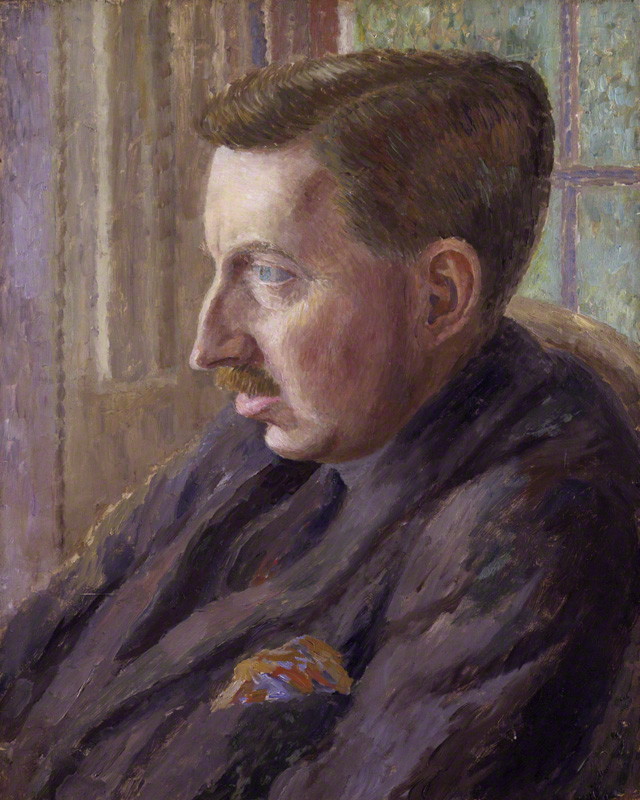
(A portrait of Forster by Dora Carrington, circa 1924-25, via Wikimedia Commons)

Policing The Police With Cameras, Ctd

A reader writes:

Your recent post about equipping police forces with video cameras struck a chord with me, as I recently sat on a jury where the lack of video played a central role. The case was not particularly exceptional, and the lesson obviously anecdotal, but it was a major eye-opener for me.

A young Hispanic male from a nearby town known for its drug trade was targeted and arrested by a drug task force, although no drug charges were presented. He was charged with two counts of assault with a deadly weapon (ramming the undercover cruiser behind him with his car), operating a motor vehicle to endanger (driving on the sidewalk to evade the ad hoc police blockade), leaving the scene of an accident, negligent operation (running stop signs) and failure to stop for police.

The very first question the defense lawyer asked was, “Where’s the video?” Of course there was none, and in the absence of actual evidence, video or otherwise, the six middle/upper-middle class white people that composed our jury took it on faith that four police officers would casually perjure themselves and voted not guilty on the assault and endangerment charges. At one point, one of the jury members asked “Why are there no witnesses?” I’m no friend of the police, but I felt I had to remind the group that technically the State presented four witnesses – the four police officers.

In the end, we voted to convict on the negligent operation and failure to stop charges, based on the defendant’s own account of the episode during his testimony. I couldn’t help but think that the police have a real, existential problem when the juror I expected to be most sympathetic to the police – the contractor who told the court he knew a few cops from the neighborhood – turned out to be the one most adamant that the officers’ testimony should be completely disregarded.

The day may be fast approaching when any officer who wants to be believed in court will welcome video evidence to back them up, and that will surely be a win for anyone interested in justice.

The Hawk Gap

by Dish Staff

Last week, after observing that the prospective 2016 candidates are taking much more hawkish positions on foreign policy issues than public opinion would suggest, Beinart suggested that this might be one more deleterious effect of money on our political system:

For a century, Americans have responded to disillusioning wars by demanding a less interventionist foreign policy. It happened after World War 1, after Korea, after Vietnam, and it’s happening again in the wake of Afghanistan and Iraq. The difference between this moment and past ones is the role of money in politics. As on so many issues, politicians’ need to raise vast sums from the super-rich makes them ultra-responsive to one, distinct sliver of the population and less responsive to everyone else. The way campaign finance warps the political debate over financial regulation is well known. What we’re witnessing this year is a case study in the way it warps the foreign-policy debate as well.

Daniel Drezner’s not so sure about that, pointing out that foreign policy talk is about as cheap as it gets:

Beinart’s thesis is that this gap has grown even more in recent years, but I’m not sure that’s what going on. The most important fact about American foreign policy and public opinion is that Americans just don’t care all that much about the rest of the world. Sure, they’ll express less interventionist preferences when asked, but most of the time they don’t think about it. It’s precisely this lack of interest that gives presidents and foreign policymakers such leeway in crafting foreign policy. … Statements about how one would do things better on the foreign policy front are among the best examples of cheap talk you’ll find in Washington. Why? Because the world will look different in January 2017 than it does today. So of course these proto-candidates can say they’d do things differently. No one will hold them to these claims if they’re elected, because the problems will have evolved.

Larison agrees with Drezner. In another post touching on this opinion gap, he takes down the notion of a “paradox” in the public’s attitude toward Obama’s foreign policy:

According to this story, Obama has given Americans the foreign policy they say they want, but they now disapprove of Obama’s foreign policy, so we’re supposed to believe that there is a “strange duality” at work. Instead of coming to the much more straightforward conclusion that Obama is not giving Americans the foreign policy they want (and that his foreign policy is still too activist and meddlesome), elite interventionists of different stripes engage in a lot of groundless speculation that the public actually wants the same things that the interventionists themselves want. It’s not obvious that most Americans “want a president to lead” in this case. The obsession with such “leadership” is primarily one shared by elites, and their idea of “leadership” requires a degree of U.S. activism overseas that the public hasn’t supported for years. The public-elite gap on foreign policy has rarely been wider than it is now because most Americans have no real interest in the “leadership” role for the U.S. or the president that foreign policy elites demand.

The Meaning Of #Ferguson

by Dish Staff

Over the weekend, David Carr marveled at how well Twitter has matured as a tool for journalism:

For people in the news business, Twitter was initially viewed as one more way to promote and distribute content. But as the world has become an ever more complicated place — a collision of Ebola, war in Iraq, crisis in Ukraine and more — Twitter has become an early warning service for news organizations, a way to see into stories even when they don’t have significant reporting assets on the ground. And in a situation hostile to traditional reporting, the crowdsourced, phone-enabled network of information that Twitter provides has proved invaluable. …

In and of itself, Twitter is not sufficient to see clearly into a big story; it’s a series of straws that offer narrow views of a much bigger picture. But as a kind of constantly changing kaleidoscope, it provides enough visibility to show that something significant is underway.

Along those lines, Amma Marfo focuses in on how important Twitter has become to the black community, particularly over the past week:

Twitter’s lack of algorithms to control the display of content means that posts are elevated in popularity only by the people who favorite, Retweet, and share screen captures of impactful or informative messages. Such a structure allows the insight of the observant but relatively unknown amateur, alongside high-profile and highly educated (another population that uses Twitter in high volume), to stand alongside one another. This egalitarian information sharing model is welcome for historically disenfranchised populations. This could be key for its popularity with other minority groups such as Hispanics. Its use among African-Americans continues to rise, as does the increasing use of Twitter as a credible means to gauge public opinion and the newsworthiness of given topics.

But it’s worth noting that the overall social media ecosystem is not always like this. Last week, Zeynep Tufekci pointed out the difference in following the Ferguson protests on Twitter, which shows you all the tweets from whoever you follow in real time, and Facebook, which uses an algorithm to determine both what you see and when you get to see it. To highlight the frenzy of Ferguson tweets last Wednesday night she flagged this graph:
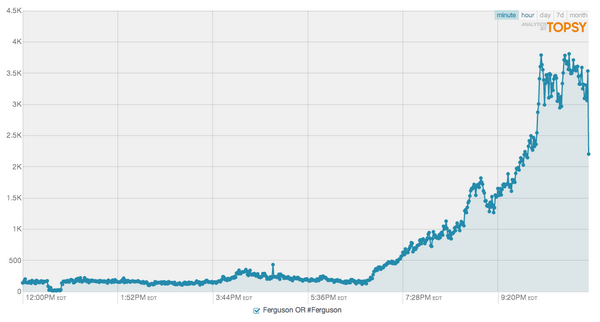
1-Iiwrv_8HH3EkUZqPtwtouw

But when she checked her Facebook feed during that spike, there was nothing at all about the story, not until the next morning:

Overnight, “edgerank” –or whatever Facebook’s filtering algorithm is called now — seems to have bubbled [the Ferguson items] up, probably as people engaged them more. But I wonder: what if Ferguson had started to bubble, but there was no Twitter to catch on nationally? Would it ever make it through the algorithmic filtering on Facebook? Maybe, but with no transparency to the decisions, I cannot be sure.

Would Ferguson be buried in algorithmic censorship?

And as she goes on to note, Twitter already does use an algorithm to determine what topics trend nationally, which may have partially delayed the onset of Ferguson’s social media attention last week. Also, it looks like Twitter is now messing even further with what their users see, as Jay Yarow explains:

Until now, your timeline was filled only with tweets from the people you follow, or retweets from those same people. In other words, you got only the content for which you opted in. [The new policy] opens up the possibility for Twitter to start putting tweets from people you don’t follow in your feed.  … By doing this, Twitter makes its timeline more like Facebook’s News Feed, which populates based on algorithms that measure likes and interests.

“The Politics Of Respectability”

by Dish Staff

Coates is beyond tired of the continual “transmutation of black protest into moral hectoring of black people”:

Don Imus profanely insults a group of black women. But the real problem is gangsta rap. Trayvon Martin is killed. This becomes a conversation about how black men are bad fathers. Jonathan Martin is bullied mercilessly. This proves that black people have an unfortunate sense of irony.

The politics of respectability are, at their root, the politics of changing the subject—the last resort for those who can not bear the agony of looking their country in the eye. The policy of America has been, for most of its history, white supremacy. The high rates of violence in black neighborhoods do not exist outside of these facts—they evidence them.

Ioffe likewise addresses the “troubling self-flagellation in Ferguson’s black community”:

Respectability, in essence, is about policing the behavior in your community to make sure people are behaving “properly,” so as to not attract unwelcome attention from whites“with ‘properly’ being a normatively white middle class presentation,” says [political scientist Michael] Dawson. In feminist discourse, a similar phenomenon among women is described as internalizing the patriarchal gaze. That is, women see themselves as the men in charge want to see themfeminine, sexy, pliantand then behave and dress accordingly. Respectability is the same thing, but with blacks internalizing the white gaze. …

In some ways, this is an understandable response: If you are in the minority, and are disadvantaged and exposed to danger because of it, it is natural to try to minimize the downsides by trying to live according to the laws of the ruling majority and not call attention to one’s differences from them. It also provides a modicum of comfort, a sense that one can have control over the amount of discrimination one is exposed to even when in fact it is out of your control. “There’s good empowerment and false empowerment,” says [Jelani ] Cobb. “But if you think that the problem is within us, then at least it gives you the idea that you have the capacity to change it.” It also sidesteps the issue of institutionalized racism, the real reason for the fact that, in Chicago, blacks and Latinos were four times more likely to be stopped by the police than whites. “Really, what we’re dealing with is racism that is entrenched, and that we have limited capacity to determine how much of it we’re exposed to in our lives,” says Cobb.

Policing The Police With Cameras, Ctd

by Dish Staff

Ferguson is exploring outfitting its officers with dash and body cameras. Sara Libby points out a problem San Diego has had with its body cams:

Here in San Diego, our scandal-plagued police department has begun outfitting some officers with body cameras, and the City Council has approved a plan to roll out hundreds more. Officers wearing the cameras were present during at least two shootings earlier this year. Yet we’re still not any closer to knowing what happened in those chaotic moments—whether the perpetrators can be easily identified, what kind of interactions the officers had with those present, nothing.

That’s because the department claims the footage, which is captured by devices financed by city taxpayers and worn by officers on the public payroll, aren’t public records. Our newsroom’s request for footage from the shootings under the California Public Records Act was denied. Once footage becomes part of an investigation, the department says it doesn’t have to release them. SDPD also said during the pilot phase of the camera program that it doesn’t even have to release footage from the cameras after an investigation wraps.

Kriston Capps sees limits to what police cameras can accomplish in Ferguson:

A survey of the available research conducted by the Office of Justice Programs Diagnostic Center shows that most of the claims about police body cameras have not been fully tested, while many of the consequences for law-enforcement agencies, labor unions, and communities have not even been explored.

But city leaders have other, better, more immediate options if they truly want to “demonstrate the transparency of our city departments.” Namely, leaders in Ferguson should require officers to put their badges back on their vests and ask the Federal Aviation Administration to put the news choppers back in the air.

T.C. Sottek expresses more skepticism:

Body cameras would be a welcome improvement for many in Ferguson, but even dash cameras, used by other police departments across the United States, haven’t been installed there. The city’s police chief revealed last week that the department purchased two dash cameras and body cameras, but never installed them due to cost.

Scott Shackford, for his part, thinks cameras may help. He points out that Rialto, California “has made national news for making officers wear vest cameras, reducing the use of force by police and complaints against the police.” Earlier Dish on the cameras-for-cops debate here.

How Far Will Obama’s Iraq War Expand? Ctd

by Dish Staff

Refugees Fleeing ISIS Offensive Pour Into Kurdistan

Saletan chronicles how the limited intervention in Iraq has already outgrown its original parameters:

In his weekly address on Aug. 9, Obama added a third mission to the military agenda: “We will protect our citizens. We will work with the international community to address this humanitarian crisis. We’ll help prevent these terrorists from having a permanent safe haven from which to attack America.” He repeated that point in a press conference: “We will continue to provide military assistance and advice to the Iraqi government and Kurdish forces as they battle these terrorists, so that the terrorists cannot establish a permanent safe haven.” That’s a huge undertaking. Any land controlled by ISIS can be construed as a safe haven. Does Obama plan to drive ISIS out of places such as Fallujah, which it held for months while the United States looked on? Does he plan to push ISIS all the way back to Syria?

Obama hasn’t forgotten all the principles that limited his commitment. He continues to insist that the solution to Iraq’s crisis is political, that Iraqis must achieve that solution themselves, and that putting U.S. troops on the ground creates a dangerous rationale for additional deployments to protect them. But 12 days into the military campaign, he’s showing signs of slippage. He’d better watch himself.

Larison stresses that mission creep is the rule, not the exception, when it comes to such interventions:

Once a president has committed to using force in a foreign conflict, all of the effective political pressure is on the side of escalation.

Having conceded that the U.S. should be involved militarily in a conflict, the president is bombarded with demands for deeper involvement in order to pursue the illusion of victory. If he doesn’t agree to these demands, he will be steadily pilloried in the media until he does, and any adverse development in the affected country will usually be attributed to insufficient American involvement. Since the initial decision to intervene was driven in part by the same sort of pressure, it is more than likely that the president will keep yielding to calls to “do more.”

Keating wonders what “mission accomplished” will mean in Iraq this time around:

The cynical answer is that the goal seems to be for Iraq to become just stable enough that we can go back to not paying attention to it. And I suspect that in the end, that may have more to do with how long the U.S. media continues to treat Iraq as a major story than with what’s actually happening there.

And Benjamin Friedman argues that “Americans, the president included, need to admit being out of Iraq potentially means letting it burn”:

The collapse of the fiction that U.S. forces stabilized Iraq before exiting forces us to confront the unpleasant contradictions in U.S. goals there. We want to avoid the tragic costs of U.S. forces trying to suppress Iraq’s violence. We want a stable Iraqi federal government and we want Iraqis to live peacefully. Each of those goals conflicts with the others. Even if the new Prime Minister is amenable to Sunni demands, U.S. bombing is unlikely to allow Iraqis to destroy ISIL and its allies. Large-scale violence will likely continue. Suppressing insurgency will likely require resumption of U.S. ground operations. And even that, we know, may not help much.

(Photo: Spencer Platt/Getty Images)