Grand Jury, Limited Justice?

by Dish Staff

Darren Wilson, the police officer who shot and killed Michael Brown, may be facing a grand jury. Jonathan Cohn explains:

Here’s how the process will work, according to criminal law experts based or practicing in Missouri. The grand jury, which consists of twelve people plucked from the local population, will sit around a table in a deliberation room somewhere in the county courthouse building. It’s the prosecutor’s show: He will present the case, starting with an overview and then bringing forward evidence. But it’s not like a trial. There will be no attorney for the other side, no judge, not even a bailiff. For most of the time, they will be alone except for the prosecutor and, on occasion, a witness who will be providing testimony.

The idea behind a grand jury is that it serves as the people’s voicein effect, a democratic check on the enormous power of prosecutors to bring charges and force people into trials. A grand jury can be a truly deliberative body if it wants. Members can ask for witnesses to appear and testifyand ask those witnesses questions directly. Grand juries can also control their proceedings, deciding how much evidence to hear and when, finally, to vote on charges. In Missouri, it takes at least nine jurors to deliver an indictment, which is known as a “true bill.” Any less and the jury reaches a verdict of “no true bill,” which means no indictments.

Amanda Taub interviews former federal prosecutor Alex Little on what a grand jury will mean for this case:

The only question the grand jury must answer is whether there is probable cause to believe a crime has occurred. That’s a very low standard, and it’s almost always met when the District Attorney seeks charges.

“So when a District Attorney says, in effect, ‘we’ll present the evidence and let the grand jury decide,”‘that’s malarkey. If he takes that approach, then he’s already decided to abdicate his role in the process as an advocate for justice. At that point, there’s no longer a prosecutor in the room guiding the grand jurors, and — more importantly — no state official acting on behalf of the victim, Michael Brown.

“Then, when you add to the mix that minorities are notoriously underrepresented on grand juries, you have the potential for nullification — of a grand jury declining to bring charges even when there is sufficient probable cause. That’s the real danger to this approach.”

Joe Coscarelli points out that the same procedure is taking place in the case of Eric Garner’s killing:

In Staten Island, District Attorney Daniel Donovan said in a statement, “I have determined that it is appropriate to present evidence regarding the circumstances of [Eric Garner’s] death to a Richmond County Grand Jury. Yesterday, the Court granted my application for the impaneling of an additional Grand Jury and I intend to utilize that Grand Jury sometime next month to begin presenting evidence on this matter.” In what the medical examiner ruled a homicide, Garner died after being put in what appeared to be an illegal NYPD chokehold during an arrest for selling loose cigarettes.

The move to a grand jury comes after a “careful” review of the evidence, Donovan said.

Angela J.Davis argues we should look beyond just the cops in Ferguson:

Bob McCulloch is the prosecutor for St. Louis County and has held the position for 23 years. McCulloch has stated that he will present the evidence of Michael Brown’s killing to a grand jury, but members of the African-American community have expressed concern about his ability to be fair. There is always such a concern in cases involving the investigation of police officers. Police officers don’t technically work for prosecutors, but they are definitely part of the prosecution team. They investigate the cases, gather the evidence, and testify as witnesses for the state. Without police officers, prosecutors can’t bring cases or secure convictions. So prosecutors have an inherent conflict of interest when they are considering charges against police officers.

The conflict seems particularly deep-seated in this case. Bob McCulloch’s father was a police officer who was killed in the line of duty when McCulloch was a child. And McCulloch was very critical of Missouri Governor Jay Nixon’s decision to place the Missouri State Troopers in charge of security after complaints about the St. Louis police department’s violent attacks on peaceful protestors and journalists. McCulloch called the governor’s decision “shameful” and accused him of “denigrat[ing] the men and women of the county police department.”

Chris Geidner expects lawsuits all around:

“There will be lawsuits up the kazoo,” said Barbara Arnwine, the longtime president and executive director of the Lawyers’ Committee for Civil Rights Under Law, in an interview Sunday evening. “I think you’re going to see ripple after ripple of legal matters here in response to this outrageous situation.”

The first matter will be the potential criminal and civil actions related to Brown’s death. But legal experts also predict possible litigation stemming from the actions taken by police in Ferguson, lawsuits brought by store owners against the police related to looting, and even the imposition of a curfew.

Fark Self-Censorship

by Dish Staff

Amanda Hess has limited expectations for a new misogyny ban at Fark:

Policing misogyny is fabulous in theory. In practice, it’s a bitch. [Drew] Curtis notes that Fark’s commenters often appear to be engaging in an extreme “parody” of sexism, using a pastiche of satirical cultural references. (Fark contributors favor the SNL line “Jane, you ignorant slut” and callbacks to Blazing Saddles’ rape jokes.) Where is the line between pointed social commentary and vile misogyny? “On SNL and in a comedy movie … the context is clear,” Curtis continues. “On the Internet, it’s impossible to know the difference between a person with hateful views and a person lampooning hateful views to make a point. The [moderators] try to be reasonable, and context often matters. We will try and determine what you meant, but that’s not always a pass.” He added: “I recommend that when encountering grey areas, instead of trying to figure out where the actual line is, the best strategy would be to stay out of the grey area entirely.”

Telling members of an anonymous Internet message board to stop hating women is, unfortunately, a monumental ask. But instructing posters to refrain from pushing the boundaries of acceptable human discourse—to avoid a “grey area” just in case—is an irresistible provocation. The gray area between vile offensiveness and dark humor is where Fark’s commenter community thrives.

Jason Koebler is more optimistic:

“oderating speech online is tricky, and there’s the whole “slippery slope” argument to be made about censorship. Let’s be clear here: privately owned websites are obviously not required to respect the First Amendment, but there’s a mandate on the internet that anything and everything goes that there’s this de facto assumption that you should be able to say whatever you want, anywhere on the internet.

But Fark’s move is more likely to actually facilitate truly free speech, rather than restrict it. And it’s a sign that women’s rights are thankfully and finally being taken a bit more seriously of late (take a look at what Gawker finally did over at Jezebel last week for another example).

Jessica Roy, meanwhile, responds to some of the backlash the ban has received:

It’s hard to imagine Fark’s community will suffer from the banning of easy rape jokes — if anything, it will make the community a safer space for women and might even elevate the quality of humor. And don’t worry, if you’re desperate to discuss how women who dress slutty deserve to be raped, there’s always r/mensrights.

The Slums Of The Future

by Dish Staff

Prachi Vidwans explains why we should worry about them:

If it seems like conflict over slums is mounting, that’s because it is: The urbanization of the world is accelerating. In 1950, just 29 percent of the world’s population lived in cities; back then, that was roughly 742 million people. Today, more than half of the world’s people — more than 3.5 billion — are citydwellers. That may sound like a dramatic shift, but you ain’t seen nothing yet. Roughly 70 million people move into cities every year, and the vast majority of them usually end up in illegal or informal urban settlements. According to U.N. estimates, by 2050, a third of the world’s population will live not just in cities, but in slums.

The growth of slums is a bit like climate change: We know it’s happening. We know it’s important. But no one, so far, seems to have much of a response. Policymakers tend to view slums as a necessary evil, a problem best contained through coercion or ad hoc responses. Experts point out, however, that there is a rational way to deal with the coming surge of urbanization: Plan for it. If cities are prepared to anticipate and acknowledge the inevitable influx of urban migrants, slums might not be slums.

What’s The Matter With St. Louis?

by Dish Staff

St Louis

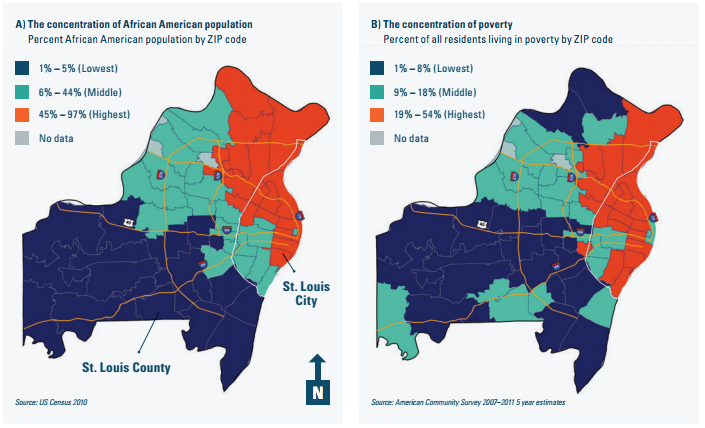
Yglesias digs up an illuminating set of maps:

In May of 2014, researchers from Washington University in St Louis and St Louis University put together a long report on racial health disparities in the St Louis area. It’s largely a deep dive into the socioeconomic roots of these disparities, and includes this map highlighting the pattern of segregation by race and income levels in both the City and County of St Louis. On the left is the distribution of the African American population in the city and county, and on the right is the distribution of poverty

Philip Bump examines the racial disparities in St. Louis:

The unemployment and poverty rates for blacks in St. Louis County are consistently higher than those rates for white residents. Only one time between 2007 and 2012 has the poverty rate for blacks been less than three times that of whites, according to Census data (which is only available through the latter year). The unemployment rate is two-to-three times higher, and, as of 2012, had grown worse while it grew better for whites.

What’s more, those figures disproportionately affect younger residents. [St. Louis Post-Dispatch columnist David] Nicklaus pulls out a subset of Census data: “47 percent of the metro area’s African-American men between ages 16 and 24 are unemployed. The comparable figure for young white men is 16 percent.”

Jamelle Bouie expects tensions in the St. Louis area to continue for some time:

A 2012 report from University of Missouri–St. Louis criminologist David Klinger found that, from 2008 to 2011, St. Louis police officers fired their weapons 98 times. “Any comparison across cities right now is still missing the lion’s share of circumstances in which people are shot by the police,” Klinger said to the St. Louis Post-Dispatch. “There are only a smattering of cities that report their officer-involved shootings, and when compared against them, St. Louis is on the high end.” The data on police violence is incomplete, as there is no federal effort to pull together information on unjustified homicides. But the anecdotes of brutality and excessive force out of St. Louis  and St. Louis County are rampant and often startling. In 2009, for example, a man was wrongly arrested, beaten by police, and subsequently charged for bleeding on their uniforms.

This abuse is so ubiquitous that the shooting of Michael Brown might seem like static against a backdrop of awfulness. But even for the area, Brown’s death was brutal. Which is why—in an otherwise quiet town in an otherwise quiet area—we’re dealing with an explosive fire that shows no signs of ending.

Perfectionist Parenting

by Dish Staff

Jesse Singal flags new sociological findings about the pressure on mothers and fathers to be “super-parent[s]”:

It’s almost as though when you tell parents that they need to be able to perfectly juggle work and child-rearing, but don’t give them the assistance basically every other rich developed country does, this leads to mental-health issues. Almost.

Jessica Grose concurs:

Of course, this is a very small study, and we can’t draw any sweeping conclusions from it. It doesn’t mean that these women would not be depressed if they breast-fed easily or if they had ample maternity leaves or if they had better family support. But certainly these things are not helping them feel like their best selves. I am a broken record these days in my exhortations to lay off judging new moms and to give them some goddamn maternity leave. So I’m glad that [Carrie] Wendel-Hummell did this study, and that we hear more and more voices of new moms who are struggling. The louder we are, the likelier we are to see some actual cultural and political change.

Excessive Financial Force

by Dish Staff

Sarah Stillman spotlights the economics of police militarization:

[T]he economic arm of police militarization is often far less visible, and offender-funded justice is part of this sub-arsenal. The fears that [Jelani] Cobb and [Malik] Ahmed describe—court debts that lead to warrants and people who are afraid to leave their homes as a result—compound the force that can be wielded during raids or protests like those on the streets of Missouri. Debtors’ fears change their daily lives—can they go to the grocery story or drive a child to school without being detained? “It deters people who have legitimate problems from calling the police, and removes the police’s ability to do what they’re supposed to be doing—helping people in the community respond to emergencies,” [Equal Justice Under Law cofounder Alec] Karakatsanis said. It erodes the community’s trust in and coöperation with law enforcement.

Court fees are Ferguson’s second biggest source of municipal revenue. Thomas Harvey, whose “group represents low-income residents of St. Louis County in municipal court proceedings,” illustrates what this means for individuals:

We had one woman who was pulled over and charged with driving with a suspended license, failure to register and no proof of insurance. She was ticketed and assessed fines of $1,700. She couldn’t pay that; she’s a mother of three living in Section 8 housing. She didn’t go to court, a warrant was issued for her failure to appear and a few months later she got into a car accident that wasn’t her fault.

They saw that she had a warrant, and held her for two weeks and then took her in front of a judge. She told them I can’t pay this money, so they reduced it to $700. For her, that might as well have been $700,000. What ended up happening was her mom borrowed against her life insurance policy and her sister gave her half her bi-weekly paycheck. That was two weeks in jail for unpaid traffic tickets. And what the court learned from that, is that, if they send people to jail, they’ll probably make money.

Every Sex Worker Is Somebody’s Daughter, Ctd

by Dish Staff

Elizabeth’s post about sex workers as the theoretical “daughters” of those opining on the topic continues to cause a stir. Adam Ozimek argues against thinking of adults in this way, no matter the issue at hand:

Whether you’d want your kid to do something is a terrible, selfish, and self-centered way to think about policy. You hear this kind of argument when it comes to drug use too. “Do you really want your kid to be able to smoke pot?” But the laws of this country aren’t the rules of your household. Stopping your kid from smoking pot or becoming a prostitute isn’t our job, it’s yours. Quite frankly if you need the law’s help in that regard then I’m guessing you’re going to have other problems on your hands anyway.

Ozimek, perhaps spoiling for a Dish guest-blogger show-down, goes on to quote Freddie making such an argument:

On the left you hear things like this when it comes to labor standards, especially around the globe. For example, I recall Freddie deBoer once wrote of an NPR piece on labor conditions in China:

Would Ira Glass ever allow his children, when grown, to work 60 hours a week? In those factories? In those conditions? Of course not.

Here we have not only have every U.S. citizen being treated like your child, but every worker in China, a country of 1.3 billion people that is thousands of miles away. That’s quite a paternalistic reach.

Many readers also responded to Elizabeth’s provocative argument. And it turns out that no, not everyone is losing sleep over the possibility that their children are or might become sex workers. Some speak from personal experience:

My friend recently went to LA to shoot porn. Her parents were fully aware; and she went with her husband (she only shot solo stuff and “girl girl” scenes. Her parents gave their blessing; I’m not sure “approve” is the right word, but they definitely were not upset by her decision and they were happy she seemed so excited.

I suspect a lot of parents would be like this: your primary desire is your child to be happy and safe; and after a certain point you get convinced that both will be true within that industry.

That said, it WAS a very odd experience. This is a girl who had had sex with only one guy in her life, and one girl; yet her second day there she is taken to a shoot in a hotel room, meets another young nervous girl, and in 15 minutes is having sex with her on film. The fact that she loved it was beside the point; there is something very weird about having a third party arrange your sex partner for you, and you having sex with them within 15 minutes of meeting them.

My friend is also a cam model on one of “those” sites; and she could easily make $75k this year. This is working from home, maybe 15-20 hours a week, setting her own hours, doing something that she loves to do. What parent WOULDN’T want their child to be in a situation like that?

Another reader astutely notes that even non-controversial romantic situations have the potential to freak out one’s immediate family:

“I submit that virtually every honest person — those with children of their own, as well as those who merely possess a functional moral imagination — will admit to being appalled at the thought.”

Sure, and every one of us is appalled at the thought of our parents having sex, too.  That doesn’t mean sex for old people is wrong.  It just means we don’t want to think of it. We don’t like to contemplate the sexuality of the people we have a close non-sexual relationship with.  When we men don’t are appalled at the thought of our daughters having sex for money, it’s just a more advanced version of not wanting to think of them having sex at all.

And another makes a feminist libertarian argument:

I think the key thing to understanding this is the framing – Father, Daughter.  It’s an entirely paternalistic approach, treating these adults as if they were children. “I know better than you.” The gender aspect matters to a degree, since it touches on the tendency towards protectiveness/possessiveness towards the sexuality of daughters, but even if we were talking about a mother or a son, the key point is the same.  This sort of logic and thinking should not be what drives us.  Your children are not yours to make decisions for once they become adults, nor should it remain in that frame. Just because someone wouldn’t want their daughter (or son) to sleep with half the people at their college, doesn’t mean that we should outlaw sex.

We need a society where everyone’s choices are respected, not treated as perpetual children. Laws should be about reducing risk associated with those choices (focused on making sure no one else screws us over, literally or figuratively) not about making our choices for us.

A different reader – one with daughters! – argues that there are options worse than sex work:

What a lede – it just made me shout out, in the presence of both my kids “THAT’S NOT TRUE!”  Having a daughter as a sex worker is not my worst nightmare – there are many fates worse than being a sex worker, and being a sex worker can actually prevent some of them (dying homeless, being “forced” by finances into a bad marriage, starving while working “legit” fast food, etc.).  My daughters both agreed.  And then they added that most of the true hazards of the sex business come from its illegality.

Another reader dissents:

One does not have to be an uptight sexual prude to expect more from one’s daughter beyond having sex for money. Does this mean I do not respect sex workers? I respect them if they made their own choice to be in the sex business; but I often wonder if they truly did.

Why? Because I shared a rehab group therapy with a number of young women who worked the sex trade as teenagers and then young women. The experience showed me that none of them did sex work as an ambition; none said they sold their bodies as a deliberate choice to work in the sex trade. Most told how they started peddling their bodies for sex as strippers, or because a man offered to pimp them (one was 14 when her volleyball coach raped her, then turned her out). Sex work was a way to pay for drugs, and to feel loved for a bit. None spoke highly of the sex work they did. All were trying to end doing it, and those with daughters were very concerned their children might end up in sex work, because of how they got there.

Add to it none saw sex work as a viable way to make a living.

My stance on this front is: I do not want my daughter to aim so low in her life, that sex work becomes her only option, or an option at all.

The Ferguson Fishbowl

by Dish Staff

Earlier this week, Max Fisher shared his alarm at how the press have been treated in Ferguson, where at least 11 journalists have been arrested since the protests began:

This has a much deeper and more damaging effect than just suppressing media coverage. Arresting and intimidating journalists are inherently political acts, guaranteed by design to generate attention. Much as when it’s done in far-away conflict zones and authoritarian states, it’s about making a statement. It’s about demonstrating, to ordinary citizens even more than to journalists, that police believe they can exercise absolute control over the streets and anyone in them.

That police in Ferguson are targeting journalists so openly and aggressively is an appalling affront to basic media freedoms, but it is far scarier for what it suggests about how the police treat everyone else — and should tell us much about why Ferguson’s residents are so fed up. When police in Ferguson are willing to rough up and arbitrarily arrest a Washington Post reporter just for being in a McDonald’s, you have to wonder how those police treat the local citizens, who don’t have the shield of a press pass.

But Chris Hayes, who was himself threatened by a cop while reporting on the protests, nonetheless sympathizes with the police:

I think it’s a fair assessment to say police don’t really enjoy doing this job while being recorded all the time. That press freedom is beautiful is not the prevailing sentiment. In their defense, they’re in a high-stress, highly adrenalized situation. It’s dark. They’re hearing over the police radio “shots fired!” I heard that over a police radio. It turned out to be fireworks. But they’re worried they might be in danger.

Noah Rothman, meanwhile, casts aspersions on some of the media in Ferguson for essentially roleplaying:

Crowd control requires managing the press just as it does for protesters, and it is the height of irresponsibility for reporters to create the conditions, as some have, which would force police to view them as a threat proportionate to that of the protesters. While police would be well-advised to avoid making martyrs of journalists, even if some appear to welcome that condition, there is only so much leeway law enforcement can provide.

What is going on in Ferguson is complicated, but the press may no longer be playing a helpful role. In fact, they could be inflaming a tense situation even further. While that is debatable, what is indisputable is what the media has become: part of the story.

Josh Voorhees shakes his head:

[M]issing from such handwringing about the reporters’ ostensible loss of objectivity is the fact that the media had left the sidelines long before [the Washington Post’s Wesley] Lowery and [the Huffington Post’s Ryan] Reilly were handcuffed. The very reason that national reporters … packed their bags for Ferguson was to get answers. Answers to why a member of the Ferguson Police Department opened fire on an unarmed black teen in broad daylight. Answers to why city officials originally refused to identify the cop involved in the shooting or even say how many bullets he had fired. Answers to why police were responding to what originally were largely peaceful protests with military-grade riot gear.

In short, the media descended on Ferguson looking for the same thing that had led protesters to take to the streets: the truth. That’s the real reason the media is siding with the protestors: What the people in the streets of Ferguson want is the same thing the journalists were sent there to find.

And in the end, sometimes getting arrested just gives journalists an alternative method of access, which is what happened with Ryan Devereaux:

[Bild reporter Lukas Hermsmeier and I] were jailed with a cross-section of the Ferguson protesters. Most of our cellmates were African American and from Ferguson or surrounding areas, though there were also some white men in the mix, too. There were three recently discharged veterans in our group and one active duty service member. I don’t know how many—if any—of the men I was in jail with had participated in the violent, destructive protesting that I saw. But far from being the hardened criminals some might paint them as, these young men—most of whom had never met before last night—offered support for each other. They were kind to one another. …

The concerns these men raised—and the intensity that they have for this moment in Ferguson—runs very deep. Several cited the disproportionate number of traffic stops of young men of color as a specific problem. On a more fundamental level, their grievances centered on a perceived lack of respect from the police sworn to protect their communities, a sense that anything could be done to them and nothing would be done in response. One young African American man from the area positively beamed at being arrested for a cause; he likened it to going to jail with Dr. Martin Luther King, Jr.

Follow all our Ferguson coverage here.