Face Of The Day

by Dish Staff

Bird Feeding

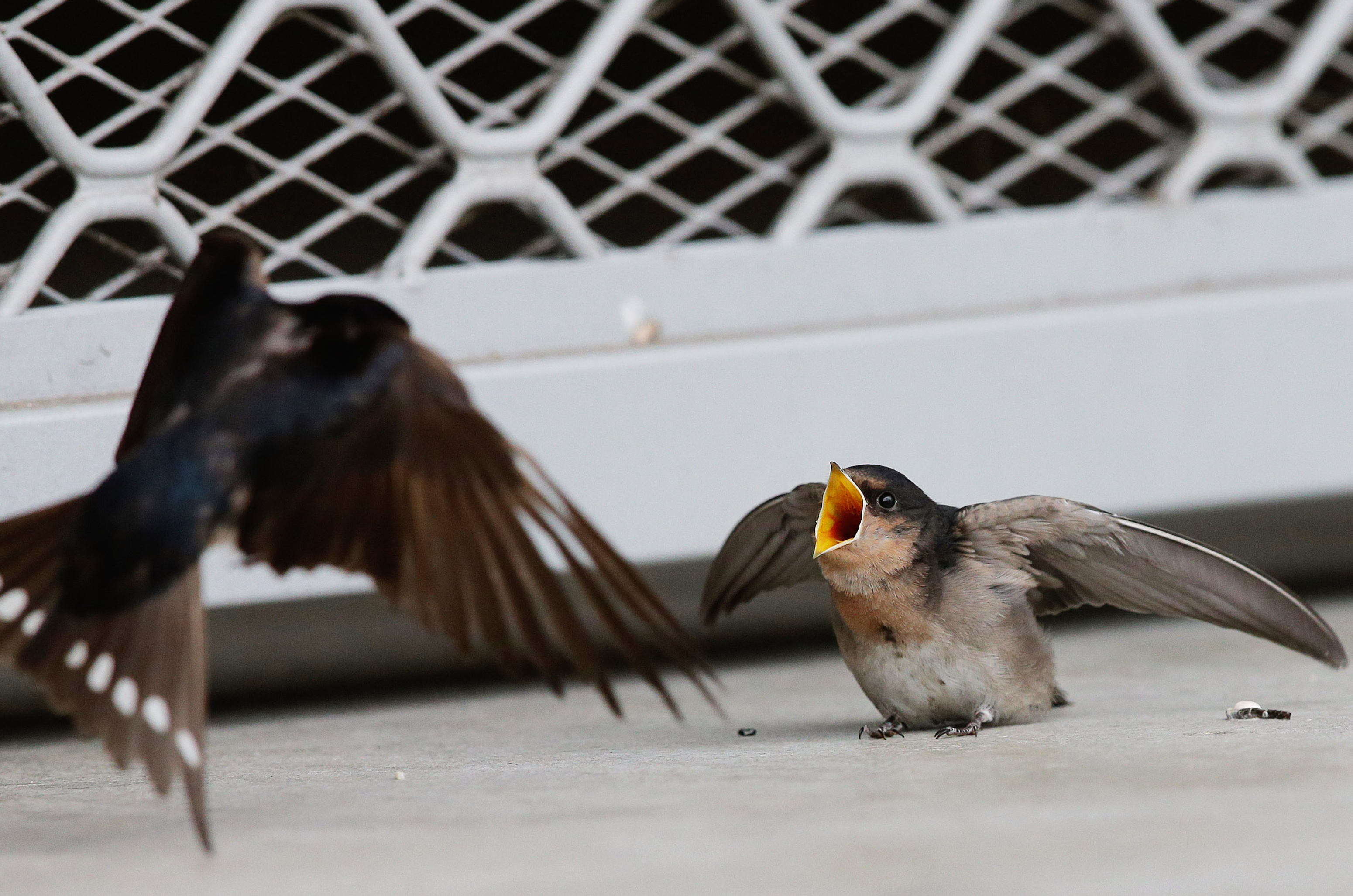
A Mynah bird feeds its young in Sydney, Australia on December 18, 2014. By Guillaume Gros/GG. Update from a reader:

I’m sure I’m not the first to tell you, but those do not look like Mynah birds. They look to be swallows, but I don’t know what species they would be in Australia.

Another adds, “They are probably Welcome Swallows, Hirundo neoxena.”

Getting High For Two

by Dish Staff

Libby Copeland tells the story of Tamara Loertscher, “a woman arrested for drug use even though she says she stopped when she realized she was pregnant, brought to court and twice refused lawyers (even though her fetus was given one), and then sent to jail for 17 days, where she was placed in solitary confinement, denied prenatal care even as she began cramping, and not given her thyroid medication for two days, according to the woman and her lawyers”:

[Y]ou can’t consider Wisconsin’s punitive approach to pregnant women—which purports to protect “unborn children”—without first considering how the state has failed to promote actual family values.

Loertscher, who suffers from hypothyroidism and depression (they are often linked), says she quit her job last February during a depressive episode and then found herself without insurance. Wisconsin is one of the states that turned down the Medicaid expansion tied to Obamacare that might have made it easier for people in her situation to get health insurance. She says she started using meth and marijuana in an attempt to self-medicate for the fatigue and depression she was experiencing, using meth two to three times a week and marijuana less often. She also took an over-the-counter supplement for the thyroid problem.

Commenting on the case, Katie McDonough notes:

Wisconsin is far from the only state to subject pregnant women to a different set of rules and the threat of arbitrary detention. Earlier this year, Tennessee became the first state in the nation to criminalize pregnancy outcomes, though other states have used existing child abuse laws to detain pregnant women.

Between 1973 and 2005, National Advocates for Pregnant Women have documented 413 documented cases in which a woman’s pregnancy was a necessary factor in criminal charges brought against her by the state. There have been an additional 350 cases documented within the last decade. In each of these cases, women have been deprived of due process, the right to legal counsel and other basic constitutional protections because they were pregnant.

Amanda Winkler focuses on Tennessee:

The number one cause of death in Tennessee is drug overdose, surpassing the number of vehicle accidents fatalities in 2013. And pregnant women aren’t immune from addiction: approximately 900 babies were born with Neonatal Abstinence Syndrome (NAS) in the state last year, a ten-fold increase from a decade ago. NAS is caused when mothers continue their opiate or narcotic drug use through pregnancy; babies can usually be weened off the drug within a few weeks after birth and there are no known long term effects.

However, Tennessee officials have declared NAS an “epidemic” and took action this past July with the implementation of Public Chapter 820. The law makes it possible for a woman to be charged with assault for the use of a narcotic drug while pregnant if her child is born harmed by the drug. An assault conviction is punishable by a fine and anywhere from one to 15 years in prison. So far, around 9 women have been charged under this law. The law has been controversial, with opponents saying it’s counter-productive to put a drug-addicted mother in jail.

Obama Scraps Our Failed Cuba Policy, Ctd

by Dish Staff

Screen Shot 2014-12-18 at 12.26.49 PM

Erik Voeten notes that, in one respect, Cuba isn’t the only country that’s been internationally isolated by the US embargo:

The United Nations General Assembly has voted since 1992 on an annual resolution on the “necessity of ending the economic, commercial and financial embargo imposed by the United States of America against Cuba.” In 1992, with the Cold War just ending, fewer than 50 percent of all member states voted in favor of the resolution (more than half abstained). The graph above shows how quickly any semblance of support for the embargo evaporated.  In its latest iteration only Israel joined the Americans in voting against the resolution, although, to its credit, the United States did get the Marshall Islands, Micronesia, and Palau to abstain.

U.N. General Assembly resolutions have mostly symbolic value as they do not create binding legal obligations. Yet, U.S. isolation probably undermined the effectiveness of the embargo.

Juan Carlos Hidalgo applauds Obama’s decision to re-establish relations:

The president’s move should be uncontroversial. U.S. policy toward Cuba has been a blatant failure. It has not brought about democracy to the island and instead provided Havana with an excuse to portray itself as the victim of U.S. aggression. It has also served as the scapegoat for the dilapidated state of Cuba’s economy. Moreover, according to government reports, the embargo has also become somewhat of a U.S. security liability itself. As for the economic measures, they are significant in symbolism, yet limited in their likely impact as long as Cuba retains its failed communist economic system. The 114th Congress should pick where the president left off and move to fully end the trade embargo and lift the travel ban on Cuba.

The Bloomberg View editors argue that Obama’s move will hasten the end of the Castro regime, especially if (as is unlikely) Congress plays along and lifts the trade embargo:

The opening of embassies will also have beneficial effects diplomatically. It sucks some air out of the most fevered denunciations of the U.S. by fellow Cuban travelers such as Venezuela, makes it easier for the U.S. to partner with countries such as Brazil, and helps transform the doddering Castros from symbols of resistance to minor diplomatic players.

Of course, as long as the U.S. embargo remains in place, the Castros will retain some of their revolutionary cachet, not to mention their grip on Cubans’ livelihoods. For that to go away, and for Cuba to leave socialism and its 1950s Chevrolets in the rearview mirror, the U.S. Congress must act: Under the terms of the Helms-Burton Act and other laws, the embargo can’t be fully lifted without its concurrence.

Fallows calls the embargo the stupidest American policy of the last 35 years:

I choose “at least 35 years” as the demarcation point for undeniable irrationality because that is when the U.S. fully normalized its relations with mainland China. If successive Republican and Democratic administrations could see the merit of trying to engage (rather than exclude) a one-party repressive communist-run state, even when that state had four times as many people as the U.S. did, and is nuclear-armed, and is a regional rival of several U.S. allies, how much more obvious is the case for a tiny little island practically within eyesight of the American mainland and certain to fall under the sway of U.S. cultural and economic influence if given a chance?

Not to mention that recognizing the People’s Republic of China meant cutting off America’s relationship with the people and government of the Republic of China on Taiwan, which itself has twice the population of Cuba and nearly 10 times as large an economy. There is no comparable tit-for-tat cost for the U.S. in normalizing relations with Cuba.

Keating wonders, however, what Castro’s motives are:

“I do think that they’re trying to lay the groundwork for a process of change in which they can keep their scalps and guide the country toward a more sustainable political system,” Christopher Sabatini, senior policy director and chairman of the Cuba Working Group at the Americas Society/Council of the Americas, told Slate.

The other big factor at play here is the turmoil in Venezuela. The South American nation threw the tottering Cuban economy a lifeline during the regime of Hugo Chávez, providing the island with 100,000 barrels of oil per day. Today, in the aftermath of Chávez’s death and bruised by political turmoil and the plummeting price of oil, Venezuela’s economy is in chaos and the government is on the verge of defaulting on its debt. “You don’t need to be a capitalist to realize that Venezuela’s economy is in very dire straits,” said [Christopher] Sabatini. “It’s getting worse literally by the day. So they’re going to lose that benefactor.” Add the Venezuela situation to the Castros’ advancing years and you can understand what’s driving Raúl toward a more accommodating stance.

Jason Koebler highlights what a big deal it will be for Cuba to finally get the Internet:

What’s this all have to do with the internet there? Well, the ​submarine cable system that connects much of the world with fiber optics has basically bypassed Cuba. Instead, the country has been relying on extremely old and slow satellite technology to give its people (limited and censored) internet access. Obama specifically said he will allow American telecom companies to work with Cuba. …

That’s huge. Internet access in the country is abysmal. Only 5 percent of Cubans have internet access, and barely anyone had internet in their homes until this year, when the state-owned Empresa de Telecomunicaciones de Cuba began offering very limited, very slow internet connections to some residents. Before that, the internet was only available at 118 kiosks, where residents had to pay $4.50 an hour (an astronomical sum in Cuba) to use computers.

Yglesias Award Nominee

by Dish Staff

“It’s been a half century now. Unless and until someone can show me something besides political talking points to the contrary, the embargo was simply not working. The Castros remain in power and the government has not significantly changed. And as we have repeatedly demonstrated in our negotiations regarding sanctions and punishment of other nations such as Iran, Iraq or Russia, sanctions and embargoes do not work unless you can get significant buy-in from your allies. Nobody is joining us on this. Canadians regularly vacation in Cuba. Nearly every other western nation trades with them. We simply don’t have any backup here,” – Jazz Shaw, Hot Air.

Terrorstan

by Dish Staff

bialik-datalab-peshawar

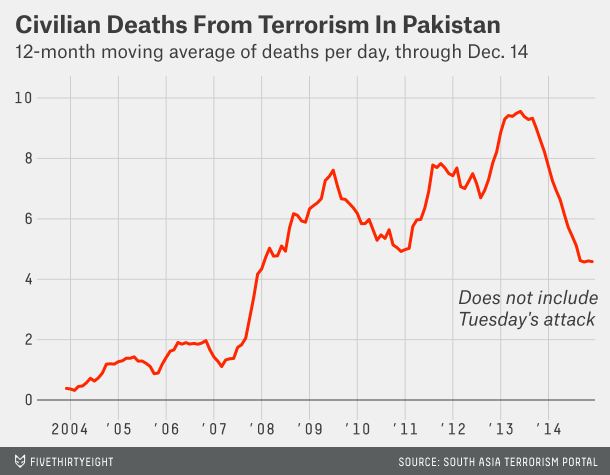
Before Tuesday’s horrific attack on an army school, Carl Bialik grimly notes, Pakistan’s terrorism problem was on a downward trend, from utterly horrifying to just god-awful:

More than 3,000 Pakistani civilians died in terrorist attacks in both 2012 and 2013, according to the South Asia Terrorism Portal, which monitors violence in the region. This year, through Sunday, 1,595 civilians had died, including 26 this month. Twenty-six is a horrific total for most countries in a year — 20 more than the number killed in all of 2013 in the U.S., which has roughly 75 percent more residents than Pakistan. But it’s also a monthly rate of about 58 civilians, the fewest killed in a month in Pakistan since 56 civilians died in August 2007. Tuesday’s attack reversed that modest progress; December now is the deadliest month since February.

So how did Pakistan become so unmanageably violent? In part, Matthew Green blames the government’s longstanding policy of cultivating ties with some militants in order to fight others:

First, and most important, Pakistan’s security establishment has to make a permanent break with its decades-long romance with jihadi proxies. The distinction that some in the nation’s security apparatus draw between “good Taliban” — shorthand for groups who serve their regional interests — and “bad Taliban” — militants at war with the state — must end. … The upshot is that religious extremists and allied Kalashnikov-toting thugs now wield a far greater degree of influence over Pakistani society than their small constituencies might otherwise project. As long as nobody is quite sure where the military and its feared intelligence agencies stand in relation to jihadis, liberal politicians, community leaders and moderate religious voices rightly assume they will live longer by keeping quiet.

“When a government coddles and finances terrorist groups for this long,” Omer Aziz argues, ” it is only a matter of time before the jihadists start attacking their masters and eventually their fellow citizens”:

It was not always so. In the 1970s, Pakistan was a fairly liberal society. When Paul McCartney landed in Pakistan in 1964, he was swarmed. That there was once a vibrant Jewish community in Karachi has all been forgotten. The same Peshawar where militants roam freely was even once part of the famous ‘Hippie Trail’ that brought adventurous Westerners to South Asia. Muhammad Ali Jinnah, a barrister trained in England who founded what was then named the Dominion of Pakistan, told his newly independent nation: “You are free to go to your temples. You may belong to any religion or caste or creed.” This imagined community of liberal Muslims has been extirpated in favor of a conservatively Islamic state.

While successive Pakistani governments supported terrorist groups, so they also embarked on the politically expedient but morally criminal mission of Islamizing the country, transforming Pakistan from a state for Muslims into a Muslim state. … An entire generation was born into a society coarsened by years of religious fundamentalism where it remains a widely-held opinion that Malala Yousefzai is a CIA spy.

It’s also high time, in Juan Cole’s opinion, for Pakistan to take real responsibility for governing and developing its dirt-poor, lawless northwest:

[T]he Federally Administered Tribal areas or FATA need to be made a province and integrated into the Pakistani state. The standard of living of people in Waziristan is extremely low. Maybe some of the investment of China in Pakistan could be slotted for FATA. This is an area where some 800,000 people have been displaced by the Pakistani military campaign against militants in North Waziristan. There are torture facilities and bomb-making workshops. These need to be rolled up and FATA needs to be developed.

In response to the massacre, Pakistan will step up its anti-terror operations:

“We cannot take a step back from this war against terrorism,” Nawaz Sharif said, addressing a hastily called meeting of political parties in Peshawar, where Tuesday’s horrific school attack occurred. The fight would spill over “on the Afghan side of the border,” he added, after speaking with Afghan President Ashraf Ghani. It was not clear what actions that might entail. But such a cross-border offensive would mark a significant shift in Pakistan’s tactics against Taliban militants, whose strongholds and supply lines straddle the frontier.

Rogin and Lake expect the US to deepen its involvement:

Inside the Obama administration, officials have been divided between those who believe that the TTP represents primarily a threat to Pakistan and those who believe the U.S. has a real national-security interest in helping the Pakistani military destroy the group. But due to the seriousness of this attack, the Obama administration will now feel compelled to more heavily support the Pakistani military as the war against the TTP escalates and the implications for the entire country’s future become more pronounced.

That may be especially true now that the TTP, as Sami Yousafzai and Christopher Dickey report, claims to be coming for us next:

In fact, the terror networks to which the TTP is linked have grown more complex and treacherous than ever, with some factions connecting not only to al Qaeda but to the so-called Islamic State (ISIS or ISIL) that now controls large swathes of Syria and Iraq. And while analysts think it is unlikely the TTP can mount an attack against American targets inside America again soon, the TTP said it butchered the children in Peshawar specifically because of the U.S.-backed campaign against it.

Amanda Taub, meanwhile, offers another possible explanation for Tuesday’s carnage, namely internal power struggles within the Taliban:

The TTP has split into multiple factions in recent months. A number of moderate factions have made peace with the government, Staniland explained, so that what is left behind is an increasingly radical core that is splintering into different groups. That process was accelerated when Maulana Fazlullah, an outsider who formerly headed a group of militants in Pakistan’s Swat district, took command last year. He has been a divisive leader, causing the powerful Messud family to leave and form its own organization. Competition for power within an armed group or between different splintering factions often leads to increased violence, as leaders jockey to prove their authority and improve their reputations by carrying out ever more audacious or brutal attacks.

But Saim Saeed can’t imagine how the TTP will score PR points by butchering innocent kids:

the Taliban have just taken on the unenviable task of explaining how murdering scores of innocent children is a good thing for Islam. No one, no one, will support the Taliban after this. The attack was even condemned by Hafiz Saeed, whose Jama’at-ud-Da’wah  is the subject of United Nation’s sanctions. Hardline mullahs may have twisted and contorted Islam to endorse blasphemy laws, child marriages and jihad against America and India, but even they will have a tough time arguing that this attack somehow fulfills their purpose. They could perhaps argue this was an Indian or American conspiracy, but that argument is also slowly losing credibility, not least by the Taliban’s own desperate attempts to claim this attack.

The depressing situation leaves Pankaj Mishra at a loss:

Something more than just economic and political distress must explain the worldwide proliferation of men who espouse spine-chilling convictions and fantasies of mass murder. We cannot afford to renounce the possibility of achieving a more democratic, free and just society through political change. Yet we can no longer believe that the enabling conditions of nihilistic violence or the apocalyptic mind-set can be removed by reform or modification of public policy alone, let alone by military retaliation.

The blood of innocent children rouses us to drastic action. But it is not cowardly to acknowledge problems to which there are no stock sociopolitical remedies, and to grasp the unprecedented nature of the threats in our time to human life, freedom and dignity. Certainly, however deep our revulsion to atrocities perpetrated by all sides — sectarian or secular, governments or terrorists — it won’t help to blame religion for a phenomenon that is so clearly rooted in a catastrophic loss of the religious sense.
But How Will It Play In Miami?

by Dish Staff

Cuba Support

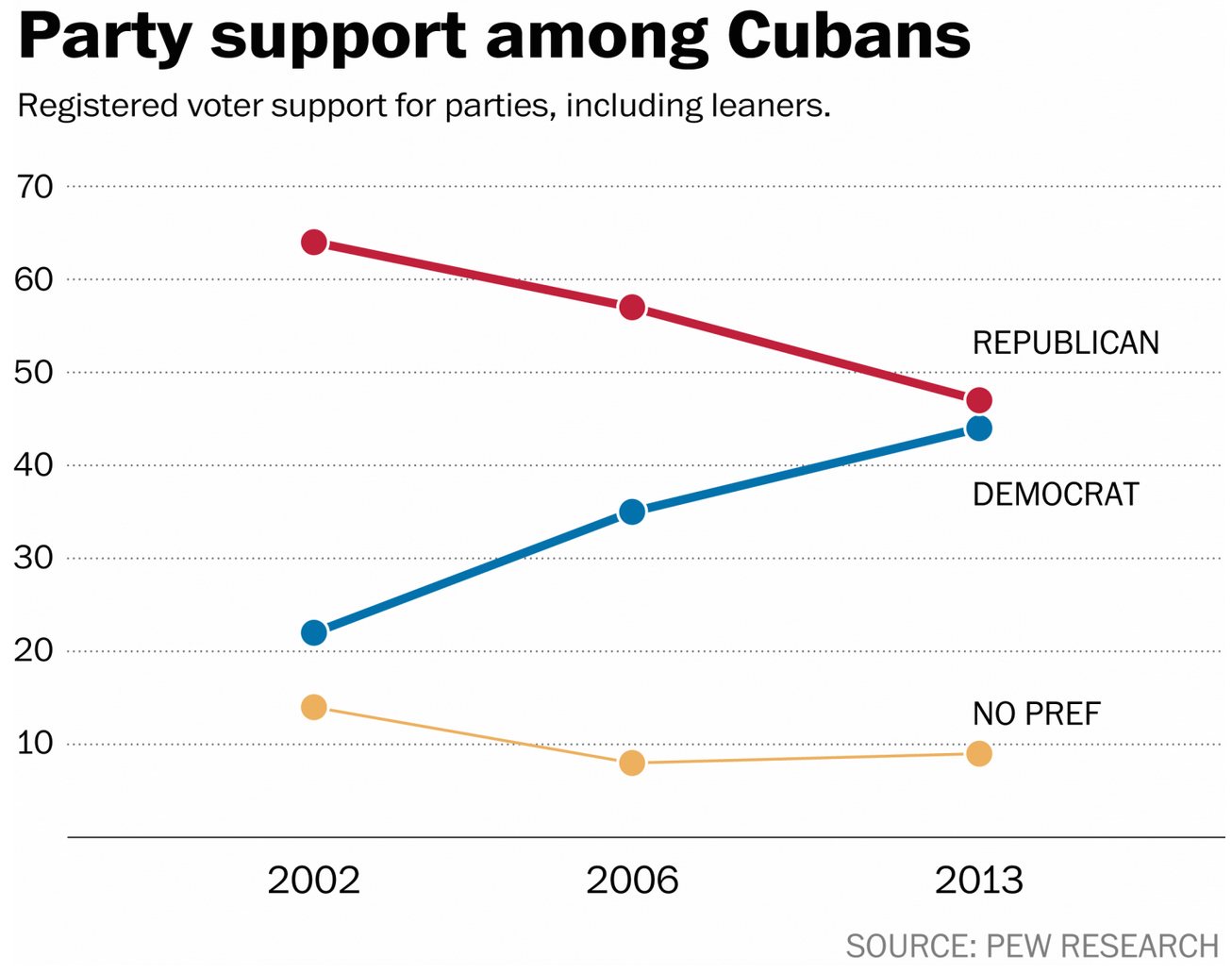
The supposedly implacable, politically powerful bloc of Cuban exile voters in southern Florida has long been one of the obstacles to a rapprochement with Cuba, but Annie Lowrey points out that this bloc isn’t as solidly Republican or pro-embargo as it used to be:

Is there a chance that President Obama’s policy might swing some Cuban-Americans back towards the Republican Party? Certainly, and we won’t know for sure until we get new polling data, likely in a number of weeks. But it is worth noting that those younger Cuban-Americans tend to be much more supportive of diplomatic normalization than their older counterparts. A recent Florida International University poll found that 90 percent of young Cuban-Americans in Miami-Dade County — 90 percent! — favor having diplomatic relations with Havana. A similar proportion support lifting the travel ban, and just more than 60 percent of young Cuban-Americans support ending the embargo.

Nate Cohn looks at some other evidence that Cuba just isn’t that much of a political flashpoint in Florida anymore:

It’s hard to know whether Mr. Obama’s decision will move the needle among Cuban-American voters. Polling data reflecting Mr. Obama’s decision, which will arrive in a few weeks, will tell us more. Nonetheless, the available polling data suggests that many Cuban-American voters are receptive to restoring diplomatic relations with Cuba, including 68 percent in an F.I.U.poll and 79 percent in an Atlantic Council poll (although the sample was extremely small).

Perhaps the more telling evidence, though, is that Mr. Obama managed to make substantial gains among Cuban-Americans even though he was open to revising Cuba policy. Mr. Crist also ran on a more open Cuba policy and won the Cuban-American vote in the exit polls last month. The fact that Mr. Crist’s advisers thought it strategic to emphasize the issue may be an indication of what their polling data showed. The uninspired Republican response in prior campaigns may be telling in its own right. Republicans didn’t exactly blanket the Miami media market with ads about Mr. Obama’s Cuba policy, which might also be an indication of how they think the issue plays.

Tell that to Marco Rubio, who could very well run for president wearing this issue on his sleeve. Russell Berman doubts such a strategy would get him very far, though:

Polls show more and more Americans support normalizing relations with Cuba, and the trend even extends to Rubio’s cohort of Cuban-Americans. Rubio dismissed talk of the 2016 race on Wednesday, “out of respect for the gravity of the issue,” he said. And he didn’t have much to say about the polling, either. “This is not a political thing,” he said. “I don’t care if polls say the 99 percent of the people support normalizing relations with Cuba.” It’s a principled stand, sure, but it probably won’t make his increasingly arduous journey to the White House any easier.

Larison shakes his head at Rubio’s insistence that opening diplomatic channels with Cuba is beyond the pale:

It’s important to repeat again and again that establishing normal diplomatic relations is the bare minimum of engagement with another country. The U.S. maintains normal relations with all kinds of governments, including some of the very worst in the world. That isn’t because we approve of everything they do, nor is it because we are doing them any favors by having normal relations, but because this is the kind of relationship all governments seek to have with each other except in times of crisis or war. There is no good reason for the U.S. and Cuba not to have normal relations today, and so we should have them. If the U.S. refused to have normal relations with every state because of its authoritarian character or the abuses it has committed, as Rubio claims to want, it would have to shut down its embassies in half the countries around the world.

(Chart from Philip Bump.)

Losing Your Faith In Santa

by Dish Staff

When did you stop believing in Santa Claus? Email us your tales of childhood disillusionment and we’ll post the most interesting ones. To start us off, here’s a handful of stories from Dish staffers. Managing editor Chas:

Through a stroke of creative genius, my parents delayed my realization about Santa by at least a few years. When I was 4 or 5, they forged a letter from Santa in which they not only thanked chas-santamy sister and me for leaving some food, pizza, for the reindeer, but they actually printed, in pizza sauce, a single hoof print on the letter. This became irrefutable evidence of the existence of Santa and his reindeer, which I held tight to for years as more and more classmates and friends learned the truth and attempted to convince me. I remember actually citing the letter in one particularly contentious debate around the lunch table in 4th grade. Finally, as with many, it was my own snooping around for presents that finally exposed the lie. I found a Sega Genesis box with a price tag in my parent’s closet, and then on Christmas morning it was one of the gifts I’d received from Santa.

Thinking back I think the hoof print was actually from one of our cats, so how I mistook it for a hoof I have no idea. Also, you’d think the similar handwriting would be a dead-giveaway too.

Dishtern Phoebe:

As a child – not sure how old – I was at a Christmas party for my father’s work, and I confessed to the Santa that I was Jewish. The man in the Santa suit, a colleague of my father’s, told me not to worry – he was Jewish, too.

Associate editor Tracy:

As a four-year-old, I had the bright idea of asking Santa to sign the note I left out with his milk and cookies. So with my parents’ help, I drafted an entreaty along these lines:

Dear Santa:
Are you real? If so, please sign below.
Love,
Tracy

No signature, I reasoned, no Santa. So I was delighted to see the letter signed in big block Tracy 4yoletters on Christmas Day.

It wasn’t long before I realized that I could use the same method to determine whether God existed. And since God was a) invisible and b) knew everything, I decided to hide my letter in the bottom of a stationery drawer, telling no one. So I crossed out “Santa,” wrote “God,” and waited overnight for the Big Guy to work his magic.

When I saw the letter unsigned the next day, I handled it with aplomb. I was less disappointed that God evidently didn’t exist – even then I had my doubts – and more pleased that my little experiment had worked. And besides, I still had Santa.

Literary editor Matt:

My fall from faith in Santa began with a simple question: how did Santa deliver my gifts if our house didn’t have a chimney? A chimney was necessary, of course, because Santa and his reindeer landed on the roof, not in the street. It didn’t make sense for Santa to shimmy down the side of the house and walk through our (presumably locked) front door. My parents told me Santa handled it by touching his nose – a move that magically placed the presents under the tree. I was placated for awhile, but the seeds of doubt were sown.

Why Not Release The Interview Online?

by Dish Staff

James Poniewozik wants the film made available on demand – now:

Maybe Sony is waiting to see if it can put the film in theaters later; maybe it’s afraid of further cyber repercussions. But if this is an issue of principle, then act like it. Americans have broadband, big-screen TVs, and plenty of free time around Christmas. Give us the chance to make our own statement, if we so choose, to show that we don’t want bullies squelching our expression.

Artists and audiences lost an unprecedented battle here. But we can still win the war, even if we have to do it in our living rooms.

Aisha Harris agrees:

People started floating this idea more than a week ago, but it has picked up momentum in the wake of the latest threats, with screenwriter Arash Amel and BuzzFeed’s Matthew Zeitlin both suggesting it on Twitter last night. On Wednesday morning The Verge made the case.

And they’re right: By releasing The Interview on demand, Sony will allow the public to view the film (or not) without the fear of any possible retaliation at a movie theater. And it will make clear to those behind the hacks and the threats that they cannot force censorship of this film. It may be a goofy comedy, but it is still expression, and Sony should stand behind its right to exist.

Walt Hickey notes that “nobody’s been willing to release a major, heavily advertised motion picture straight to  without hitting theaters first”:

The closest thing we have to data on VOD’s potential is “Snowpiercer,” the 2014 sci-fi movie/class parable that the Weinstein Co. made available for digital purchase two weeks after its theatrical release. The results were really interesting. The film made $3.8 million in its first two weeks on VOD, compared to $3.9 million over its first five weeks in theaters, according to Variety’s reporting.

That’s a data point, but it’s not enough to draw any conclusions. We don’t have multiple instances of studios seriously kicking the tires of VOD for major theatrical releases. And that’s the kind of data that — hypothetically, if VOD is really worth the hype — could potentially persuade studios to look into the distribution medium as their first avenue of release.

David Sims’ take:

[B]ecause of on-demand technology, The Interview could very well benefit, in a cruel and unusual sort of way, from all this bizarre publicity. Were the situation not so financially harmful and publicly embarrassing for Sony, it’d be easy to conspiratorially regard it as some kind of high-concept publicity stunt to convince us of The Interview’s political bravery.

Evie Nagy throws cold water on this plan:

Despite being an enormous entertainment corporation, Sony Pictures does not work alone in distribution, and this includes in VOD technology. Sony could upload the movie to the web on its own—but in order to get The Interview onto your connected TV, Roku, Xbox, or other streaming-enabled device, Sony has to work with partners who own the technology and platforms. The one platform they do own—PlayStation—does not have a large enough user base to get the film to the masses.

The risk to those partners with this particular film is, of course, becoming the target of a new cyber attack. And despite the cutting-edge aspect of being part of such a release, the payday likely wouldn’t be worth the risk: According to sources who work in the VOD space (who asked not to be identified by name), all seven major studios command very large royalties—in the 80% range—for the first two weeks after release. Sony could lower that rate for The Interview, but if they do that once, it’s possible that no one would ever pay them that much again.

Jeb’s Electability Argument

by Dish Staff

Jeb Bush Favorables

Kilgore finds it wanting:

[D]espite his name ID, his resume, and his “centrist” positions on at least some subjects, this on-paper “winner” is not very popular with the general electorate. In two solid years of being pitted against Hillary Clinton in polls, Bush has not led a single one, and trails her in the latest RealClearPolitics average by over 9%. That’s a poorer margin than for Ryan (6%), Christie (7%), and Huckabee (8%), and about the same as for Paul. Ted Cruz is the only regularly polled putative GOP candidate running significantly worse than Bush against HRC (an RCP average gap of 13%), and that’s largely because he’s far less well-known.

Hillary may currently beat him in the polls, but Frum insists that Jeb entering the race is bad news for her:

Republicans nominate septuagenarians like Ronald Reagan, Bob Dole, and John McCain; Democrats nominate spry 40-somethings like John F. Kennedy, Bill Clinton, and Barack Obama. The presidential campaign of yet another Bush epitomizes the Republican tendency to look backwards. Yet Hillary Clinton, who’ll be nearly as old on Election Day 2016 as was Ronald Reagan on Election Day 1980, epitomizes an equivalent Democratic tendency—and even more so. “To those who say it was never so, that America’s not been better, I say you’re wrong. And I know because I was there. And I have seen it. And I remember,” Bob Dole said in his acceptance speech at the 1996 Republican Convention. Hillary Clinton likewise rests her political case on nostalgia for days gone by, in her case, the 1990s. Republicans understandably speak to the old: Those are their voters. Democrats need to mobilize the young. The more often Democrats hear the 2016 race compared to that other Bush-Clinton race a quarter-century ago, the more they’re liable to wonder: Shouldn’t the party that talks most about “change” be able to offer something a little more fresh?

(Chart from HuffPo)