“No. No. No.” Ctd

by Dish Staff

A reader writes:

That email is such a compelling, extraordinarily well-written, and utterly heartbreaking account of a truly sadistic and unspeakably selfish rape. I find myself completely ashamed that I share similar chromosomal make-up with someone capable of such an act. This account should be required reading for all men, and not merely because it’s always good to remember that sexual assault creates far more damage – lasting damage – than just the violent act itself, but also as a broader reminder that empathy is one of the most important values that anyone can have and demonstrate in all aspects of our lives.

The disgusting selfishness displayed by this woman’s rapist, and the total lack of empathy for the feelings and well-being of another human being is truly chilling. And the planning that took place to execute this violent assault. So many opportunities to take a step back from the precipice. So many opportunities to listen to the inner voice that says “No. This will hurt someone.” And yet.

We must do better. We fathers of sons must do better.

Another gut-wrenching story:

I wanted to write to tell you that rarely have I been moved – rocked may be a better word – by something on your blog more than that story of a woman’s rape and its aftermath. Considering all of the subjects you deal with on a daily basis and how long I’ve been reading the Dish, that’s saying something. It’s also saying something because I’m a man, and yet much of what she wrote rings very true for me. Let me explain.

When I was in my late 20s, I learned that the woman I planned to marry had also been raped while in college, also while studying abroad.

She also had said nothing about it to anyone. A few weeks before I was planning on asking her to marry me, she felt that she needed to share with me what had happened to her. Needless to say, I was shocked and stunned and angry in a way I’d never been before. I desperately wanted vengeance, and yet I wanted to concentrate on not making it about me. I wanted to support her in any way I could. 

In the days and weeks after that, she revealed that there was more she had to tell me, and it wasn’t just about that horrible night. Much like the woman in the email, she was struggling and ashamed because of some things she’d done after that night – some things she’d done while trying to regain the identity and self-control which had been taken from her. She was with people she normally wouldn’t surround herself with, abusing alcohol and drugs. There were sexual encounters she was ashamed of. She was “typically responding.” They were things that didn’t seem like the type of things the woman I know would do, and they were fairly recent.

As the man who loved her, these were very difficult things to hear. They were even more difficult things to understand. I felt like I didn’t know who she was before she met me, or at least that there was a part of her I wasn’t privy to.

It unsettled me, and I’m embarrassed to say that these revelations eventually unravelled our relationship and our plans to marry. I tried hard to come to grips with all of this new information, but I simply couldn’t return to the level of trust and confidence I had in her before.

It’s painful to write that, because I understand now what I didn’t then: that none of this was her fault. These weren’t character flaws. Those incidents weren’t who she was. They were an attempt to recover from what had been done to her. I knew this, but after reading the email you posted, it suddenly made sense in a way it hadn’t before. I’m sitting here today, at my desk, ashamed of not being more understanding, ashamed of quietly blaming her for how she conducted herself in the months after she was raped. Ashamed of judging, of holding those things against her instead of understanding that she needed someone to do the exact opposite.

She has since moved on with another man and married him, and I am happy for her. Like the woman in the email you posted, she was not defeated by her rapist. She’s successful. She has a young family. No one around her knows the things she’s been through. Her parents don’t even know, which makes me wonder how many women (and men) are quietly suffering in our midst. But I’m sure her husband knows, and that he’s a more loving, more understanding man than I ever was.

Or maybe he doesn’t. Maybe what I taught her is that you have to keep those things to yourself if you want to have a life with someone. My stomach hurts just writing that.

I want to thank this woman for sharing her story, for explaining her struggle so honestly and eloquently. As horrified and saddened as I felt after having read that, I hope she knows she’s helped me understand what my ex had been through in a way I never had before. And that like she said, she is surely not alone, sadly.

Calling Out Catcalls

by Dish Staff

catcalling3

YouGov’s Peter Moore presents a new survey:

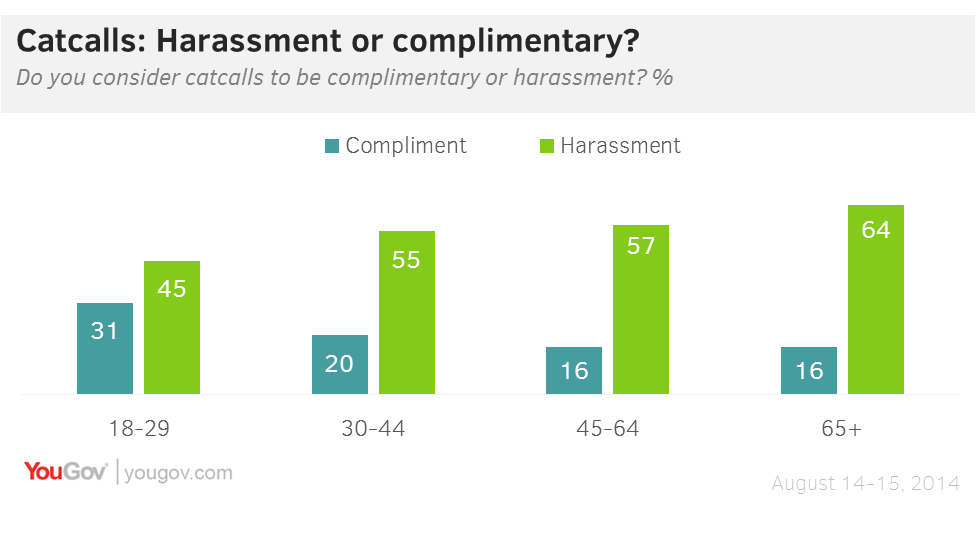
[A]ccording to a large majority of the public, it is never appropriate (72%) to catcall. 18% say that it’s sometimes appropriate, while 2% think that it’s always appropriate. Men (22%) were only marginally more likely than women (18%) to say that it is ‘sometimes’ or ‘always’ appropriate. Asked whether catcalls are compliments or not, most Americans (55%) say that they [constitute] harassment, 24% aren’t sure while only 20% think that they are ‘compliments’.

As seen in the chart above, the relationship between age and catcall-attitudes may come as a surprise:

The question of whether or not catcalls are harassment or complimentary reveals a significant generation divide. Under-30s are the least likely group to say that catcalls constitute harassment (45%), and are the most likely to say that catcalls are complimentary (31%).

In another study released this year, 57% of women indicated they had suffered street harassment and 23% reported they had been “purposely touched or brushed up against in an unwanted, sexual way” while in public. Bryn Donovan recently collected some catcall horror stories:

One woman was harassed right after having her dog put down after his battle with cancer.

I’m at least glad she let the guy have it. Two of the women I talked to had been catcalled while going home from a funeral. One of them had stopped at a convenience store, wearing a black dress, because she had cried so hard at her friend’s service that she needed some Gatorade. A man called after her, making kissing noises and saying, “Damn girl you make that dress look gooood.” A doctor told me possibly the worst story. She had finished a terrible shift in the ER. After declaring a 15-year-old girl brain dead, she had a painful talk with the family about organ donation. Then she admitted a 14-year-old girl who had been raped, beaten, and left for dead, and a long-term patient of hers suddenly coded and died. She came out into the parking lot at 10 a.m. and got catcalled. The family of the 15-year-old was walking out with her, and when the doctor hugged the girl’s mother, the stream of harassment got worse.

Many of us have a long history with harassment, beginning in our early teens. One of my friends thought being pregnant would make her temporarily immune. Nope. I honestly thought that at my age, I would be done with it. Middle-aged women, I am always told, are invisible. I don’t want to be invisible in social situations or at work, but on the street? Yes please.

For more stories, read through our 2012 thread The Terror Of Catcalling.

No One’s Watching The Skies

by Dish Staff

Mark Jacobson mulls over the decline of UFO culture:

It is true that very little beyond a shadow of a doubt forensic proof of alien presence has come to light over the years, but there are a number of subsidiary reasons for the seeming twilight of the UFO moment. With voracious proliferation of vampires, New World Order conspiracies, and the unprecedented rise of evangelical Christianity, the simple flying disc from far, far away has become a quaint, almost nostalgic specter. The saucer may have been the post-war generation’s signifier of the strange, but even versions of the unknown outlive their usefulness.

The end of the era may have commenced with William Gibson’s Neuromancer, which located the drama of the unknown inside the claustrophobic cyberspace accessible to the common keyboardist. Instead of the far-flung wonder to the universe, much of what falls under the rubric of contemporary ufology has become deeply interiorized, resigned to the viscous psych-sexual abduction phenomena described and popularized by people like Budd Hopkins, Whitley Strieber, and John Mack.

Update from a reader:

While it may seem as if the UFO community is dying, there’s still a lot of interest in UFOs. I write for the weird news section of HuffPost, which does a lot of UFO stories. In fact, HuffPost is the only major news website with its own full-time UFO reporter, Lee Speigel. Those stories attract a lot of attention, and Lee gets a lot of deserved credit for focusing on the science and not the “woo woo” part of the UFO community.

Why Are American Police Trigger-Happy?

by Dish Staff

The Economist blames Americans’ easy access to guns:

Last year, in total, British police officers actually fired their weapons three times. The number of people fatally shot was zero. In 2012 the figure was just one. Even after adjusting for the smaller size of Britain’s population, British citizens are around 100 times less likely to be shot by a police officer than Americans. Between 2010 and 2014 the police force of one small American city, Albuquerque in New Mexico, shot and killed 23 civilians; seven times more than the number of Brits killed by all of England and Wales’s 43 forces during the same period.

The explanation for this gap is simple. In Britain, guns are rare. Only specialist firearms officers carry them; and criminals rarely have access to them. The last time a British police officer was killed by a firearm on duty was in 2012, in a brutal case in Manchester. … In America, by contrast, it is hardly surprising that cops resort to their weapons more frequently. In 2013, 30 cops were shot and killed—just a fraction of the 9,000 or so murders using guns that happen each year. Add to that a hyper-militarised police culture and a deep history of racial strife and you have the reason why so many civilians are shot by police officers.

What A (Hemingway) Man Wants

by Dish Staff

TNR recently pulled this review by Max Eastman of Hemingway’s Death in the Afternoon by from their archives, which purportedly causes Hemingway to track Eastman down in his New York City office and show him just what was under shirt. You can see why:

Why then does our iron advocate of straight talk about what things are, our full-sized man, our ferocious realist, go blind and wrap himself up in clouds of juvenile romanticism the moment he crosses the border on his way to a Spanish bullfight? It is of course a commonplace that Hemingway lacks the serene confidence that he is a full-sized man. Most of us too delicately organized babies who grow up to be artists suffer at times from that small inward doubt. But some circumstance seems to have laid upon Hemingway a continual sense of the obligation to put forth evidences of red-blooded masculinity. It must be made obvious not only in the swing of the big shoulders and the clothes he puts on, but in the stride of his prose style and the emotions he permits to come to the surface there. This trait of his character has been strong enough to form the nucleus of a new flavor in English literature, and it has moreover begotten a veritable school of fiction-writersa literary style, you might say, of wearing false hair on the chestbut, nevertheless, I think it is inadequate to explain the ecstatic adulation with which Hemingway approaches everything connected with the killing of bulls in the bull ring.

Reviewing The Letters of Ernest Hemingway, Volume 2: 1923-25, Edward Mendelson offers related insights into Papa’s psyche:

What makes the book revelatory is not its biographical detail but the spacious view it gives of Hemingway’s mind at work in his long, eager, and unguarded letters to boyhood friends. For the past fifty years, ever since his embittered older sister Marcelline reported that their mother had dressed the young Hemingway as a girl and had tried to raise the two of them as twins, and ever since his posthumous novel The Garden of Eden (1986) revealed his androgynous fantasies, the conventional reading of Hemingway explained him away as the product of sexual confusion and category-crossing. This turns out to be as simplifying and crude as the he-man image it supplanted. These letters make clear that both the he-man and the androgynous fantasist were surface expressions of a deeper wish that shaped Hemingway’s life and work, a driving impulse that ultimately had nothing to do with sex.

The wish, Mendelson argues, has to do with the breakdown of heroic male code the young Hemingway upheld, which included belonging to a band of brothers – but which failed as he became an adult, at which point he fantasized that “he could merge instead with a lover”:

Everyone quotes the most obvious examples. A Farewell to Arms: “There isn’t any me. I’m you.” “We’re the same one.” “I want us to be all mixed up.” For Whom the Bell Tolls: “I am thee also now…. You are me now.” “I am thee and thou art me and all of one is the other…. I would have us exactly the same.” The Garden of Eden: “Now you can’t tell who is who can you?” (this after the woman enters the man with her hand). Everyone interprets these as gender-crossing, but they express the same wish for dissolution that recurs throughout Hemingway’s letters to his band of brothers, where, in one enthusiastic paragraph after another, he refers to each of them with the single phrase “a male.”

What Hemingway wanted—both as he-man and as androgyne—was a lasting intimate connection that did not require him to be a separate individual person—something no one can have. Virginia Woolf, in a review that infuriated him, perceived the price he paid for his wish. Hemingway’s characters, she said, are like people overheard in a restaurant talking in rapid slang, “because slang is the speech of the herd.” Those who speak it are “seemingly much at their ease, and yet if we look at them a little from the shadow not at their ease at all, and, indeed, terribly afraid of being themselves.”

Art-Sigh

by Dish Staff

dish_demoisellesdavignon

Bryan Appleyard isn’t convinced by Arthur I. Miller’s Colliding Worlds: How Cutting-Edge Science Is Redefining Contemporary Art, a book based on dozens of interviews with “science-influenced artists and musicians” that heralds “the onset of a new ‘third culture’ in which art and science will, somehow, embrace.” Why he’s skeptical of what Miller calls “art-sci”:

Perhaps the problem is that the very idea of some kind of art-science union is incoherent. Art and science are not separated by misunderstandings or ignorance, they are separated by definition. Art engages with the complexity of human experience, more precisely with that it feels like to be human; science explores the material world in a manner that necessarily ignores all such considerations. In the book the problem with this discontinuity is repeatedly made apparent by scientists who know perfectly well that art cannot impinge in any way on what they do, however enthusiastic certain artists may be. A deal between the two – Miller’s Third Culture – is, therefore, likely to be more of an annexation than a partnership.

The one exception to this might be said to be neuroscience.

This now claims to have access to the physical substrate of our minds, feelings, impulses and so on. And, indeed, Miller does mention Semir Zeki, the genial and entertaining UCL professor who observes the reaction of our brains to works of art. Thanks to Zeki and others, neuroaesthetics is a distinct discipline. But what does any of that mean – that Titian would have been a better painter if he had been stuck in an MRI machine?  Or, in biology, there are those fatuous evolutionary explanations of art as some kind of adaptive mechanism. Maybe but so what? You’re not going to get very far with Les Demoiselles d’Avignon if you persist in seeing it as nothing more than an attempt to propagate Picasso’s genes. The point about art is that it is precisely about those things that science cannot address, those things that make us more than the sum of our (no doubt) adaptive parts.

(Photo of Picasso’s Les Demoiselles d’Avignon, 1907, via Flickr user gωen)

ISIS vs The Obama Doctrine

by Dish Staff

In Peter Feaver’s view, Obama’s intervention in Iraq disproves what had been a main feature of his foreign policy doctrine: the value of leading from behind. “In authorizing new combat action in Iraq when he did,” he argues, “Obama conceded that his approach of doing less as a way to make others do more was not working — at least not with respect to Iraq”:

President Obama rightly recognized that there was no long-term solution in Iraq until the Iraqi polity picked a less sectarian successor to Maliki. More controversially, Obama rejected multiple appeals for help from the Iraqis (and from our Kurdish partners) earlier in the crisis in the hopes that withholding aid would drive the Iraqis to dump Maliki in a desperate effort to secure American assistance. … Finally, when Obama was staring at a potential catastrophe in Erbil in the Kurdish region that might eclipse the disaster in Benghazi, he decided he could wait no longer and ordered U.S. forces into combat — despite the failure of Iraqis to meet the hitherto stated conditions for U.S. assistance.

Shortly after Obama acted, the Iraqis finally acted themselves, nominating a (hopefully more inclusive) replacement to Maliki. In other words, the Iraqis themselves may have been waiting to see if they could trust Obama’s offers of help. Perhaps it was Obama’s initiative that catalyzed the Iraqi’s action, rather than vice-versa, as Obama had intended. That, at least, is how the Bush administration would have interpreted the strategic dynamic.

James Jeffrey worries that Obama’s aversion to direct military action makes him reluctant to use one of his most potent tools:

Given Obama’s ambivalent views on the efficacy of military force, and America’s tortured history in Iraq, he downplays his strategy’s second element: direct U.S. military actions. Despite the president’s oft-stated belief that there is never any military solution to, well, almost anything, IS’s advances into Kurdish and Shiite Arab areas of Iraq are not a political or social phenomenon but a military achievement. And one cannot confront a classic military strategy with diplomatic niceties. …

Do military actions of this sort open the door to a “slippery slope” that could lead to new Iraqs and Vietnams? In theory, yes. But Barack Obama is the least likely president to make a mistake of this sort. Moreover, the reality doesn’t equal the fear: Over scores of deployments and combat operations since 1945, the United States has rarely headed down the slippery slope. And let’s be clear: The Iraq adventure under President George W. Bush was not a slippery slope but an intentional regime-change strategy gone wrong. What the president thus must do is to convince first himself and then the American people that our key interests — oil supply, protecting the homeland and allies from terrorism — are at stake so long as the Islamic State is rampant. Americans need to understand that if the United States does not stop them, no one will.

And Nabeel Khoury believes that we have no choice but to take the lead in defeating ISIS or concede hegemony in the Arab heartland to Iran:

There are no good options for the U.S. administration at this point, only bad and worse ones. Any counter-offensive to dislodge ISIS would have to include large forces on the ground, something the president has ruled out. This leaves two options for Washington: Take a deep breath, hunker down, and focus on a long term project to arm and train Kurdish forces, hopefully in collaboration with what’s left of the Iraqi army. The long delayed adoption of the FSA would be a natural part of this strategy. Washington’s failure to lead in these efforts will leave only one other option, which is to step aside and let Iran and Hezbollah take the responsibility for ousting ISIS, and therefore take credit and full control of Iraq after the fight is done.

Why Is Ferguson’s Government So White?

by Dish Staff

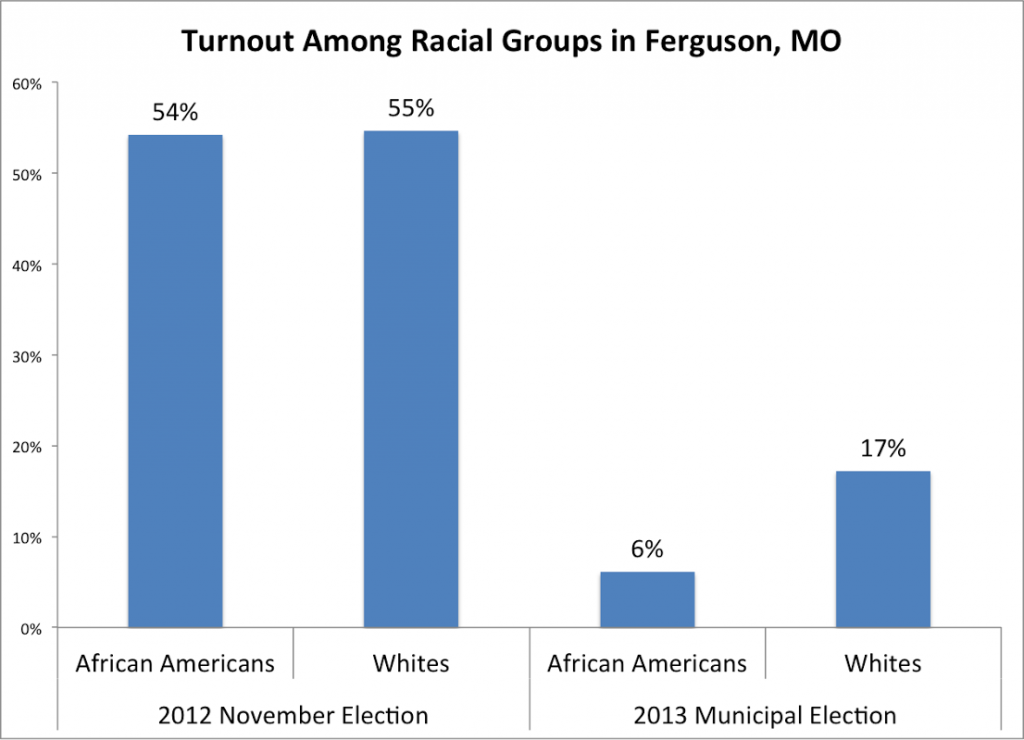
dish_fergusonturnout

Brian Schaffner, Wouter Van Erve and Ray LaRaja illustrate “why Ferguson’s elected officials look so little like its population”:

The first chart shows turnout rates among African Americans and whites in Ferguson for both the 2012 general election in November and the 2013 municipal election in April. In 2012, African Americans and whites turned out in nearly identical numbers (54 percent and 55 percent, respectively). In the April 2013 municipal election, turnout was dramatically lower among both groups, but whites were three times more likely to vote than African Americans. …

In 2012, when turnout was high and African Americans voted at a similar rate to whites, 71 percent of Ferguson voters were black. However, in 2013, whites became a majority of the Ferguson electorate, by a margin of 52 percent-47 percent. This is a dramatic difference, and it would almost certainly help to account for the extent to which Ferguson’s elected officials are of a much different racial makeup than its population.

But Masket calculates that “Ferguson is a serious outlier” in this regard:

As of 2001, it was a majority African American city with zero African Americans on the city council. The only city with a greater representational disparity was Riverdale, Georgia, but African American representation in that city has increased dramatically since then. Ferguson, meanwhile, has gained one African American city council member since then (17 percent of the council), but its African American population has increased to 67 percent, meaning it’s still a rather extreme outlier in terms of representation. …

This isn’t to dismiss Ferguson as a meaningless outlier. As Clarissa Hayward notes: “Ferguson is anything but anomalous. It’s an all-too-familiar manifestation of how racial injustice lives on, even after significant shifts in white racial attitudes.” There are problems with representation in a number of places across the country, and Ferguson is, sadly, hardly the only city to see an unarmed young black man gunned down by a white police officer.

Toward Lifespan Equality

by Dish Staff

M.S.L.J. notes a new study on life expectancy for black and white Americans, writing that although a gap persists “despite policies aimed at closing it … the good news is that blacks are slowly catching up”:

Between 1990 and 2009 the difference in average life expectancy for black and white men narrowed from 8.1 to 5.4 years, and for women from 5.5 to 3.8 years. But some places made more headway than others. Washington, DC had the largest gap between blacks and whites of both sexes in 1990 (14.4 years for men and 10.4 for women) and saw the least improvement overall (reducing the spread by just 0.4 years for men and 0.2 for women). The city also underwent a significant demographic shift: the proportion of blacks as a percentage of the District’s population decreased from 70% to 50% in the decades studied. …

In New York campaigns to stamp out crime and provide care for those suffering from HIV/AIDS are seen to have contributed to a 5.6-year reduction in the male black-white gap—the largest reduction in the country. Tougher and smarter policing tactics and a jump in arrest rates helped lower the number of murders in New York City by 73% during the 1990s. This extended the lives of young black men in particular. More than half of America’s murder victims are black, though blacks make up just 13% of the population. Blacks are also more likely to die from AIDS than any other racial group, so new treatments and a decline in needle-sharing amongst drug users has benefited them disproportionately.

Policing The Police With Cameras, Ctd

by Dish Staff

Last week, in the wake of Michael Brown’s shooting, making police wear body cameras was suggested as a way to rein in the police. Mark Steyn focuses instead on the lack of dash cam footage:

“Law” “enforcement” in Ferguson apparently has at its disposal tear gas, riot gear, armored vehicles and machine guns …but not a dashcam. That’s ridiculous. I remember a few years ago when my one-man police department in New Hampshire purchased a camera for its cruiser. It’s about as cheap and basic a police expense as there is. … In 2014, when a police cruiser doesn’t have a camera, it’s a conscious choice. And it should be regarded as such. And, if we have to have federal subsidy programs for municipal police departments, we should scrap the one that gives them the second-hand military hardware from Tikrit and Kandahar and replace it with one that ensures every patrol car has a camera.

No argument there. But Jonathan Coppage has concerns about cops wearing cameras:

Yet even setting aside the natural privacy concerns raised by strapping recording devices to every patrol officer circumambulating their city’s streets, it is worth raising a smaller, subtler, but nevertheless potentially significant concern: the increasingly intermediated cop. One only has to glance in the window of a local patrol car to see the sprawling array of screens, keyboards, and communication devices designed to link the officer to all the information they could need. The problem being, of course, that the most important information the common cop needs still can’t be pulled up within his car: the knowledge gained from building relationships with those in the community he patrols.

That relationship-building is a core component of a police officer’s mission, and may be almost entirely divorced from the work he can get done on his car’s mounted notebook computer. It also requires a certain amount of discretion, getting to know a neighborhood’s warts as well as its virtues. The conversations that give an officer an accurate picture of the seedy but not destructive side of his citizens’ lives could very well be more difficult or awkward should the policeman’s sunglasses be rolling film.

However, Conor Friedersdorf bets that cops will want such cameras:

As the police continue to lose the trust of the public, due largely to documented instances of bad behavior by fellow officers, as well as law enforcement’s longstanding inability to police themselves, I suspect that more and more good cops will be clamoring for cameras on their dashboards and lapels. Until then, citizens ought to record police during every incident as it unfolds.