Napoleon: Complex

by Tracy R. Walsh

Jacques_Louis_David_-_Bonaparte_franchissant_le_Grand_Saint-Bernard,_20_mai_1800_-_Google_Art_Project

Brian Eads notes that “200 years on, the French still cannot agree on whether Napoleon was a hero or a villain”:

“The divide is generally down political party lines,” says professor Peter Hicks, a British historian with the Napoléon Foundation in Paris. “On the left, there’s the ’black legend’ of Bonaparte as an ogre. On the right, there is the ’golden legend’ of a strong leader who created durable institutions.”

French politicians and institutions in particular appear nervous about marking the 200th anniversary of Napoleon’s exile. … While the 200th anniversary of the French Revolution that toppled the monarchy and delivered thousands to death by guillotine was officially celebrated in 1989, Napoleonic anniversaries are neither officially marked nor celebrated. For example, a decade ago, the president and prime minister – at the time, Jacques Chirac and Dominque de Villepin – boycotted a ceremony marking the 200th anniversary of the battle of Austerlitz,Napoleon’s greatest military victory. “It’s almost as if Napoleon Bonaparte is not part of the national story,” Hicks tells Newsweek.

Should Future Generations Have A Vote Now?

by Tracy R. Walsh

Arguing that our current political system doesn’t do enough to take the interests of future citizens into account, philosopher Thomas Wells calls for 10 percent of all votes to be set aside for “trustees” acting in their interests:

Trusteeship has played a political role before – indeed it is the very model for the role of elected legislators that Burke himself advocated, as did the British political economist John Stuart Mill a century later. All the same, we would certainly need to introduce some new rules and legal instruments to ensure the success of this novel kind of political trusteeship by organizations, and especially to protect them from improper ‘presentist’ influence by partisan or commercial interests. To ensure their independence, these organizations might have to demonstrate popular support (say 50,000 unique citizen members), be non-profit-making, comply with electoral campaign financing legislation and so forth. …

[T]he presence of trustee voters has the potential to benefit democratic deliberation in general. They would make sustainability an unavoidable political topic, one that politicians have to treat in a way that is credible to these cognitively sophisticated agents. The improved quality of politicians’ attention to the future would also help the merely human voters who struggle to turn their moral concern for the future into effective political choices. At least to some degree, the myopia built into the institutions of democracy would be overcome.

Alex Tabarrok favors a different mechanism:

Robin Hanson’s government of prediction markets (“futarchy”) is a better approach. It is now well understood that relative to other institutions, prediction markets draw on expertise to produce predictions that are far-seeing and impartial. What is less well understood is that through a suitable choice of what is to be traded, prediction markets can be designed to be credibly motivated by a variety of goals including the interests of future generations. …

We can also incorporate into our measure of welfare predictions of how future generations will define welfare. We could, for example, choose a rule such that we will pass policies that increase future environmental quality unless a prediction market in future definitions of welfare suggests that future generations will change their welfare standards. It sounds complicated, but then so is the problem.

Meanwhile, Corey Robin Robin Hanson is dismissive of the whole idea:

We could also give votes to people in the past. While one can’t change the experiences of past folks, one can still satisfy their preferences. If past folks expressed particular preferences regarding future outcomes, those preferences could also be given weight in an overall welfare definition.

We could even give votes to animals. One way is to make some assumptions about what outcomes animals seem to care about, pick ways to measure such outcomes, and then include weights on those measures in the welfare definition. Another way is to assume that eventually we’ll “uplift” such animals so that they can talk to us, and put weights on what those uplifted animals will eventually say about the outcomes their ancestors cared about.

We might even put weights on aliens, or on angels. We might just put a weight on what they say about what they want, if they ever show up to tell us. If they never show up, those weights stay set at zero. Of course just because we could give votes to future folks, past folks, animals, aliens, and angels doesn’t mean we will ever want to do so.

All Toddlers Are Hyperactive

by Tracy R. Walsh

Pediatrician Russell Saunders is alarmed by the finding that thousands of American two- and three-year-olds take medications for ADHD:

Because the behaviors that typify ADHD are common and normal in toddlers, thus contraindicating treating them with medication, there is little study on the effects of treatment at this age. However, the side effects of these drugs are well known. Among others, they include interference with sleep and suppression of appetite. Toddlers and preschoolers typically need lots of sleep, including daytime naps, so giving a medication that throws their ability to sleep into disarray is ill-advised. (Sleep deprivation can make ADHD-like behaviors even worse.) Further, they are often picky eaters under the best of circumstances, and curbing their appetite during a period of crucial growth can have a significantly negative outcome.

What’s more, using medication rather than consistently and patiently helping these children learn self-control robs them of a necessary part of cognitive development. Parents need to help their kids learn boundaries, behavioral expectations, and how to control their own impulses (I usually recommend a simple and sensible approach like “1-2-3 Magic”), and replacing this education with Ritalin does them a grave disservice with potentially long-term behavioral ramifications.

KJ Dell’Antonia notes that poor children are “disproportionally represented” among the medicated:

Medication for some toddlers can seem like a cheap and fast fix, and one that parents who are probably already struggling may welcome. Many toddlers on Medicaid live in single-parent homes, where the time to put into alternative programs may be as scarce as the programs themselves. For black parents, other considerations come into play: even in preschool, black students are more likely to be suspended; children with ADHD behaviors often find school difficult; and parents of children on Medicaid who are lucky enough to have a preschool placement for their children (particularly during working hours) may have a lot at stake if that place is lost.

It’s not hard to see what may lead a parent and a doctor to choose to medicate a toddler’s ADHD-like behaviors under those circumstances. What is difficult is addressing the vast set of inequalities that underlies this particular example of the increasingly large gap between the childhoods of low-income children and those of children whose circumstances are more fortunate. For now, we’re left with one of the ironies of income inequality: a rare instance of poor children getting more of something than they need.

Recent Dish on ADHD here.

The Biggest Tourist Draw In Paris

by Tracy R. Walsh

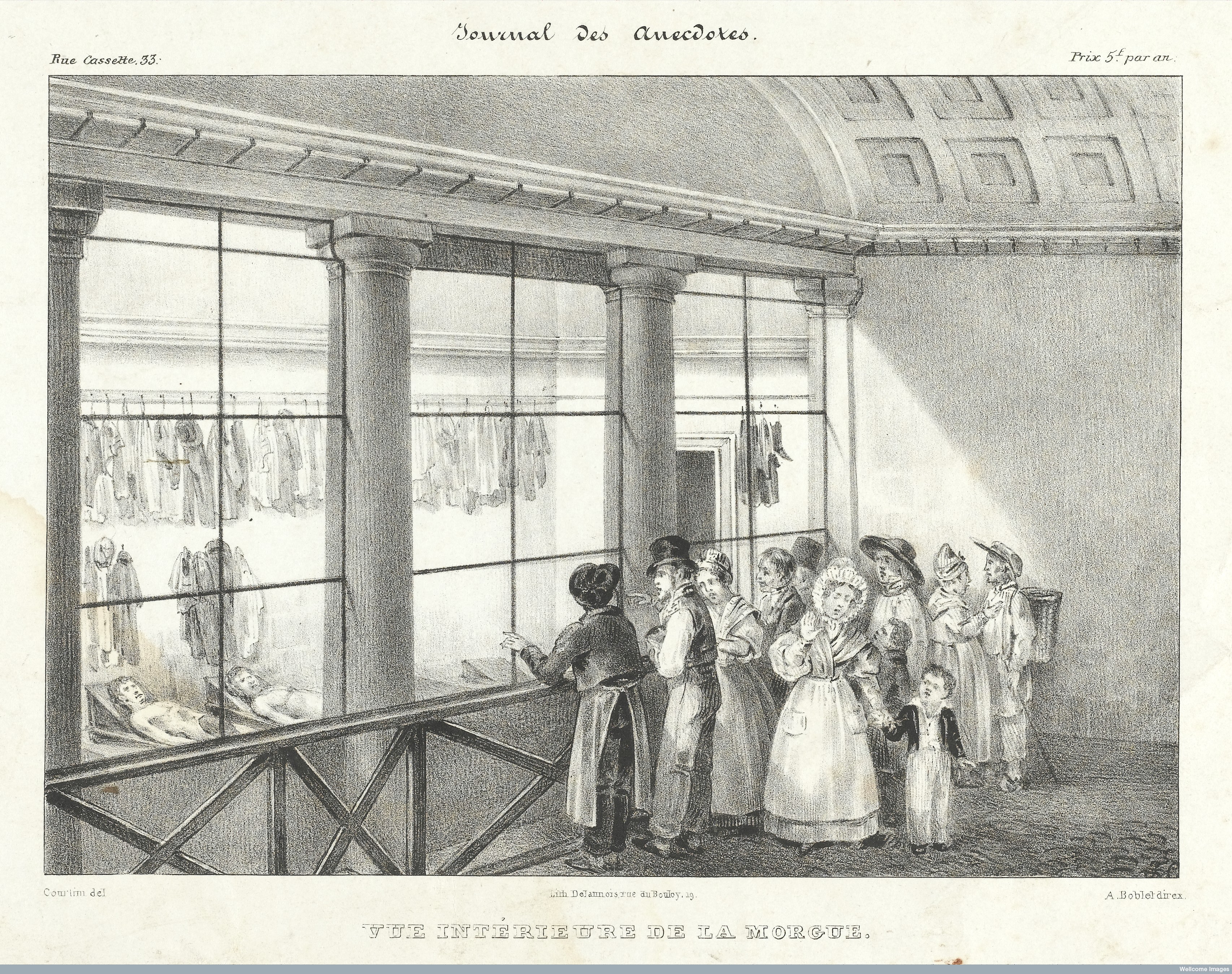
L0042495 People visiting the morgue in Paris to view the cadavers.

It used to be the city morgue:

There aren’t many other ways to describe the Paris Morgue during the 19th century other than as a place of entertainment, for Parisians and tourists alike. Conveniently located behind the Notre Dame on the southern tip of the Ile de la Cité, built in 1864, the original purpose of the morgue was of course not to attract tourism but to identify unknown bodies found in the city; many that had been fished out of the Seine or suicides that no one had reported missing. Their unfortunate remains were displayed on slanted marble tables behind glass, inviting friends and families to claim the deceased. Word of the morbid (and free) exhibition of dead bodies quickly spread, and soon the morgue became a fixture on the Parisian social circuit, enticing the curiosity of men, women, even children from all social backgrounds, who would visit regularly, filing past the grisly display, providing themselves with at least a week’s worth of fresh gossip on the possible identities of the corpses and causes of death.

Update from a reader:

I want to point out that MessyNessy’s blog post to which you link today is drawn entirely from the scholarship of the historian Vanessa Schwartz, from her book Spectacular Realities: Early Mass Culture in Fin-de-Siecle Paris. Shouldn’t Dr. Schwartz be mentioned in your post? Historians work hard to dig this stuff up, and they deserve credit.

(Image: A crowd, including a mother and her young son, gathers to view the grisly sight of the bodies at the Paris Morgue circa 1820. Credit: Wellcome Images, Wellcome Library, London.)

The Secular Sublime

by Tracy R. Walsh

Amid the ongoing conversation about whether non-believers can ever truly understand religious art, Kenan Malik calls for a humanist appreciation of the sacred:

Transcendence does not necessarily have to be understood in a religious fashion, solely in relation to some concept of the divine. It is rather a recognition that our humanness is invested not simply in our existence as individuals or as physical beings but also in our collective existence as social beings and in our ability, as social beings, to rise above our individual physical selves and to see ourselves as part of a larger project, to project onto the world, and onto human life, a meaning or purpose that exists only because we as human beings create it.

The capacity to grasp the transcendent in this fashion has transformed through history. In the premodern world it was difficult to conceive of meaning or purpose except in relation to God, or gods, or as aspects of the universe itself (though there were major strands in ancient Greek, Indian and Chinese philosophy that attempted to understand this in a purely human way). Hence, transcendence was inevitably seen in a religious light. But with modernity it became increasingly plausible to imagine purpose and meaning as humanly created. Indeed, as the French philosopher Denis Diderot claimed: “If we banish man, the thinking and contemplating being, from the face of the earth, this moving and sublime spectacle of nature will be nothing more than a sad and mute scene.” It was “the presence of man which makes the existence of beings meaningful.” …

If today we are uncomfortable with the idea of the transcendent, if many reject the idea entirely, while others can discover it only in a religious context, it is largely because we have a degraded sense of the human. That is why to read Marilynne Robinson, to gaze upon a Rothko, to listen to Olivier Messiaen can feel so essential. For some it may be to surrender to a religious experience. It is also, paradoxically, to remind ourselves what is truly human about the human condition.

Raw Fish And Red Tape

by Tracy R. Walsh

Eveline Chao notes that health inspectors in major cities tend to come down hardest on ethnic eateries. For example, in New York City:

Chinatown’s 293 restaurants paid $600,000 in inspection-related fines from July 2012 to March 2013, versus $30.3 million paid citywide – a disproportionately high amount for such a small community, according to Rada Tarnovsky the president of Letter Grade Consulting (LGC), a company that helps restaurants navigate the grading scheme. … Chinatown is not the only community disproportionately affected by the grading system. A Huffington Post analysis found that the percentage of Chinese, Indian, Korean, Latin American, and African restaurants with grades below A hovered around the 30s. Worse, 54 percent of Pakistani restaurants and 58 percent of Bangladeshi restaurants scored as such. (It’s worth noting that Department of Health’s online food protection course is available only in English, Spanish, and Chinese.)

In addition to language barriers, Chao sees at root “a larger clash between tradition and bureaucracy”: Continue reading Raw Fish And Red Tape

The Daring Book For Everyone

by Tracy R. Walsh

Hector Tobar reports that “a campaign in the United Kingdom that seeks to pressure publishers to stop titling and labeling children’s books as being ‘for boys’ and ‘for girls’ is quickly gaining momentum”:

“We’re asking children’s publishers to take the ‘Boys’ and ‘Girls’ labels off books and 9265589249_9ff49ca3ec_b allow children to choose freely what kinds of stories and activity books interest them,” says the statement by the Let Books Be Books campaign. Such labels, the organizers of the campaign say, “send out very limiting messages to children about what kinds of things are appropriate for girls or for boys.”

On Sunday, the campaign got an important boost when the newspaper the Independent announced it would no longer review such books, or even blog about them. … The Guardian reports that one of Britain’s biggest bookstore chains, Waterstones, as well as U.K. “Children’s Laureate” Malorie Blackman, and U.K. Poet Laureate Carol Ann Duffy have also announced their support.

Independent literary editor Katy Guest explains why she supports the campaign:

Splitting children’s books strictly along gender lines is not even good publishing. Just like other successful children’s books, The Hunger Games was not aimed at girls or boys; like JK Rowling, Roald Dahl, Robert Muchamore and others, Collins just wrote great stories, and readers bought them in their millions. Now, Dahl’s Matilda is published with a pink cover, and I have heard one bookseller report seeing a mother snatching a copy from her small son’s hands saying “That’s for girls” as she replaced it on the shelf. … What we are doing by pigeon-holing children is badly letting them down. And books, above all things, should be available to any child who is interested in them.

Happily, as the literary editor of The Independent on Sunday, there is something that I can do about this. So I promise now that the newspaper and this website will not be reviewing any book which is explicitly aimed at just girls, or just boys.

But some remain skeptical:

Catherine Pearlman, a social worker who works as an assistant professor at the College of New Rochelle and writes the periodic “Family Coach” column for Speakeasy, said via email that there is a “gender divide” across many children’s items like books, toys and clothes. But, Pearlman said, “I don’t think simply deciding not to review any book with a gender line solves the problem.”

“Maybe it would be more powerful to review a book and point out how much more interesting it could have been if marketed to both boys and girls,” Pearlman said. “Also just shunning ‘princess for girls’ books doesn’t eliminate the fact that so many girls love those stories. If they connect to reading through those stories what a shame to try to take that away.”

(Photo by Flickr user Book Life)

Undercover MD

by Tracy R. Walsh

Taking a page from Nellie Bly, the psychiatrist who blogs as “Simple Citizen” spent a day as an inpatient at the adolescent Residential Treatment Center where he ordinarily works:

I first learn how boring the morning is, and how many times you get woken up. First they shine a flashlight on you every 15 minutes during the night to make sure you are still in bed, alive, and not hurting yourself or trying to commit suicide. Then the phlebotomist wakes up anyone who needs their blood drawn for labs that have been ordered. (likely by me)

Then we get woken up again by the sound of “med-pass” when all the kids who take morning medications have to go to the nurse one by one, take their pills, swallow, open their mouths and move their tongues all around to show that they really swallowed and didn’t “cheek” the pill. Then it’s shower time. I have to push the button every 25 seconds to keep the hot water coming, and there is no bathroom door or shower door – there are curtains only. The curtains are only held up by Velcro, so you couldn’t use them to hang yourself.

After a day in the facility, he concludes:

I see how residential treatment can help. I also see how it can drive you up the wall, make you want to scream, and leave you overweight and out of shape when you leave after 90 days. I can see how it seems pointless at times. I felt a little bit of the helplessness these kids must feel, and that was even knowing that I wasn’t really locked in there. How would it be to spend 90 days there? How about 180 days like some kids I’ve seen?  Or worse – be told you’re going to Disneyland with a short stop on the way and then find out your parents lied to you and they’ve admitted you to a locked psychiatric facility?  (It’s happened multiple times.)

Dinah Miller praises this type of experiment while noting its limitations:

I don’t believe these experiences are anything like the real thing, nor do I believe they are meant to be. For one thing, the person having them has not gone through the lifetime of events, traumas, distresses that led the inmate or patient to be in those places. Or in the case of the patient, the doctor also is not experiencing both the internal discomfort that comes with the mental illness, or the side effects which come with the medications, or the emotional upheaval that comes from having been left there by their family … Still, I like that these people did this, it’s good that they want to try to understand what their charges are going through. Even if it’s not a complete understanding, it still acknowledges that the condition is different with a willingness to see and understand what the other is going through, for better or for worse.

Turkey Kills Twitter

by Tracy R. Walsh

https://twitter.com/Timcast/statuses/446766583005077504

Juan Cole summarizes:

At midnight last night, Twitter went dark in Turkey after the service was lambasted by Prime Minister Tayyip Erdogan. News of his massive corruption has been leaking out on social media, with damning audio clips and other evidence. Erdogan controls the old media – television and the print press – in Turkey, but has no way to stop the ten million Turkish Twitter users from sharing around the leaked material (which he maintains is fraudulent). So Erdogan said, “We Will eradicate Twitter.” Erdogan’s Justice and Development Party (AKP) is facing local municipal elections at the end of the month and it may be he hoped to close down conversations about the corruption issue in the run-up to them. If AKP does well in those elections, they will form a platform for his anticipated run for the presidency in five months.

If the audio clips are actually fraudulent, it should be possible for Erdogan to have forensics performed on them and to discredit them. In a democracy, you deal with allegations by debating them, not by trying to close down national discussions. Erdogan is demonstrating an increasingly troubling tendency toward dictatorial methods.

Brian Merchant isn’t surprised:

My colleague Tim Pool, broke the news from Istanbul. He tells me that “the reaction seems to be anger and confusion. I see a lot of people on facebook just asking ‘is twitter down for you?'” Erdogan called Twitter a “menace to society” when a popular uprising swept the country last year, and has made noise about curtailing social media use in Turkey ever since.

Prime minister Recep Tayyip Erdoğan huffed, “We now have a court order. We’ll eradicate Twitter. I don’t care what the international community says. Everyone will witness the power of the Turkish Republic.” But the ban doesn’t doesn’t appear to have been that successful:

Not even a day after Prime Minister Recep Tayyip Erdogan said the social media service would be “eradicated” from the country, Turks were still actively tweeting by the millions through a variety of workarounds. A Turkish website, Zete.com, said 2.5 million tweets had been posted since the ban, reportedly setting traffic records in Turkey.

Yoree Koh and Danny Yadron detail another way people are circumventing the ban

Twitter has relationships with carriers in many countries, including four in Turkey, that have provided Twitter with short codes that allow users to send tweets. Users type in the code – either 2444 or 2555 in Turkey to signal the start of a tweet. The website then matches the sender’s phone number with their Twitter account. It makes for a handy back up plan when other methods may be compromised. Users receive all the texts sent by accounts they follow.

On Thursday, Twitter advised users in Turkey to text their tweets shortly after news stories of the shutdown surfaced. Twitter offered the same suggestion to users when the Venezuelan government restricted certain access to the service last month.

David Kenner notes that it’s not just the opposition that’s up in arms:

[T]he ban also appears to have exacerbated divisions within Erdogan’s party. President Abdullah Gul, who visited the headquarters of Twitter in 2012, said a ban on the site was “unacceptable” – and to add insult to injury, he made his comments via his Twitter account.

Gul isn’t alone. Melih Gokcek, the mayor of Ankara and another member of the ruling party, also continued to tweet. His first message after the ban was announced could’ve been interpreted as support or defiance – whatever he meant, it was retweeted thousands of times by Twitter users within Turkey:

Michael Koplow views the ban as a mistake:

Erdoğan, whose political instincts used to be top notch, appears to have badly miscalculated this time. The courts are denying that they issued any shutdown orders, other countries and NGOs are criticizing him left and right, and the economy has taken yet another dip in response to his latest move. Even if the local elections at the end of the month go the AKP’s way, Erdoğan’s own political viability has never been more in question. He may have some more tricks up his sleeve, but it is difficult to envision how Erdoğan ever recovers the colossal stature he had only a couple of short years ago.

Trusting A Shifty Eye

by Tracy R. Walsh

Robots with a fixed gaze don’t seem that convincing:

Sean Andrist at the University of Wisconsin-Madison and his team have a number of other tricks to make a humanoid robot seem “alive.” One is to introduce small random movements into a robot’s head rotation motor, so that instead of appearing stationary, the robot’s head twitches slightly now and then. A face-tracking camera can ensure a robot always looks at the person it is interacting with, but instead of staring straight at their face, the team have programmed in a tendency for the robot to avert its gaze from time to time. The idea is to mimic the human habit of glancing fleetingly to one side when thinking of an answer to a question.

The team asked 30 students to assess conversations with Nao robots programmed to act like librarians or job interviewers, some of which had been set up for gaze aversion. They found that people thought robots that glanced around seemed more purposeful and thoughtful.

Previous Dish on robot-human interaction and the uncanny valley herehere and here.