Double-Helix Portraiture

by Tracy R. Walsh

unnamed

We’re one step closer to it:

Sometime in the future, technicians will go over the scene of the crime. They’ll uncover some DNA evidence and take it to the lab. And when the cops need to get a picture of the suspect, they won’t have to ask eyewitnesses to give descriptions to a sketch artist – they’ll just ask the technicians to get a mugshot from the DNA.

That, at least, is the potential of new research being published [yesterday] in PLOS Genetics. In that paper, a team of scientists describe how they were able to produce crude 3D models of faces extrapolated from a person’s DNA. “We show that facial variation with regard to sex, ancestry, and genes can be systematically studied with our methods, allowing us to lay the foundation for predictive modeling of faces,” the researchers wrote in their paper. “Such predictive modeling could be forensically useful; for example, DNA left at crime scenes could be tested and faces predicted in order to help to narrow the pool of potential suspects.”

Sara Reardon explains:

[Mark] Shriver and his colleagues took high-resolution images of the faces of 592 people of mixed European and West African ancestry living in the United States, Brazil and Cape Verde. They used these images to create 3D models, laying a grid of more than 7,000 data points on the surface of the digital face and determining by how much particular points on a given face varied from the average: whether the nose was flatter, for instance, or the cheekbones wider. They had volunteers rate the faces on a scale of masculinity and femininity, as well as on perceived ethnicity.

Next, the authors compared the volunteers’ genomes to identify points at which the DNA differed by a single base, called a single nucleotide polymorphism (SNP). … Then, taking into account the person’s sex and ancestry, they calculated the statistical likelihood that a given SNP was involved in determining a particular facial feature. This pinpointed 24 SNPs across 20 genes that were significantly associated with facial shape. A computer program the team developed using the data can turn a DNA sequence from an unknown individual into a predictive 3D facial model.

Peter Aldhous notes the research opens up “the intriguing possibility of producing facial reconstructions of extinct human relatives”:

Even for Neanderthals, where there are numerous fossil skulls, palaeoanthropologists have little idea about the soft tissues of the face. “We don’t know how far out their noses extended,” says Shriver. This means that artists’ impressions of what the species looked like are partly guesswork. Shriver hopes that there will be enough overlap between the Neanderthal and modern human genomes for variants that influence face shape to start filling in such gaps.

(Image via PLOS Genetics)
A Felon In Florida? No Vote For You

by Tracy R. Walsh

Screen Shot 2014-03-20 at 4.13.06 PM

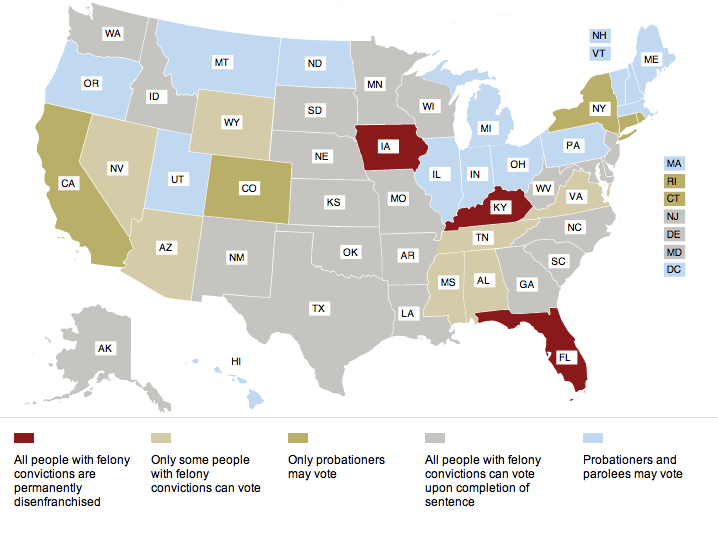
Jessica Chiappone laments losing her rights at the ballot box after pleading guilty to conspiracy to possess cocaine:

I served seven months in a federal prison in Texas, where I was subjected to strip searches every other day after being sent into a forest to chop trees. I spent one year in a halfway house in Brooklyn, and then three years on supervised release – one year earlier than projected. I graduated from college with a degree in criminal justice. I found a job and paid my taxes. I became a mother, graduated from law school and passed the New York State Bar Exam. … Despite my time served and my accomplishments as a legitimate contributing member of society, my fundamental right to vote in Florida was denied – along with several other rights that are supposed to be inalienable in America.

The United States passively accepts the existence of second-class citizenship. Rather than provide an opportunity for automatic restoration of voting rights, Florida imposes a subjective review process that leaves the formerly incarcerated with no clear standard to meet: intrusive and uninformed questions about financial stability, substance abuse and HIV/AIDS – none of which are barriers to voting for those not convicted of crimes, nor should they ever be.

Last month, Eric Holder urged states to “fundamentally reconsider” the practice. Recent Dish on the subject here.

(Map of state felony disenfranchisement laws via ACLU)

The Adult Case Against Homework, Ctd

by Tracy R. Walsh

Dana Goldstein provides another reason not to help the kids with homework:

In the largest-ever study of how parental involvement affects academic achievement, Keith Robinson, a sociology professor at the University of Texas at Austin, and Angel L. Harris, a sociology professor at Duke, mostly found that it doesn’t. The researchers combed through nearly three decades’ worth of longitudinal surveys of American parents and tracked 63 different measures of parental participation in kids’ academic lives, from helping them with homework, to talking with them about college plans, to volunteering at their schools. In an attempt to show whether the kids of more-involved parents improved over time, the researchers indexed these measures to children’s academic performance, including test scores in reading and math.

What they found surprised them. Most measurable forms of parental involvement seem to yield few academic dividends for kids, or even to backfire – regardless of a parent’s race, class, or level of education.

How We Abet Animals In Their Bad Decisions

by Tracy R. Walsh

Christopher Kemp explains what the boozy monkeys of St. Kitts (seen above) can teach us about how humans affect ecosystems:

According to biologist Bruce Robertson at Bard College in New York, the monkeys are caught in an “evolutionary trap.” Their enjoyment of alcohol exists for a very good reason, he says: they evolved to crave energy-rich foods. But now that piña coladas are easier to obtain than bananas, it has become a liability. “It’s an incorrect behavior that happened because we changed the environment too fast for evolution to catch up,” Robertson says.

Evolutionary traps – also called ecological traps – are everywhere. They have been found in almost every type of habitat, affecting mammals, birds, reptiles, amphibians, fish and insects. Bamboozled by rapid environmental change, these animals can no longer accurately assess the suitability of food resources, mates, habitats, or much of anything else. Bad choices look like good ones, and the animals are lured into an evolutionary dead-end. In this new world, a male giant jewel beetle lands on a beer bottle and tries to mate with it. … A Cuban tree frog swallows a fairy light in a backyard in Florida, responding as if the bulb were a tasty insect.

Farm-Fresh Photojournalism

by Tracy R. Walsh

Andrew Cohen applauds the coalition of animal rights groups, civil liberties organizations, and media groups challenging Idaho’s three-week-old “ag-gag” bill:

The statute creates the crime of “interference with agricultural production” by punishing anyone who makes an unauthorized “audio or video recordings” of what transpires inside food processing facilities in Idaho with up to one year in prison. It is designed, as its lengthy legislative record suggests, to help Big Ag prevent the public dissemination of images of animal abuse or unsafe conditions. Images like those posted in April 2011 as part of an award-winning investigation into the state’s dairy industry by the Boise Weekly. Or the video of farm workers in Idaho kicking and stomping on cows that the Boise Weekly posted in October 2012. It was this investigative work that caused one concerned lawmaker to lament recently not the cruelty, or unclean food, but the injustice of these farm operators being “tried and convicted in the press or on YouTube.”

Ken Paulson of the First Amendment Center weighs in:

There is a certain redundancy to all the ag-gag bills. They invariably try to limit investigative work by criminalizing things that already are criminal. …  You violate the law if you enter a farm by “force, threat, misrepresentation or trespass.” Each and every one of those is already prohibited by multiple statutes. If you were trying to eliminate coercion and fraud and trespass, you would not need to pass this bill. If you were trying to limit the scrutiny of the agriculture industry, you would need to pass this bill.

It is not only constitutionally suspect, it’s terrible public policy on the part of the legislature. Give me the very best argument for why this needs to be in place and then tell me why you wouldn’t then pass similar legislation for day-care centers. Would anyone suggest that you would send someone to prison for documenting child abuse? Is there anyone who is going to run on that platform?

Katie Valentine argues such laws have already had a chilling effect elsewhere:

In the six other states that have ag gag laws on the books, activists and journalists have said they’ve stopped attempting to document abuse on farm operations for fear of prosecution. This chilling effect means that the public in these states has little chance of seeing footage that can expose cruel and dangerous practices on agricultural operations and lead to major change in the agriculture industry. In 2008, for instance, an undercover video exposed “downer” cows, which can’t stand on their own and are sometimes diseased, being used for beef. The video led to the largest meat recall in US history and prompted the US to ban the use of downer cows for meat.

A Horse On The Force Leads To Buyer’s Remorse

by Tracy R. Walsh

3291351844_2904b76089_b

In some cities, at least:

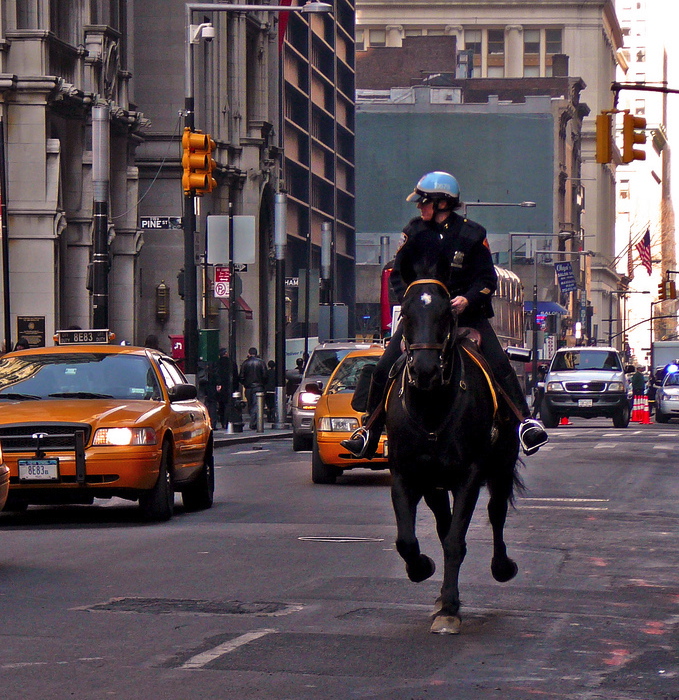
When you factor in all the expenses for training, feeding, stabling, and outfitting, funding a single police horse is decidedly expensive. And horse units, usually deployed at large public events, perform poorly on typical accountability metrics like arrest rates. With so many more cost effective alternatives, mounted police have been forced to make the case that their units still belong.

Last month, Portland, Oregon, became the latest city to consider dropping its horse program. City Commissioner Steve Novick, hoping to redirect the $860,000 the city chips in annually to other budget concerns, had some harsh words for the department’s fleet:

“The mounted patrol is largely ornamental.” He explained to his fellow commissioners, “The primary justification for the unit, as I understand it, is ‘crowd control.’ But marauding crowds have not seemed to be a major source of crime in Portland for quite some time.” In Waterloo, Ontario, budgetary concerns similarly led to the disbanding of its program. And in New York City, there are signs Mayor Bill de Blasio’s high-profile campaign against the city’s “inhumane” horse-drawn carriages could extend to the NYPD’s mounted unit.

Blake Zeff thinks de Blasio would be foolish to push the carriage issue so soon after winning a battle over pre-K funding:

Like President Obama, the mayor expended a tremendous amount of chits early in his first term on an enormous new social program that looks likely to pass by a hair, with alterations to the initial design. … If you’re the City Hall senior staff right now, you could sure use a steady, stable few months of quiet, if you can control it. It’s not the time for more fights.

(Photo by Flickr user Campra)

A Faster FAFSA?

by Tracy R. Walsh

Sophie Quinton looks at an attempt to simplify the notoriously complex Free Application for Federal Student Aid (FAFSA):

The Education Department has made it easier for students and families to fill out the FAFSA on their own by removing repetitive questions and streamlining the online application using methods common to tax-preparation software. The online form—which almost all students now use – skips questions that don’t apply to that student, alerts them to glaring errors, and will automatically input tax information from the Internal Revenue Service. It takes most students about a half-hour to complete.

But Laura M. Colarusso isn’t too impressed with the new form:

[T]here are still 100 questions on the FAFSA’s six pages, many of which have several parts and ask for sensitive financial data beyond what’s required even on a tax return. Some are straightforward, but many are so convoluted they require their own separate sections of instructions.

Take, for example, Question 45, which has 10 parts.

It requires that students list any “untaxed income not reported in items 45a through 45h, such as workers’ compensation, disability, etc. Also include the untaxed portions of health savings accounts from IRS Form 1040—line 25. Don’t include extended foster care benefits, student aid, earned income credit, additional child tax credit, welfare payments, untaxed Social Security benefits, Supplemental Security Income, Workforce Investment Act educational benefits, on-base military housing or a military housing allowance, combat pay, benefits from flexible spending arrangements (e.g. cafeteria plans), foreign income exclusion or credit for federal tax on special fuels.”

And that’s just Part I.

Update from a reader:

My kids are hopefully college bound in the next couple years, and after doing the research on funding college tuition, I am currently engrossed with rearranging my assets just so that I won’t have to spend a big chunk of my savings on tuition. If you own anything – a vacation home for instance, that was part of my retirement plan – you get nothing, nada. The colleges might just as well be raiding your retirement fund. So now I have to sell real estate, pay off debt, find alternative investments, make big changes in my portfolio just so that I can send my kids to college without wrecking my retirement plans or sending them into a debt spiral.

We have to jump through so many hoops just for affordable health care and education. Is this what America has become? Every man for himself? I envy the citizens of other nations – even if they do have to pay higher taxes – because they don’t have to worry so much, or expend so much energy, to take care of their health and education needs.

An expected update from another:

Really? This person is upset at the idea that he/she might have to spend savings to pay for the kids’ college education? Really??? Might I suggest that paying for your child’s education is something you should do if you can? Financial aid is there for families that do not, in fact, have second homes waiting for them when they retire; people without substantial real estate holdings and stock portfolios; people who might hold jobs well into their 70s just to pay off the loans they take to ensure their kids get the college education they did not?

Is filling out the FAFSA a pain in the tail? Sure. Most “help” comes at the cost of time and effort. Streamlining would be a good thing, but making it easier for wealthy kids to get aid so their parents don’t have to use their savings? Not really what the whole thing is about.

The Global Workspace In Your Head

by Tracy R. Walsh

review of Stanislas Dehaene’s latest book, Consciousness and the Brain, lays out the cognitive scientist’s theory of awareness:

Dehaene takes the “global workspace” model of consciousness developed by psychologist Bernard Baars and boldly extends it, identifying consciousness as the process of brain-wide information sharing. At any time, millions of short-lived mental representations of your world are being created by unconscious processing, he says. Consciousness selects one and makes it available to distributed, high-level decision systems through a brain-wide “broadcast”. … Consciousness, thinks Dehaene, may have evolved to pick out what is relevant from this huge amount of parallel activity, and keep it active within the global workspace while different parts of the brain evaluate it. It is necessary so we can deal with one important thing at a time and enable a kind of “collective intelligence” to be reached. That would include providing access to memory and mental associations, as well as to language processors which could describe the ongoing experience, Dehaene suggests. It all takes time, which may explain why consciousness seems to run about a third of a second behind reality.

Previous Dish on Dehaene’s work here.

When GIs Can’t Find Joe

by Tracy R. Walsh

In an excerpt from his new book Caffeinated, Murray Carpenter reveals how military researchers are developing various alternatives to coffee:

One of the buildings at Natick has a brightly lit room called the Warfighter Cafe. That’s where Betty Davis, who leads the Performance Optimization Research Team, showed me a small table covered with snack foods – applesauce, beef jerky, energy bars, and nutritious “tube foods,” which taste like pudding but come in a package that looks like a large tube of Crest. The products have two things in common. They are formulated for soldiers (“warfighters” in the current Department of Defense lexicon). And they all contain added caffeine.

Davis showed me a plastic-wrapped ration, about the size of a small hardcover book. It’s called a First Strike ration, a concentrated package of nutrition designed for soldiers moving quickly with minimal gear. The First Strike rations include plenty of caffeine. For starters, there is Stay Alert gum, with five pieces per pack, each piece containing 100 milligrams. This was originally developed by a subsidiary of Wrigley, working with researchers at the Walter Reed Army Institute of Research. And there is Zapplesauce, caffeinated applesauce. It comes in a plastic pouch and packs 110 milligrams of caffeine. There is a mocha-flavored First Strike Nutritious Energy Bar, also packing 110 milligrams of caffeine. Some of the rations also include instant coffee (which soldiers sometimes put between their cheek and gum, like a dip of Skoal, a sort of do-it-yourself version of the Grinds Coffee Pouches) or caffeinated mints.

Where Do RT Reporters Come From?

by Tracy R. Walsh

Often straight out of J-school:

RT America, by the accounts of the former and current employees with whom BuzzFeed spoke, has a strategy of hiring very young reporters who are eager to break out of small markets and want to cover international news. And the channel pays relatively well, more than most 22- or 23-year-olds expect to make in journalism. One former employee said a correspondent starting out could make as much as $50,000 or $60,000. “They’ll hire really young people and you almost feel like you’re working in a mini-CNN-type situation,” the former reporter said. “You’re not covering snowstorms or the puppy parade. You’re doing stories that are a lot bigger and meatier.”

And in Rosie Gray’s telling, it doesn’t take long for disillusionment to set in:

Soon after joining the network, the current and former employees said, they realized they were not covering news, but producing Russian propaganda. Some employees go in clear-eyed, looking for the experience above all else. Others don’t realize what RT really wants until they’re already there. Still others are chosen for already having displayed views amenable to the Kremlin. Anti-American language is injected into TV scripts by editors, and stories that don’t toe the editorial line regularly get killed.

Chait cringes:

A tragically large number of left-wing Westerners in the 20th century deluded themselves about the horrors of Soviet communism. As awful and unforgivable as it was, the process by which they made themselves into dupes was at least explicable:

They loved socialism, and one country in the world was implementing socialism, so they persuaded themselves, and for a while, it was working.

Today’s Russia dupes are a smaller, more pathetic lot. Above all they are just plain weirder, because they lack a clear ideological motive for their stoogery. Soviet Russia not only commanded a vast propaganda network, but embodied a doctrine with international appeal (and which had originated outside of Russia). Vladimir Putin’s Russia follows no model except Russian nationalism. To the extent it employs a non-nationalist philosophy, its main idea is that gays have weakened Europe. And yet the dupes still come.

Meanwhile, Weigel wonders how the network will find guests:

After [Alyona] Minkovski left the network, I saw fewer credible pundits make the walk to RT studios. I know of at least one magazine that warned its staffers not to go on anymore. Without sitting and auditing all of RT’s coverage, it seems like the network’s American opinion took more cues from the fringe.

This is where Abby Martin, a 9/11 truth activist and artist came in. In 2010 RT was getting exclusives with Rand Paul; in 2012 Martin was ambushing Paul to challenge his endorsement of Mitt Romney – a “Goldman Sachs, Bilderberg puppet.” It was Martin’s on-air denunciation of the Ukraine incursion [seen above] that woke up the media, again, to the strangeness of RT. It was anchor Liz Wahl’s on-air resignation and Martin’s quick back-peddling that deepened the strangeness, and brought new media attention, and will probably make it even harder for RT to book top guests. No secret here: D.C. (and New York) are in ready supply of pundits who want to go on TV shows and collect clips of themselves to show bookers for other TV shows. RT was a possible stop along the way, but some tanks in Crimea might have ended that.

Dish coverage of Wahl’s resignation here.