St. Patrick’s Day Drinking

by Tracy R. Walsh

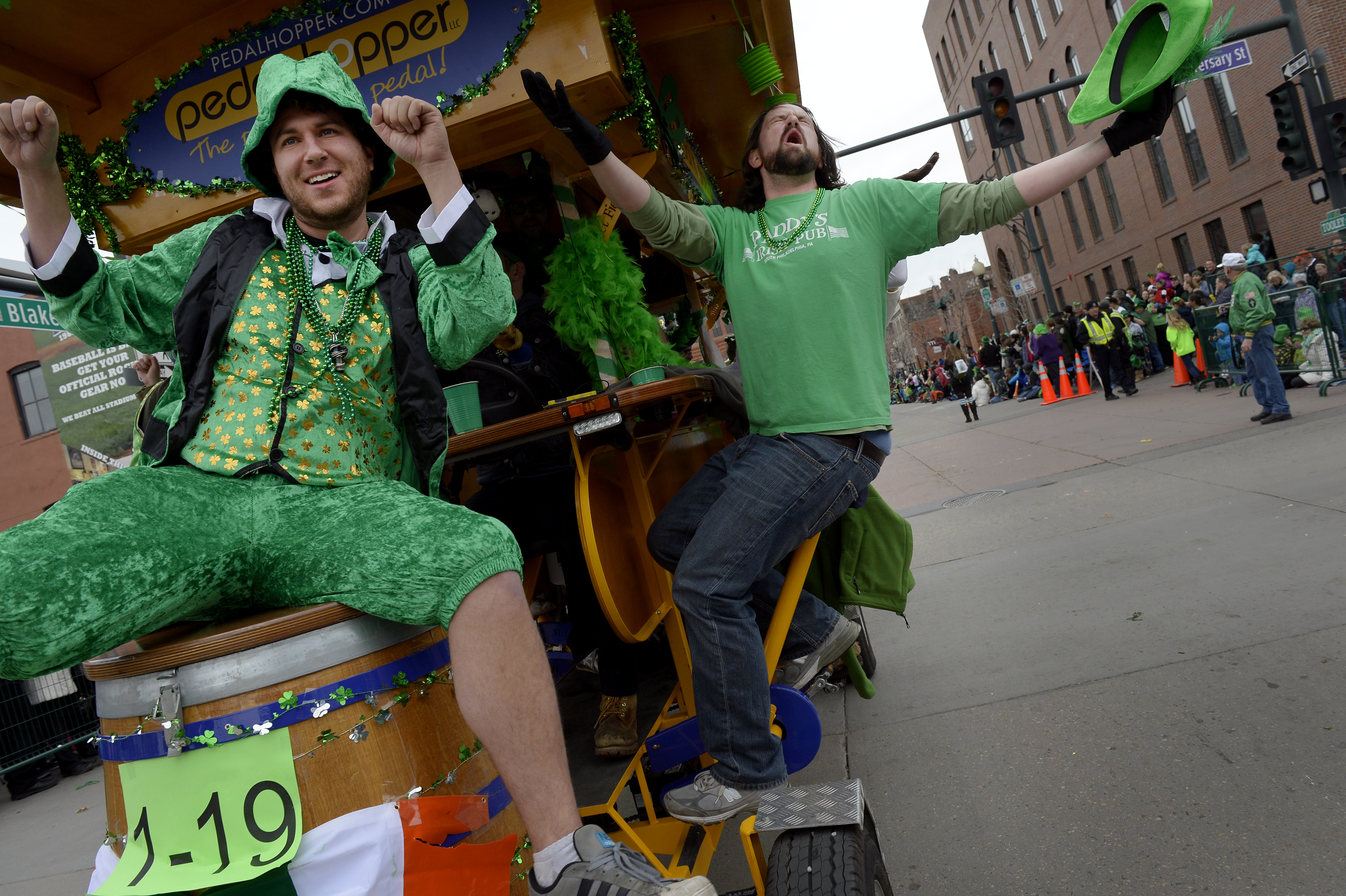
Denver St. Patrick's Day Parade

Scott Bixby tsk-tsks from his perch at McSorley’s, the venerable New York tavern:

On St. Patrick’s Day, everyone is Irish – except for the gays – but mostly, everyone is just drunk. In one hour, the East Village street that lays claim to McSorley’s saw three people vomiting, four young men belligerently insisting that every stranger within arm’s distance give them a high five, two public urinations, one apparent breakup, and two more young men losing their Lucky Charms behind parked cars. … Underneath the Irish pride and the excitement about the coming spring, St. Patrick’s Day is a childish spectacle of obnoxious behavior celebrated by inebriated manchildren who could use a few whacks with a shillelagh.

But not everyone is so sour on the revelry. Over at Next City, Jake Blumgart makes “the urbanist case for rowdy-ass bars”:

Let’s call it the Jane Jacobs Theory of Drinking:

It’s good to have eyes on the street, even if they are seeing double, and especially because many non-drinking businesses are closed after 9pm or 10pm on weeknights. Jacobs famously lived at 555 Hudson Street in Greenwich Village and wrote of the “sidewalk ballet” that made her block a joy to live on. One of the businesses she names as a neighbor in good standing is the White Horse Tavern, where according to literary legend Dylan Thomas drank himself to death (“I have had 18 straight whiskies, I think that’s the record”). In The Death and Life of Great American Cities, Jacobs speaks highly of the influence of bars on her block:

Strangers become an enormous asset on the street on which l live … particularly at night when safety assets are most needed. We are fortunate enough, on the street, to be gifted not only with a locally supported bar and another around the corner, but also with a famous bar that draws continuous troops of strangers from adjoining neighborhoods and even from out of town … this continues until the early hours of the morning … The comings and goings from this bar do much to keep our street reasonably populated until three in the morning, and it is a street always safe to come home to.

She may have felt differently if the shop below her apartment sold shots and not lollipops, but from a utilitarian perspective the point is good.

Update from a reader:

Check out what happened in 24 hours this past weekend on Chicago’s north side, from Wrigley Field to Lincoln Park, the “safe” part of town.

The title of that play-by-play post: “St. Pat’s Festivities Rack Up 21 Arrests, 17 Ambulance Runs In Wrigleyville”.

(Photo: Revelers lead the Pedal Hopper ‘party bike’ down Denver’s Blake Street during the city’s St. Patrick’s Day Parade. By Craig F. Walker/Denver Post)

The Dark Ages Of E-Books

by Tracy R. Walsh

Revisiting the early days of the form, Alison Flood finds that its pioneers weren’t exactly well-received:

When Peter James published his thriller Host on two floppy disks, in 1993, it was billed as the “world’s first electronic novel,” and attacked as a harbinger of the apocalypse which would destroy literature as we knew it. Now it has been accepted into the [London] Science Museum’s collection as one of the earliest examples of the form, as the spotlight of academia begins to shine on the history of digital publishing.

“I got absolutely pilloried,” says James. “I was on Today accused of killing the novel, I was a front-page headline on papers in Italy – 99 percent of the press was negative … one journalist even took his computer on a wheelbarrow to the beach, along with a generator, to read Host in his deckchair.” The digital version of the novel (it was also published physically) went on to sell 12,000 copies, according to James, and two years later, he was speaking on a panel on the future of the novel at the University of Southern California, together with Apple founder Steve Jobs. “I said e-books would catch on when they became more convenient to read than the printed novel,” said James. “It was astonishing the amount of outrage it caused.”

Previous Dish on e-books here, here, and here.

How To Look Trustworthy

by Tracy R. Walsh

Smiling_Girl,_a_Courtesan,_Holding_an_Obscene_Image 2

It’s all in the cheeks:

The Dutch psychologist Corine Dijk gave volunteers a series of photos of people, some blushing and some not, accompanied by tales of their recent mishaps, ranging from appearing overdressed at a party to farting in a lift. The blushers were judged more favorably, despite their indiscretion.

Other research has found that if you blush people are more likely to forgive you, and it can even avert a conflict. When you’re trying to work out who to trust, it makes sense to choose the people who would feel guilty if they did anything wrong. The ideal person is someone who would blush and give themselves away.

Update from a reader:

That blushing article is really troubling (as is the research producing it). Everyone blushes, but not everyone’s blush is visible to everyone. Indeed, this sounds a lot like Thomas Jefferson’s infamous “Query XIV” in Notes on the State of Virginia, in which he aesthetically assesses human beings of European and African descent:

Whether the black of the negro resides in the reticular membrane between the skin and scarf-skin, or in the scarf-skin itself; whether it proceeds from the colour of the blood, the colour of the bile, or from that of some other secretion, the difference is fixed in nature, and is as real as if its seat and cause were better known to us.  And is this difference of no importance?  Is it not the foundation of a greater or less share of beauty in the two races?  Are not the fine mixtures of red and white, the expressions of every passion by greater or less suffusions of colour in the one, preferable to that eternal monotony, which reigns in the countenances, that immoveable veil of black which covers all the emotions of the other race?  Add to these, flowing hair, a more elegant symmetry of form, their own judgment in favour of the whites, declared by their preference of them, as uniformly as is the preference of the Oranootan for the black women over those of his own species.  The circumstance of superior beauty, is thought worthy attention in the propagation of our horses, dogs, and other domestic animals; why not in that of man?

In other words, Jefferson’s eye can’t see the blush. He “sees” like a black-and-white photocopier that would later reproduce complex, verisimilitudinous images of lighter-complexioned people and reduce images and thus the humanity of darker-complexioned people to an undifferentiated dark blop. It doesn’t take too much reason and imagination to see how pernicious and dangerous this all is amid current conversations about how cops see black children as “less innocent and less young than white children.” Jefferson’s beliefs are hardly a relic of the past.

(Gerard van Honthorst’s Smiling Girl, a Courtesan, Holding an Obscene Image, 1625, via Wikimedia Commons)

Where They Really, Really Want Gay Marriage

Las Vegas:

The rapid increase in the number of states permitting gay marriages has crushed demand for commitment ceremonies, a legally meaningless alternative many of the resorts and chapels have offered. DeCar and Flint, who has owned the Chapel of the Bells in Reno for 51 years, said such bookings have plummeted since California resumed same-sex marriages following a landmark U.S. Supreme Court decision last June. “We don’t get the same amount of committal ceremonies because the real thing is so available,” Flint said. “It collapsed overnight.”

Some travel agents have tried with little success to take advantage of legal marriage in neighboring states. Terry Wilsey of A Answer On Travel said he gave up on an idea to drive same-sex couples from Las Vegas to the California state line 40 miles away for ceremonies on the California side of a golf course that straddles the state line. Aside from the fact that transportation costs are prohibitive, Wilsey also discovered the closest place to obtain a California marriage license was in Barstow, another 115 miles away.

State Sen. David Parks, Nevada’s first openly gay elected official and someone who has made a career of pushing for pro-gay laws, said an important business opportunity may already have passed. “The train left the station and we’re still standing on the platform,” Parks said. “I don’t see that we’re likely to recover that.”

The Brunch Not Eaten

by Tracy R. Walsh

Neal Pollack has united the greatest poets of the 19th and 20th centuries with the greatest crowdsourced-review site of the 21st:

https://twitter.com/nealpollack/status/371286632306987008

https://twitter.com/nealpollack/status/371300619929133056

Other writers are joining in:

(Hat tip: Chase Hoffberger)

Expletives Deleted

by Tracy R. Walsh

Maria Bustillos traces the history of the bleep. Bustillos prefers it to the “dump button delay”, which “is different from bleeping in that the edit is concealed completely from the audience“:

The dump button provides a relatively insidious, more censorship-like form of editing, because its alteration of the original broadcast has been actively concealed. If we are to have disagreements about what constitutes acceptable media for a civilized general audience — and we should — they should be aired in every possible way. Through a very loud bleep, for example. And through litigation, and yes, complaints to the FCC. Through arguments at dinner tables and letters to the editor.

A bleep is honest, immediate, noisy. It’s the cultural superego in motion, calling attention to a difference of opinion regarding the offensiveness of the bleeped material. Here is this questionable thing; think about it for yourself, investigate if you like. In this way, the bleep is a literal demonstration of First Amendment principles: the 1KHz-sound of a community actively engaged in the process of establishing standards, and struggling to understand itself.

Why There’s A Human In The Cockpit

by Tracy R. Walsh

Nick Valery worries that pilots are too dependent on automated systems:

The problem today is that aircrew may log thousands of hours on the flight decks of modern airliners, but their actual hands-on flying experience may amount to mere minutes per flight. When things get frantic – whether through a mistaken input or a sudden runway change by air-traffic control during descent – aircrew can be so preoccupied punching fresh instructions into the flight-management computer that they may fail to notice their airspeed and altitude are falling precipitously. This reduction in situation awareness, along with the degradation of basic piloting skills and a huge increase in cognitive workload on flight crew are all part of the unintended consequences of cockpit automation. Combined, such human factors can quickly lead to disaster.

America’s two recent fatal air crashes – the Asiana Boeing 777 passenger jet on final approach into San Francisco international airport on July 6th and the United Parcel Service Airbus A300 freighter coming into land at Birmingham airport in Alabama on August 14th – are cases in point. Though investigations have barely begun, both situations point to distractions the pilots faced while trying to take control of the aircraft. In both instances, the pilots seem to have been unaware, until the last few minutes, of their proximity to the ground and of how slowly their planes were flying. Both finished up crashing short of the runway.

Recent Dish on autopilot here.

Investing In Sensible Sex Ed

by Tracy R. Walsh

graphs

Sarah Mirk welcomes the news that, between 2007 and 2011, “the teen birth rate nationwide dropped a whopping 25 percent.” Mirk credits a change in how the government funds sex education:

Instead of betting all its money on abstinence-only education, since 2010, reproductive health advocates pushed federal policy to instead favor “evidence-based” teen pregnancy prevention programs—meaning rigorous research has shown they’re actually effective. Or, as Katy Suellentrop of the National Campaign to Prevent Teen and Unplanned Pregnancy puts it, “The biggest policy change in teen pregnancy was in 2010 when there was a focus on using programs that work.” From 1998 to 2010, the federal government spent over a billion dollars on abstinence-only sex education. During that same time, the teen birth rates slowed, flat-lined, then actually began to increase in 2006, and then declined again. Now, the government sets aside $190 million to fund “evidence-based” teen pregnancy prevention programs like the ones working with Multnomah County’s Latino youth.

The birth rate for 15- to 19-year-olds reached a record low of 31.3 per 1,000 in 2011, according to the CDC.

Households Shrink; Houses Don’t

by Tracy R. Walsh

Households by type

Emily Badger notes almost nine out of 10 U.S. dwellings are built for two or more people, even though more than 27 percent of Americans live alone:

Screen Shot 2013-08-27 at 3.01.16 PMAmerican households have been getting smaller as our houses, conversely, have actually been getting bigger. But the disconnect between those two trends may be felt the most strongly by people who live alone, whether they’re 22-year-old women who aren’t yet married, or 70-year-old retired widows. As more Americans are opting to live alone than ever before, that now seems like an entirely unremarkable choice. But for years we’ve been building houses for that big nuclear family that’s now less common. And housing data released earlier this summer by the Census Bureau, illustrated at right, suggests that the U.S. is now a country where many people live alone in a land of three-bedroom houses.

The Contradictions Of Military Justice

by Tracy R. Walsh

Nadal Hasan was sentenced to death for killing 13 soldiers in Texas just days after Robert Bales was sentenced to life for killing 16 civilians in Kandahar. Hendrik Hertzberg wonders how the Muslim world will respond:

Consider: One member of the U.S. Army is an apple-pie American (white, Catholic, high-school football captain, Ohio State student, married father of two) with a slightly shady past (he was implicated in a financial-fraud case when he worked as a broker, before joining the Army, in 2001). He kills 16 unarmed Afghan Muslim civilians, including four women and nine children. He gets life.

The other member of the U.S. Army is a Muslim, the eldest son of Palestinian immigrants, a medical doctor, an Army officer, unmarried. He kills 13 uniformed American soldiers, unarmed. He gets death.

A third case hovers in the background.

In 2003, in Kuwait, an Army sergeant used hand grenades and a rifle to kill two of his comrades and injure fourteen more. In 2005, a military court sentenced the sergeant to death. Last year – on July 13, 2012 – the Army’s court of appeals affirmed the sentence. While appeals continue, the sergeant remains on death row at Fort Leavenworth, Kansas. This third member of the U.S. Army, Sergeant Hasan Karim Akbar, né Mark Fidel Kools, is also Muslim. He is an African-American whose parents changed his name when they converted to Islam. He kills two American soldiers. He gets death.

Hertzberg hopes Obama will stop the executions:

If he declines to sign a death warrant in one of these cases, he will, of course, be subject to unrestrained demagogic attack from the Republican right. But if he does sign, and if the execution or executions are carried out, he will have essentially confirmed the suspicion that the United States places significantly less value on the lives of Muslims, regardless of nationality, than on the lives of Christians and other non-Muslims, also regardless of nationality. One can only hope that he will have the fortitude to reject that choice – a choice that, besides being morally abhorrent, would be grievously damaging to the national interest.