Obama’s March On Washington Speech: Reax

by Tracy R. Walsh

Watch the whole thing here or read the transcript here. Waldman thinks the speech was directed to future generations, not the present:

This seemed to me to be a speech written in the hope it would be read 50 years hence. He’ll get some criticism for not talking about any specific policy issues, but that’s what happens when you swing for the rhetorical fences; you can’t get too bogged down in the mundane arguments of the moment. And what struck me most about it was how little he talked about Martin Luther King. He mentioned him only a few times, but spent much more time talking about ordinary people. This was the running theme of the speech and perhaps what was most important about it.

Brentin Mock agrees that history will be the judge:

Obama’s speech wasn’t, as rapper Keith Murray would say, the most beautifulest thing in the world, but it accomplished what Obama has been setting out to accomplish from the beginning: staying the middle-road course in effort to appeal to the liberals and conservatives among all races in the spirit of perfecting the union. Whether his legacy will reflect a victory on this as an honorable effort or flat failure won’t be determined for decades.

But Jamelle Bouie argues that now is no time for bromides:

What Obama didn’t say, but what the civil rights movement recognized, is that the specific experience of African-Americans requires – and required – a specific response. It’s what motivated the Freedman’s Bureau of Reconstruction, and Martin Luther King Jr.’s call for an inner city “Marshall Plan” during the Second Reconstruction of the 1960s. … [T]he economic legacy of white supremacy is still with us, and—outside of half-measures and rhetoric—we’ve shown little appetite for dealing with it. Simply put, 350 years of bondage and oppression can’t be ameliorated with 50 years of citizenship rights, tepid liberal programs, and “colorblindness.” That includes the president, who works hard to avoid race and its role in shaping our problems.

Jelani Cobb agrees:

That Obama could not – or would not – elucidate his plans to address the intractable realities of race and the economic consequences of those realities, even as he acknowledged that “black unemployment has remained almost twice as high as white unemployment, Latino unemployment close behind,” calls into question the logic of a black Presidency in itself. There was something despair-inducing about the way he said “change doesn’t come from Washington, it comes to Washington,” an oratorical turn that cloaked the fact that something vital was being reneged upon.  …

Obama’s tic for rhetorical evenhandedness meant that even in his discussion of racial inequality, he had to nod to black failings by pointing to “self-defeating riots” and “criminal excuse-making.” And his tendency to chide black America in public appears all the more cynical when compared with his refusal to point to his own responsibilities to that community as Commander-in-Chief.

Peniel E. Joseph is similarly disappointed by Obama’s vagueness:

[W]here were the specifics that would have truly honored the March on Washington? The 250,000 people who gathered 50 years ago were looking for specific solutions, not just soaring rhetoric. Where was the president’s promise to sign a series of executive orders that would focus on anti-poverty efforts or increase access to higher education? Or governmental action that perhaps could ease the transition of ex-offenders back into communities or promote jobs programs, especially in economically devastated urban and rural communities?

Meanwhile, Ed Kilgore detects a hint of despair from the commander-in-chief:

What struck me most about it was that it seemed a wistful tribute by a politician hemmed in by politics to a social movement that alone has the power to overcome the resistance to change. “Change does not come from Washington but to Washington,” Obama said, and while some may view that as an abdication of responsibility, it’s more a plain fact of the long struggle for justice and equality. This passage in particular seemed a recognition that Obama – once thought to be the Joshua who would bring the civil rights movement into the promised land its “Moses generation” could not reach—was passing the torch to the next generation: There’s a reason why so many who marched that day and in the days to come were young, for the young are unconstrained by habits of fear, unconstrained by the conventions of what is. They dared to dream different and to imagine something better. And I am convinced that same imagination, the same hunger of purpose serves in this generation.

And Jeff Shesol believes Obama was holding himself back:

When Obama permits himself to speak about [race and equality] — as he did in his 2004 debut at the Democratic National Convention, in his “race speech” of 2008, in his unscripted remarks about the Trayvon Martin shooting — he conveys an understanding that enriches our own. On each of those occasions it was said, rightly, that only Obama could have given that speech. But one of the disappointments of yesterday’s speech was that it could have been given — credibly, if less movingly — by any one of a number of Democrats. It was largely devoid not only of first-person pronouns, but first-person perspective.

Meanwhile, TNC hears echoes of W.E.B. du Bois:

Like du Bois, Barack Obama has taken the stage at a moment when it is popular to assert that black people are the agents of their own doom. There has never been any other such moment in American history. The response to Trayvon Martin, indeed the response to Barack Obama himself, has been to attack black morality, to highlight black criminality and thus change the conversation from what the American state has done to black people, to what black people have done to themselves. Like Du Bois, Barack Obama believes that this these people have a point. His biographer, David Levering Lewis, says that Du Bois came to look back back on that speech with some embarrassment. I don’t know that Barack Obama will ever reach such a conclusion.

Indeed, if we are – as the president asks us to be – honest with ourselves, we will see that we have elected a president who claims to oppose racial profiling one minute, and then flirts with inaugurating the country’s greatest racial profiler the next. If we are honest with ourselves we will see that we have a president who can condemn the riots as “self-defeating,” but can’t see his way clear to enforce the fair housing law that came out of them. If we are honest with ourselves we will see a president who believes in particular black morality, but eschews particular black policy. It is heart-breaking to see this. But it is also clarifying.
This Week In Mind Manipulation

by Tracy R. Walsh

Nathan Ingraham reports on a major advance in brain-to-brain communication:

Using a non-invasive brain-to-brain setup, a researcher in one lab was able to send a signal from his brain to control the movements of a second researcher in a lab on the other side of campus. It’s believed to be the first human brain-to-brain interface; previous demonstrations have featured rat-to-rat and human-to-rat communication.

The demonstration focused on a simple computer game: Rajesh Rao, a professor at UW who has worked on brain-computer interfacing for more than a decade, looked at a screen and had to fire a cannon to shoot down an enemy plane while avoiding friendly planes. On the other side of campus, Andrea Stocco had the keyboard to execute those commands, but couldn’t see the game itself. But using their brain-to-brain interface, Rao imagined that he was using his right hand to click the space bar on a keyboard  and Stocco’s right hand carried out the command without any conscious movement on his part. Stocco likened it to an involuntary twitch or a nervous tic.

John Biggs emphasizes that this “is not mind control”:

The subject cannot be controlled against his or her will and neither party can “read” each other’s thoughts. Think of this as sending a small shock controlled via the Internet to trigger a fairly involuntary motion.

But Dan Farber sees big possibilities:

“It’s very much a first step, but it shows what is possible,” [project contributor Dr. Chantel] Prat said. “Right now, the only way to transfer information from one brain to another is with words,” she said. With advances in computer science and neuroscience, people could eventually perform complicated tasks, such as flying an airplane, and dancing the tango, by transferring information in a noninvasive way from one brain to another. “You can imagine all complex motor skills, which are difficult to verbalize, are just chains of procedures,” Prat said.

The Awesome And Destructive Power Of Politicians

by Tracy R. Walsh

Bill McKibben’s environmental group is campaigning to name hurricanes after climate-change deniers:

Phil Plait approves:

This ad campaign is pretty clearly tongue-in-cheek, but maybe this isn’t such a bad idea. Clearly, when politicians stick their heads so deeply into the sand that they can see the Earth’s core, something needs to be done. Public mockery isn’t the worst thing that can happen.

The State Of The Dream

by Tracy R. Walsh

View_of_Crowd_at_1963_March_on_Washington

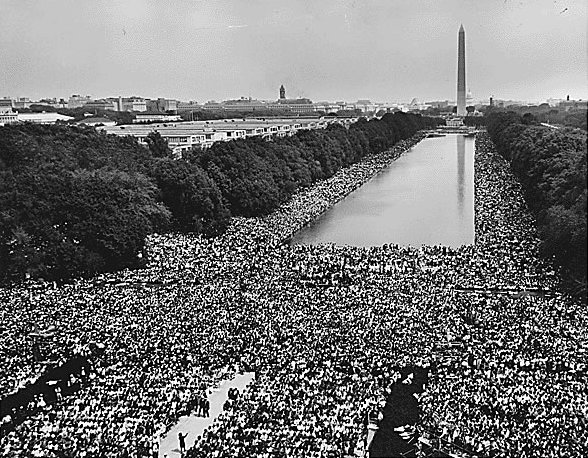
As America marks the 50th anniversary of the March On Washington for Jobs and Freedom, Jelani Cobb sees a country beset by contradictions:

There’s a bizarre dissonance that comes with watching the first black Attorney General give a speech to mark the fiftieth anniversary of the March on Washington and recognizing that the themes of his speech might have fit well with those given at the original march, in 1963. … That Eric Holder’s speech made explicit some implied truths – “But for the movement,” he said, “I would not be Attorney General and Barack Obama would not be President”—and nodded toward the humbling tenacity of unnamed thousands is not particularly surprising. That he went on to articulate a demand that the right to vote be protected for every citizen, and that the criminal-justice system be freed of bias, is alternately noteworthy and depressing.

Martin Luther King III agrees there’s far more to be done:

There are many in our nation who thought that the civil rights movement was done. They saw the election of Barack Obama as a moment ushering in a post-racial era in American history. But what happened? You’ve seen a backlash. Leaders of the Republican Party have demonized the president as an outsider, as if he doesn’t belong in the Oval Office. The Supreme Court has gutted the Voting Rights Act, which undermines the very work my father gave his life for. And Trayvon Martin has met the same fate as Emmett Till  not just in death, but by virtue of an unfair verdict that aimed to render his life less valuable. This is enough to show that the dream is not yet fulfilled and the mission is ongoing.

Bill Fletcher reminds everyone that it was a march for jobs as well as freedom:

The Americans, a high school history text by publishing giant Houghton Mifflin Harcourt, tells students that the march was called simply “to persuade Congress to pass the [1963 civil rights] bill.” In reality, the demand for jobs was not a throwaway line designed to get trade union support. Instead, it reflected the growing economic crisis affecting black workers. Indeed, while Dr. King was a major player, the March on Washington did not begin as a classic civil rights march and was not initiated by him. There is one constituency that can legitimately claim the legacy of the march – one that has been eclipsed in both history as well as in much of the lead up to the August 2013 commemorations: black labor.

Imara Jones adds:

Four out of the 10 demands march organizers listed were explicitly economic, and the announcement calling marchers to Washington cited “economic deprivation” as the impetus. Fifty years on, many of the same critical economic challenges the organizers targeted remain unmet. In fact, the African American unemployment rate is higher now than in 1960: roughly 13 percent in 2013 vs. 8 percent in 1963. Moreover, as Robert Fairlie and William Sundstrom laid out in the The American Economic Review, the employment gap between blacks and whites widened in the 1960s and has never closed. These data point to the fact that addressing racial inequality without a steady unwinding of economic injustice hardens and expands white supremacy.

At the same time, Brentin Mock warns that the Dream can’t survive without equal voting rights:

There’s no separating voting rights struggles from civil rights—the former is basically the source code for the latter. Which is why [John] Lewis and civil rights leaders knew back in 1963 that you couldn’t simply fold voting rights into a small section of the Civil Rights Act. It needed its own bill. Without the ability to vote, other civil rights gains would be suboptimal. …  [T]he voting rights of African-Americans and people of color are in their most vulnerable position since the [Voting Rights Act of 1965] was passed. This is why the call for Congress to restore VRA and to pass a constitutional amendment that guarantees the right to vote was such a prominent feature of Saturday’s march.

Jamelle Bouie says America should remember the march as “militant and unpopular”:

The striking thing about the original March on Washington 50 years ago is how it wasn’t a moment of interracial unity—at least, not in the way it’s portrayed today. Rather, the 1963 March for Jobs and Freedom was militant, a demand for equal treatment under the law and direct investment in the long-neglected fields of black America. It wasn’t a popular agenda. That January, George Wallace was inaugurated governor of Alabama and declared: “Segregation now, segregation tomorrow, and segregation forever.” That June, Medgar Evers, field secretary for the NAACP, was assassinated in Mississippi while coming home from a meeting with lawyers. And that September, in retaliation for the march, four little girls would be killed after their church was bombed in Birmingham.

And Peniel E. Joseph thinks it’s worth taking a moment to celebrate what the march achieved:

In one week, during the run-up to two national celebrations of the 50th anniversary of the March on Washington (the second will occur on Wednesday when Obama makes a speech at the Lincoln Memorial, joined by former Presidents Jimmy Carter and Bill Clinton and members of the King family), we have witnessed two remarkable events: A black president in a nation founded on racial slavery promotes racial healing and economic equality. And an African-American attorney general vows to wage a robust struggle to defend and restore voting rights that were thought to have been won two generations ago.

Both of these instances attest to how far we have come as a nation since 1963 and the long road that lies ahead.

(Photo: Wikimedia Commons)

Chart Of The Day

by Tracy R. Walsh

Nancy Duarte maps the rhetoric in the “I Have A Dream” speech:

duarte_MLK1

She writes:

Metaphors are a powerful literary device. In Dr. Martin Luther King Jr.’s “I Have a Dream” speech, about 20 percent of what he said was metaphorical. For example, he likened his lack of freedom to a bad check that America has given the Negro people … a check that has come back marked ‘insufficient funds.’” King introduced his metaphor three minutes into his 16-minute talk, and it was the first time the audience roared and clapped.

(Hat tip: Maria Bustillos)

More Kids Born With Silver Spoons In Their Mouths

by Tracy R. Walsh

Screen Shot 2013-08-26 at 11.51.46 AM 2

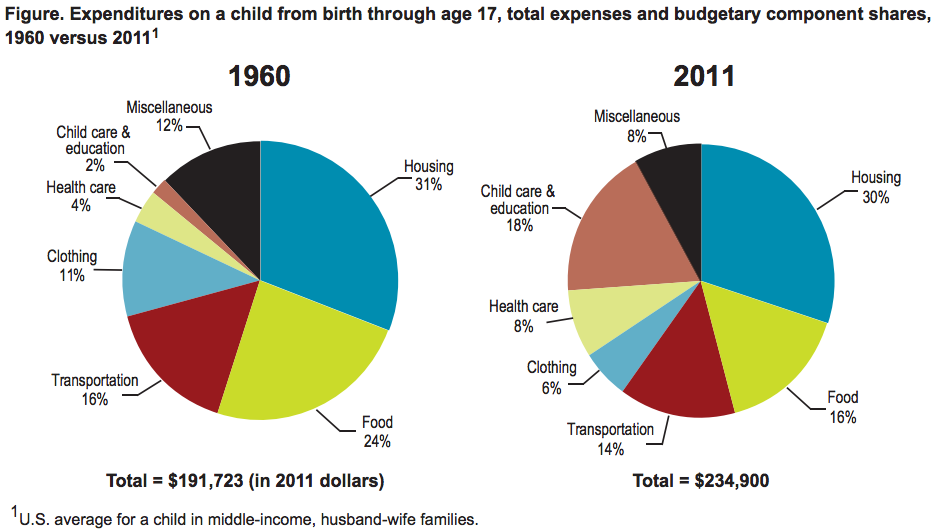
Christopher Carr thinks the rising cost of raising a child is actually a mark of progress:

Much was made last week of a recent study on the cost of child-rearing by economist Mark Lino at the U.S. Department of Agriculture. The total cost of raising a child born in 2012 is an estimated $241,080 – and double that if your kid attends college. That’s a 23-percent increase from 1960.

It’s easy to conclude that the cost of raising children is becoming more burdensome over time, and the historical data suggests that’s right – but only half-right. The rising cost of child care does create a great burden for some families. But it also represents commendable progress in our ability to meet our kids’ most basic needs. The middle class is far better off now than we were in 1960. We can afford to spend more on our kids’ well-being. In fact, the vast majority of the increased spending is for services that were once the exclusive province of the rich, such as high-quality health care and education.

Turning Every Muslim Into A Suspect

by Tracy R. Walsh

New York magazine has a lengthy excerpt from Matt Apuzzo and Adam Goldman’s forthcoming book about the NYPD’s post-9/11 surveillance program, and their account manages to be both harrowing and absurd. One example, of many:

Nobody trained the rakers [undercover officers] on what exactly qualified as suspicious, so they reported anything they heard. One Muslim man made it into files even though he praised President Bush’s State of the Union address and said people who criticized the U.S. government didn’t realize how good they had it.

Even the FBI recognized the problems with the program:

Confirmation that the activities of the Demographics Unit went far beyond what federal agencies were permitted to do was provided by the FBI itself. Once, Sanchez tried to peddle the Demographics reports to the FBI. But when Bureau lawyers in New York learned about the reports, they refused. The Demographics detectives, the FBI concluded, were effectively acting as undercover officers, targeting businesses without cause and collecting information related to politics and religion. Accepting the NYPD’s reports would violate FBI rules.

Conor pounces:

The full story contains a lot more objectionable behavior, and after reading how the undercover officers operate it’s easy to understand why the unit would cause Muslim-American mosque attendees, small-business owners and patrons, and students throughout the city to grow paranoid in their daily lives. And defenders of the program are unable to point to even a single case where it prevented a terrorist attack – in fact, they can’t even point to a terrorism-related arrest or prosecution.

Usually, when I write phrases like, “This is how a secret police force with files on innocent Americans starts,” I’m issuing a warning about the future. But the NYPD literally started a secret police unit that began indiscriminately keeping files on innocent Americans. This isn’t a warning about a slippery slope. It is an observation about ongoing abuse of civil liberties in America’s biggest city.

Living In Nixon’s World

by Tracy R. Walsh

Ben Richmond calls the newly released Nixon tapes both “quaint” and ahead of their time:

From the 21st century, the content of the Nixon tapes – the casual sexism and racism and paranoia – are shocking, but the existence of the recordings seems almost banal. So much of communication is recorded just as it’s made, and when it surfaces via Wikileaks or wherever, people applaud the transparency of it all. …

But maybe this makes the Nixon tapes an even more fascinating relic, as they may contain the last truly candid recordings. They might contain the last time people spoke frankly in the White House. After Nixon’s public destruction and his [successor] Jimmy Carter’s blunder of saying America was having a “crisis of confidence,” everyone realized what a liability displaying human frailty could be. It already feels like we live in a world of Nixon’s creation – China is our most important trading partner, the most advantageous political position is playing the victim (no matter how powerful you actually are), and if you need someone to blame, “the media” is always there. And, of course, everyone recording everyone else is de rigueur.

(Audio: In a conversation recorded April 26, 1973, Richard Nixon and Attorney General Richard Kleindienst discuss the Oglala Lakota and American Indian Movement occupation at Wounded Knee, South Dakota.)

What You And Detainees Have In Common

by Tracy R. Walsh

A_book_from_the_Guantanamo_captives'_library

Elias Groll considers why so many Americans are interested in the library at Guantánamo Bay:

[Books] have the ability to humanize and establish connections between people. Browsing through the GitmoBooks Tumblr, you might realize, suddenly, that you and a detainee have something in common – you both read and loved Harry Potter. Derek Attig, a Ph.D. candidate at the University of Illinois, has written about this phenomenon on his blog:

A main point of the Guantánamo system … has been to make it seem as though Americans have nothing in common with the men being held within it. But books connect. Not as strongly as some theorize – reading the same book as someone else doesn’t make you inexorably and totally connected-but shared experience of a cultural artifact is, indeed, a powerful thing. Scrolling through photos of Danielle Steel novels, of Narnia books, of Harry Potter and 300 Orchids: Species, Hybrids, and Varieties in Cultivation, I’m struck by the intense familiarity of these shelves that I’ve never seen, in a place I’ve never been, used by people that I do not know or, by design, know much about.

(Photo: An Arabic edition of Harry Potter and the Half-Blood Prince held at Guantánamo Bay. By Michael Billings)

Throwing In The Trowel

by Tracy R. Walsh

477824main_SturmandTuckerwGPR

Today’s archaeologists can “dig” without breaking ground:

A major concern in archaeology has always been the potential damage caused by excavation – Indiana Jones may have trampled through ruins without a care in the world, but real-life archaeologists try their best to preserve the remnants of the past as best they can. In recent years, scientists have begun testing out quite a few different non-invasive techniques to analyze archaeological sites. Ground-penetrating radar, or GPR, allows archaeologists to see what’s underground without ever needing to dig. Back in 2002, researchers successfully used GPR in Petra, Jordan to locate underground structures and guide later excavations. People have also used the technique extensively for the Duffy’s Cut Project, which seeks to learn more about the lives of Irish immigrants who were buried in Duffy’s Cut, Pennsylvania almost 200 years ago. And recently, scientists used GPR to try to map undiscovered ruins in Pompeii – they believe the technique could be used to provide detailed maps of the subsurface ruins, which will probably never be excavated.

(Photo: Earth scientist Compton Tucker and radar specialist Jennie Sturm use GPR during an archeological expedition in central Turkey. By NASA/Joe Nigro)