Alexis Madrigal heralds the first animated tattoo:
Anthony Antonellis marked another milestone for the body-hacking movement, implanting an RFID chip encased in glass into his hand. The tiny chip can transmit an animated GIF that he’s stored in it through a tiny antenna. He can swap out the image it carries and transmits, but here’s what he’s currently got in the one kilobyte of memory his implant stores:
The NFC / RFID chip is the size of a grand of sand. It’s equipped with a tiny antenna and encased inside a glass capsule to keep it from being disrupted by its fleshy environment. This chip stores 1KB of data and is readable like a key fob by compatible phones, tablets, card readers and the Arduino microcontroller. … It’s read-only, but changeable when Antonellis decides to upload new works. These could be GIFs, JPGs, Midi files, favicons, [or] ASCII art.
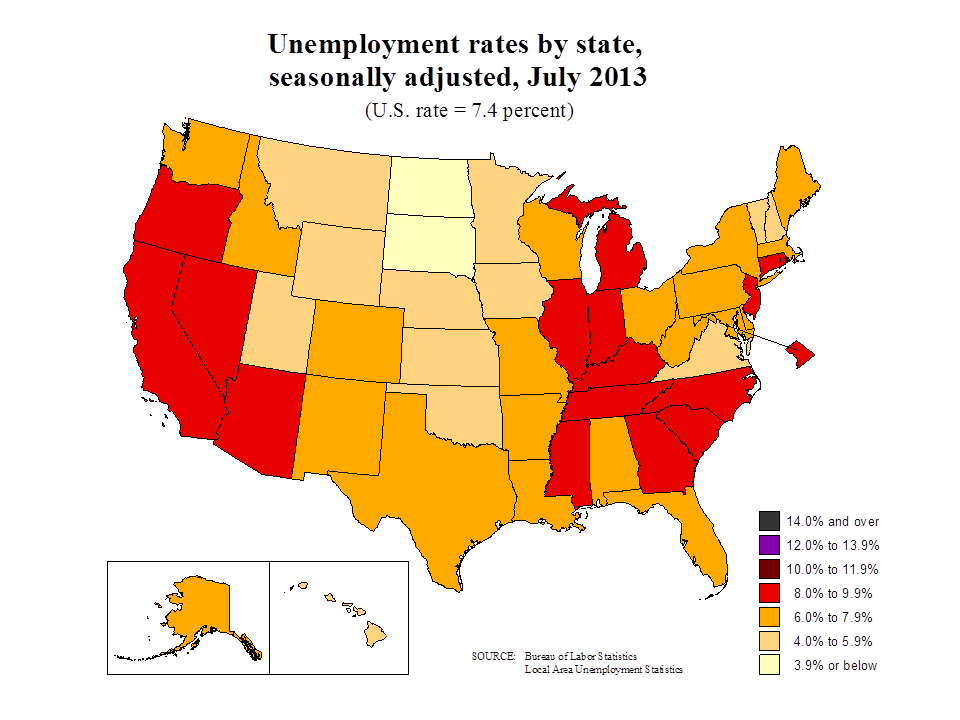
Yglesias wonders why more Americans aren’t moving to find work:
Back in 1985, over 20 percent of the population moved. That number fell steadily to 11.6 percent in 2011 before ticking back up to 12 percent last year. What’s more, even if you just look at interstate moves, a lot of the shifting doesn’t appear to be related to a search for employment. New York to Florida (presumably retirees) leads the Census Bureau’s list of the 10 most common state-to-state moves. None of the 10 lowest-unemployment states are destinations of the top 10 interstate moves, and none of the five highest-unemployment states are departure points for the top 10 interstate moves.
This is bad for unemployed people in Rhode Island and Nevada who perhaps could be getting work in Vermont and North Dakota. But it’s also bad for the broader economy. An outflow of unemployed people from high-joblessness regions would reduce pressure on state and local budgets. And in the low unemployment areas, the arrival of more workers wouldn’t just fill job openings. Their presence would make local labor markets more efficient and would spur investment.
A recent study by a language-processing company called Idibon tried to establish not which languages are “hard,” but which are “weird.” It used a resource called the World Atlas of Linguistic Structures (WALS). WALS indexes hundreds of languages across hundreds of different features (from whether verbs precede objects to whether the language uses click-sounds as consonants). The Idibon study tried to find which languages use the greatest number of unusual features—i.e., those features shared with few other languages. But for tricky methodological reasons, the study had to limit itself 21 features. The languages that have the least “normal” values of these 21 features are the “weirdest.”
Does English rank high? Not especially. Many non-European languages dominate the top of the list. Of those languages in the Indo-European family with English, German, Swedish, Danish, Dutch, Norwegian, Czech, Spanish, Kurdish and Kashmiri all rank as “weirder.” English is at place number 33 of 239 languages in the “weirdness index.”
However, the study’s authors note that 33 out of 239 is still “highly unusual.” The weirdest tongue is Chalcatongo Mixtec, a tonal language spoken by 6,000 in southern Mexico, while the most conventional language is Hindi.
Anthropologist Kathleen Richardson is skeptical of futurists who think technology will “irrevocably change what it means to be human”:
In books such as The Singularity is Near: When Humans Transcend Biology, [Ray] Kurzweil is forever predicting that we will merge with machines and be able to upload our “complete” consciousness into machines. This idea is emerging as the next big challenge in robotics, but it could equally be viewed as a basic feature of human cultural existence. I’m “uploading” my consciousness right now into this article. A visual artist, when she paints is also “uploading” her consciousness. Consciousness is just another way of saying psychic life – the life and impulses of the individual as a member of a family and collective. Arguably, any human being that has ever created anything has transferred aspects of their consciousness to artificial materials.
Yesterday, President Obama delivered the first of three speeches setting out his vision for higher education: an ambitious if not-entirely coherent list that includes new federal college rankings, outcomes-based funding, more MOOCs, and universal income-based student loan repayment. Jon Chait zooms out:
The most controversial element of Obama’s proposal is to create a metric measuring which colleges provide the best value. This has been a longtime goal of higher education reformers – the Washington Monthly, for instance, has published its own college rankings. Under Obama’s proposal, the U.S. Department of Education would craft such a measure by 2014 and then, after trying it out to ensure it works well enough, begin using it to prorate federal tuition subsidies by 2018. That is, students could get more generous loans for the most effective schools, and less-generous loans for the least effective. 2018 is far enough in the future that it might as well be “eventually,” but it matters in the sense that Obama is laying down a marker that a successor president can choose to hit if the first stage goes off as planned.
Kevin Drum adds, “The basic idea here is that endlessly increasing the amount of federal student aid just isn’t working anymore”:
At this point, all it does is encourage universities to raise their prices, which means that students are no better off than they were before. In fact, maybe worse, since they end up graduating with ever more gargantuan loans to pay off. Instead we need to reward universities that actually provide a good bang for the buck: a solid education and high graduation rates at a reasonable cost.
Scott Jaschik notes that the plan has “common elements” with the administration’s proposed regulations for for-profit schools:
An underlying goal both of those regulations and this plan is an attempt to judge colleges based on the “value” they provide to students and taxpayers, based on a mix of student outcomes. Gainful employment, aimed at vocational programs, focused exclusively on employment outcomes and debt; the president’s plan for colleges generally would look at a broader mix of institutional and student outcomes, including access and affordability as well as employment outcomes.
We’ll need to see how the rating systems work when the Department of Education releases them next year. But this is the right direction to be moving in. As with health care, third-party payment causes the education sector to focus too little on cost, and the government needs to make sure that tax dollars are spent efficiently. If we want to make college affordable, the government needs to bend the cost curve, not just write bigger checks.
Daniel Luzer is cautiously optimistic, but notes that “there are a lot of ways for this to go wrong”:
Colleges are likely to lobby pretty seriously against more oversight. Republicans might oppose it just because it’s an Obama policy, and because it introduces more regulations to a system many argue is already over regulated. The real outcome will look a lot different from what Obama proposes and it’s possible some compromises will result in very different outcomes from those intended. Rewarding colleges for higher graduation rates but not also rewarding them for enrolling more Pell students would likely cause colleges just to enroll fewer poor students, who have more trouble getting through college. Enrolling all students in “pay as you earn” programs but not providing schools with more money through Pell grants could result in massive funding shortages, for instance. But there’s a lot to work with here, and the ideas are impressive.
So far, I don’t get it. There seems to be plenty of information about colleges, and I doubt if a federal rating system would improve on those ratings already privately available. To the extent that federal system became focal, the incentives to game and scheme it would become massive, and how or whether to punish the gamers, if and when they are caught, would be a political decision. I don’t see that as healthy. … Should we be giving colleges an incentive to identify and deny admission to potential lower earners? Do we really want the federal government helping to crush humanities majors? And I don’t see that the kind of rating system under discussion here is measuring actual value added.
Meanwhile, Diane Ravitch slams the plan as “No Child Left Behind for higher education,” and Walter Hickey is outright cynical:
In the pursuit of fundamental change, President Obama will in all likelihood create just a new way for college to juke the stats. He shouldn’t be surprised. Colleges “adjusting” the stats in order to achieve a higher rating is a longstanding tradition in academia. In order to rank highly on the U.S. News and World Report college ranking — by and large the most trusted resource for high school seniors attempting to ascertain an arbitrary and decontextualized numerical value of a college — universities will do anything necessary to move the needle. … George Washington university lied about their freshmen class rankings, worth 6 percent of the score. Baylor paid their freshman to retake the SAT, worth 7.5 percent. The U.S. Naval Academy allegedly inflated their admissions numbers, worth 1.5 percent. Allegedly, the Ivy League often has discrepancies between the numbers they report to U.S. News and the number they report to the Federal Government. Clemson University was alleged to have manipulated a realm of stats in order to climb from 38th place to 22nd place in the ranking.
Borrowers in the class of 2013 started their post-collegiate lives $35,200 in debt and entered a job market where even biology and chemistry majors struggle to find work. In that context, Obama’s speech is welcome: After all, the first step is solving a problem is admitting you have one. But ranking systems and accountability-based funding have backfired at the K-12 level, and Obama’s plan does little to address two major problems: declining state aid to universities, and student-loan bankruptcy laws that encourage banks to lend students enormous amounts of money regardless of their ability to repay (and encourage schools to raise tuition accordingly). Given those realities, it’s not clear students have much to celebrate.
Researchers are inching closer to identifying states of consciousness just by examining brain waves:
Marcello Massimini’s team from the University of Milan found that people in different states of consciousness will respond to a non-invasive electromagnetic pulse with distinctive patterns of brain waves. If other groups confirm that these waves are reliable markers of consciousness, it would be a huge help to doctors who treat people with brain injuries. Many of these patients look the same from the outside — they don’t respond to doctors or loved ones with words, say, or eye blinks, or hand squeezes. But they are not the same. Some 68 percent will recover consciousness within a year, and 21 percent will lead independent lives, according to one study. What’s more, some people gain consciousness one, two or even five years after their injury. With current technologies, however, it’s extremely difficult for doctors to predict which patients will have positive outcomes and which will never break through.
Hughes says the study illustrates “essential point” about human awareness:
“Doctors assume that after clinical death, the brain is dead and inactive,” the rat study’s lead investigator, Jimo Borjigin, told Ed. “They use the term ‘unconscious’ again and again. But death is a process. It’s not a black-or-white line.” Right, death is a process. But consciousness, too, is a process — a very slippery one.
Garance Franke-Ruta thinks college graduates should have some student loans forgiven if they move to struggling areas:
Cities like Detroit; Cleveland; and Gary, Indiana, need people: young people, college-educated people, people with an entrepreneurial spirit who might be willing to put down roots and pay local taxes and taken on renovation projects and bring new views and businesses and opportunities to distressed, underpopulated communities. Debt-burdened recent college graduates, for their part, need cheap housing and to pay off their student loans. . … Maybe it’s time to try to yoke these two problems together and allow for partial loan forgiveness for people who commit to living in distressed communities for a set period of time. The rents in Detroit couldn’t be cheaper, nor could houses, should anyone want to lay down deeper roots. Think of it as something akin to Washington’s first-time-homebuyer tax credit, but available to renters, too, and accomplished through educational-debt reduction rather than the tax code.
Meanwhile, Aaron Renn wants city governments to take a page from corporate America and recruit residents:
While most cities have paid lip service to attracting newcomers, few have put any real muscle behind it. There might be a website or marketing-type materials, but often these are not very good. The lack of seriousness in these efforts is shown by the critical missing piece: sales. That is, going out and actively recruiting individual, specific people to want to live in a place, not just to fill a specific opening at a specific company. Ask yourself this: The last few times you visited a place, did anyone try to sell you on it as a community you might want to live in or build a career or business? In my experience, the answer is almost always no.
A New York developer is under fire after proposing separate entryways for rich and less-rich tenants at a planned luxury condo:
A 33-story building slated to be built on Riverside Boulevard between 61st and 62nd street will have an entirely separate entrance for people of lower socioeconomic means: a door for the poor, or as we call it, a “Poor Door.” The affordable homes will be oriented towards the back of the building, while market-rate units will have a view of the Hudson.
Emily Badger calls the building, which will include 55 affordable-housing units, “a perfect metaphor for New York City’s gaping inequality”:
Of course, it’s easy to segregate affordable housing–and the people who live in it–into its own part of town, its own neighborhoods, even its own isolated blocks. But it takes some serious creativity to keep the haves and have-nots apart in the very same building.
Bill Bradley sees a case of tax incentives backfiring:
Floors two through six of the building will be available only to residents earning less than 60 percent of the area median income, putting them under the “affordable” umbrella. Those five floors are part of the exact same building as the luxury condos, but because of the separate entrance they could be legally designated as a separate entity. So technically, [the developer] would have an entire building consisting of affordable housing. On paper, this makes the project eligible for subsidies ostensibly meant to protect lower-income tenants, not move them out of sight.
We require and incent developers who build market-rate housing to also sell or rent some units in the same developments at cut-rate prices. The idea is that affordable housing shouldn’t just be affordable and livable; it should be substantially similar in location and character to new luxury housing. If rich people are getting brand new apartments overlooking the Hudson River, so should some lucky winners of affordable housing lotteries. … Getting mad about the “poor door” is absurd. The only real outrage is that Extell had to build affordable units at all.
Keith Humphreys thinks the phrase “progressive Puritans” is unfair to both progressives and Puritans:
A Puritan would be delighted to meet a fellow member of the faithful, but that is not what I see in these parents. If they are vegetarian and meet another vegetarian, they are unhappy and commit to becoming a vegan. If they then meet another vegan, they become unhappy and commit to becoming an ovo-lactic vegan. They don’t want other people to share faith in a community of peers; they want to outrank their lessers within a hierarchy. This is also why they are not truly liberal or progressive. They are not trying to save the world, they are trying to get an edge in life for themselves and for little Hayden and Sawyer too.
Rather than surrender the terms liberal or progressive so easily to the domain of lifestyle and shallow issues of personal identity, I suggest we let those terms retain their political meaning by not describing panicky, entitled, hierarchy-obsessed, materialistic strivers as “liberals.” Likewise, let’s not throw theology and history to the side and call them “Puritans” either. If we need a shorthand term for them, I suggest that someone with literary skill invent an entirely new one, as long it isn’t very polite.
Visiting Charleston’s 500-year-old Angel Oak, Alicia Puglionesi mulls over the irony of eco-tourism–namely, “we don’t like to see nature having a rough time”:
It’s no fun to see adorable deer starving to death, or baby birds falling out of trees, or a pristine forest consumed by flames. The temptation to meddle is strong when we believe our intentions are pure. [City official Daniel] Burbage told a story about the Angel Oak. About 10 years ago, the park managers called him because of a large cavity on the side of the tree. They were worried that the limb below the cavity was falling. … The cavity looked bad; it made people think about rot and weakness. Burbage knew that everything was fine. But people don’t like to see such blemishes on symbolic old things, so Burbage put a screen over the cavity and covered it with putty and painted it to look like the tree’s bark. He never received another call about the falling limb. Like all of his interventions, the screen would have little impact on the centuries-long processes of growth and decay taking place slowly inside the tree.



 The Dish
