Chris Rock, on Newt Gingrich, back in the Clinton days:
Category: Dick Morris Award Nominee
Von Hoffmann Award Nominee
"If Rick Perry runs, he'll win, right? Barring some unforeseen scandal I don't see how he loses," – Matt Yglesias, June 9th, 2011.
Von Hoffmann Award Nominee, Ctd
A reader counters the nomination of James C. Moore's prediction that Perry will win the presidency:
Ahem:
"I think the GOP probably will nominate Perry, and probably regret it," – Andrew Sullivan, October 3rd, 2011.
Another adds:
I think you failed to see the sarcasm in Moore's original post. And knowing his past writings against George W. Bush, I just don't see him as a big Perry supporter.
A sentence with two probablys doesn't qualify for a quality VHA. But I'll take my lumps.
Von Hoffmann Award Nominee
"America is beginning the process of electing another Texan to be president. … Perry's coyote-killer good looks, $2,000 hand-tooled cowboy boots, supernova smile and Armani suits, combined with podium skills to embellish the mythology of Texas, all will create a product Americans will want to believe and buy," – James C. Moore, August 11th, 2011.
Dish award definitions here.
(Hat tip: PM Carpenter)
Von Hoffmann Award Nominee
“Everything I know about [Palin] suggests she will [run for president]. But Washington – Republican and Democrat – is convinced she’s over. We’ll see. I hope the establishment is right. But none of the current candidates seems viable to me,” – Andrew Sullivan, August 17, 2011.
“Yes, I know she could be squeezing the last drop of the publicity that will end abruptly the minute she says she’s not running. And I can’t know the future. All I can say is that everything I have ever learned about Palin suggests she will run. It’s her divine destiny, as she and countless others believe,” – Andrew Sullivan, August 11, 2011.
“One reason I think she may well still run is not just that it’s who she is, but the vehemence of the Republican political and media establishment’s hostility to her candidacy. That’ll goad her some more,” – Andrew Sullivan, September 8, 2011.
“She has wanted to be president for much of her adult political life. She wanted it well over a decade ago. She risked a huge amount in saying yes to John McCain, a gamble of monumental proportions, in the pursuit of that goal. She believes sincerely that she is on a mission from God, that she is the Esther of the End-Times. Why is any of this hard to understand? By her words and her actions, she wants to be the GOP nominee. And at a time when Republican extremism is the brand, who better represents the party than she?” – Andrew Sullivan, April 27, 2010.
“[H]ow can someone who said she wanted to be president as long ago as 1996 resist? … She is the biggest political power after Obama in this country. And, unless the full truth emerges with such force it cracks even the FNC/RNC sealed universe, she will run against him in 2012,”- Andrew Sullivan, April 26, 2010.
“The obvious problem is that [a third-party run] would all but guarantee the re-election of Barack Obama. Is she delusional and narcissistic enough to plow onward regardless? You betcha!” – Andrew Sullivan, hours before her announcement yesterday.
Award glossary here.
Von Hoffmann Award Nominees
"Sure, all things being equal, a president would rather have his allies firmly in control than not. But recent presidents have had more success when forced to work with slim majorities in Congress, or even none at all." – Matt Bai, 1/7/10.
"Under those conditions, the only way to achieve sustainable bipartisanship is to divide control of the government, forcing the parties to negotiate in order to get anything done. That pulls policy toward the center, which encourages reasonableness." – Jonathan Rauch, 3/25/10.
Collected by John Sides, who made the right call.
Von Hoffmann Award Nominee, Ctd
What about my prediction that "[w]ith American seriousness and credibility thus restored, we will enjoy fruitful cooperation from the region’s many opportunists, who will show a newfound eagerness to be helpful in our larger task of rolling up the international terror network that threatens us"? That, too, turned out to be true. Witness how, after Saddam Hussein was toppled, Muammar Qaddafi? suddenly decided to give up his weapons of mass destruction, and even the Iranian government paused its development of nuclear weapons. We did get more cooperation even from our foes when our credibility was at its height in 2003. That cooperation waned, however, as we became bogged down in an insurgency in Iraq, with Secretary of Defense Donald Rumsfeld stubbornly refusing to send enough troops to gain control of the situation. The success of the surge once again restored American credibility–but it is in danger of eroding again, with President Obama prematurely drawing down in Afghanistan and all but pulling out of Iraq.
It's staggering to contemplate the epistemic closure here.
The point of the criticism of the Iraq war is not against its immediate military success (which did temporarily achieve what Boot notes) but in the lack of a follow-through, because we do not understand and cannot indefinitely govern foreign countries against the will of their people. To keep insisting on the former fact when the latter stares us in the face – when tens of thousands of innocents died because of Boot's armchair prognostications – is close to nuts.
Boot seems to believe our problem is that we didn't act more like an old-style empire, indefinitely occupying two of the least governable places on earth: Iraq and Afghanistan. He still wants an eternal empire, even as he sees the Arab Spring as somehow a vindication of neoconservatism. Does he not realize that the Arab Spring broke out after neoconservatism was defeated in 2008? That al Qaeda has been decimated far more by Obama than by Bush? But that would require the kind of soul-searching that is banished by neoconservatism's high priests. Never admit error.
Von Hoffmann Award Nominee
“Once we have deposed Saddam, we can impose an American-led, international regency in Baghdad, to go along with the one in Kabul. With American seriousness and credibility thus restored, we will enjoy fruitful cooperation from the region’s many opportunists, who will show a newfound eagerness to be helpful in our larger task of rolling up the international terror network that threatens us,” – Max Boot, as early as October 15, 2001.
Von Hoffman Award Nominee
by Chris Bodenner
"Tuesday marked a week and a day since the Associated Press published the controversial remarks of Sen. Rick Santorum, R-Penn., in which he seemed to equate gay sex with incest and possibly even bestiality. It was the fourth day since President Bush said, through a spokesman, that Santorum was an "inclusive man" who was "doing a good job as senator—including in his leadership post." (Santorum is the No. 3 in the Senate GOP.) And it was the day Santorum himself was enthusiastically welcomed at a Senate GOP lunch, after which Majority Leader Bill Frist of Tennessee declared him to have "the full, 100 percent confidence of the Republican leadership in the United States Senate."
And with that, the furor seems all but over," – Jake Tapper, in a 2003 Salon piece entitled "Santorum's One-Week Scandal."
(Via Dan Savage, natch)
Von Hoffman Award Nominee Ctd
by Zack Beauchamp
Daniel Larison responds to my critique of his post:
Yes, I repeatedly referred to a stalemate in Libya. That is what the Chairman of the Joint Chiefs called it on July 25, and it was only very recently that this description became inaccurate. Libyan war supporters never liked the word stalemate, perhaps because it weakened public support for the war, but for much of the spring and summer it was the appropriate word to use. Admiral Mullen said, “We are generally in a stalemate.”
But Mullen immediately followed that statement with "although Qaddafi forces continue to be attrited," a number of other arguments as to why the current campaign was succeeding, and concluded that "in the long run, I think it's a strategy that will work… (toward) removal of Kadhafi from power." Larison, you'll see, was using the term to suggest precisely the opposite of Mullen's conclusion: Qaddafi wasn't going anywhere. That's why he got the Von Hoffman.
First, the reason that Libya war supporters "never liked" the term stalemate was because it wasn't accurate when used to suggest the conflict was going to drag on. As Juan Cole argues:
There was a long stalemate in the fighting between the revolutionaries and the Qaddafi military. There was not. This idea was fostered by the vantage point of many Western observers, in Benghazi. It is true that there was a long stalemate at Brega, which ended yesterday when the pro-Qaddafi troops there surrendered. But the two most active fronts in the war were Misrata and its environs, and the Western Mountain region. Misrata fought an epic, Stalingrad-style, struggle of self-defense against attacking Qaddafi armor and troops, finally proving victorious with NATO help, and then they gradually fought to the west toward Tripoli. The most dramatic battles and advances were in the largely Berber Western Mountain region, where, again, Qaddafi armored units relentlessly shelled small towns and villages but were fought off (with less help from NATO initially, which I think did not recognize the importance of this theater). It was the revolutionary volunteers from this region who eventually took Zawiya, with the help of the people of Zawiya, last Friday and who thereby cut Tripoli off from fuel and ammunition coming from Tunisia and made the fall of the capital possible. Any close observer of the war since April has seen constant movement, first at Misrata and then in the Western Mountains, and there was never an over-all stalemate.
This comports with Mullen's view that the status quo strategy was ousting Qaddafi and, as I noted, several other analysts' views at the time. These people argued that Qaddafi's regime was doomed because the longer term trends favored the rebels. Lynch, June 18th:
This is a good time to realize that the war in Libya was very much worth fighting and that it is moving in a positive direction. A massacre was averted, all the trends favor the rebels, the emerging National Transitional Council is an unusually impressive government in waiting, and a positive endgame is in sight.
Goldstein, July 18th:
Back in June, I wrote that the Libya war could be over before the end of the month. I was wrong about that; it’s been slower. But I still think the situation is not a stalemate or quagmire, but one that moves continuously in one direction, albeit slowly — toward Gaddafi’s collapse.
Damningly, Larison wrote a post disparaging precisely these arguments on July 26th:
Despite the claims that “all trends favor the rebels,” the rebels in Libya remain as far from their goal as ever. It is absurd to continue refusing a cease-fire in the vain hope that there will be a breakthrough, which the onset of Ramadan makes even less likely.
It seems fairly clear in that post that Larison was predicting that there would be no breakthrough, and that the trends didn't favor the rebels. Larison argues that, in the other post cited in the Award, he was simply saying NATO didn't have an alternative plan in case the bombing didn't work. But "we are no closer to finding a means by which Gaddafi would be forced to 'go' than we were four months ago" can only be read in that fashion if one assumes that the current strategy wasn't a means by which Qaddafi would be forced to go. As is clear in context of his other post, that was precisely Larison's assumption. That turned out to be quite wrong.
He also could have made an argument that no one could have seen this coming at the time, so he wasn't making a prediction, just stating a supposed fact:
When I wrote, “We are no closer to finding a means by which Gaddafi would be forced to ‘go’ than we were four months ago,” that was informed by reports earlier in the month that the rebel military leadership had no expectation of a rapid rebel advance on Tripoli. C.J. Chivers wrote in one of his reports that “expectations of a swift rebel advance out of the mountains toward Tripoli are unrealistic, barring a collapse from within of the Qaddafi forces blocking the way. The rebel military leadership has admitted this much, too. A force equipped as they are, they say, cannot expect to undertake an arduous open-desert march against a dug-in, conventional foe with armor, artillery, rockets, and more.” What changed? Gaddafi’s forces collapsed, and they collapsed so quickly that the speed of it reportedly startled NATO officials. At the time that I wrote that line, it was a fair description of the situation, and it seemed a reasonable response to vague demands to “finish the job” that included no explanation for how that was to be done. It doesn’t matter very much, but it wasn’t a prediction.
The Chivers post only supports his position if one accepts that we couldn't have predicted, based on a reasonable reading of the evidence, that Qaddafi forces were going to collapse. Not only do the expert predictions I've cited belie that, but so do U.S. and European intelligence reports from the time. From Joby Warrick on July 12th:
While the momentum has generally favored the rebels for weeks, Western analysts are seeing troubles escalate on the loyalist side, possibly explaining the surge of interest in finding a negotiated end to the fighting, according to two senior U.S. officials who have seen the assessments. “There has been a shift,” said one of the officials, who insisted on anonymity in discussing the classified reports. “The situation is looking much better [for the rebels] than it was just a month ago.”
There were a number of reports of lack of money, fuel, flagging morale, etc. on the loyalist available at or around July 26th that could have led one to conclude the Qaddafi forces were going to collapse. That's what led people like Lynch and Goldstein to say "all trends favored the rebels." Larison interpreted the evidence differently. That's a reasonable disagreement – as I've said, Larison is a very smart guy, an excellent commentator, and a wonderful check on my own generally interventionist tendencies. But it doesn't make his prediction that no "breakthrough" was coming or that the NATO plan would prove inadequate towards collapsing Qaddafi any more correct. That other Washington Post article about the speed of collapse doesn't really help his case either, as he flatly predicted that NATO'S strategy would not produce a breakthrough, not that it would take a really long time.
I'm engaging in this exercise because I think it's valuable to point out when people got things wrong. I've made a number of wrong predictions in the past and almost certainly will again, on matters trivial and not. I should hope someone points them out. It's worthwhile to do so because the reasons I or anyone else got things wrong could potentially be useful as data points for the future. Understanding why the Libya intervention succeeded in ousting Qaddafi (which relate to the factors discussed above) can help judge the prospects of any similar intervention to succeed at stopping mass violence and/or regime change. That Larison got it wrong this time isn't a mark against him especially – it's simply something worth noting.
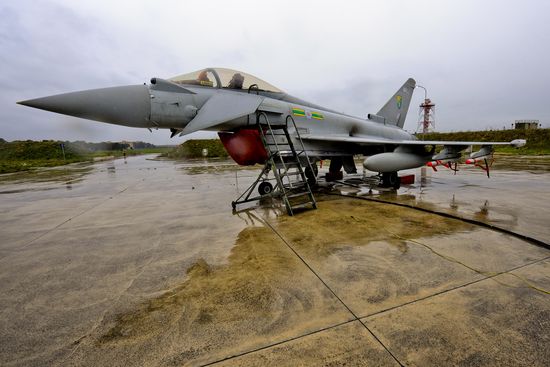
(Photo: Royal Air Force Typhoon aircraft prepare as part of Operation Ellamy, the British action in support of the UN security resolution to enforce a no-fly zone over Libya on March 21, 2011 in Gioia Del Colle, Italy. By SAC Neil Chapman/MoD via Getty Images.)
 The Dish