It’s Still 1968

Daniel Henninger pushes back against the argument of my Obama essay:

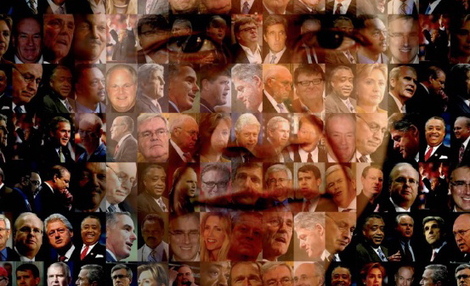
If it’s Hillary versus Rudy, McCain or even the placid Mitt Romney, we will be in those streets again. Besides, her candidacy comes with Jumpin’ Jack Flash himself, Bill Clinton. Would it be a good thing if the country’s politics said bye-bye baby to the children of 1968? Probably. But it won’t happen this time.

As Cartman would put it, why the fuck not? I’m as tired of it as Blue Crab Boulevard:

The saddest thing is that many of the idealists who formed their worldviews in the 1960s do not see that they have become more rigid in their outlook and even more authoritarian than the society they rebelled against in their youth… There is not a single hint that they see the irony in complaining vehemently over the reaction to an inappropriate display of anti-Bush sentiment by a bridge team while simultaneously screaming for the silencing of talk radio.

Steve Hayward suspects that

the Hillary nomination is inevitably going to open up another, but hopefully the last, chapter in the Hatfield-McCoy aspect of the baby boom saga.

But she can still be stopped! Tune in for Vegas debate bloggery later tonight.
The Case For Clinton

Obama makes it:

"If you believe that these are problems that are incremental in nature, that really you just have to do a tweak here and a tweak there, and that our big problem has been that George Bush has just been a poor manager of government, then I think that Hillary’s arguments are persuasive."

I put it this way:

The paradox is that Hillary makes far more sense if you believe that times are actually pretty good. If you believe that America’s current crisis is not a deep one, if you think that pragmatism alone will be enough to navigate a world on the verge of even more religious warfare, if you believe that today’s ideological polarization is not dangerous, and that what appears dark today is an illusion fostered by the lingering trauma of the Bush presidency, then the argument for Obama is not that strong. Clinton will do.

I think America’s current moment requires something other than more polarization and fearful pragmatism.

Lessig For Obama

Web icon Lawrence Lessig rips into Clinton in this post and offers another personal testimonial in defense of Barack Obama. Money quote:

She supported the war, but as my support of Edwards last time round indicates, I can forgive that. The parts I can’t get over all relate to the issues around corruption. I signaled as much in my comments about her comments about lobbyists. We see two radically different worlds here. And were she President, I’d bet everything that we’d see radically little change.

But the part that gets me the most about Senator Clinton is the eager embrace of spinelessness. I don’t get this in Democrats generally. I never have, but I especially don’t get it after two defeats to the likes of George Bush (ok, one defeat, but let’s put that aside for the moment). Our party seems constitutionally wedded to the idea that you wage a campaign with tiny speech. Say as little as possible. Be as uncontroversial as you can. Embrace the chameleon as the mascot. Fear only that someone would clearly understand what you believe. (Think of Kerry denying he supported gay marriage — and recognize that the same sort of people who thought that would win him support are now inside the control room at ClintonHQ).

Clinton’s main advantage at this point is fear. Americans used to fight fear. Now they seem to embrace it.

Beyond Red and Blue?

This I didn’t know:

Hedgecoth estimates 15 percent of the people walking into and volunteering at the Linn County for Obama office are Republicans or former Republicans. Electing someone who can represent and find support on both sides of the political spectrum, he said, should go a long way to ending "the political gridlock" of recent years.

Or this:

The campaign is hoping outspoken people like Blix, combined with Obama’s third-place finish in a poll of Republican caucus-goers, will convince Iowans that electability isn’t an issue for Obama.

I hadn’t heard of that poll. But it doesn’t exactly go against the grain of my Atlantic piece.

An Inconvenient Truce

1207cover

My essay on the Obama candidacy is now online:

[T]he most persuasive case for Obama has less to do with him than with the moment he is meeting. The moment has been a long time coming, and it is the result of a confluence of events, from one traumatizing war in Southeast Asia to another in the most fractious country in the Middle East. The legacy is a cultural climate that stultifies our politics and corrupts our discourse.

Obama’s candidacy in this sense is a potentially transformational one. Unlike any of the other candidates, he could take America—finally—past the debilitating, self-perpetuating family quarrel of the Baby Boom generation that has long engulfed all of us. So much has happened in America in the past seven years, let alone the past 40, that we can be forgiven for focusing on the present and the immediate future. But it is only when you take several large steps back into the long past that the full logic of an Obama presidency stares directly—and uncomfortably—at you.

At its best, the Obama candidacy is about ending a war—not so much the war in Iraq, which now has a momentum that will propel the occupation into the next decade—but the war within America that has prevailed since Vietnam and that shows dangerous signs of intensifying, a nonviolent civil war that has crippled America at the very time the world needs it most. It is a war about war—and about culture and about religion and about race. And in that war, Obama—and Obama alone—offers the possibility of a truce.

Obama and the Gays

A reader writes:

Yesterday, I went to see Barack Obama speak at North Carolina Central University, a "Historically Black College" in Durham, North Carolina.  The vast majority of the crowd was black.  In his riffing on what groups we cannot allow to be scapegoated in the next election, Barack built to and concluded with "homosexuals" … to the conspicuous (and regrettable) silence of the crowd.

It wasn’t the "right" thing to say politically, but it was the right thing to say.  The national media certainly wouldn’t have reported on it had he left homosexuality out of this particular speech.  All he accomplished, by sticking to his principles, was run the risk of alienating people whose support he desperately needs.  Though, in fairness, this did cement my support.

Andrew, this man is a strong ally.  Anyone for whom sexuality issues are important would be making a grievous error to jump his ship over the Donnie McClurkin fiasco.

Can you imagine Senator Clinton defending "homosexuals" in front of a non-gay crowd? Unimaginable.