Chart Of The Day

Civil Unions

Robert Jones and Daniel Cox examine support for civil unions over time:

The changing political composition of civil union supporters shows that the center of gravity of this debate has shifted significantly. The civil union option has moved from being a middle way dominated by political moderates a decade ago to one that is, today, most attractive to political conservatives. And looking ahead, there is evidence that the civil union option may have a limited future, at least if younger Americans are any indication. When given a three-way choice, civil unions are the least popular option among Millennials (Americans born after 1980). Only slightly more than 1-in-10 (13%) Millennials prefer civil unions, while 67% say they support allowing gay and lesbian people to marry, and 15% oppose any legal recognition of a gay couple’s relationship.


Chart Of The Day

Drug And Murder Sentences

Julie Turkewitz flags a recent report:

For years, Latin American governments have been dishing out increasingly harsh punishments to people convicted of drug-related crimes, including those convicted of low-level offenses—possession of, say, 50 grams of marijuana. While anecdotal evidence has often pointed toward this pattern, a new study conducted by Dejusticia, a Colombian research and advocacy group, documents this trend and comes to a harsh conclusion: “In three of the seven countries surveyed, drug trafficking garnered longer maximum and minimum penalties than murder.” In all countries studied, “the maximum penalty for drug trafficking is nearly equal to or, in most cases, greater than the maximum for rape.”

(Chart created by the Washington Office on Latin America (WOLA). Check out their Border Fact Check blog, which separates fact from fiction on border security issues.)

Chart Of The Day

aol-netflix-march2013

As Dan Frommer observes, “it doesn’t get more clear than this”:

At the end of March, almost 2.7 million people still subscribed to AOL service, the company reported this morning. That’s about where Netflix stood at the end of 2004. Since then, Netflix’s subscriber base has grown — 29 million at the end of March — and AOL’s has declined at a remarkably parallel rate. But that makes perfect sense: Nothing says “dialup” more than AOL, and few services have benefited more from the growth of broadband than Netflix. (The paths cross in early 2008, just as Netflix’s streaming video service was starting to take off.)

Chart Of The Day

Muslim Death Penalty

Max Fisher created the above chart using data from a new Pew report (pdf):

According to Pew’s data, 78 percent of Afghan Muslims say they support laws condemning to death anyone who gives up Islam. In both Egypt and Pakistan, 64 percent report holding this view. This is also the majority view among Muslims in Malaysia, Jordan and the Palestinian territories.

It’s important to note, though, that this view is not widely held in all Muslim countries or even among Muslims in these regions. In Bangladesh, another majority Muslim South Asian state that has a shared heritage with Pakistan, it is about half as prevalent, with 36 percent saying they support it. Fewer than one in six Tunisian Muslims hold the view, as do fewer than one in seven Muslims in Lebanon, which has a strong Christian minority.

The view is especially rare among Central Asian and European Muslims. Only 6 percent of Russian Muslims agree that converts from Islam should face death, as do 1 percent of Albanian Muslims and, at the bottom of the chart, 0.5 percent of Kazakhs.

But look at Egypt, Pakistan, Jordan and Palestinians. How is it possible to have any sort of liberal democracy when religious conscience is worthy of the death penalty, for a hefty majority of citizens in those countries? More to the point: if you could pick a single country on earth least likely to become anything like a Western democracy, it would be Afghanistan. And yet US soldiers are still there trying to bring it about.

My guess is that this is hubris that future generations will look back on with amazement. We tried to do what? I’m just relieved George W. Bush’s errors will now be restricted to various canvases and easels.

Chart Of The Day

drug_overdose

As part of Popular Science’s “Drug Week” coverage, Katie Peek parses the data on drug overdoses, which have more than doubled since 1999:

About half of those additional deaths are in the pharmaceuticals category, which the CDC has written about before. Nearly three-quarters of the pharmaceuticals deaths are opioid analgesics—prescription painkillers like OxyContin and Vicodin. And while cocaine, heroin and alcohol are all responsible for enough deaths to warrant their own stripes on the chart, many popular illegal drugs—including marijuana and LSD—are such a tiny blip as to be invisible.

Chart Of The Day

Bullying

Bullying has long-term consequences:

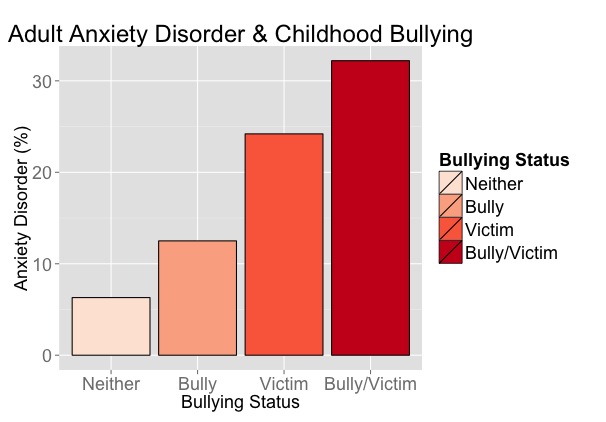
The first column represents the rate of anxiety disorders in the adults who were neither bullies nor victims in childhood. The second and third are those who were just bullies or just victims, and the last is the rate of disorder among adults who were both bullies and victims of bullying. Although anxiety is a universal experience, an anxiety disorder is a severe and potentially disabling condition. The rate of such disorders is almost four time as high among victims as among those with no experience of bullying, and nearly five times as high among those who were both bullies and victims.

Chart Of The Day

wsjlongformjpg

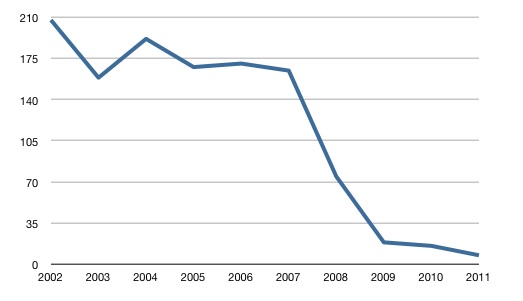
Noting the absence of the WSJ from this year’s Pulitzer finalists, Dean Starkman charts the number of WSJ pieces longer than 2,500 words:

A common trait among Pulitzer projects is that they are ambitious, require extensive reporting and careful writing, carry some significance beyond the normal gathering of news, and/or have some kind of impact on the real world, like, as I’ve written, fixing Walter Reed. Basically, this is work that takes a long time to do and requires some length in which to do it. And just because a project has all those elements obviously doesn’t mean it’s going to win anything. Public-service projects have to be a routine and done for their own sake.

[Rupert] Murdoch’s oft-stated antipathy to the concept of longform narrative public-interest journalism was the main reason some of us opposed his taking over the Journal in the first place. … It’s been well-reported what he thinks about the public-service aspect of journalism, which in some quarters is also known as, “the point.” His biographer/medium, Michael Wolff, reports, ad nauseumon Murdoch’s view: “The entire rationale of modern, objective, arm’s-length, editor-driven journalism—the quasi-religious nature of which had blossomed in no small way as a response to him—he regarded as artifice if not an outright sham.” Wolff had 50 hours of interviews with Murdoch, by the way, so he’s not guessing here.

Chart Of The Day

Judge Circumstances

Laura W. Murphy flags a new public opinion poll on immigration:

A key factor that contributes to this unjust system is that, despite its crushing consequences, deportation is a civil penalty, not criminal. Deportation hearings therefore lack many of the due process protections associated with criminal punishment. No right to a speedy trial. No guarantee of going before an immigration judge for a bond hearing. No right to counsel, even for children traveling alone and people with mental disabilities. Costly mass imprisonment of immigrants without any reason to think they would flee or threaten public safety. Separation of U.S. citizen children from their parents (more than 200,000 such parents were deported in 27 months from 2010-2012).

If Americans knew how different the immigration judicial system is from what they are accustomed to when they serve on juries or watch Law & Order, they would be appalled and demand change. That’s exactly what this poll found: decisive majorities of Americans support fundamental values of due process and human rights for immigrants.

Chart Of The Day

Teen vs Adult Spending

Derek Thompson compares teen and adult spending habits across various categories:

I can’t show dollar figures, since the study looks at percents only, so this graph compares the share of spending between teens and adults. Teens spend 14X more of their money on food; 8X more on books and clothes; and twice as much on the entertainment super-category, which includes electronics, movie tickets, concerts, and video games. Basically, this is how we all wish we could spend our money if we didn’t have to worry about a mortgage, insurance, savings, or any of that important “life” stuff.