Chart Of The Day

Cohen singlemomchart2 thumb 615x590 106252

Philip Cohen interprets it:

Violent crime has fallen through the floor (or at least back to the rates of the 1970s) relative to the bad old days. And this is true not just for homicide but also for rape and other assaults. At the same time, the decline of marriage has continued apace. 

He adds:

I've written before about the assumption that the rise in single-parent families was responsible for the violent crime bonanza of the 1980s and 1990s. (Romney and Ryan returned to this theme….) By my reading of the research, it is true that children of single mothers are more likely to commit crimes. But other factors are more important. 

Chart Of The Day

Children_of_inmates

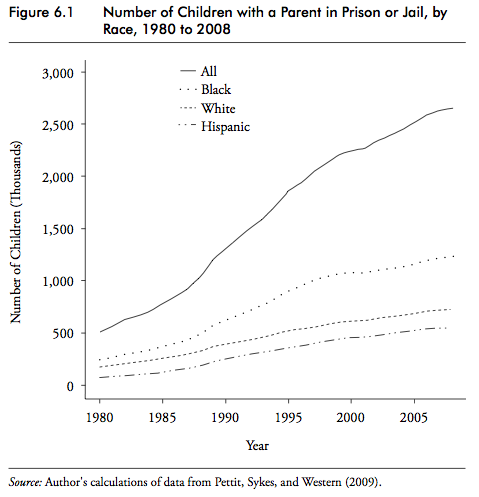
Mike Konczal points out that "24% of black children will have had a parent behind bars by age 17, an eightfold increase since 1980":

There aren't definitive answers for how incarceration changes family structure, though there is evidence that incarcerated fathers are less like to be cohabitating or marrying a year after their child's birth. And incarceration increases the liklihood of divorce. But we don't have full answers, in part because the incarcerated fall off the government's radar for data collection.

Chart Of The Day

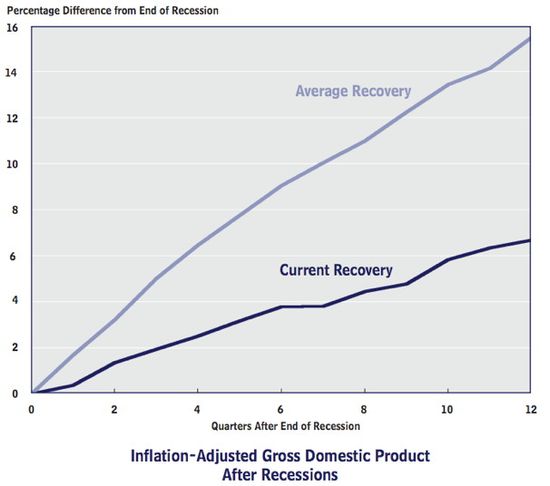
The CBO puts (pdf) the current recovery in context:

Recovery_Chart

Neil Irwin comments:

This economic recovery has been a big disappointment relative to what the United States has usually experienced after a recession. Growth has been 9 percent below what was seen in past recoveries on average in its first three years. The CBO report tries to disentangle where that underperformance is coming from and its answer is deeply unsettling: The U.S. economy just isn’t as good at growing as it used to be.

Chart Of The Day

Middle_Eastern_Oil

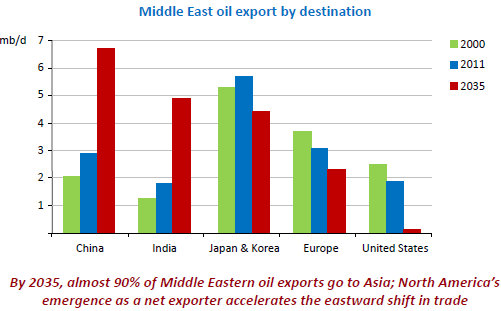
Ryan Avent studies the latest World Energy Outlook.  Given the trends in the above chart, he wonders whether "Asia, and China in particular, might come to develop a greater interest in Middle East security than it has now." He also considers the consequences for US climate politics:

In America "energy security" has long been a stalking horse for broad questions about the sustainability of current energy practice, including concern about climate change. As the economics of American energy markets change, it seems possible that the country's attitudes about climate matters may change as well, not in a good way, and it isn't as if America's commitment to addressing global warming is particularly strong as things stand.

Chart Of The Day

Screen Shot 2012 11 08 at 3 05 16 PM

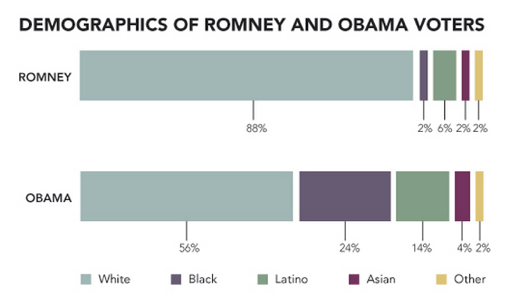
Tom Scocca notes that 88 percent of Romney voters were White:

[W]hite separatism was not enough to break up the actual Obama mandate. Obama's support was so broad that if white people had simply split 50-50, rather than favoring their ethnic candidate, the president would have won 58 percent of the popular vote.

Chart Of The Day

Buying_Election

Jennifer Victor tallies spending, using data available on election day:

These totals represent a nearly equal game between the candidates.  However, this may not be a fair comparison. The totals for the individual candidates are money raised, not spent (as of Election Day), and the IE total includes money from the Republican primaries.  Also, money spent by the parties on behalf of their standard bearers are not included here.

Some evidence suggests that the Obama team slightly outspent the Romney team.  But for now, it is safe to conclude that the election was not "bought." 

Chart Of The Day

Silver_Update

Silver's projection has become more favorable for Obama:

If the national popular vote winds up roughly tied, instead of favoring Mr. Obama by two points or so, then Mr. Romney could claw back to win Florida, Colorado and Virginia, and perhaps Iowa and New Hampshire. But Mr. Obama’s lead in Ohio, Wisconsin, Nevada and Pennsylvania is clear enough to withstand some underperformance in the polls, and his margins in the polling averages there have converted into a victory on election night a very high percentage of the time historically.

In order for Mr. Romney to win the Electoral College, a large number of polls, across these states and others, would have to be in error, perhaps because they overestimated Democratic turnout. It’s this possibility, more than the chance of a successful hail-mary in a state like Pennsylvania, that accounts for most of Mr. Romney’s remaining chances of winning the Electoral College.

Wonkblog and Daily Intel have rounded-up predictions from various pundits.

Chart Of The Day

20121103_woc372

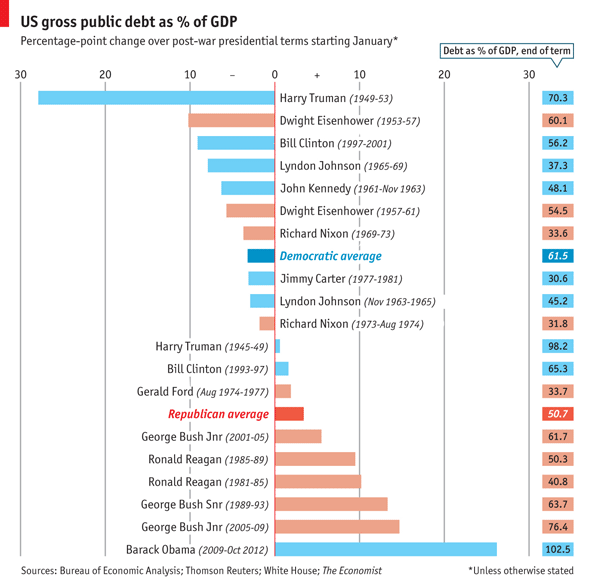
The Economist looks at which party has better balanced our books over the long term:

Since the end of the second world war, Democratic presidents have been considerably more successful than Republican presidents at keeping a tight grip on the nation's finances. Democrats have presided over reductions in the debt burden, on net, while Republicans have led in periods with net increases in borrowing.

Why Obama has his work cut out for him:

Mr Romney's response to the allegation that Republicans are the party of debt may be that no postwar president has presided over as large an increase in the debt-to-GDP ratio as Mr Obama. Mr Obama would respond that much of the debt attributed to him is not his fault. He would have a point. The deep recession he inherited likely added some 10-15 percentage points to the debt-to-GDP ratio, according to the Center on Budget and Policy Priorities. Fair or not, the rise in debt over his term will make it difficult for Mr Obama to claim the mantle of fiscal responsibility he might otherwise enjoy as a Democrat.

Chart Of The Day

Party_favorability

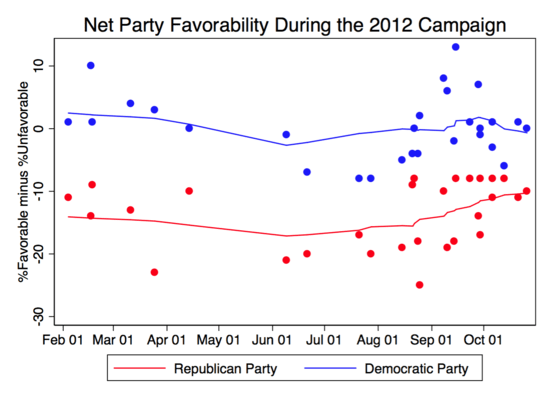
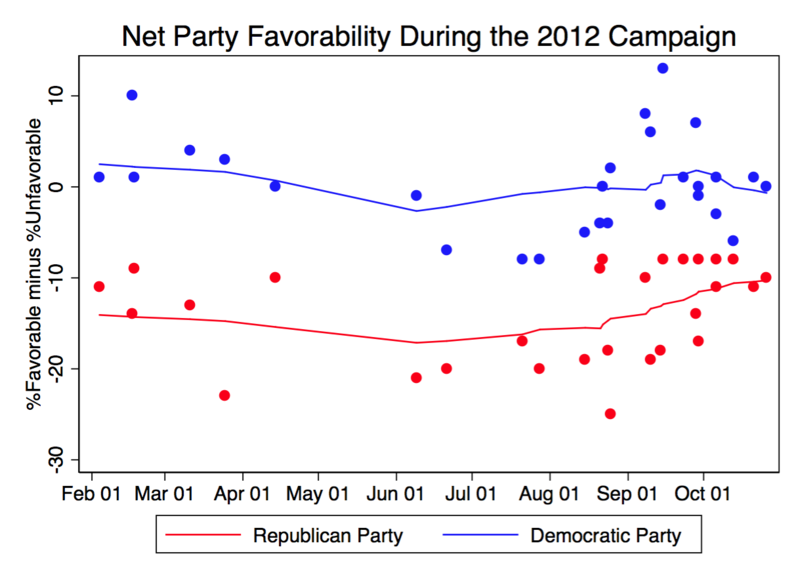
Tom Holbrook finds that the GOP brand is still tarnished:

[T]hroughout this campaign period the Democratic Party has been viewed more positively than the Republican Party. In fact, there is not a single poll in this series in which the Republican party registered a net positive rating, and not a single case in which the net Republican rating was higher than the net Democrat rating. The average net rating for the Republican Party in this series is -13, whereas the average for the Democratic Party is +.3. To be sure, the net rating for the Democratic Party is sometimes in the negative, and the gap toward the end of the series is not as great as it was in the wake of the Democratic convention, but it is clear that the Democrats hold an advantage on this front

Steven Taylor adds:

The bottom line is: we know a substantial number of voters (in the high 40s to low 50s) will vote for Romney, the Republican, next week. However, we also know that partisan ID in polls does not fit those numbers. As such, it is clear that a lot of people who will vote Republican do not wish to be called Republican for whatever reason. The above graph gives us some context: the net view of the GOP at the moment is negative, and it is not just because Democrats view the party unfavorably (because there are not enough Democrats to create a net unfavorable outcome).