Chart Of The Day

Weather_Deaths

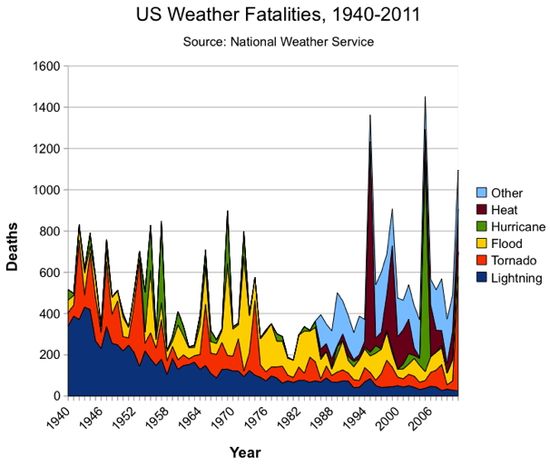
Dylan Matthews tallied weather-related fatalities:

As Wonkblog’s Brad Plumer explained in a Monday post, it’s hard to attribute single weather events to climate change. But clearly something is causing the across-the-board rise in weather-related deaths, and global climate change, which worsens hurricanes and promotes heat waves and tornadoes, may be a prime culprit.

Fallows sees parallels between the global warming debate and the smoking causes cancer debate:

Of course no one can prove that this storm was "caused by" climate change and global warming. But the increasingly frequent occurrence of "unusual," "extreme," and "once per century" weather events — heat, cold, drought, flood — is in keeping with all warnings about the effects of climate change (as explained here). I'm not arguing the entire climate change case now, and don't have special standing to do so anyway. I am saying that this reminds me of the mounting evidence about smoking and health, when I was a kid — the medical conventions my father went to in the early 1960s were full of smokers, those a decade later had practically no smokers — or about environmentalism generally in the 'Silent Spring' era. Denialism continues, until all of a sudden it is irrelevant.
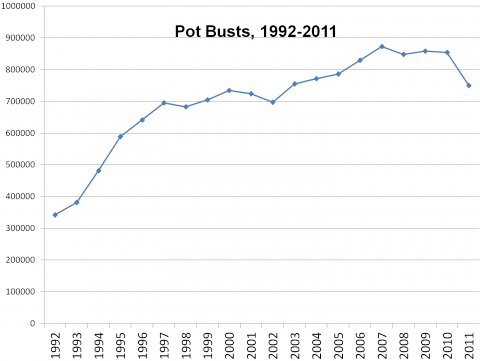
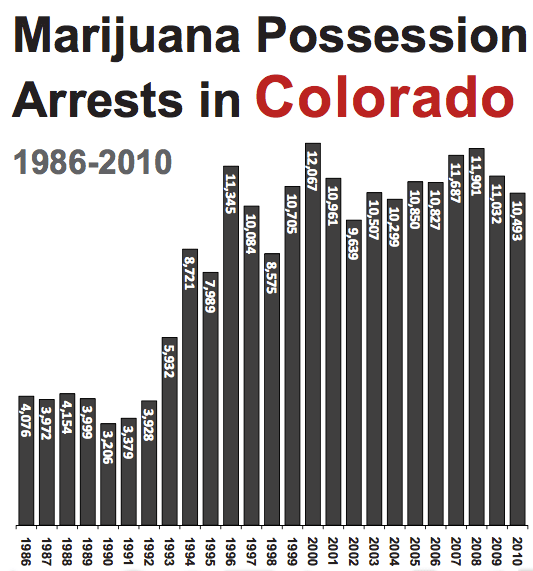
Chart Of The Day

Marijuana arrests are decreasing:

Pot_Busts

Jacob Sullum wonders whether the trend continue:

The FBI's latest figures for drug arrests … indicate that marijuana busts fell significantly between 2010 and 2011, from about 854,000 to about 750,000. That's a drop of 12 percent, compared to declines of 3 percent from 2008 to 2009 and 0.5 percent from 2009 to 2010. … Have tight budgets encouraged a refocusing of police resources?

Chart Of The Day

Colorado_Arrests

Jacob Sullum flags a new report:

Less than two weeks before Colorado voters decide whether to legalize marijuana in that state, a new report highlights one important reason they should vote yes: Even though Colorado supposedly "decriminalized" marijuana possession in 1975, police there continue to arrest more than 10,000 pot smokers every year. That's because possession of small amounts (less than an ounce at first, two ounces since 2010) remains a crime, albeit a "petty offense." 

Chart Of The Day

Urine_wheel

Christina Agapakis is fascinated by this Urine Wheel from 1506:

The Urine Wheel was used for diagnosing diseases based on the color, smell, and taste of the patient’s urine in the early 16th century. Many diseases affect metabolism and many changes in metabolism can be detected in the urine. For example, diabetics will excrete sugar in their urine–sometimes enough sugar that it can be fermented into whisky. There are many other diseases that change the smell of a person’s urine, including the very descriptively named Maple Syrup Urine Disease or Sweaty Feet Syndrome, now much more likely to be diagnosed by electronic sensor arrays than actually tasting the urine.

Nicola Twilley rounds up more wheels.

(Image: The Urine Wheel for diagnosing metabolic diseases, from Epiphanie Medicorum by Ullrich Pinder)

Chart Of The Day

Obama_Romney_Ads

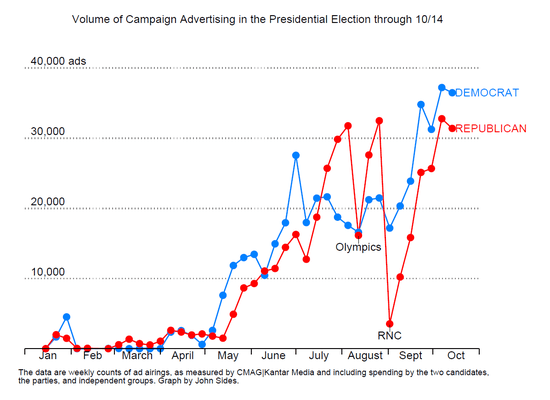
John Sides finds that Obama has more ads on the air than Romney does:

Why is this happening?  One of the challenges facing Romney and Republican-affiliated super-PACs and 501c’s is that they are currently paying higher rates for advertising than Obama.  This reflects both campaign finance law, which allows candidates to pay lower rates than independent groups, as well as Romney’s decision to buy advertising time relatively late in the cycle.  

Here is what this means: across all the presidential general election advertising by candidates, parties, and groups, each pro-Obama ad has cost an average of $502 dollars.  But each pro-Romney ad has cost an average of $630.

More findings from Sides that we highlighted earlier are here.

Chart Of The Day

40Years0fDrugWarFailure

Matt Groff explains why the y-axis on this chart doesn't add up to the $1.5 trillion cited:

In a tight production schedule, I utilized a data set that I thought most accurately illustrated the nature and growth of the costs of the War on Drugs and that data is US federal drug control spending.  But the $1.5 trillion figure … accounts for many more costs, including state level costs, prison costs, lost productivity costs due to incarceration and others.

Mike Riggs layers in more data:

According to The Economic Impact of Illicit Drug Use on American Society, last published by the Department of Justice in 2011, enforcing illegal drug laws imposes an annual cost on the American criminal justice system of $56 billion; while incarceration of drug offenders poses an annual cost of $48 billion. That's $104 billion spent annually by states and cities on two aspects of the drug war (and doesn't include treatment, public assistance, and a slew of other costs), compared to roughly $21 billion spent by the federal government. For $1.5 trillion to reflect just federal spending, the federal drug control budget would need to have been $37.5 billion a year, every year, for the last four decades. It's only slightly more than half that this year.

Chart Of The Day

Deficit

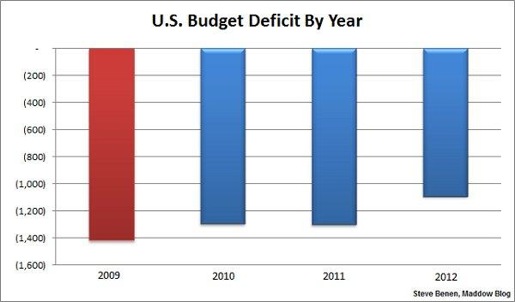
Steve Benen summarizes:

[This chart] starts with the figures released in 2009, when the deficit reached a record high of $1.4 trillion. Why is the column in red? Because, thanks to fiscal years, Obama inherited a deficit of nearly $1.3 trillion from Bush/Cheney the moment he took the oath of office. This year, however, according to the official data published by the Treasury Department, the deficit was $1.089 trillion.

When the president's critics spin this, they'll say, "The deficit was over $1 trillion again," and that will be accurate. What the criticism fails to note, however, is that (a) the deficit is now much smaller than it was when Obama took office; (b) this is the smallest deficit we've seen in four years; (c) this new figure represents an improvement of over $200 billion since last year; and (d) the main drivers of the remaining deficit are Republican policies.

Chart Of The Day

Nones_Growth

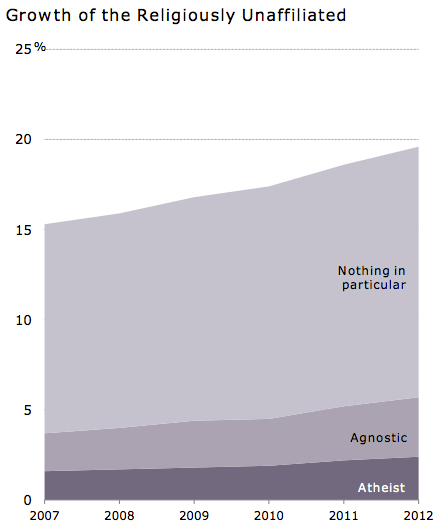
Pew finds that more and more Americans are religiously unaffiliated:

One-fifth of the U.S. public – and a third of adults under 30 – are religiously unaffiliated today, the highest percentages ever in Pew Research Center polling. In the last five years alone, the unaffiliated have increased from just over 15% to just under 20% of all U.S. adults. Their ranks now include more than 13 million self-described atheists and agnostics (nearly 6% of the U.S. public), as well as nearly 33 million people who say they have no particular religious affiliation (14%).

Alan Jacob asks:

The question I would ask is this: Has there been an actual increase in religiously unaffiliated people, or do people who are in fact unaffiliated simply feel more free than they once did to acknowledge that fact? My suspicion is that until quite recently a person born and baptized into the Catholic church who hadn’t attended Mass in fifteen years would still identify as a Catholic; but recently is more likely to accept his or her unaffiliated status.

Razib Khan adds:

There has always been a tendency for more people to hold to atheistic and agnostic positions than those who would admit to being atheists or agnostics. That gap is closing. Why? I have no idea, but I do think that people need to stop talking about how terrible the New Atheism is for secularists. I doubt this wave of secularization has anything to do with the New Atheism (it precedes it), but certainly the New Atheism has not turned people off to secularism.

And Ed Kilgore thinks politically:

[I]t’s important to remember that America remains far and away the most religiously oriented of advanced industrial democracies. But without question, the Democratic Party with its ever-strenghtening commitment to church-state separation and diversity is better equipped than a GOP in thrall to an ever-militant Christian Right to cope with the religious trends of the country as they appear today. 

Chart Of The Day

Mormon_Searches

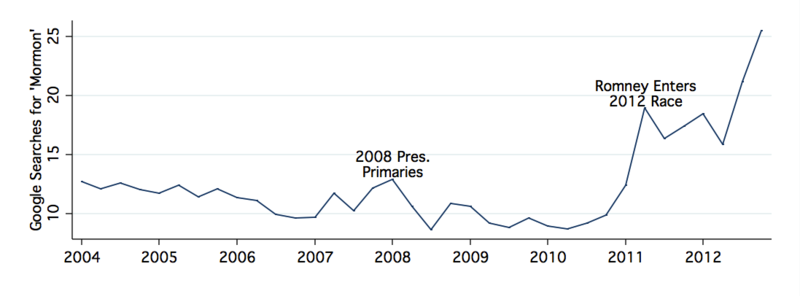
John Sides finds evidence that Romney's campaign has increased interest in Mormonism:

The bottom line is that politics plays a pedagogic function. It is sometimes quipped that foreign policy crises cause Americans to become acquainted with world geography. In much the same vein, the nomination of a presidential candidate with a Mormon religious background has prompted vast numbers of Americans to seek out information about this religion and its adherents.

Update from a reader:

"The Book of Mormon" opened on Broadway in March 2011.