Chart Of The Day

Wealth Gap

Josh Marshall highlights a depressing one:

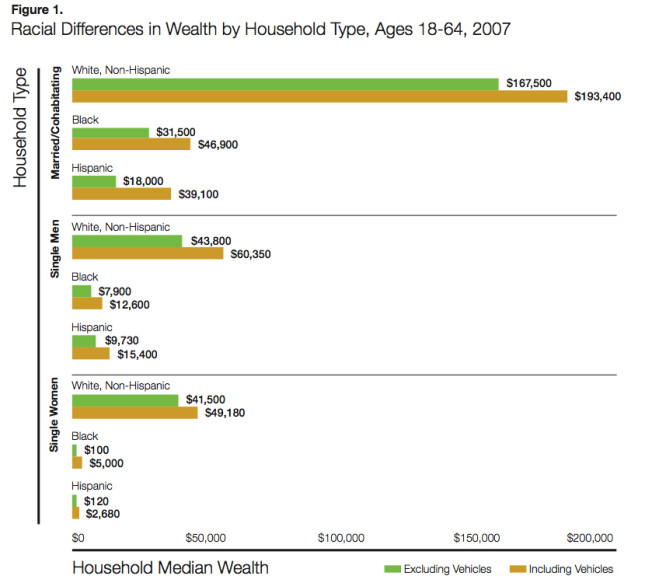
The chart illustrates a pattern that most of us probably do not find surprising. But the sheer chasm separating single white men from Black and Hispanic single women is still shocking to see visualized so clearly. Single white men have 438 times the assets as single Black women and 365 times that of single Hispanic women. As we can see, marriage is a huge determinant of wealth – but mainly if you’re not white, and especially if you’re a woman.

Note that the chart provides data for wealth with and without vehicles (in most cases, cars). Here I’ve referenced the latter statistic. As the report notes, owning a car is an important way to access more employment opportunities among other things. But that wealth is not easily accessible in dollar terms, which is highly relevant for the following reason. Great disparities of wealth not only have a huge impact on life opportunities and the prospects for wealth accumulation. They are hugely important factor in the precariousness of economic life experienced by different demographic groups.

Chart Of The Day

Medical Marijuana Teen Use

Christopher Ingraham insists that “the notion that medical marijuana leads to increased use among teenagers is flat-out wrong”:

A new study by economists Daniel Rees, Benjamin Hansen and D. Mark Anderson is the latest in a growing body of research showing no connection — none, zero, zilch — between the enactment of medical marijuana laws and underage use of the drug. The authors examined marijuana trends in states that passed medical marijuana laws. They tracked self-reported pot use by high school students in the years leading up to and following the enactment of these laws. They conclude that the effects of medical marijuana on teen use are “small, consistently negative, and never statistically distinguishable from zero.”

Chart Of The Day

Capital Flight

Tim Fernholz wonders whether sanctions are increasing capital flight from Russia:

Russia’s had a real problem with capital flight in recent years, as its wealthiest citizens and corporations have moved assets to tax havens and wealthy economies to avoid instability and political interference in Russia. (The erstwhile shareholders of Yukos, the oil company that the Kremlin seized and broke up in the mid-2000s, just won a $50 billion compensation claim in the Hague.) That left Putin plaintively asking oligarchs to bring back their cash, please. No dice: Capital flight has increased this year, already exceeding each of the last two years in preliminary data for the first two quarters of 2014. Is that the fault of the sanctions? In part—few investors want their money to be trapped if a new iron economic curtain is raised.

Chart Of The Day

Yesterday, Virginia’s marriage equality ban bit the dust. Burroway charts the progress of the gay rights movement:

Equality Chart

Emma Green explains what makes the VA ruling stand out:

The question of “rights” is exactly what makes this decision significant, said Claire Guthrie Gastañaga, the executive director of the American Civil Liberties Union of Virginia. Unlike some other cases on same-sex-union laws, Bostic examines whether couples have a fundamental right to marriage. The judges applied strict scrutiny, the highest standard of legal review, under which the government has to show a compelling interest for limiting the plaintiffs’ ability to marry. “This court says very clearly: This is a fundamental right, and the government just didn’t meet their burden of explaining why there should be a [ban on] same-sex marriage,” Gastañaga said.

Dale Carpenter observes that the ruling referred to the ban as a form of “segregation”:

The idea that laws limiting marriage to opposite-sex couples are a form of segregation is historically loaded, especially for a court sitting in the heart of the old Confederacy. Analogies to the black civil rights movement, and in this context specifically to anti-miscegenation laws and second-class status, have become a staple of gay-rights political and legal arguments. Rarely have they gained quite this explicit an endorsement from a prominent court.

Mark Joseph Stern describes the striking down of Virginia’s gay marriage ban as “the latest victory for marriage equality in a unbroken string of triumphs since the Supreme Court overturned DOMA in 2013.” On what the opinion could mean for other states:

Although the court struck down only Virginia’s marriage ban, the 4th Circuit also has jurisdiction over Maryland, West Virginia, South Carolina, and North Carolina. The latter three states still ban gay marriage—but today’s ruling throws those laws in serious jeopardy.

Chart Of The Day

Ukraine Opinion

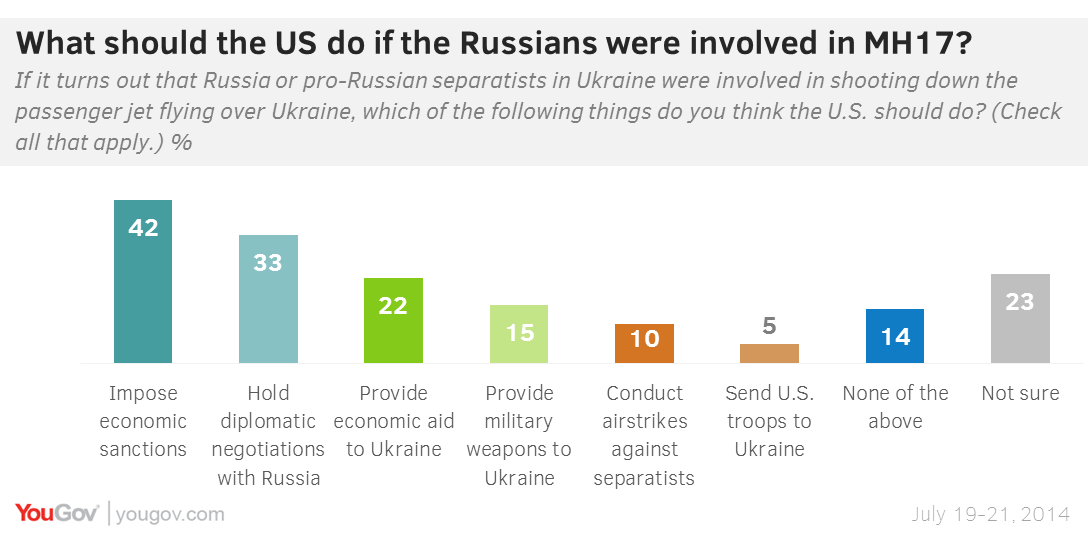
Americans remain opposed to getting involved militarily in Ukraine:

Public support for the various measures the US could take are actually relatively unchanged from when they were first asked in March 2014, when respondents were provided with a similar question that did not reference the shooting down of MH17 or the possibility of airstrikes on separatists. 40% of Americans supported economic sanctions then, compared to 42% now, though support for diplomatic negotiations with Russia has dropped from 44% to 33%.

Chart Of The Day

Immigrants

Casselman debunks common misconceptions about the origins of America’s immigrants:

The immigration debate, now as then, focuses primarily on illegal immigration from Latin America. Yet most new immigrants aren’t Latinos. Most Latinos aren’t immigrants. And, based on the best available evidence, there are fewer undocumented immigrants in the U.S. today than there were in 2007. … The immigration debate gets one thing right: The foreign-born population is growing. In 2012, according to data from the Census Bureau, there were more than 40 million people living in the U.S. who weren’t born here, up 31 percent since 20001; the native-born population grew just 9 percent over that time. The foreign-born now represent 13 percent of the population, near a historical high. The drivers of that growth, however, have changed significantly in recent years.

Furthermore, the Latinos who have already arrived are rapidly assimilating:

Political commentary often treats the issues of immigration and Hispanic ethnicity as two sides of the same coin. But U.S. Latinos are looking more and more like other Americans. Nearly 68 percent of U.S. Hispanics speak English fluently, up from 59 percent in 2000; more than a quarter report speaking only English at home. Latino high school graduates are now more likely than whites to enroll in college, although they are still less likely to graduate. Latinos are becoming less likely to be Catholic and choosing to have smaller families, and they more closely resemble the population at large on social issues such as abortion and gay rights. Nearly half of all Hispanics and about two-thirds of native-born Hispanics consider themselves to be “a typical American.”

Chart Of The Day

drug_use_by_race

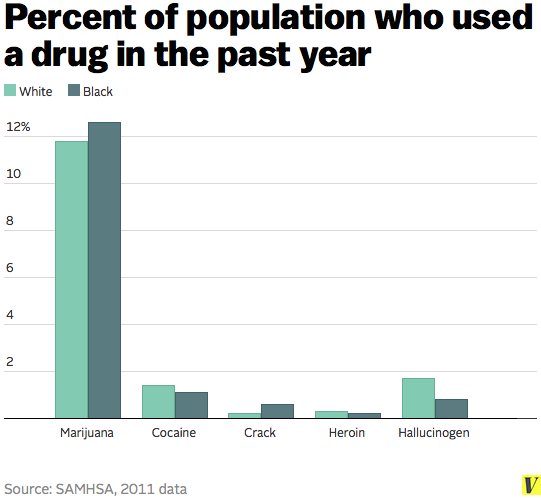
German Lopez illustrates the racial breakdown for recreational drugs – always a helpful reminder:

White and black people report using drugs at similar rates, according to the latest data from the Substance Abuse and Mental Health Services Administration. There’s some variance from drug to drug: White people report more often using cocaine, heroin, and hallucinogens, while black people report more marijuana and crack cocaine use. These statistics underline why critics decry the war on drugs as racist. Although black people are much more likely to be sent to jail for drug possession, they’re not more likely to use drugs.

Chart Of The Day

gayampercent

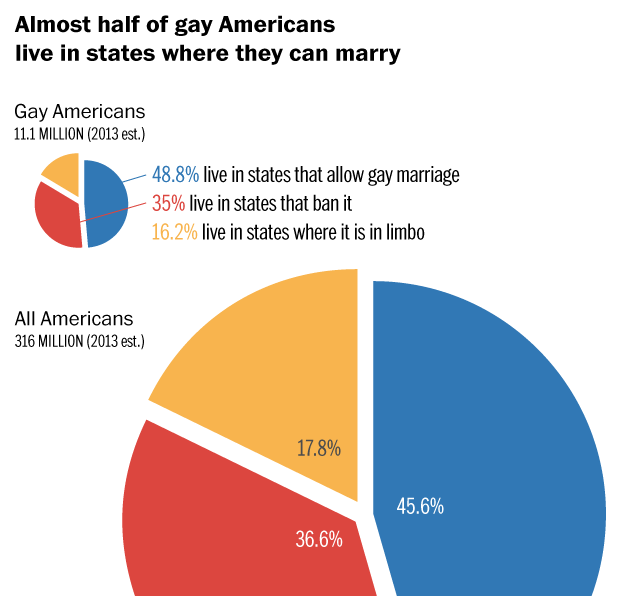
Philip Bump put it together:

Nearly half of the 11-plus million gay Americans (how we arrived at that figure is explained in more depth below) now live in states that allow gay marriage, and are more likely to live in such states than Americans on the whole. 48.8 percent of gay Americans live in states where they can legally marry, according to our estimates. The percentage of Americans in those states overall is at 45.6 percent. And, of course, a large portion of the country live in states where the legal status is in limbo.

Speaking of that limbo, Bazelon looks at yesterday’s court ruling out of Utah:

The 10th Circuit stayed its ruling to give the opponents of gay marriage a chance to appeal to the Supreme Court. Rick Hasen and plenty of other people think this means gay marriage is headed back to the justices as early as next term. So far, though, there’s no split over gay marriage in the lower courts since the DOMA ruling. Anyone want to subscribe to my (minority) theory that gay marriage could become the law of the land without another word from the high court? Gay marriage has so much righteous momentum behind it—maybe it doesn’t need another push from Kennedy. Though surely, with a record of 20–0 this year in the lower courts, he will be ready to give it.

I’m prepared to make that bet with Emily – although you never know. Ilya Somin sounds off:

For reasons I explained in this post, I am skeptical about the validity of the argument embraced by the Tenth Circuit majority. But I do believe they reached the right result, because laws restricting marriage to opposite-sex couples are an example of unconstitutional sex discrimination. This reasoning was endorsed by the district court opinion affirmed by the Tenth Circuit (though it also endorsed other constitutional arguments against laws restricting marriage to opposite-sex couples).

Be that as it may, [yesterday’s] decision is an important victory for advocates of same-sex marriage. But Judge Kelly’s dissent suggests that the legal battle over the issue is far from over. The question is likely to return to the Supreme Court, quite possibly sooner than many of us at first anticipated.

My reaction to the Utah ruling – and the more exciting one in Indiana – here.

Chart Of The Day

Screen-Shot-2014-06-18-at-5.05.59-PM

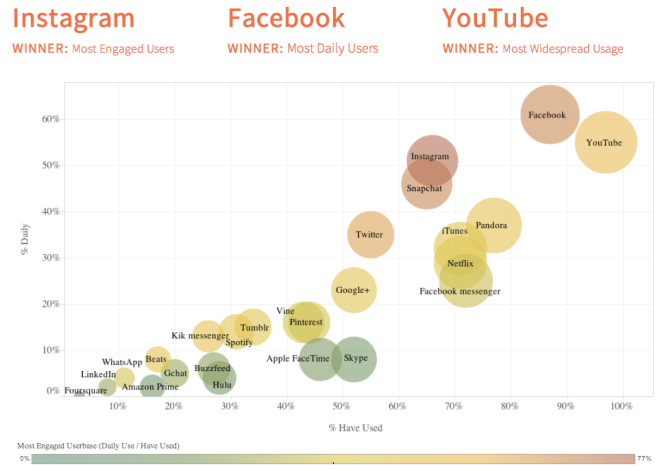
Derek Thompson shares the results of a recent survey about teenagers’ Internet habits. One of his takeaways:

If you’re confused why digital publishers obsess over Facebook and social media, make this graph your smartphone wallpaper. Even the most popular site among teens – BuzzFeed – has fewer daily visitors than any network or app in the graph. (Even Beats, which is considered a tiny music service, has more daily users than any website in the survey.) Seventy three percent of teens don’t read BuzzFeed, 84 percent don’t read Reddit, and 96 percent don’t read Mashable or Gawker.

For young people, Facebook is the newspaper, and websites are the authors.

Chart Of The Day

legality_of_lgbt_workplace_discrimination

On what other subject is the public so grotesquely misinformed? And what does it say about the acumen of the Human Rights Campaign that its Number One legislative priority for the last 25 years (with 76 percent national support!) remains as out of sight as ever? Just keep sending them your checks, guys. In another quarter century, you might get something back for them.