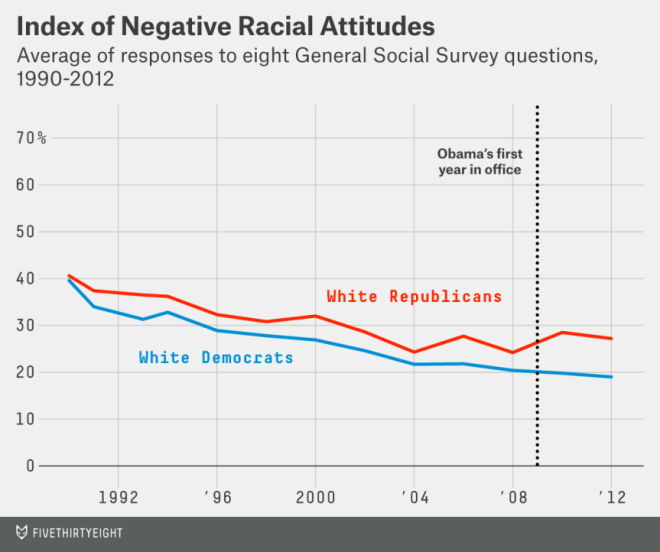
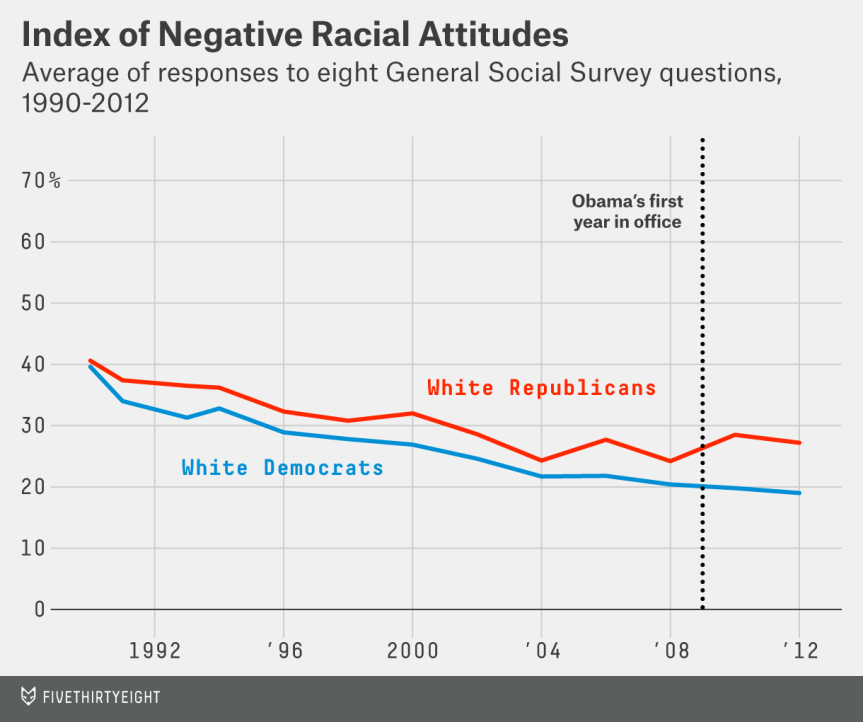
So yes, there does seem to be a slight partisan aspect to racist attitudes in the Obama era. But it is not that big, and the general trend lines over the longer term are positive. What I’m grappling with is whether my own confirmation bias is blinding me to the persistence of truly base racism in American society. I can remember only two instances in my adult life when someone said something to me foully racist. One was when someone observed that in Provincetown, there was no crime because “there aren’t any blacks.” I ended that conversation at that point. Another was a long-ago one-night-stand which in the end lasted only a few minutes. We were back in this dude’s apartment and he was cussing the cable service he had. Then he started going off on the African-American men who had installed it. “Worthless niggers,” he said in a tone that stopped me dead. I left.
I remember those moments because they were so rare. But then I went to Harvard, a bastion of anti-racist liberalism, and live in a still-largely African-American city in what remains a very racially mixed neighborhood and over the years have obviously selected racists out of my life. No, I’m not saying racism is exhausted by the kinds of vile things I heard, and obviously milder forms can be much more pervasive (even in my own consciousness). What I’m saying is that I have been actually shocked by the baldness of Donald Sterling’s bigotry – and perhaps I shouldn’t be. Charles Blow has an excellent column today, unpacking its evil. One aspect:
Stiviano asks, “Do you know that I’m mixed?” Sterling responds, “No, I don’t know that.” She insists, “You know that I’m mixed.” Later he tells her, “You’re supposed to be a delicate white or a delicate Latina girl.”
The word “delicate” there hangs in the air like the smell of rotting flesh, because by omission and comparatively, it suggests that black women, or women who associate with black men, are somehow divested of their delicateness, which in this case, and the recess of this distorted mind, sounds a lot like a term of art for femininity, and by extension womanhood. This is a disturbing peek at the intersection of racism, misogyny and privilege. “I wish I could change the color of my skin,” Stiviano says. Sterling responds, “That’s not the issue.” He continues, “The issue is we don’t have to broadcast everything.”
Another disadvantage I have in grasping all this is that I wasn’t born in America and didn’t grow up here – and so the contours of America’s long and hideous conversation about race are not in my bones. All I can say is: I’m trying to fit all the new data points in my worldview, and haven’t reached a conclusion. Oh, and Ta-Nehisi could not have invented a series of revelations more likely to prove him right about the lingering power of white supremacy, in the shadows of our lives.




 The Dish