Chart Of The Day

South African Pride

John Sides provides historical context:

In 1982, whites were nearly unanimous in expressing some degree of pride as South Africans (98%), but barely half of blacks (57%) did so. This gap is a stark reminder of how deeply the effects of apartheid were felt. It was not just a question of opposing a white-led government.  Among blacks, there was a profound alienation from the state itself.

But the release of Mandela from prison in February 1990 and the early signs of apartheid’s end — such as negotiations between the white-led government and the African National Congress that spring and summer — appeared to close this gap.  In the 1990 survey, which was fielded in October and November, 93% of whites and 90% of blacks expressed pride.

Mandela’s legacy may be even more visible in how little white and black South Africans’ patriotism has changed since then.  Although his leadership — indeed, any one person’s leadership — could never eliminate racism or racial tensions, whites and blacks continued to express high levels of pride.  The transition to a black-led government under Mandela and later Thabo Mbeki did not make white South Africans any less proud to be South African.  Blacks too remained similarly proud, despite the disappointments that they have experienced and the challenges they still face.

Chart Of The Day

Approval Caucus Lost

Trende created the chart above on “the relationship between presidential job approval in the final Gallup poll before midterm Election Day and the share of the president’s party’s congressional delegation that went down to defeat”:

This isn’t a perfect relationship, but presidential job approval is still the most important variable for how his party fares in midterm elections, explaining about half of the variance. The relationship is highly statistically significant: For every point in job approval the president loses, his party loses 0.6 percent of its caucus. (The chart doesn’t measure drop in job approval; just job approval.) So, at 60 percent, the president should lose 5 percent of his caucus; at 50 percent, it is around 12 percent of his caucus lost; at 40 percent, it’s about 18 percent of his caucus lost — which would be 36 seats.

Now the latter is highly unlikely to happen. To pick up 36 seats, the GOP would have to win every seat that Obama won with 56 percent of the vote or less in 2012. Right now the GOP only holds five seats the president won with 54 percent of the vote or more, and only one seat he won with over 56 percent of the vote.

Chart Of The Day

dish_CDCchart

Lisa Wade points out that “the percent of teenagers that have had intercourse has been dropping consistently over the last 20 years”:

[D]espite the fact that young people are more likely than earlier generations to engage in oral sex before initiating penile-vaginal intercourse (especially fellatio), they continue to take intercourse very seriously. This may be, in part, because men are becoming more like women in this regard. Men’s numbers have dropped much more sharply. In addition, for the first time the CDC study found that boys’ #2 reason for not having engaged in intercourse was that they were waiting for the right person. Men cited this reason 29% of the time, compared to 19% for girls. For both boys and girls, the #1 reason is that it’s against their religion (41% of girls and 31% of boys). Concerns about pregnancy come in third.

Chart Of The Day

Fewer and fewer politicians serve in the military before taking office:

Vets In Congress

Erik Voeten flags the work of Peter Feaver and Chris Gelpi to explain why this is important:

Feaver and Gelpi establish the following regularities (see especially this book and this chapter-length update):

— On issues that concern the use of force and the acceptance of casualties, the opinions of veterans track more closely with those of active military officers than with civilians.

— The U.S. initiates fewer military disputes when there are more veterans in the U.S. political elite (the cabinet and the Congress).

— The U.S. uses more force in the disputes it initiates when there are more veterans in the U.S. political elite.

— Veterans are less likely to accept U.S. casualties for interventionist uses of force than for “realpolitik” uses of force.

Chart Of The Day

Young Broke

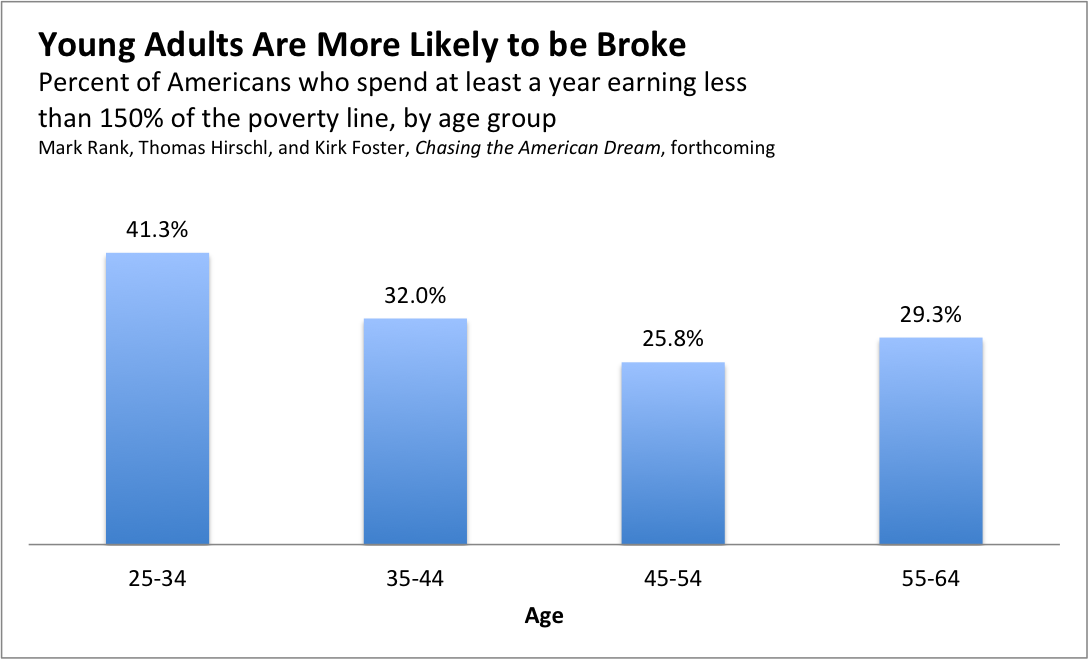
The young have it rough:

Mind you, these numbers aren’t just a snapshot of today’s economy, which has been notoriously dreadful for Millennials. Rather, they’re drawn from an analysis of the Panel Study of Income Dynamics data collected between 1968 and 2009. So in a sense, they’re a longterm assessment poverty through the American lifecycle. What they tell us, then, is that twenty and early thirty-somethings have lived financially wobbly lives in the U.S. for a very long time. Every generation has its horror stories about being young and poor.

Chart Of The Day

VA Exits

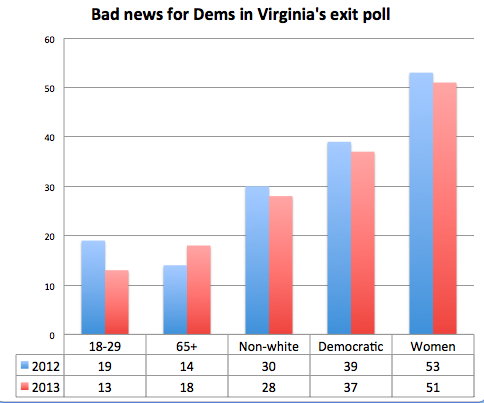
Ezra, who posts the bar graph seen above, finds “worrying signs” for Democrats in Virginia’s exit polls:

[T]he exit polls out of Virginia give Republicans some reason to cheer heading into the 2014 midterms. Though Virginia’s GOP chose a candidate who turned off moderate Republicans and motivated Democrats, and though the Democrats had vastly more money, the exit polls still showed the kind of demographic drift that could help Republicans make gains next year. … One cautionary note here is that exit polls, of course, are imprecise, and 2013′s exit poll has a margin of error of four percentage points — so some of these differences might just be noise. But some, like the age gap, aren’t, and all the movement is in the same direction — towards the Republicans. Remember, too, that the cold logic of statistical uncertainty means the Republican tilt could easily be sharper than these results indicate.

Nate Cohn is on the same page:

McAuliffe couldn’t win by a wide margin in all but ideal conditions. Most significantly, McAuliffe made few, if any, inroads into GOP territory. McAuliffe did as bad as President Obama in coal country and western Virginia, the exact sort of places where Democrats need to rebound to retake the House. In comparison, Tim Kaine won significant chunks of Republican-leaning terrain in 2005. That’s exactly what Democrats need to win back the House, and if a perfect storm couldn’t produce those gains, then there’s plenty of cause to question whether Democrats can retake the ground necessary to win the House in twelve months.

Sean Trende reads the Virginia numbers differently:

There was a bounce-back from 2009 lows, as expected, but the demographic shifts were probably about more than a bounce-back. To use racial crosstabs as an example, the 2012 electorate was 70 percent white, while the 2009 electorate was 78 percent white. The 2013 electorate was 72 percent white. Most of that difference came from increasing the African-American share of the electorate vis-à-vis 2009. This is probably the most encouraging data point for the Democrats for the night.

Meanwhile, Waldman resists reading too much into yesterday’s elections:

The point is, unless something truly spectacular occurred, the next year or two of American politics would play out exactly the same way no matter what happened in Virginia and New Jersey. You may have found one or both of them to be interesting races on their own terms. But if you’re going to make an argument about what’s going to happen in the future, you’ll have to do better than citing the explanatory power of these elections.

Chart Of The Day

GOP Brand

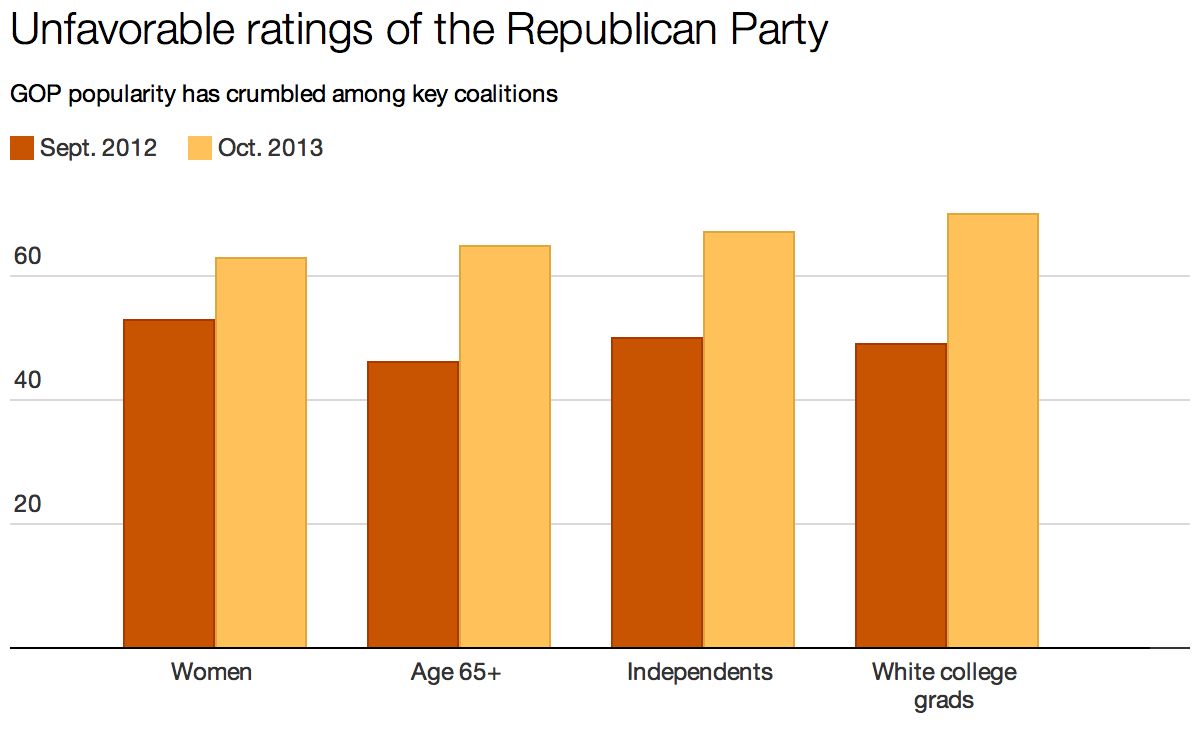
Sargent breaks down the Republican party’s unpopularity:

Polling released this week by the Washington Post and ABC News found the GOP’s unfavorability ratings among Americans at an all-time high of 63 percent. But a closer look at the numbers reveals that this has been accompanied by a massive collapse in 2013 of the GOP brand among core constituencies important in midterm elections: Independents, women, and seniors. The crack Post polling team has produced a new chart demonstrating that in the last year — since just before the 2012 election – there’s been a truly astonishing spike in the GOP’s unfavorable ratings among these core groups

The Crystal Ball has put out new House rankings:

To sum it up, the race for the House is getting more interesting by the day.

Republicans remain favored to retain control — call it Likely Republican in the parlance of our ratings — but the shutdown has shaken things up. At this point, we’re now expecting a small Democratic gain, instead of the small Republican gain we were forecasting earlier in the cycle. That prognostication is likely to change once Congress tackles the same old fiscal deadlock in January and February. Have Republicans learned anything from their October debacle? We shall see.

Nate Cohn remains cautious:

If there’s anything I could get people to understand about the next election, it’s this: Even a 2006 or 2010-esque tsunami might not give Democrats control of the House. That might seem shocking. In 2006, Democrats won 31 seats; Republicans won 63 in 2010. Today, Democrats only need 17 seats—which might not sound like much. But the fact is that Republicans just aren’t exposed. To turn the “tsunami” into an extended metaphor, an unprecedented share of the Republican caucus has evacuated to high ground.

Chart Of The Day

Anti Incumbency Mood

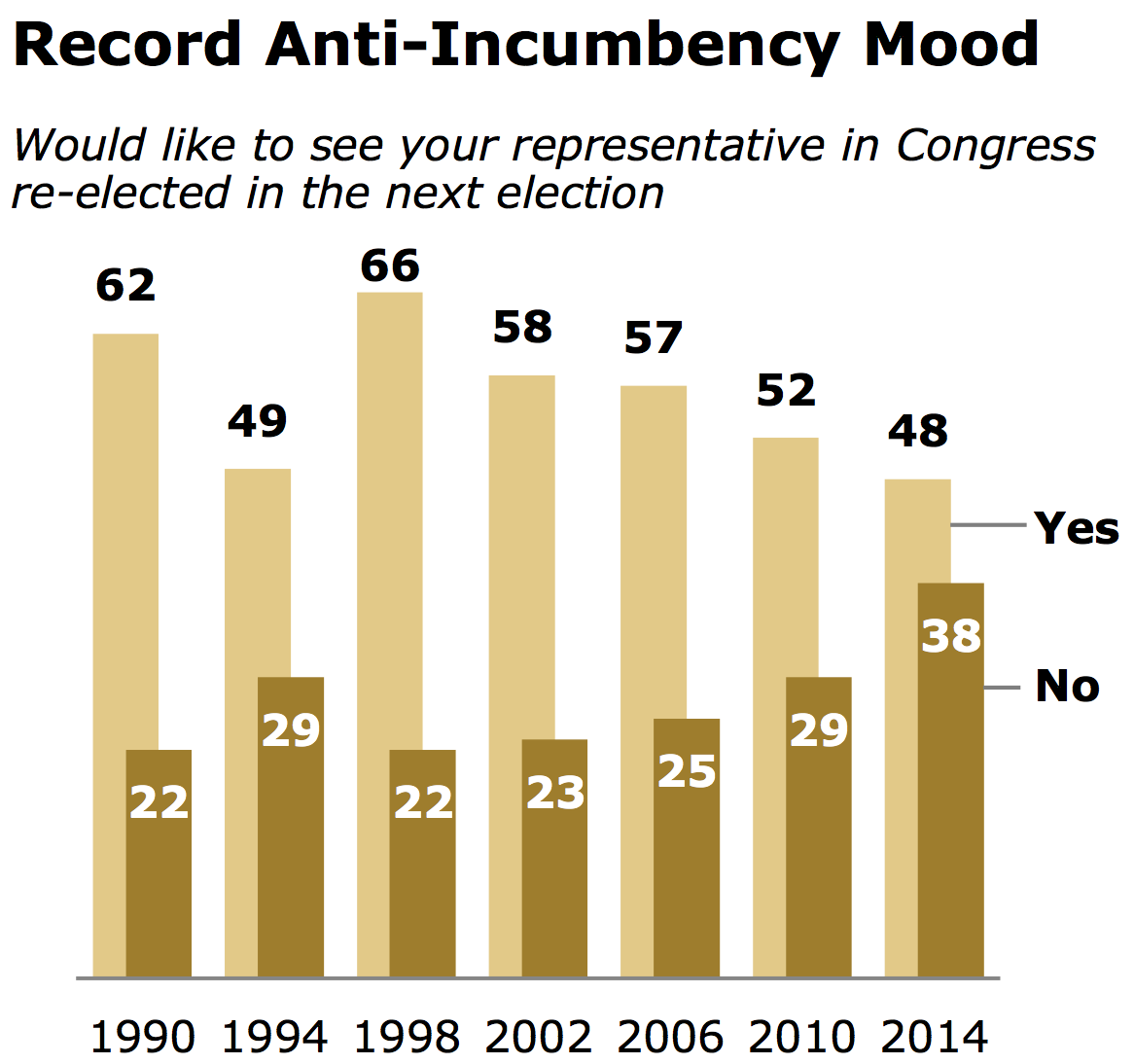
Cillizza suggests that Congress pay attention to some startling new data:

[T]here’s a new number in a national Pew poll that should give incumbents who assume that people hating Congress will exempt them in the next election some pause.  That number? Thirty eight percent — as in 38 percent of people who say they do not want to see their own Member of Congress re-elected in 2014. While that number is far lower than the 74 percent who say they would like to see most Members of Congress lose, it’s still the highest percentage wanting to get rid of their own member in more than two decades of Pew polling.

That stat has to be — or at least should be — concerning to incumbents in both parties particularly given, as Pew notes, that at this time in the 2010 election — when 58 incumbents lost — just 29 percent of respondents said they wanted to replace their own Member of Congress.  Things might return to “normal” — hate Congress, love your Member — well before the 2014 midterms. But, we are currently in the midst of historically poor ratings for Congress, meaning that depending on “how things have always been” could be a major miscalculation.

Chart Of The Day

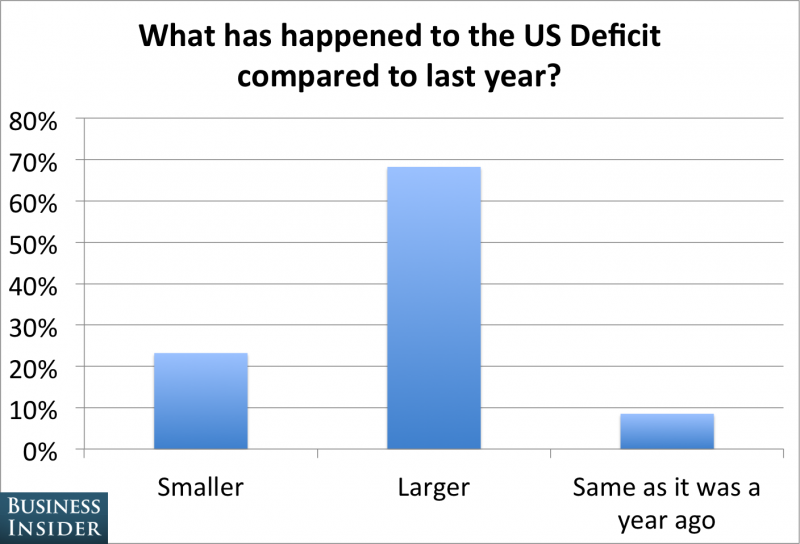
Most Americans have no idea that the deficit is falling:

Deficit Poll

Derek Thompson captions:

The point isn’t that Americans are stupid. They have busy lives and concerns that have nothing to do with the annual gap between taxes and outlays. Instead, the point is that public-opinion polls don’t belong on the same plane as facts and informed analysis, because they qualify as neither. … Public polls are a fine gauge of public opinion, but they’re not to be treated as a barometer of reality. Pretending otherwise mixes up the regurgitated misinformation of readers with the careful analysis of people who are in the business of busting misinformation.

Americans are also terrible at estimating the number of jobs added:

In the past twelve months, the U.S. has added 2.2 million jobs. And even though most respondents knew that unemployment has gone down, the average estimated number of jobs added was a mere 305,000.

Chart Of The Day

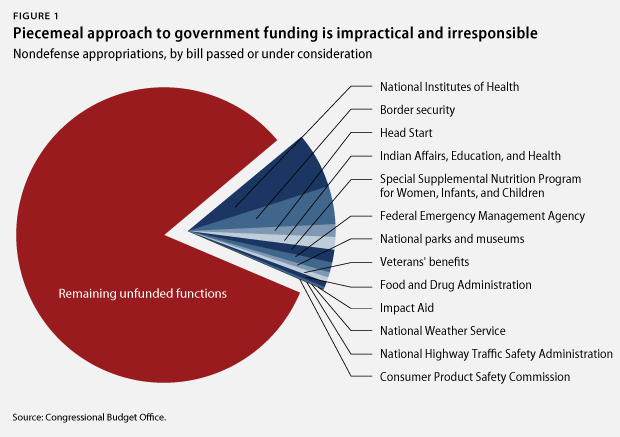
Michael Linden visualized the parts of government that the GOP wants to fund:

Piecemeal

Derek Thompson captions:

Obama wants to fund the whole pie below. The GOP, which would like to pair government funding with Obamacare’s defunding or delay, is asking him to fund the blue slices only. The White House’s logic is that passing the blue stuff makes it more likely that we go even longer without the larger, redder part of the pie.

But doesn’t the GOP actually want the entire government shrunk to that blue size? And isn’t this massive over-reach part of that completely delusional strategy?