
Bainbridge Asks

Some good questions. I answered some of it here. But let me deal with them specifically:

How can a Tory like yourself embrace someone running as a change agent?

Because societies need to change, as Burke understood. The question is whether the change is organic, drawn from the traditions within the society, and responding to felt needs, rather than ideological abstractions. So a Tory could support Thatcher and Reagan – as radical change agents who sought to restore their societies to forgotten principles. It is the greatest canard that conservatives never seek change. They are cautious, yes, but sometimes the right kind of change is necessary.

What specific changes in law, society, or polity, if any, that Obama supports do you also support?

I support a fresh start in foreign policy, a willingness to negotiate where necessary, a new outreach to allies, and prudent, expeditious withdrawal from Iraq. I favor an end to poisonous partisan polarization. I favor strong measures to innovate new energy sources. I favor a restoration of the Geneva Conventions.

Why are those changes “necessary”?

Because the war is draining massive resources, and, despite recent tactical success, is clearly a historic mistake. Because the U.S. is extremely isolated and needs more support in the world, and especially a new appeal to moderate Muslims worldwide. Because the red-blue divide has poisoned our polity to the detriment of practical problem-solving. Because dependence on foreign oil is both environmentally fatal and dangerous for our future security. Because torture gives bad intelligence and is un-American.

What evidence is there, if any, that Obama would be prudent in effecting such changes?

Obama’s legislative record, speeches, and the way he has run his campaign reveal, I think, a very even temperament, a very sound judgment, and an intelligent pragmatism. Prudence is a word that is not inappropriate to him.   

Paulites For Obama?

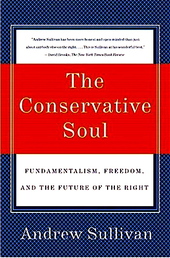
How can I write "The Conservative Soul" and find myself rooting for Obama? How can my core beliefs resonate with the libertarianism of Ron Paul and yet allow for support of an urban liberal like Obama? Good questions. One short answer: because conservatism faces a deeper threat from corrupt Republicans than from honest liberals. Because, after eight years of big government Christianism, a unifying liberalism is something I can live with. Because I want to win the long war against the Jihadists – and we need to unite the country again to do it. Because grow-ups know that any democratic society needs at least two parties and that the alternation of right and left – without tipping into extremism – is a healthy thing. And then – what this reader wrote:

I have a fondness for Ron Paul because he’s the first candidate for president whose views actually mirror my own in most respects, but Barak Obama is the first to actually inspire me. And if anecdotal evidence compiled from my like-minded friends is worth anything, I’m not alone.

We disagree with his political philosophy and very nearly all his positions, and yet are drawn to him and universally agree that we’d be proud to have him as our president. And maybe that pride is enough. We were too young at the time to really understand Reagan, and since we’ve had nothing but a litany of poor choices with unsurprising results. If we can’t realize our vision for America, at least, maybe in Obama we can truly admire our leader for the first time.

Don’t be surprised if many of the young people enthusiastically supporting Paul today wind up crossing the line in a general election and using some of that enthusiasm in support of Obama. I’m sure there are many who gravitate to Paul because of individual issues or out of anger against the establishment. Those followers will drift to third-parties or sit out the election altogether. But there are more, like me, who gravitate to him because of his faith in personal freedom and in the fundamental belief in the human spirit such conviction implies. Obama may not satisfy our thirst for liberty, but he certainly appeals to the human spirit.

There are a lot of us.

Obama’s Disarming Of The Right

A very smart post from Steven Teles:

I think it’s probably the case that Obama is, in fact, the candidate that Republicans least want to run against. In fact, I think that it’s actually the case that where Obama is concerned, conservatives lack much of the gut-level animus that drives them to really hate HRC, Kerry and Gore. All of these Dems represented what conservatives most hate about liberals–they all represent a liberal style (as apart from substance) that looks down on and dismisses conservatives.

Obama, by contrast, comes from a generation of folks who, while certainly not conservative, have actually engaged seriously with them. Obama taught at U. of Chicago law school, and so he knows that conservatives are driven by a respectable set of ideas. He disagrees with those ideas, but I sense that he knows at least some conservatives who he believes are respectable interlocutors. And I think conservatives know this.

The Looming GOP Civil War

This primary season seems to me to have made it both more possible and more bitter. Romney isn’t a solution. And Huckabee helps heighten the contradictions. After what Bush and Rove have done to conservatism, I cannot say I am surprised. Fundamentalism and conservatism may be temporary electoral allies, but as a coherent governing philosophy, they are each others’ nemesis. Even a war cannot disguise that divide.

“Tried And True”

A reader writes:

With respect to your post on Mark Levin’s description of torture techniques opposed by McCain: Note that the definition (from http://www.m-w.com) contains an element of not just efficacy but also moral merit:

: proved good, desirable, or feasible : shown or known to be worthy <a tried–and–true sales technique>

Desirable, huh? I used to think, in the ’80s, that people who supported, e.g., the Argentine Junta did so despite their human rights abuses. Now I think they did so, on some level, because the Junta was manly enough to torture people.

This is now mainstream American conservatism.

The Right and Religion

Hatchescross

It’s amazing to me to watch Rich Lowry and Charles Krauthammer begin to panic at the signs of Christianism taking over the Republican party. Where, one wonders, have they been for the past decade? They have long pooh-poohed those of us who have been warning about this for a long time, while cozying up to Christianists for cynical or instrumental reasons. But now they want to draw the line. Alas, it’s too late, I think, for Charles to urge an openness toward atheism or non-religion in a party remade on explicitly religious grounds by Bush and Rove. Who was it, after all, who cited Jesus Christ as the most influential "philosopher" in his life as part of his electoral strategy? Who reorganized his party to base it on churches? The man whom Krauthammer eagerly supported in two consecutive elections.

The theocon consensus that front-runners Romney and Huckabee both reflect is that religion is intrinsic to public life and public debate, that it is a necessary component of any political discussion – and that this does not merely mean rote invocations of Nature’s God or Providence or the kind of inclusive, vague language that the Founders believed in. It means a very thick, constant and inviolable recourse to religious argument in secular politics. If you haven’t noticed this development in the past decade, you have had blinders on.

Charles again refers to a straw man so as not to sound too much like, well, "shrill hysterics" like yours truly:

Imposing religion means the mandating of religious practice. It does not mean the mandating of social policy that some people may have come to support for religious reasons.

But there is a critical distinction here that Charles elides. It may well be that support for a piece of social policy emerges from religious reasons. But in a secular society, it is vital that when making the argument for your position in public, you do not deploy arguments that depend on or invoke religiously-revealed Tcs2 truths. The essential civic discipline in a pluralist democracy is to translate your religious convictions into moral arguments – arguments that can persuade and engage people of all faiths or none. Only a few secularist extremists are saying that people’s politics should not be informed in any way by religious faith (an impossibility in any case); most of us anti-Christianists are saying rather that political arguments should not be made on explicitly religious grounds, and political parties should not be allying themselves explicitly with one religion or another.
Let me confess something here. When I examine my conscience, I realize, in fact, that my absolute opposition to the torture of other human beings is, at its root, a religious conviction. It springs from my Catholic faith, which, despite the best efforts of the Catholic hierarchy, endures. The inherent dignity of all human beings is something I believe is a reflection of God’s will through the revelation of Jesus Christ. In the end, that is where I stand. But you will notice that my arguments on this matter have very, very rarely depended on my resort to this religious argument. Because I am not addressing fellow members of my church, but others in America, those who are people of faith, and those who are not. So my arguments have been historical, legal, constitutional, moral, strategic, utilitarian. And they have been arguments – about American history, Western civilization, and winning a war. They have not been religious arguments. And I certainly don’t believe that opposition to torture depends on a religious base. Many, many atheists and agnostics have been heroes in the long history of outlawing torture. The two most influential on me, over the years, have been Camus and Orwell, two atheists whose sense of morality outshines that of many Christians.

This, to me, is the critical distinction between a Christianist and a mere Christian. One wants to infuse politics with religion; the other wants to respect both, separately, and to keep religion private. I should add I do not want to banish the word "God" from the public square. But I do want that invocation to be as thin and as empty and as formal as the Founders intended. The current Republican party has reinvented itself as a force on opposite grounds. The party of Huckabee and Romney, the party of Hewitt and Dobson, the party of Ponnuru and Neuhaus is emphatically not a secular party.

And that is why part of me, I confess, wants Huckabee to win. So he can lose. So the GOP can lose – as spectacularly and humiliatingly as possible. If we are to rid conservatism of this theocratic cancer, we need to start over. Maybe it has to get worse before it can get better. But it is certainly too late for fellow-traveling Christianists like Lowry and Krauthammer to start whining now. This is their party. And they asked for every last bit of it.

Post-Conservative Huckabee?

A reader writes a challenging email to Jonah. Well worth reading. I think Huckabee represents a natural evolution of Rovian sectarian politics, and would lead to the end of conservatism as I understand it. Jonah doesn’t dispute this, but doubts Huckabee’s potential:

I think what Huckabee represents — as I wrote here —  is compassionate conservatism on steroids. I don’t know that I’d call it post-conservatism so much as paleo-progressivism (a term that pops up in my book). If carried to its logical conclusion Huckabeeism is rightwing progressivism. If I have to choose between leftwing progressivism and rightwing progressivism, I’d probably choose rightwing progressivism on most issues and leftwing progressivism on a few issues. But I don’t want to have to make that choice. I don’t think I will have to either.

I wouldn’t be so sure. Once the Bush Republicans signaled that they had stopped supporting or believing in limited government conservatism, the potential for paleo-progressivism expanded exponentially. Huckabee’s charm may be one of those contingent historical wrinkles that tips the balance. I fear the consequences. But I warned ya.