Face Of The Day

HaitiSpencerPlattGettyImages

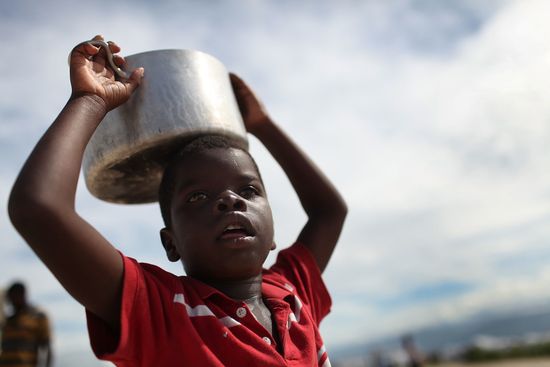
On November 3, 2010 in Port au Prince, Haiti, Lovens Lezak, 5, stands with an empty pot in the Corail-Cesselesse relocation camp for individuals who lost their homes in the January 12 earthquake. Anticipating flooding rains and high winds from Tropical Storm Tomas, the Haitian government has ordered the evacuation of the tent city. The storm could reach the island by the end of the week where there is potential for it to develop back into a hurricane with wind speeds of between 74 and 110 miles per hour. Over 1 million Haitians are refugees due to the January earthquake. Haiti, one of the poorest nations in the Western Hemisphere, has been further unsettled by an outbreak of cholera which has so far killed over 330 people. By Spencer Platt/Getty Images.

Face Of The Day

OURLADYAhmadAl-Rubaie:AFP:Getty

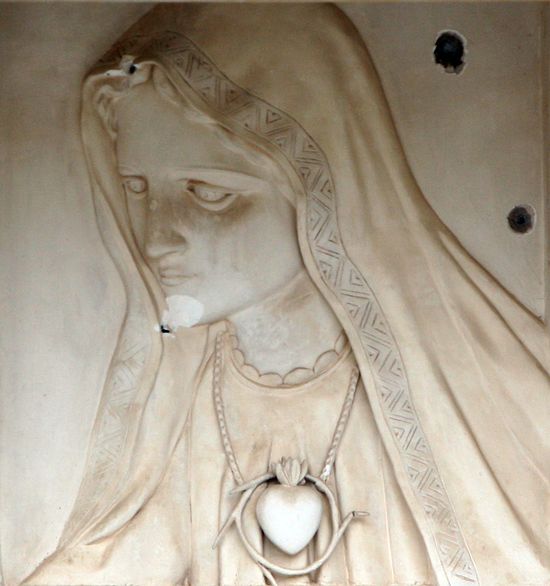
Bullet holes scare a stone relief of the Virgin Mary which decorated the entrance to the Sayidat al-Nejat Catholic Cathedral, or Syrian Catholic Church, in central Baghdad on November 1, 2010, the day after seven security force members and 58 Christian worshippers including two priests were killed when US and Iraqi forces stormed the cathedral to free dozens of hostages in an attack claimed by Al-Qaeda gunmen. By Ahmad Al-Rubaye/AFP/Getty Images.

The events yesterday were truly horrifying, especially for Iraq's beleaguered Christian population:

"This is more than a tragedy," said Iraq's Human Rights minister, Wijdan Mikheil, who is a Christian.


Choking back tears as she spoke with reporters outside Our Lady of Deliverance church, she said: "What is happening to Iraqis in general and Christians in particular is an attempt to push them out of the country, but we hope Iraqis remain united."

Our Lady of Deliverance is a Syrian Catholic church.

Karim Khalil, a 49-year-old Iraqi Christian, said he moved to Syria with his family last year because he felt his religion made him a target in Baghdad.

"Iraqi militias threatened me, saying I was on the side of the Americans because I am Christian," Karim told the AP. "They said I would be killed if I stayed in Iraq."

Now he lives in Damascus with his wife and five children.

"I have left behind my house and everything to escape with my family," he said.

Many other Iraqi Christians living in Syria refused to speak to the AP. They said they fear militias may exact revenge on their families in Iraq.
Face Of The Day

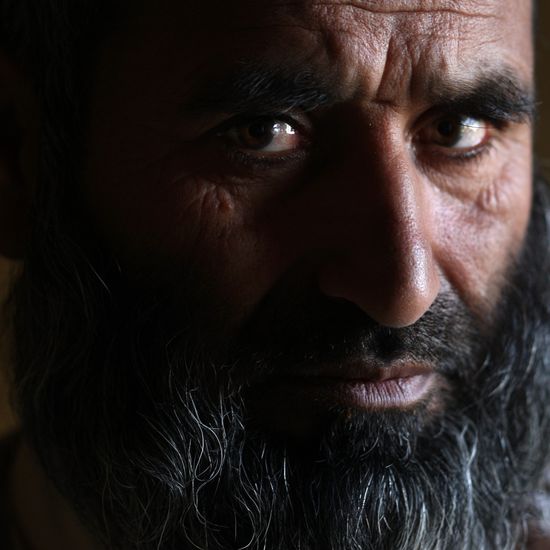
MohammedUllahJohnMooreGetty

David Furst and James Estrin interview Getty Images' John Moore on photographing those under Afghan and American custody:

Guantánamo is the most difficult place to work as a photojournalist. The rules we have to obey; the restrictions, the documents we have to sign. Not only can we not show the detainees’ faces, we cannot show the guards’ faces.

Also, the military censors the work of photojournalists in the detention camps. At the end of the day, you take your discs from your camera. A military or civilian censor looks through every single picture on your disc and deletes photos that they consider a security risk. And oftentimes pictures are cut in a very subjective way. For instance, if you showed not just a beard but a little of his chin they’d cut that out. …

At one of the open-air camps, one of the detainees saw me with my camera and waved at me. I greeted him by saying, “Salaam aleikum,” which is how you say hello in Arabic. It literally means, “Peace be upon you.”

My military escort, a young sailor, lodged a complaint that I had been communicating with the detainees. It went up the chain of command. The Pentagon issued a formal complaint against me and Getty Images, asking for my side of the story. Once they received my written response that I was just answering a greeting, I was cleared of any wrongdoing and told I was welcome to come back.

(Image: Convicted insurgent Mohammed Ullah, age 50, stands in the Pul-e-Charkhi prison October 16, 2008 near Kabul, Afghanistan. Ullah, who said he fought the Americans in Afghanistan's Lagman province as a member of Hizbul Islami, is serving a 7 year sentence in the prison. By John Moore/Getty Images)

Face Of The Day

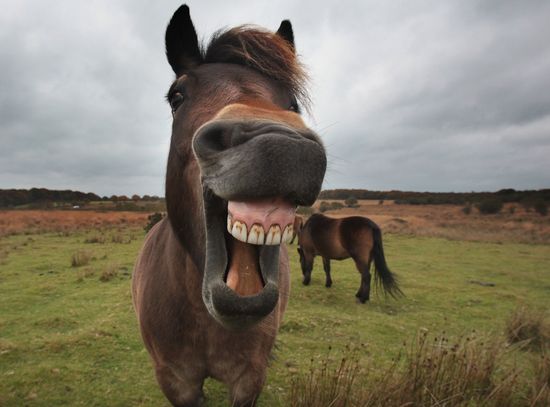
HorseMouthMatt CardyGetty

Exmoor ponies graze close to where it has been reported that the 'Emperor of Exmoor' was last seen after being shot dead by an unnamed but licensed hunter, on October 29, 2010 in Rackenford, England. Although it has been claimed that the red deer, thought to be one of Britain's largest wild animals – at 300lb and almost 9ft tall – was shot by trophy hunters for his antlers valued up to 10,000 GBP, no body has been seen, prompting rumours that he may not be dead after all. By Matt Cardy/Getty Images.

Face Of The Day

AfghanManMajidSaeediGettyImages

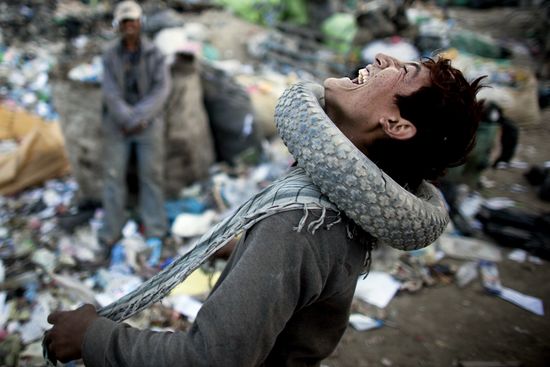
An Afghan man wears a tire around his neck while sorting through plastic and metal items near a rubbish dump on October 27, 2010 on the southern outskirts of Kabul, Afghanistan. According to the Global Anti-Incinerator Alliance (GAIA), about 15 million people throughout the developing world earn a living from collecting garbage. By Majid Saeedi/Getty Images.

Face Of The Day

UMMAL-FAHMUrielSinai:Getty

Riot police arrest an Israeli Arab youth during clashes, on October 27, 2010 in Umm al-Fahm, Israel. Hundreds of Israeli police attended the protest against a rally of ultranationalist Jews in the Israeli-Arab town, using tear gas and stun grenades to disperse the crowd. By Uriel Sinai/Getty Images.

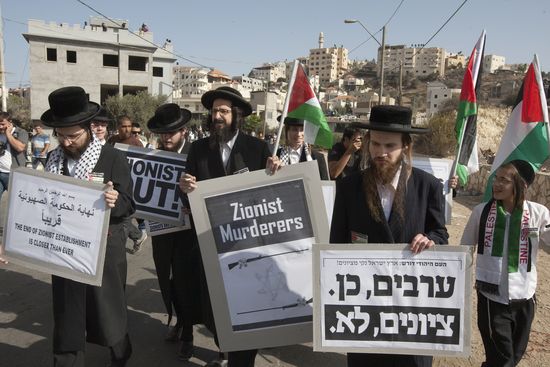
Haaretz's story is here; the Guardian's here. It seems a pretty ugly and unecessary provocation by an extreme right Israeli group. Among the more striking aspects of the clash was the involvement of ultra-Orthodox Jews protesting alongside Palestinians, waving the Palestinian flag and carrying placards declaring: "Zionist Murderers!" and "Zionist Out". It seems uncannily pertinent to my insistence earlier today on the distinction between anti-Zionism and anti-Semitism. Images below the fold:

ZIONISTOUTUrielSinai:Getty

Also by Urial Sinai/Getty.

Face Of The Day

MonkeyShotSonnyTumbelakaAFPGetty

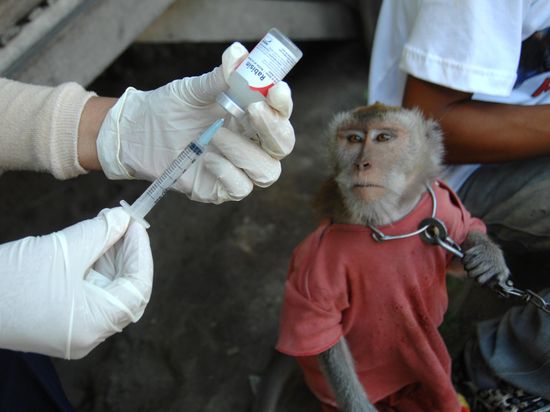
This photo taken on October 25, 2010 shows a health worker preparing a rabies vaccination for a monkey in Denpasar as part of the province's battle against the disease on the resort island of Bali. A campaign to vaccinate almost 400,000 dogs against rabies began in September, as an outbreak caused at least 100 deaths over the past two years. Bali's provincial government has also been trying to stop the outbreak by killing more than 100,000 stray dogs since 2008, although experts say culling is not the most effective or humane way to deal with rabies outbreaks. By Sonny Tumbelaka/AFP/Getty Images.