Can Church Be Hip? Ctd

by Chris Bodenner

A reader writes:

I recommend Pedro the Lion. It's pretty heavy and often crushingly-depressing music from a deeply disturbed mind, but nonetheless deeply religious. As for songs, I'd recommend "Diamond Ring" above all others, but also "Bad Things to Such Good People" and "Lullaby".

Another writes:

David Bazan, formerly of Pedro the Lion, has true indie bonafides with releases on Jade Tree and a history in the Seattle hardcore scene.  Not all his music is related to religion, but damn near every interview feels the need to address the seeming paradox of his beliefs and his musical tastes. He's taken a lot of flack for what one Pitchfork-type review lamented as "his unfortunate hard-on for Jesus."

Another:

I can't really say if this is contemporary since he has since become an atheist, but Bazan is a pretty iconic figure as far as indie Christian music goes. The fact that he still has been invited to perform at Christian music festivals is also pretty intriguing at that. His music, while pretty ridiculously honest, personal, somber and occasionally satiric probably isn't something you'd want played at a religious service however, either by mood or content. The way he writes about sex, modernism, and criticizing church itself. And uses obscenities. Of course, probably the most interesting thing about him is listening over the course of his music how he lost his Faith in God.

Another:

I remember hearing Pedro the Lion in youth group growing up in the '90s, and I was struck by his frank and honest depiction of faith.  Perhaps he was too honest: Bazan has since given up his faith, and that has been hard for some in his Christian audience to understand.  Check out a song from his recent "break up with God" album [seen above].

Another:

His latest album, "Curse Your Branches," is a nakedly emotional document of his wrestling with and eventual abandonment of belief mixed up with confessions of alcoholism, problems in his marriage, and the struggle to be a good father. Though the album is about Bazan's abandonment of faith, it is ironically the most Christian album I've heard in years because of the way Bazan honestly wrestles with issues of faith and identity. Plus, the songs are terrific. Lots of terrific melodies, memorable hooks, and production touches that pull in from dozens of influences, but still sound cohesive and unique.

Another:

He began doing concept story-albums with themes of morality, relationships, and mortality. Now he's doing music under his own name and it's gotten to the point where it's agnostic, sometimes really angry-at-God stuff. But it seems like there's always an undercurrent of the faith he knows he can't forget.

Bazan talked about his faith on his DVD, "Alone At The Microphone":

At The Hour Of Our Death

DOVEJohnMoore:Getty

Damon Linker is, in my view, one of the most arresting and honest writers of his generation on the subjects of faith and politics. And now he takes the extraordinary composure and rational grace of Hitch facing his own mortality and compares it with Primo Levi’s refusal to succumb to religious temptation at the hour of his death. Levi wrote about the concentration camp he survived:

I must nevertheless admit that I experienced (and again only once) the temptation to yield, to seek refuge in prayer. This happened in October 1944, in the one moment in which I lucidly perceived the imminence of death . . . naked and compressed among my naked companions with my personal index card in hand, I was waiting to file past the “commission” that with one glance would decide whether I should go immediately into the gas chamber or was instead strong enough to go on working. For one instance I felt the need to ask for help and asylum; then, despite my anguish, equanimity prevailed; one does not change the rules of the game at the end of the match, nor when you are losing.

Damon respects this composure, as I do. And, I think the great failing of today’s atheists is a lack of respect for the alternative: which is, as Damon writes, not the use of faith as some kind of crutch for less anxious living and dying, but the belief that being human is not simply about our rationality, that

a Christian believes that the experience of suffering discloses essential truths that cannot be discovered or known in any other way. What are these truths? That we are fundamentally weak and needy creatures. That we are anxious animals, longing for someone or something to soothe us, to protect us from and relieve us of our worries.

Christianity’s radical claim is that it is in suffering alone that we approach the truth about our ultimate condition, just as Jesus’ intense suffering on the Cross makes sense only as an act of God’s solidarity with us in this mortal, existential panic. The position you take on this cannot be reduced to an argument. It is much deeper than that.

I revere reason and respect atheism. (And I think the writer who most taught me about the need for mutual respect between atheists and believers was an atheist, Albert Camus.) Watching my friend die in this remarkable fashion is as persuasive an argument for atheism as I can imagine. Hitch is dying as he lives – with integrity and passion. But for me, it is the fear too that informs us, the dread and the pain and the loneliness of dying and suffering. The moments I have felt closest to God have been when I have been stripped of every security, the moments when I have felt no love, known no safe home, witnessed unspeakable cruelty – and was rescued by nothing but his ineffable, boundless and yet intimate Love.

This is not an argument, I know. It can easily be dismissed as wish-fulfillment. I beg of you only to respect that this is not how I experienced these moments. They were real. In suffering, I have felt and known God reach into my life and grab me by the scruff of my neck and shake me with the brusque affection of a father’s compassion. “Andrew, Andrew … you fret and are anxious about so many things. But only one thing is necessary.”

Agnus Dei, qui tollis peccata mundi, miserere nobis.
Agnus Dei, qui tollis peccata mundi, dona nobis pacem.

(Photo: John Moore/Getty.)

The Language Of Faith, Ctd

Language

A reader writes:

I am responding to your post on the need for a renewal of religious language to capture religious experience. This was the precise problem I was engaged in trying to resolve before I lost my faith entirely and went to law school. Very early on it struck me that the crisis of faith in my own experience was a crisis of language that obfuscated spiritual reality. It seemed that the mystical traditions of both Catholicism, certain forms of Buddhism and Islam had struggled mightily to push the limits of what we could speak of in terms of God and our experience of God. I think the post-modern hermeneutical tradition had much to say on this with respect to language in general.

I always began with St. Paul’s admonition about seeing through a glass darkly as roughly defining the limiting effects of human language and experience. While a worthwhile struggle and one that is necessary to faith, to engage in the struggle to reinvent, update, and put into words the experiential properties of what we refer to as “grace” “salvation” “incarnation” “trinity” “faith” hope” “love” “god” etc, requires itself a living a vibrant faith, one capable of surviving despair and hopelessness.

Sadly, on a personal note, the struggle left me personally and spiritually bankrupt. Far from finding anything at the end of language, I simply found profound silence. Endo’s book “Silence” to this day rings the most true. My loss of faith, or a sustainable religious paradigm that could meaningfully explain my experience, is one of the most difficult losses I have had to experience to date. I pray that it is not lost forever and your posts continue to push and prod in that direction, with a nod to recent posts re Marilyn Robinson.

The Language Of Faith

Thornton Wilder once wrote these prophetic words:

“The revival in religion will be a rhetorical problem — new persuasive words for defaced or degraded ones.”

This seems to me to be a much more potent problem than many of us believers grasp. Sometimes, I think of faith as like looking at an old and famous painting for so long that it becomes impossible to see it any more. By see it, I mean see it with eyes fresh to its core meaning, open to its ambiguities and associations, and prepared to be shocked by its audacity.

I think of the term “incarnation” – a word that has come to seem like tired dogma. But what can it possibly mean that God became man? How is that different from God infusing all of us with love and hope and sometimes such overwhelming power that we lose all sense of ourselves? What made Jesus so different, so more remarkable than all the rest of us sons and daughters of God? To non-believers I know this must seem just insane; for those of us trying to get past the staleness of our faith, it’s a pressing challenge.

Mockingbird blog touts Paul Zahl, mentioned on the Dish before, as someone engaged with this issue. The video above speaks for itself. There are more here.

What Do Believers Think Of Death?

A Protestant reader writes:

To my eye, death is the most proximal intrusion on our lives of a more general fact — the finiteness of our lives in contrast to the infinity (or nearly that) of time and space.  The questions that once bothered me did not verge towards, "do I live on after death?" but ran more towards the cosmic.  As quickly as I can summarize, "if I am just strutting and fretting my nanosecond upon an infinitesimally tiny stage in the great arc of the universe, with any evidence of my life disappearing in a few scant thousand years, with my species but a midget latecomer on a single planet around a single star, ready to be snuffed out at any moment by a passing asteroid or our own cleverness, just what the hell is the point of my getting out of bed this morning?" 

The answer, in as much as I've been able to come up with one, is that I am faced with a question which is utterly beyond scientific inquiry or rational consideration.  I can either believe that, as the great American prophet of the 20th century observed, "the arc of the moral universe is long but it bends toward justice," and attempt to play my bit part in that play, or I can believe that this is false and that it is all a stack of amoral laws and properties and waveforms and such, and that any actions I take are, in the not-very-long run, utterly and completely moot.  I make the conscious decision to believe the former, which is to my theology (and, despite what atheists looking for a straw man might rush to argue, that of my church), a statement of religious,

irrational belief in God.

This problem does not, however, restrict itself to cosmic meditations.  Your passage on your dying friend reminds me that in the experience of my life and those close to me, religion is not nearly so important in contemplating one's own death but in contemplating the deaths of those to which we are closest.  The spiritual challenge of one's own mortality is tiny and remote compared to the challenge of the mortality of one's children or other dearest loved ones.  I can contemplate my own finitude with little disconsolation, but as I think of childhood friends who died far too soon, something not from my rational faculties begins to cast frantically about, trying to seize upon something which might suggest some part of them lives on — that memories and objects somehow preserve the person I felt close to.  Surmises that "what a person does lives on in the lives of those touched by him or her" strike me as only slightly less irrational than the supposition of an immortal soul.

On a similar note to loss, there's the human problem of absence.  In an exchange some time ago on your blog, one atheist reader angrily replied to religion's role in providing comforting words that as atheists, his family relied on each other.  I'll certainly not interfere with this form of support, but the question remains — what of those who lack some or all of their family?  What of missing or abusive parents?  While I look through the eyes of a believer, I can't see a "vast chasm" between on the one hand a perfectly rational orphan who, in times of despair, relies upon the belief that there are forces for good in the world which can lift her up, and on the other hand Obama's "audacity of hope," which didn't seem to trouble too many atheists.

In my own times of trouble, I've consoled myself with my belief that there is good inherent in the world, reinforced this with songs, scripture, and poetry, and called that force the Holy Spirit, but that doesn't seem any more of a stretch than ascribing the rain to Mother Nature or taxes to Uncle Sam.  (I feel considerable sympathy with a Jesus of Nazareth who, divine or not, clearly realized at an early age that Joseph was not his father, and who called the God of Israel, Abe, or "daddy.")

At extreme risk of sounding just as condescending and trite as the "you can't deal with death" atheists, I have to observe that it's much easier to say goodbye to a happy, healthy life than to one filled with unfairness and injustice and illness. If we're going to be ascribing religious beliefs to mental failings, I'm far more ready to accept that it comes from the offense to our innate sense of justice when a selfless and caring person suffers a long, horrible, painful, and lonely death than some fear of the terminal dark.  It's far easier to accept an "unjust" death if one can imagine the soul sleeping peacefully in the arms of the Savior than imagining that years of humiliating pain are the final word on a life.  Indeed, I confess to thinking that atheists are even able to hold these more scornful takes on religious belief because they haven't come face to face with truly horrible pain and suffering in their lives.  Whatever gets you through that, I'm pretty sure it doesn't come from rational consideration.

And, if I may add something to this deeply personal note, reducing this religious experience to a "crutch" presupposes that a crutch is somehow unnatural. But this experience of suffering and loss and death is part of the core human experience. Which is why faith endures. Modernity has helped keep this suffering at bay – numbing it with pharmaceuticals and technology and material comfort previously unknown.

But it hasn't changed our deepest reality; it has merely muffled it and enabled our denial some more. Death comes. Injustice remains. Unfairness triumphs. On this earth, at least.

Jesus And Christ, Ctd

A reader writes:

I'm a Christian . . . I think.

I say, "I think" because a recent trip to India left me stumbling on the foundation of faith laid since my youth. I was raised in the church, by a fundamentalist, Baptist preacher father and an "amen" mother. It's true that at several points during the course of my life I have left the practice of my faith, but even in those willful and deliberate seasons I still knew God was God and I could just as soon call him Jesus if I wanted to.

India, for better or worse, has caused me to question all of that.

The temptation, mind you, is not to now let go of Jesus and embrace any of their hundreds of gods – though they are older and arguably more tangible and personal than he is . . . and more clear in their own assertions of divinity. No. What India did is place me squarely at the foot of the cross of Christ to wonder if it was big enough to shadow this whole, big, diverse, Hindu, Muslim, Buddhist, etc., world.

Most people I spoke with in India shared the same gratitude and love for their beloved Ganesha that I did for Jesus. Does this, as the Bible has been traditionally interpreted to suggest, mean that all those beautiful, hardworking, sincere people are going to hell, forever?

For the first time in such a visceral way, the morality of eternal hell – a cornerstone in the Christian faith – struck me as severely lacking. I returned from India angry, incredulous, and disoriented in and about the faith that I had for years prior really made the compass of my life and work (yes, I work in a church). Hell, I didn't even know who to pray to or what to say if I did stumble my way into a quiet mind and heart.

My new-found discontent sent me into the arms of Karen Armstrong and others trying to find a scholarly approach to God, but what can a finite mind fully know of transcendent infinity? I went back to favorites like Lewis and still rebuffed against the exclusivity and "one way"-ness of my faith. In truth, atheism seems like the kinder position . . . except that would require that I deny the countless and real encounters throughout my life that I've had with God, His grace, His mercy, His provision, His joy, and His presence. But still I question, everything. All is not lost.

In my reading, I've stumbled on a book or two that have helped me shape my thoughts and put into words my present experience with Jesus and God. The most notable is If Grace is True by Philip Gulley and James Mulholland. I don't agree with every position they take, but it resonates somewhat within my spirit. And, it gives me hope that the God I love is not morally inferior to me, rejecting some of his children while embracing others . . . but that he will claim every child as His own in the end.

I have to believe that, otherwise, I simply can't stay if what Jesus did isn't enough for everyone.

Jesus And Christ, Ctd: “The Corpse Stood Up”

A reader writes:

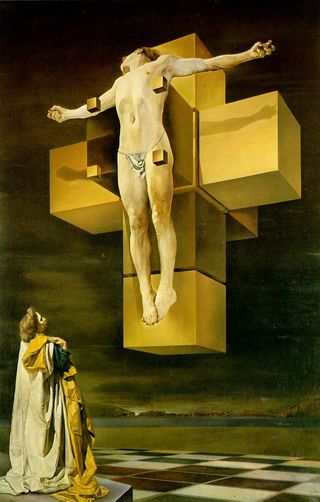
I am a Christian because I follow Christ before anyone else (not to say I don’t believe that we have a lot to learn from the other faiths!), and there must be a reason for that, in my opinion.  Dali_Crucifixion_hypercubeIf Jesus was little more than a uniquely-adept Jewish mystic with a profound experience of the Divine (God-as-“Daddy,” a pretty great idea), then while that is profound, it’s no reason for me to follow him uniquely as opposed to the path of the Buddha, the Hindu mystics, or the Kabbalah.

I could follow him as one sage among many, but not as something unique. 

This is fine, mind you, but let’s not kid ourselves by saying that we (or anyone else of any other faith, for that matter) could keep our special spiritual identity in this way.  We fall into an amorphous blob of “Jesus, Buddha, Muhammed, and the Gita are all saying the same thing!” philosophy, and while that may be good for the Kumbayah campfire, it’s not good for serious scholarship in comparative religion (Protherto is making the rounds with this point, thank God).

This is where the Resurrection comes in, I think.  I don’t believe the early Christians viewed this as a purely spiritual phenomenon (see research into the Semitic Totality Concept for just one reason why), but something real and physical (one of the earliest Christian creeds that we have on record is a bit crude about it, in fact, saying that, in regards to the Resurrection, “the corpse stood up”).

It was the thing that separated Jesus from all the other miracle-working Torah commentators of his day (as stated previously, if one just takes Jesus at face value, he’s pretty unremarkable).  The Resurrection divinizes Jesus and humanizes God (the most amazing part, I think), and as such, makes Christianity unique.  To say that there was a first-century Jew wandering the highways with whores and fisherman and breaking the bureaucracy of his religion and drinking like a fiend and bringing God to the masses is one thing.  To say that it was God that was doing all that is quite another.

Therein lies Christianity’s real trump card.

It’s not that we have a unique experience of God, it’s not that we have a monopoly on God, it’s not that our ceremonies and rituals are better (they’re pretty terrible sometimes).  It’s that God knows what it’s like to be a human being.  God eats, drinks, sleeps, cries, gets angry, bleeds, dies, and then shows us that death is not the end.  If we’re to believe the whole “We are the Body of Christ” bit, too, then that means this mystery is continuing.  Our eating, our drinking, our joys, our sufferings, and our deaths are all our participation in the life of God, and God’s participation in ours.

If Jesus did not rise, if he really was just chewed up by dogs after the crucifixion, then let’s be honest about it, see Christianity for the bankrupt system that it is, and move onward into other faiths of our choosing (I’ll probably be bathing in the Ganges.)  I can’t do this yet, however, because I believe the scholarship doesn’t allow it.

At The Hour of Their Death, Ctd

DOVEHANDSJohnMoore:Getty

A reader writes:

I wanted to tack this onto the post "At The Hour of Their Death."

12 years ago my mothers passed away after a 9-month battle with cancer. I was in the room as her body gave up her spirit. It was that clear. Her forced breathing. The tension in her neck and face. The physical energy left inside the very sick and very emaciated body must have been so little, but the change in her appearance at that final moment was vast. Her body gave up her spirit. The air in the room took on a very distinct quality. It seemed a moment when anything could happen. That the air could shimmer and tear apart and I would not have been surprised.

The air was similar at the birth of my three children. When my children were born anything could happen. The air was filled with a remarkable energy. A moment when all laws of nature, all science, all proof, everything man knows about existence and life was so limited. Religion is not all about "fear of death" – it is also because we have all witnessed things that science and learning cannot explain.

Another reader:

Atheists, from my own experience (and I did not always identify myself this way; I still prefer god-free to atheist, as it implies being against something), don’t think about death much at all, except when we ponder its inevitability, our own experiences of loss, and the way it has of telescoping time.

When my partner died in 1991 I’d been mostly an atheist, though I didn’t spend much time defining that for myself.  But when he died, I had an experience similar to the nurse’s.  I was suddenly convinced that he had been a person, a spirit, and now he was gone.  I searched and wondered, and I started going to a church I’m still fond of and will still attend from time to time.  I was most perplexed by where he went.  Many years later, I’m at peace with the whole issue.  I need neither to believe not to disbelieve.

 Your reader's sense that the people who died in her presence were gone is quite accurate and there’s nothing supernatural to it.  But the underlying sense she has, and that I had, that the person had gone somewhere, is at the heart of the matter.  We are indeed gone when we die, but we do not go anywhere.  It is the living we leave behind who grapple with the question of where we have gone, and interpret the experience to mean there is somewhere to go and our spirits have left our bodies en route.  What leaves our bodies is life, and life is energy.  So, yes, we are here and then we are not, and it’s all quite mystical and profound, but it does not require an afterlife of anything but silence.  Why that is not enough for so many, many, many people is something I understand but don’t participate in.  An anecdote has it that when the Buddha was asked if god exists, he remained silent.  I have always loved that.  He did not say yes and he did not say no.  I interpret that to mean that he had no need to answer the question.

A final reader:

Your reader's reference to a "palpable feeling of departure" when someone dies reminded me of a couple of scenes from the movie (and person) "Temple Grandin".  Ms. Grandin is a highly functioning autistic person whose autism seems to have bestowed upon her an unusual ability to observe and recall small details.  In the movie, there is a scene in which she witnesses a cow's instantaneous death in a slaughterhouse.  "Where does it go?", she asks the slaughterhouse manager, who thinks she is asking what the next step is in processing the cow into beef.  But really what she wants to know is, one second there was a cow there, the next second there was only beef – so where did the living, aware cow GO?
 
Later in the movie she asks the same question at the funeral of a teacher who meant a great deal to her.  She is not saddened to see the body, but she still wants to know, where did he GO?  Temple does not experience the emotional loss of death the way most of us do, but she is acutely able to sense that something has left the body.

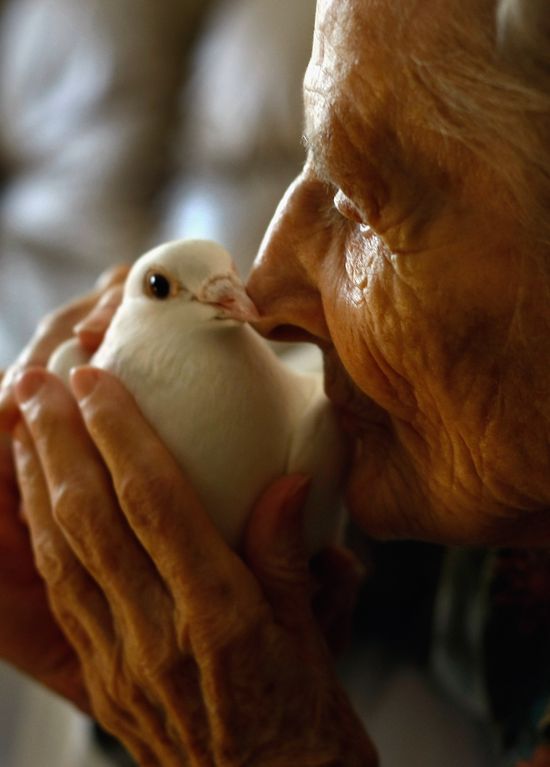
(Photo: Terminally ill patient Jackie Beattie, 83, touches a dove on October 7, 2009 while at the Hospice of Saint John in Lakewood, Colorado. The dove releases are part of an animal therapy program designed to increase happiness, decrease loneliness and calm terminally ill patients during the last stage of life. The non-profit hospice, which serves on average 200 people at a time, is the second oldest hospice in the United States. The hospice accepts patients regardless of their ability to pay, although most are covered by Medicare or Medicaid. By John Moore/Getty Images.)

Jesus And Christ, Ctd

A reader writes:

Just a quick thought about your meditation on the gospels, and your grappling with the relationship between doctrine and story, humanity and divinity.

100524_r19634_p233 It is worth pointing out that inasmuch as the doctrines of the 4th and 5th centuries sought to articulate Jesus’ “divinity” – that he was “God from God,” and so God’s very self-expression in our common history – those doctrines did as much to preserve the distinctiveness and integrity of his humanity, and so to place brakes upon any tendency, whether explicit or subtle, to blur the distinction of “God” and “creature.”
That Jesus did not go about declaring himself “God” throughout his ministry is in fact entirely keeping with the view that Jesus, precisely as a human person, is God’s “being with” and “being for” us. That God can do this is, of course, a statement of faith. That God has done this is, from the point of view of that same faith, utterly astonishing – and the greatest gesture of love imaginable. God becoming human is an event that leaves nothing out from our human experience: not suffering, not death, and not even the experience of God’s otherness.

In Jesus, God is “other” to God’s own self. And it is in the space of that otherness – that creatureliness – wherein our humanity dwells. The Incarnation means that God “assumes” what is and remains “other” to God. Which is why, from the point of the view of the article you cite, Jesus’ own doubt, fear, pain, and sense of abandonment is so essential to affirm. God knows and undergoes this too.

Another writes:

In the spirit of expanding the conversation I query whether the Incarnation as defined as the pre-existence of Jesus as God from eternity is indeed the core of the Christian faith.  On this point see Hans Kung in On Being A Christian and Christianity

Kung is persuasive to me where he argues that the core of the faith is Jesus, who was crucified and who God raised from the dead and who is now at God's right hand. In the earliest New Testament documents, the letters of Paul and the Gospel of Mark, as well as in the original Kerygma as analyzed by C. H. Dodd in The Apostolic Preaching, Jesus is the Anointed One, the Son, the Son of Man, the Servant of God.  See for example Peter's sermon to the household of Cornelius in Acts 10.

Kung argues that the classical definitions of the Trinity and the Incarnation are the result of an interpretation of the evangelical facts in terms of Greek metaphysics – but that one may be a Christian without at the same time adopting Greek metaphysics.  In my judgment, Kung's passionate interpretation of  "Jesus from below" is compelling evidence for his thesis.

What Do Atheists Think Of Death?, Ctd

DOVEJohnMoore:Getty

A sonnet, by John Masefield:

There, on the darkened deathbed, dies the brain
That flared three several times in seventy years;
It cannot lift the silly hand again,
Nor speak, nor sing, it neither sees nor hears.
And muffled mourners put it in the ground
And then go home, and in the earth it lies,
Too dark for vision and too deep for sound,
The million cells that made a good man wise.
Yet for a few short years an influence stirs,
A sense or wraith or essence of him dead,
Which makes insensate things its ministers
To those beloved, his spirit's daily bread;
Then that, too, fades; in book or deed a spark
Lingers, then that, too, fades; then all is dark.

(Photo: Terminally ill patient Jackie Beattie, 83, holds a dove on October 7, 2009 while at the Hospice of Saint John in Lakewood, Colorado. The dove releases are part of an animal therapy program designed to increase happiness, decrease loneliness and calm terminally ill patients during the last stage of life. By John Moore/Getty Images)