Meditating On Death, And Life

  Grass

There were too many emails to fit in one post, so here is a second batch of responses. A reader shares:

I agree with Drum in that death is one of many defining characteristics. Our ability to have close friendships, our bipedalism, opposable thumbs, and our ability to use language to describe complex thoughts seem quite unique and quite defining.

I do agree with you and Montaigne that to philosophize is to learn how to die…and, in turn, to learn how to live. The latter being much more important in my mind. I have to side with Drum though; there are some people who just don't care about it. I am not one of them. I, like Drum, and am atheist, but unlike him, learning how to think and approach death has been a constant focus of mine (I've always taken comfort from reading Montaigne and Seneca). It has brought me great peace to my life, which is why it can be frustrating to see other people seemingly live their whole lives without a concern at all about their impending deaths. 

I know that the history of humanity has left evidence that we've always cared about what happens at death; however, I still believe that a large portion of humanity just doesn't care (or successfully ignores it). They just don't leave any evidence of their ambivalence behind.  I can live with this, despite it irritating me on occasion, but I find myself drawn to people that actually think about this issue, and I presume that it is a similar case with other like-minded people. I can't help but think of Bertrand Russel's smug quote "Most people would rather die than think; in fact they do."

Another reader sketches out a secular view of heaven and hell:

My best friend died six years ago. A few years later, I got into an argument with a friend when I told him I no longer believed in Heaven and Hell. It was a big issue because we had both been struggling with the death of our friend and while I didn't think our friend was "in Heaven" in the traditional sense, he did believe that. He took great offense that I could say our friend wasn't in Heaven, as if I was saying he didn't deserve to be. I tried to explain what I thought Heaven and Hell meant now that I no longer believed in the traditional concepts or that they are places your soul goes after death.

I didn't say exactly this, but my argument was basically that Heaven is the emotional legacy you leave behind in the souls of others. By leaving the world a better place and touching the lives of others in positive ways, those good works ripple away from you for eternity. Hell on the other hand is hurting others and having those negative ripples go on forever. So if you're doing good things, helping others, making people smile, being a decent person, all of those actions are leaving a mark on the souls of those people you help and they and the world are better off for your having helped them.  On the flip side, hurting others marks the soul of others, as well. And because your actions will impact the actions of another and their actions do the same and so on for eternity, in a way one can reach eternal life by doing good deeds.

Another reader argues that fear of death can be overcome:

I was raised Methodist, and my Mom remains a Methodist.  My Dad is a deist.  His belief is less specific, but he is a definite believer in God.  I grew up absolutely terrified of my own mortality.  I started thinking about it around the age of 4.  I am now a hardline atheist. Simply put, there's no way to know what happens when we die, and it's generally terrifying to think that there is nothingness waiting.  No safety nets, no way of truly knowing.  Even for the devout, there's always that shred of doubt. 

And this brings me to why I chime in.  I'm not afraid anymore, Andrew.  I truly am not.  I faced the fear, I addressed it, and I decided it's unjustified.  Because I believe that my consciousness/ego will cease to exist when my physical body expires, I am in constant awe of the life I live.  Any time I think about it (more rarely, as time goes on), the colors get brighter, the smells get sweeter, food tastes better, music becomes almost achingly beautiful, I feel more love for my partner, our dog, and our cat.  I've only got a grand total of 70 years, statistically speaking.  Which leaves me a little less than 45 years left.  The first 25 went by so quickly, I'm driven to experience as much of life as I can, and above all, to live positive and be a positive influence on those around me.

My mind would not, and I believe cannot, accept religion.  It's just part of who I am.  But the fear of death was as well, and I think it's simplistic to believe that we're either born with or born without a fear of death or the ability to believe.  What makes us human is our capacity to change and adapt to circumstances in a range of ways. 

A reader challenges the importance of thinking about death:

As a scientist and a small-a athiest, I'd assert that your statement "To be human is to be aware of our own finitude, and to wonder at that" is only half true.  To be human is to wonder, but the choice of what to wonder about has no bearing on one's essential humanity.  Like Kevin, I don't wonder much about my finitude, or yours, or his.  Are Kevin and I less human?

From their writings, it's clear that believers tend to feel that athiests are somehow missing a sense of wonder, or joy, or higher purpose.  We aren't.  We feel those same feelings — just not always about the same issues as you.

Many readers made this point:

I always took comfort in Mark Twain's saying: "I do not fear death, in view of the fact that I had been dead for billions and billions of years before I was born, and had not suffered the slightest inconvenience from it."

Another reader focuses on animals:

You said:

"For me, this last thing is our first thing as humans. It is our defining characteristic, even though some animals may experience this in a different way. And our ability to think about this casts us between angels and beasts. It is our reality. Facing it is our life's task."

What, then, is the task of a deer's life?  Or a rabbit's?  What about gorillas and all other sorts of primates?

This is the central challenge I've developed when it comes to religion or spirituality of any form.  I am equally in awe of the existence of life and all that has accompanied it.  I've followed you for years and I know that you don't deny science such as evolution, an amazing demonstration of the natural wonder in our world.

 But knowing what evolution means and understanding it's implications, how can any person assert that humans would have a particularly different "task" or conclusion in life than the "beasts" we've come from?  We're as far removed from our origins as chimpanzees, and are equally subject to our world's condition and fate.

Yes, we've absolutely displayed new and fascinating progress for a species on Earth when it comes to things communication and habitat manipulation and civilization.  But so what?  So do countless other creatures all over the planet.  Our desire to describe a God that has a unique plan for "us" as individuals or as a "human race" comes from a selfish, myopic viewpoint that we're somehow more special than the life all around us.

On the same subject:

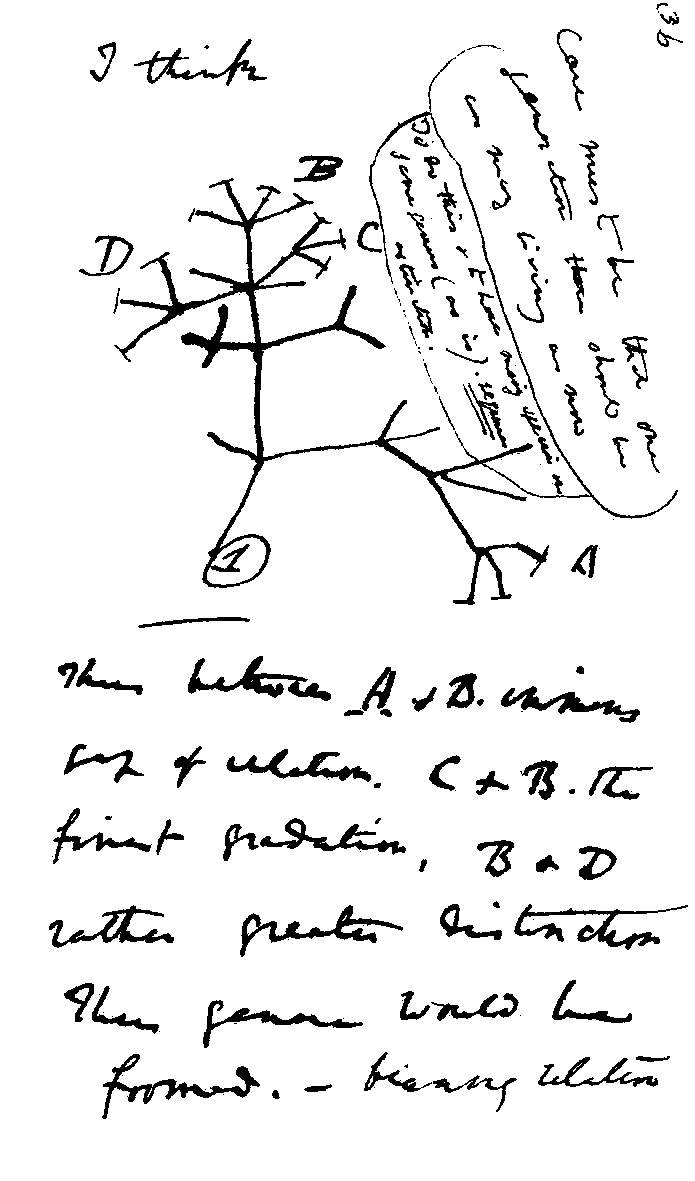
Animals have this annoying way of ruining our uniqueness. It's what happens when we stop thinking like this, and start thinking like this (Darwin's first sketch of the tree of life).

A reader goes a different direction:

To turn your question to Kevin back around to you: What would you do differently tomorrow if it were somehow revealed to you that you are 100% wrong about the existence of god/soul/afterlife?

Would you cease your many contributions to society through your blog, your published works, your lectures? Would you abandon the relationships with other humans and animals that have enriched your life and the lives of your friends and family? Would you suddenly ignore the notion of legacy and the societal progression of knowledge?

Clearly, my opinion is that you would not. Putting aside our knowledge of death and returning to the core notion that started this debate, tragic atheism, I struggle to see how it is not apparent that other wholly sufficient motivations exist beyond the supernatural and that what it is to be human in this world may have very little or nothing to do with gods.

Another reader is in similar territory:

Personally, I think that the drive toward religion is an extension of the self-preservation instinct. You spend your life avoiding fires or walking in front of buses because you would like to be around tomorrow, for whatever reason (be there to raise your son, be there to defend your legacy, etc).
 
By extension, the final insult of death from old age may as well be a fire or a bus, even though you may be a hundred years old. You’d like to be around the day after your stroke or heart attack. Entire cultural institutions, imho, have been built around this seemingly simple fact.
 
To me, the central empirical question is: if you don’t expect a heavenly reward for your miserable life, do you act differently? I don’t think we’ve had a sufficient experiment to test this yet.

A related point:

Though an atheist I agree with your feelings on death more than Drum's. I personally cower at the emptiness I expect awaits me. But that is far removed from the initial dispute over atheism and religion. The central problem that Hart and Linker, and now you, are ignoring is that there is no pre-condition that the universe be pleasant. Just because atheism is a terrifying, or tragic, viewpoint doesn't mean it is wrong. As obnoxious as the "New Atheist" attempts to destroy religion are, their central point—there is no reason to believe in god—is unaffected by that. If, like myself and most atheists, you do not feel god within you there is no other evidence or compelling factual reason to believe in one. This may lead to unpleasant realities when it comes to death, but what other option is there? Though, unlike Drum, I wish I could believe in eternal life and happy-go-lucky Heaven, I cannot because I know there is no reason for me to do so outside of wanting to believe. My own attempts to believe would thus be rendered pointless by my own awareness that they are really attempts to self deceive.

It is in turn not hard to see, especially for those who live within a scientific community, why these unpleasant realities of tragic atheism are easier to live with than self delusion and baseless belief (which is how new atheists view religion). Likewise, it is not hard to see why someone who values a positive viewpoint and order, like Hart argues Christianity offers, over analytical and reasoned belief would choose religion. That Hart applies logic and reason to make his point is perhaps ironic, but it is understandable. What is not understandable is why any atheist should, essentially, be criticized for failing to take the negative realities of their view into consideration. There may be criticism of them as theorists and philosophers, but I see none as advocates for believing there is no god (of course when they argue there cannot be one they go to far). They do not believe there is no god because of the consequences, but because they do not believe there is any evidence or reason to believe in god (a pleasant future after death not being a reason). However tragic atheism is that does not speak to whether or not it is the accurate belief. If you are trying to argue against a sunnier, but incorrect, theory you can hardly be blamed for focusing your book on accuracy and not consequence. Because they lack an equally optimistic viewpoint to replace salvation with does not mean the atheist viewpoint is wrong. It simply means the new truth is not as pleasant as the old one. But, if it's the truth, does that matter?

Yet another reader:

The thought of my own non-existence is not troubling in a vacuum.  The thought of my children’s non-existence before their time is mind-numbing.  There is nothing redemptive (in and of itself) in the tragedy of loss, no evolutionary benefit to existential consciousness.  If there is no God (which I am inclined at this moment to accept), and this life is it (which at this moment and all moments I am inclined doubt), there truly are very good emotional and logical reasons for ceasing to procreate entirely as a species.  I think it would be interesting to study the correlation between agnosticism/atheism and parenthood.  Are atheists and agnostics more or less likely to procreate than their believing counterparts?

Another reader:

There is some empirical evidence that highly religious people actually fear death more. They're more likely to seek aggressive treatment/ heroic measures at the end of life.

As an atheist, the though of the world turning without me after I'm gone is about as disturbing as the thought that the world was around before I came on the scene: strange to think about in an existential way, but not actively upsetting. It would bother me far more to have some God purposely snuff me out than to accept that death just happens, just like most people would rather die of a heart attack than be murdered.

Death isn't pleasant to think about by any means, but it's a comfort to know that at least when it's over, it's over. No eternal torture, no eternity of singing His praises, no haunting, nothing to worry about. In all likelihood, when I die I'll be very sick and in a lot of pain. It will probably be a relief to know it will soon be over.

Another:

I think it would interest you to read about Terror Management Theory (TMT).  TMT agrees with you that "facing [death]" is our life's task and what separates us from the animals.  TMT argues that the realization we will inevitably die would psychologically paralyze us, save for our ability to suppress such thoughts through telling ourselves we will "live forever" either literally (religion) or figuratively (our culture).

Yet another reader ponders the great beyond:

The prospect of my death fills me with a terror unlike any other. I admit this. My knowledge of the physical world, as I understand it, leads my to believe my eventual annihilation is permanent and complete. But therein lies the rub: as I understand it. In admitting that humanity's comprehension of the universe is limited, I allow the possibility that there may be more. What is my death? A moment in time in which my brain ceases to function. What is time? That's trickier… Hawking has said that time may have no beginning. Others have theorized that time is happening all at once. If so, where does that leave death? I'm always dead and am forever alive. What does that mean?
 
Like everyone, I have to live my life as best I know how. So I go forward assuming the only time I'll have is with air in my lungs. Still, for all the existential terror, I think this gives me more worthwhile hours than those hoping to interpret Heaven. But whatever hope I do have for an afterlife comes not from any Holy book, but from the quest for knowledge of my fellow man.

A final reader:

I am an atheist, but I always marvel at the fact that all of the public atheists claim to be unbothered by death.  It bothers me a lot!  The idea of my own non-existence is basically intolerable, and can make existence itself seem almost meaningless.  (I'll die in the end, I will have no more memories, people might remember me for a little while but not that long, eventually human life will end, the planet will be destroyed, the entire universe decay into entropy.  What is the point, exactly?)  I would really like to believe there is an afterlife, or at least that something is out there that might remember my life in some way.  I just don't, really. 

I don't mean to make it sound like I'm depressed or find no meaning in life – I have the usual hopes, goals, plans, joys, and so on.  I'm generally a happy person.  But death is definitely a big flaw in the system as far as I'm concerned, and the idea that my death allows others (future generations) to live, or that all my ancestors have died and I am no different, is a pretty meager comfort.

Not all atheists are sanguine about death.
What Do Atheists Think Of Death?

Arm

This post certainly struck a nerve, particularly among atheist readers. One writes:

Sharing Kevin's sense of never having felt the need to believe in God, perhaps my answer will be of interest.

I have always felt that when I die, I am dead and gone, my conscious life will end, my interactions with others will end, and I will be simply GONE. I don't know what causes consciousness (call it spirit, call it soul, I don't mean to pick sides with my words), but I expect that it will end. My afterlife will be in the memories of those I knew, those who loved me, those who carry me on in their hearts. I, myself, cease to exist.

This gives me a beautiful, shockingly beautiful sense of the Now. Being in the present, the here and now, is the ultimate reward of life. I am constantly gobsmacked by the minutiae of life; I stand in awe of the things around me right fucking now. There's no reward, no judgment, no heaven, no hell. I live right fucking now.

Another writes:

I think that when I die I'll cease to exist, and in some ways I'm happy about that.  Life is hard work.  Life is good, worthy work that I'm proud of and that makes me feel good, for the most part, but even though I'll probably be sad to die (and I'd hate to think I was about to die any time soon), I'm still glad, in principle, that some day life will cease, and my burdens will dissolve with my joys.  I don't want to live forever.

Another:

Speaking as someone who shares Kevin's view on this topic, what we think happens when we die is that we die, only our contributions to the world we are departing will live on, and that's all there is to it. We're not going to be around to experience it afterwards. Would it be nice not to die? Maybe, certainly sounds interesting (although I could see myself wishing fervently for death to put me out of my boredom when I turned a million, and considering it an inhuman and sadistic torment to deny that to me…). But if we wish to live in a reality based world we need to acknowledge that there is no rational reason to believe this to be true and it is a monumental case of group wishful thinking to put it politely. People are afraid of dying, they don't want to deal with it, and believing they'll never have to *really* deal with it because they're not going to *really* die is just easier.

How do I feel about it? Meh. I accepted my mortality (and that of everyone else I know) a long time ago, I dealt with it, and now I rarely give it much thought unless circumstances call it to my attention. I have better things to do with my life than obsessing over a time when it's going to be over. And no, that is not me declaring how incredibly brave and stoic in the face of death that makes atheists, I don't imagine I'd be any less scared facing the imminent ending of my life when the time comes than your average person… it is simply not a concern of mine now. Wringing my hands over it would be about as pointless as wailing over the gravitational constant of the universe not having a different value more to my liking. Reality is what it is. And reality is that people aren't immortal.

Yet another:

"I wonder what Kevin thinks happens to him when he dies?"

I think the fact that you have to ask this question at all says a lot about how the fear of death is inextricably tied to a belief in higher powers in the minds of theists. To one such as I, who shares Kevin's views, the answer is rather obvious and intuitive. Nothing is going to happen to him when he dies, because there won't be a 'him' for anything to happen to.

As for your follow up question- "And how does he feel about that – not just emotionally but existentially?"- I can only speak for myself, but again, the fact that you feel the need to ask this question says a lot about the source of your faith. Forgive me if this sounds overly judgmental, but to me terms like "faith" and "spirituality" are just shorthand for an individual's inability to cope with the concept of oblivion. Why must one feel anything particular about it in the first place? I am. One day, I will not be. This doesn't bother me and I don't understand the need to waste the precious gift of sentience agonizing about such things.

I recognize that some people can't shrug off the idea of not existing in some form. Take my husband for instance. He has an overdeveloped fear of oblivion but can't bring himself to believe in fairy tales. He takes comfort in philosophy. In the words of (probably) Marcus Aurelius:

‘Live a good life. If there are gods and they are just, then they will not care how devout you have been, but will welcome you based on the virtues you have lived by. If there are gods, but unjust, then you should not want to worship them. If there are no gods, then you will be gone, but will have lived a noble life that will live on in the memories of your loved ones.’

Another:

As an atheist who has just recently had two friends die, I can say that not all atheists are as lucky as Kevin. For me, the fear of death is far and away the most immediate and challenging aspect of my atheism. Death affects me in a profound way, because I know — it's not a matter of belief at this point, for me — that this life is all we get. As much as I would like to believe platitudes like "He's in a better place now" and "I know he's smiling down on us," I see them for what they are, and what they represent: attempts to avoid facing the reality of death.

So if you truly believe that "Facing [death] is our life's task," may I suggest you try atheism? Religion is how people AVOID facing it. It's the common thread in all religions, from the most ancient to the most modern: "When we die, it's not really the end. So don't worry so much." But for most religions it doesn't stop there. Most of them teach that life after death will not only exist, but it'll be way more awesome than stupid ol' life with all its trials and tribulations. A choir of angels! Forty virgins! Nirvana! All your old friends, your family, even Mittens and Fido will be there to give you a big hug and welcome you to eternity!

Eternity. Living forever. Whatever philosophical contortions you want to twist yourself through, if you believe in eternity, you are not facing death. Atheists face death. We have to come to grips with the finality of our end without the aid of any comforting fairy tales. It's not easy, but neither is life. Atheists and theists can agree on that, at least. We just don't think death is going to be any different.

A reader asks:

When atheists claim that religion is just a fanciful way to deal with the unpleasant inevitability of death, the faithful often decry such a reduction as unfair. And yet your main response to Kevin Drum's unapologetic description of his lack of religious impulse is to ask "Then what do you think happens when we die?" As another of those "untragic" atheists, I can only scratch my head as to why my answer to that question would seem to be revelatory to you… unless, that is, the avoidance of death offered by religion is its key selling point. So which is it? And how does soothing my fears (be they rational or irrational) make something like religion more likely to be True?

A final thought:

I believe we have a "soul," but not in the sense of a spiritual being apart from our bodies, but in the sense of a consciousness that transcends our physical limitations. It is, first, the essence of our beings, the thing that connects the person we are today to the person we have been at all the stages of our lives. The boy I once was is in some sense the man I am today and the old man I will be, and I think this persistence of being – this connective line, this inner self – is part of what I mean by "soul." In addition, by "soul" I also mean our ability to contemplate time and space and perhaps a sense of harmony far outside our own physicality. And finally I mean a higher morality – the part of our beings that makes us not only human, and thus animal, but also humane, and in that sense spiritual beings with a higher morality than self-interest and even survival. This feeling no doubt has a physical cause as well, but at some level our higher-processing brains and our experiences and learning give us feelings that seem unconnected to physical sensation. And it is here where the best of humankind resides and expresses itself.

When I worry about my own death, it is not death that I really worry about, but the manner of death, and the lead up to it of decline, decrepitude, helplessness, pain. (If I knew I would be fairly healthy until the end, and then die peacefully in my sleep, much of my anxiety would be gone.) Death itself does not scare me. I remember undergoing general surgery for some minor problem, and was given some anesthetic drip before being wheeled into the operating room. At one moment I was talking to the surgeon, and the very next moment – a nanosecond later – I was in the recovery room. I had no awareness of a dimming of consciousness. One instant I was there, an instant later I was gone. This, it seems to me, is what death is like, only there's no reawakening. Consciousness ends, and along with it any awareness and sensation. There is not even a feeling of absence.

Another way I look at it is that life after I am dead will be just like life before I was born. I don't regret not being here sooner than I was, and I had no sensation of existence before my birth. So it will be after my death.

The only death that really scares me is the death of those I love, far more than my own. This is not to say that I don't want to live as long as possible, so long as I can function in some way and not be an excessive burden. And this desire, it seems to me, is itself strong proof that there is no afterlife. Freud's thanatos notwithstanding, even our souls hunger for a concrete existence. We may long for transcendence, but it is a transcendence in our lives, not in some desire to be totally spiritual beings, removed forever from connection to the real. At least not for long – that way lies madness. Sooner or later, we want to reconnect to the world. And we constantly hunger for the visible world, the streams of sensations that feed our consciousness and being. It is the very opposite of an afterlife idealized by major religions. And that leads me to my final point (probably a startling one, from your point of view): I think life after death would be stupid.

By this I absolutely do not mean that it is stupid to believe in an afterlife or to desire it (though such a desire may be a result of naivete, irrationality, or great pain). I mean that such an existence would itself be stupid. It would be devoid of anything that gives our intelligence any significance, and our current lives any meaning. It would not in any sense be human. I remember telling my brother that if I died and there was a God and he told me that he indeed created the world in six days, I would be extremely disappointed, for I find the world as it is far more miraculous and awe-inspiring than its biblical description. Similarly, a life after death devoid of physicality would mean very little to me, and I don't desire it. Perhaps it would matter to whatever essence or spirit survived me, but to the living human being I am, this world – you and me and everyone else – is all that really matters.

Again, Andrew, what do you think happens when you die? Your body and individuality recreated in some recognizable way, with friends long gone again available to you? Andrew Sullivan as a disembodied spirit, glowing because you – or it – are in the presence of Jesus? You must have some view. Share it. And tell us if you really prefer that afterlife, to all the pain and glory of this real one.

One of the starkest things I remember from my one afternoon spent conversing with the subject of my doctoral dissertation, Michael Oakeshott, was his response to a question I posed him about the notion of salvation and the after-life (he died the following year). It was "who would want to be saved"? Oakeshott's LU last unwritten essay (I suspect he had been writing it in his head much of his life) was going to be about a conception of salvation which had nothing whatsoever with the future.

I have two intuitions about what happens when I die. The first is that I cannot know in any way for sure; and I surely know that whatever heaven is, it is so beyond our human understanding that it is perhaps better not to try an answer. The second is that I will continue to exist in my essence but more firmly and completely enveloped in the love and expanse of God, as revealed primarily in the life of Jesus.

I guess you can believe there is nothing there (atheism/agnosticism); or that there is something there into which everything dissolves – human and divine – which is a kind of non-material unity of love and compassion (Buddhism). Faith gives me the hope of the Christian alternative to both, that we will remain who we are, the unique objects of God's love, and yet part of such a miraculous sea of divine love, we will be both ourselves and yet far less limited  by ourselves, freed from the sin that keeps us from knowing one another, forgiving one another and loving one another and loving God as parent, child and spirit.

My most indelible connection with death was being by one of my closest friends of my own age as he faced his own mortality. I was there at the hour of his death; and I was there when he was fully and healthily alive; and I was there when he faced his death, day by day, for two years, until he died at the age of 31 in his mother's arms.

One memory, related in Love Undetectable, came when Patrick, toward the end of his life, was enduring terrible sweats. In one of the lulls in which his body seemed to rest, I lay down next to him on the bed and asked the hardest question:

I asked him what he thought death actually was. He was shivering and we spooned, that candlewick bedspread holding our bodies inches apart. I remember feeling his bones beneath it for the first time, the skeleton beginning to shape the once firm, rosy flesh of his body. 

"I don't know," he said. "I don't really know. Sometimes it seems like some blackness coming toward me. And sometimes it doesn't feel like anything." He paused and I felt unqualified to add anything. So we lay there for a while in silence, staring at the ceiling, me wondering if I'd asked him because I was actually curious as to what a dying man might actually think, as if he might know a little better and help me navigate what I thought was ahead of me; or whether I asked him because somebody needed to, and no one else would dare; or since I was his only close friend facing the same prospect, no one else could ask him. He shivered again, and the phone rang. But death became one more of those banalities we had in common.

Where is Patrick now? He is with me whenever my thoughts turn to him; he is alive and vivid, if transfigured sometimes, in my dreams. He is with me at the end of the Cape each summer, as a seagull flies close to me in the evening sky. He is in my prayers. He is. I can prove none of this. I can only witness that watching my dearest friend die, after being in the AIDS bunker with him for two years, helped me understand that my friend lives. You will mock me for this wish-fulfillment. But they mocked the disciples too who knew that the Lord was alive, and that death was not the master of Him.

I live in this awareness. But I also live in the awareness that eternity is here already, that the majesty and miracle of God's creation resonates through every second of our lives and every particle of matter within and without us. That is how I interpret Oakeshott's deeply Christian (and somewhat Buddhist) understanding of salvation as having nothing whatsoever to do with the future. The unity and individuality and wonder we are told we will only know then is actually here now, shielded from our own eyes by our own mortal fear, by our own avoidance of death, by our own inability to grasp that this struggle we fear is actually already over, that God loves us now unconditionally, overwhelmingly, this knowledge prevented solely from penetrating us by our own sense of inadequacy, or our looking away, or are losing ourselves in the human and worldly things that I understand by sin.

So I do not believe our consciousness is utterly different after death than now. I believe, with Saint Paul, that this is the same divine experience, but through a glass darkly. I believe it is Love, because Jesus showed me so. And I await with great fear because I am human and I await with great hope because of the incarnation and resurrection of God in human history. 

To philosophize is to learn how to die.

To believe is to hope for light in the face of "some blackness coming toward us."

Faith And Reason

Cross

Theo Hobson reads Alister McGrath’s new book:

It seems to me that Christianity is not like a second science, a conceptual system that can explain huge aspects of reality to us. It is more like a myth that can (and to my mind should) find cultural expression. And advocates of this myth (this true myth as I see it) should be honest: in certain respects it comes into sharp, shocking conflict with reason. In some ways the atheist and agnostic do hold the rational high-ground, which won’t greatly surprise them to hear. For the believer is bound to make statements that offend the normal rules of reasonable discourse. For example, the Christian’s assertion that Jesus Christ rose from the dead is clearly less reasonable than the agnostic’s doubt on the matter. McGrath’s approach seeks to obscure this – but that means trying to distract attention from what faith is really like. Apologetics ought to be honest about the reason-offending dimension of faith. Otherwise it has a brittle, defensive feel; it seems more concerned with making believers feel secure than with expounding the complicated reality of faith.

As I argue in my recent book, Faith, the counter-rationality of faith corresponds to the absoluteness of its idealism. Faith rejects reasonability in the sense of sober realism, the common-sense view.

Geras is puzzled:

If I were a person of faith, I’d be worried by this kind of thing: defences of faith that basically give up on its central core, as not being rationally defensible; and by implication the open welcome – as in Hobson’s choice (!) above – given to the pleasures of abandoning all reason.

I think the real question on, say, the resurrection is: what does it actually mean? The imperfect scriptural accounts are full of contradictions. Jesus is both clearly bodily resurrected when Thomas places his hand in his open wound. Yet on the road to Emmaeus, Jesus is somehow incarnated in a different body and the recognition comes only at the breaking of bread. Elsewhere, Jesus appears as some kind of ghost, at others like flesh and blood person. And what of the Transfiguration? Are these metaphorical stories? Are they literally true and yet contradictory?

What Pascal called the “usage et soumission de la raison” is the best approach. But, yes, in the end, faith is a spiritual gift, not a logical conclusion.

Something Much Sadder

For most observers, Leon Wieseltier’s latest attack on me as an anti-Semite, without even the candor to say so (since that would contradict his previous categorical refutation of the idea), may seem somewhat over the top. And, as many have already noted, there is a long history here, which it is unseemly to disinter and tedious to recount. But I do want to note that it is a history of deep love and friendship and mentorship, for which I shall always be deeply grateful, as well as of eventually profound animosity. The day I sero-converted to HIV, a fact I couldn’t tell anyone (even my mother who was hospitalized with severe depression at the time), he took me into his home and cared for me like a brother. He is a man capable of immense kindness, of brilliant humor, and is probably the funniest single person I have ever come across. I also deeply respect his quite remarkable legacy as editor of the literary section of the New Republic which I was honored to edit for a while under his guidance. In the good old days, I took him to gay bars (he has not a shred of homophobia); as a Jew and a Catholic, we read Buddhist scriptures together. We were, in fact, somewhat painfully alike in many ways: religious traditionalists whose reverence for our faiths was also marked by our rebellion within them. We share a commitment to secularism and religion, these days a very rare combination. His mentor was Isaiah Berlin; mine Michael Oakeshott. Their differences are fascinating but minor – and they too, sadly, came to despise each other. Although the collapse of our friendship was among the most hurtful of my life, and for which I take my own share of responsibility, I remain an admirer of his intellect. I have tried to move on, and although I have occasionally thrown a tease about his sometimes impenetrable prose, or got him to make a factual correction, I also posted this quite recently of a review he wrote for the NYTBR:

This is a very pithy summary of a view of politics and religion that I share and that Leon helped me appreciate and understand. The quote is an hors d’oeuvre before the main course, however, which is this essay: clear, stringent, restrained where necessary, vicious when warranted … and, well, humane. It’s an important essay because within it, there pulsates a whole slew of vital issues where some level of contradiction and tension is far more defensible than their opposites: being a Jew and an American, being a conservative who can see the role of liberalism in the West (and vice-versa), and being a secular citizen with profound respect for and engagement with religious truth. I think it’s the best thing Wieseltier has written in memory – and reminds me of what an immense and powerful talent he remains.

People have referred to this contretemps as the continuation of a tit for tat. More tit than tat, I’d say. But his newest charge deserves treatment beyond this personal history, because it is a very grave one. His accusation of anti-Semitism is wounding because from my teenage years, the Holocaust has remained in my mind and soul as a defining event in human history, and, as a Catholic, I have struggled mightily to hold my own faith fully accountable for its historical contribution to it. I have also an extremely long record of calling out genuine anti-Semitism on this blog – not as a way to score points against my critics, or to police the domestic discourse – but because I think it is an eternal toxin for which my own Church bears a huge amount of responsibility and which needs to be confronted wherever it appears. I despise the Iranian regime in part for its murderous and disgusting anti-Semitism, as I do Hamas and Hezbollah. Maybe other non-Jewish writers have a stronger or deeper record of this than I, but I did my best. It is demeaning to point to the many instances, as if I were in a dock and presumed guilty before having to prove myself innocent. But the record is plainly there (just search this blog or google it); it is voluminous; it is deep; and it is quite patently sincere. There is also some irony here since my political position on Israel remains, so far as I can tell, extremely close to Leon’s. I favor a two-state solution along the 1967 lines (give or take a few adjustments to reality on the ground), a partition of Jerusalem, and guarantees for both Israel’s security and that of the Palestinians, whose suffering and constant humiliation is indisputable. I cannot see a full right of return being viable, and I would like to save the idea of a specifically Jewish state from demographic suicide, and because I see the Jewish faith as the foundation of my own and my Jewish friends as more than just my friends, but part of a spiritual brotherhood.

Even on the Gaza war, which was, for me, a turning point in my view of the Israel that is emerging with ever more danger to itself and the entire world, Leon and I have very similar positions, so far as I can tell. He has a long record of calling out the racist religious right in Israel, although much less so now than in the past. Again, I posted on this blog his very elegant description of the situation a year ago:

“I have a sickened feeling about the recent campaign in Gaza. No sovereign state can accept regular aggressions across its border, but Operation Cast Lead seems to have accomplished nothing. Hamas is again firing its rockets, Israel is again retaliating against them, and Israeli politicians are again making virile promises to finish the job. The suffering of the people of Gaza during the war was partly the responsibility of their own astoundingly callous leaders, but not entirely. Israel’s choice of tactics and strategies was its own; and when it chose blunt instruments, it guaranteed harsh consequences.”

Now Leon used those words weeks after the onslaught, and I am a blogger writing in real time, reacting to the horrifying scenes of suffering, of the heads of children buried in rubble. Whatever the context, watching largely defenseless, densely packed urban areas being pummeled with missiles is traumatizing. I don’t see how a human being can watch it and not feel for those innocents trapped in terror below. I have Irish blood and a Catholic conscience. Seeing this happen in real time was as vivid for me as it was watching the people of Iran last June. There will be times in which the emotion of the moment overwhelms me. Leon despises blogging, but I see its merits as long as it is seen in proper context as provisional truth, not considered analysis. Read my Sunday Times columns or Atlantic essays to see the difference. So maybe my reaction was over-wrought. But it was certainly not over-wrought because of some kind of anti-Semitism. To be honest, I was also shocked. This was not the Israel I thought I knew.

To address the substantive points:

As evidence of my anti-Semitism, Wieseltier first cites a post in which I distinguish between “Most American Jews [who] retain a respect for learning, compassion for the other, and support for minorities (Jews, for example, are the ethnic group most sympathetic to gay rights)” and those who celebrated the Gaza attack and defend the torture of terror suspects. (I must say I’m relieved that even Leon cannot defend Michael Goldfarb!) This, apparently, to Leon, is dividing Jews between “good” and “bad” which, I am informed, has a “sordid history.”

I’m sorry if Leon immediately saw my distinction between some neocons and many non-neocons as some kind of reference to ancient persecution. But what am I to do if I am trying to describe my support for J-Street over AIPAC on these matters, or for the younger generation of American-Jewish writers as opposed to their elders? Is this analysis something no non-Jew is allowed to even discuss, for fear of offending? How am I able as a writer to make occasional distinctions between American Jewish factions whose views I have come to support and those I don’t? To give a counter-example, in my writing about homosexuals for the past twenty years, I have often distinguished between the gay left and the gay right, between strategies and arguments I support and those I oppose. Are we supposed to think that this is some kind of dark reference to the ways in which totalitarian countries persecute openly gay or effeminate gays and leave the closeted macho types alone? Please. This is searching for animus that simply isn’t there.

In defense of Charles Krauthammer’s support for torture – yes Leon Wieseltier is defending Charles Krauthammer, as Washington freezes over – Leon writes:

Krauthammer argues for his views; the premises of his analysis are coldly clear, and may be engaged analytically, and when necessary refuted. Unlike Sullivan, he does not present feelings as ideas.

Actually, I responded to Krauthammer’s first, formative and reasoned essay not with mere “feelings as ideas” but with careful and respectful arguments. And the essay, “The Abolition Of Torture“, appeared in The New Republic! Leon appears not to have read it. All I ask is that someone read that essay and see if they think that my case is a hunt “for motives, not reasons; for conspiracies, which is the surest sign of a mind’s bankruptcy.” It is an impassioned case for the American idea. My blogging on this subject has also been packed with fact, argument, research, logic and debate. To give one example, this pivotal post about the Nazi origins of “enhanced interrogations.”

Then we come to the question of “The Israel Lobby”. Leon argues that I am of “the party of Mearesheimer and the clique of Walt”. He has long since demonized them as the modern equivalent of der Sturmer. I have, in fact, criticized the book in some respects. Shortly after it was published, I wrote:

I haven’t written much about the Walt-Mearesheimer book because it’s long and I haven’t had time to read it. (There’s a concept: a blogger not posting about something he knows nothing about.) But it is interesting, it seems to me, that the debate about the Middle East does indeed feel freer in Israel than in the US, where some American Jews have a defensiveness and anger that makes calm debate very difficult. (I guess I should add that my impression of the Walt-Mearesheimer book – I did read the original article – is that it’s shoddy enough to merit Jewish defensiveness and anger. Sigh.)

But I do respect professors John Mearesheimer and Stephen Walt. I am not going to be a party to their demonization and attempted ostracism because they dared open a necessary discussion that so many tried to shut down before it even began. At TNR, I ran a cover-story by Mearesheimer, a realist case for the partition of Bosnia. I studied Walt’s work in the Government Department at Harvard and I don’t recall it being outrageous, even if it was a little dull for my taste.

My own views on foreign policy have shifted back and forth over the years – which does not make me a “Buchanan of the left”, as Leon ludicrously claims. It makes me a conservative of the kind I tried to explain in my most recent book, and is perhaps best explained in this post. I think one should adjust to events and times, even though deep down, my own preference is a kind of warm-hearted realism. I did have a neocon phase, especially after 9/11, when neoconservatism’s analysis of the world seemed to me in my anger and fear the most coherent on offer. But as I have surveyed the catastrophes and countless deaths visited upon the world by neoconservatism since, and wrestled with my own misjudgments and errors, I have come to appreciate more deeply the wisdom of foreign policy realists (and look back more fondly on Reagan’s later years and the first president Bush).

Most of the neocons, with some exceptions, such as Frank Fukuyama, seem incapable of self-reflection, of conceding error, of feeling any moral responsibility for the horrors they have inflicted – perhaps with the best of intentions – on the world. Although there can be a heartlessness in the soul of realism which I find personally hard to embrace, it sure has the recent evidence on its side.

Then this assertion that I subscribe to some dark conspiracy theory that “the Jews control Washington.” I’m sorry but this really is a vile lie, a stark accusation of anti-Semitism, unsupported by any evidence. The only people I have ever heard refer continuously and emphatically to “the Jews” as a single global entity wrote for The New Republic. This was often humorous and self-mocking, of course, until it wasn’t. But I might as well state clearly what I do believe – and know almost no-one in Washington who isn’t a fanatic who doesn’t – that AIPAC’s perfectly legal, perfectly open, brilliantly conducted lobbying operation has massive influence in the Congress. Really, any dissenters?

I have also noted that many, many other powerful lobbies exist. At TNR, I ran a major story on the malign influence of the Cuban lobby, for example, which exerted disproportionate power and distorted US foreign policy in ways that I came to believe hurt Cubans and Americans. I don’t remember being accused of being bigoted about Cubans for it. But somehow criticizing AIPAC is something forbidden for non-Jews – for fear of being labeled an anti-Semite or, if you are Jewish, a “self-hating Jew”. I refuse to be cowed by such bullying tactics. And thanks to the fact that the blogosphere now exists, such bullying is far less effective than it once was in the past.

Wieseltier then makes some wild whiffs that “[Sullivan] prefers not to dive deep into the substance of anything.” Let’s take just one example he cites:

“Does he believe that the Israeli war against Hamas was an unjust war, or that Israel should have continued to absorb Hamas’s rocket attacks–which were indisputably criminal–and not acted with force against them? His answers may be inferred from his various ejaculations–“the pulverization of Gazans,” for example, is a phrase that is calculatedly indifferent to the wrenching moral and strategic perplexities that are contained in the awful reality of asymmetrical warfare–but they are not so much answers as bar-room retorts; moody explosions of verbal violence; more invective from another American crank.”

Well let us look at the actual record (thank God for Google). This blog conducted one of its longer threads on the questions of just war and proportionality during and after the Gaza onslaught. I urge fair-minded readers to read them sequentially and see if all I did was utter “bar-room retorts” or “moody explosions of verbal violence.” The thread starts here and includes all angles and runs to thousands and thousands of words. From the beginning, the posts are here, here, here, here, here, here,  and here. I may have missed some, but you browse the archives in January 2009 and see just how deep, various and open the debate was. On this, as on so much else, Wieseltier accuses someone of something he hasn’t bothered to do even the faintest due diligence on. He should try getting an editor.

Leon then drags out some of my more hysterical and emotional posts during and immediately after the 9/11 attack. He does not refer to my considered takes on what it all meant in the NYT Magazine here or my essay, “This Is A Religious War.” Yes, I confess and have often apologized for the excess of some of my rhetoric at the time. It was a traumatizing time and I was horrified and my emotions got the better of me at times. I wasn’t the only one, of course, in a country still polarized by the 2000 recount, but it’s still no excuse. He even brings up my infamous sentence in a 6,000 word piece in the days after 9/11 about a “a fifth column” among some far leftists. He omits to note that I regretted that phrase – and its misleading implications – days thereafter, and pledged never to use it or anything like it again. More recently, I wrote

In the emotional days after the destruction of the World Trade Center, there was at least as much heat as light. I myself wrote a sloppy throwaway sentence effectively accusing such “enclaves” on the far left of being a virtual and potential “fifth column” in the coming war. I regret that ugly coinage and said so days later.

This is odd because these sentences appeared in a review I wrote for the New Republic’s literary section, edited by Leon Wieseltier. And what on earth has this to do with my alleged anti-Semitism? Seriously, is he this intent on throwing everything but the kitchen sink at me?

As for Hamas, I have never, ever done anything but condemn their vile anti-Semitism. As for their rocket attacks against Israeli citizens, I have consistently referred to them as war crimes. My Face of the Day on May 16, 2007, was of a young Ethiopian Jewish immigrant boy shedding a tear as he took refuge in a bomb shelter in Sderot, Israel. I reported that “at least 30 Israelis have been injured from more than 25 Qassam rockets that have fallen in the area in the past 24 hours.”

Then there are his semantics over fundamentalism. My point is an obvious one: many of the West Bank settlers, especially the more extreme ones, are religious fanatics. There is no political settlement to be had with those who base their views on divine sanction. Then Wieseltier asks the following unhinged question:

And does Sullivan have any notion of the magnitude and the virulence of Muslim contempt for the Jewish world? Muslim contempt for Jews does not justify Jewish contempt for Muslims, of course; but nothing justifies Sullivan’s refusal to give the whole picture.

How can anyone who has ever read anything of mine over the last few years not know of my insistent, repeated, analysis and condemnation of Muslim anti-Semitism. I have “refused” to give the whole picture? This is an unforgivable lie that requires a factual retraction and apology from TNR. My exposure of Islamism from 9/11 on has been relentless. But let me give a simple, lone example in a review I wrote for TNR, again edited by Wieseltier, in which I criticized the book because

There is no mention in the book of the pathological anti-Semitism that currently accompanies these traditional Islamic societies. But D’Souza goes out of his way to draw a distinction between Islamist terrorism undertaken purely in the name of jihad — September 11, the Bali bombing, the London and Madrid massacres — and terrorism that he regards as legitimate self-defense. He puts “the conflicts in Palestine, Chechnya and Kashmir” in the latter category: “No one can deny the horror of Palestinian and Chechen attacks upon civilians, but these have to be measured against the state-sponsored terror on the other side: the bulldozing of Palestinian homes, the shooting of stone-throwing teenagers, the obliteration of the Chechen capital of Grozny…by Russian troops.”

Again I wrote this for Wieseltier. And yet he asserts that “nothing justifies Sullivan’s refusal to give the whole picture.” Refusal implies I knew better and decided to withhold the evidence to single out Jewish prejudice. This is truly unforgivable.

There is then a legitimate argument about the role that America’s support for Israel plays in advancing America’s global interests. Here there is a good faith disagreement – but it is not a major one. I long subscribed to the view that the fundamental problem with the Middle East was the refusal of many Arab states to recognize the state of Israel. At some point, I should explain how and why the events of the last decade have educated me and complicated my view. This response is long enough not to go into all that now.

But I do believe that it is vital for the US to appeal to moderate Muslims across the world in order to isolate Islamist extremists, and I do believe that some kind of effort to jump-start the peace process in Israel-Palestine is critical to that. After watching how neoconservatism has actually – if unwittingly – empowered Islamism, I have come to see the wisdom of realism and calm in this matter. This was one central reason for my support of Obama.

I do not think it was unreasonable for the new president, with a unique chance to reset relations with the Muslim world, to ask an ally to make a gesture to freeze all settlement construction in order to bring credibility back to the US as an honest broker in the Middle East. I also believe for good measure that this is in the interests of Israel, if I am allowed to offer an opinion on the matter without being called out as a false friend of “the Jews”. I do believe that what Wieseltier himself delicately concedes were “blunt tactics” in Gaza, followed by a humiliation of president Obama in his first year of office were not the acts of a truly helpful ally of the US, especially when suspension of the settlement construction would have had zero effect on Israel’s security. And I strongly disagree that when a struggle between a foreign country’s government and the newly elected president of the United States cripples the peace process, it is somehow the president of the United States’ fault.

Look at this sentence from Wieseltier:

If “the Netanyahu government has all but declared war on the Obama administration,” it was after the Obama administration had all but declared war on the Netanyahu government. Obama may have been right about Netanyahu – the skepticism about the latter’s willingness to surrender land for a peace that will bring Palestine into being is not exactly fanciful – but Obama failed miserably, and set everything back.

To ask that Israel freeze all its settlement construction as a way to help facilitate peace is not declaring war on Netanyahu’s government. It is simply assuming the US is capable of determining its own foreign policy in the region without a foreign government’s advance permission. And notice that Wieseltier, in a convoluted fashion, does not exactly disagree on Netanyahu’s intransigence. But all of this is always Obama’s failure because it can never be Israel’s fault because to say that anything is Israel’s fault is anti-Semitic. Lovely piece of circular logic there, innit? Unless and until the president of the US recognizes that policy toward the Middle East must always be subject to Israel’s interests and sensitivities before anything else, it is the American president’s failure. Israel can never be blamed. I’m sorry but I disagree. I think Israel can be blamed and its intransigence should be exposed and criticized forthrightly – or, of course, defended – in Washington without this looming threat of the anti-Semite card being hauled out.

And this, it seems to me, must be the occasion for this rather sad attempt at character assassination. All those who dissent one iota from whatever excruciatingly arcane position Wieseltier carves out for himself at any given moment must be set up for character assassination. The first card to be used is the anti-Semitic card. It is, apparently, the responsibility of every non-Jewish or even Jewish writer who is not Leon Wieseltier to tread an extremely careful linguistic path, to walk delicately through a minefield of traps, to remain permanently fearful of being tarred as a bigot if he or she dares question the line that alone Wieseltier polices.

Look, I am not one to dismiss any notion of anti-Semitism in me or anyone else. I believe it is such a toxic theme in human history and such a grave strain in the human soul that no one should be sublimely confident that he or she is free of it entirely. I take the moral demand to guard against it very seriously. And I have indeed searched my conscience these past few years to take stock if anything like this is unconsciously entering my soul, as I try to guard against my many other sins. I certainly think I have written and thought some things about Muslims and Arabs over the years that are not always carefully parsed, conditioned or measured. I’m not immune to homophobia either. Our psyches are complex. As I said, Irish blood and a Catholic conscience are not easy bedfellows. And I can parry a little hard in the cut and thrust of debate sometimes.

At his most generous, Wieseltier accuses me of moronic insensitivity. Well, I do not think Leon thinks I am a moron. Am I insensitive? At times, I’m sure I am. I’m a writer who doesn’t much care for political correctness, of policing discourse for every single possible trope or code that someone somewhere will pounce on as evidence of bigotry. I’ve gone out of my way as an editor and writer to stir things up – on race and gender and culture and sex – and I have never been one to worry excessively about the sensitivity of others. I think I have offended and enraged far far more gay men and evangelicals than I ever have Jewish-Americans, for example. I’m a South Park devotee, for Pete’s sake.

But you will note that Wieseltier himself peppers his own prose with statements about “the Jews” as if they are some collective, monolithic mass. You will note how he interchangeably refers to Israelis, liberal Jewish-Americans, conservative Jewish-Americans, orthodox and reform, Democratic and Republican, settlers and non-settlers, Likudniks and peaceniks and Lord knows who else as “the Jews.” It is a sleight of hand reserved for him alone, and a statement that no one else can enter this debate on the same terms without obeying his rules of discourse or face some kind of ostracism or vilification.

But I will note one sentence Wieseltier writes at the beginning of this unedited rant. It refers to the Holy Trinity and the Incarnation, a profound mystery to Christians, and at the heart of our faith. He writes this:

“The idea of plurality in the deity, like the idea of corporeality in the deity (Auden would not have had an easier time with the Incarnation!), represents nothing less than a retraction of the monotheistic revolution in thinking about God, a reversal of God’s sublimity, a regress to polytheistic crudity.”

Leon is describing the central tenets of the Christian faith – the divinity of Jesus and the Triune God – as a step backward for religious thinking. He is dismissing as stupid and backward the Incarnation. He goes so far as to insult it by decrying it as a regress to polytheism. And not just polytheism but crude polytheism.

I am not one to take offense at such things. My own faith can withstand the cheap pot-shots of others. But can you imagine if Wieseltier came across a Muslim or a Christian making similar derogatory and condescending and cheap remarks about Judaism? As crude? A form of religious regression?

Yes, of course, you can.

The Real Islam, Ctd

Larison counters me:

Religious people who are political quietists will remain that way as long as their religion is not perceived to be under threat. What Andrew misses here is that the people he calls Christianists were political quietists for decades until they began to find the political and cultural changes going on around them seemed to threaten them and their religion. That is, they were “indifferent” to politics because they believed that the government and other major institutions largely left them to their own devices and did not bother them, which made withdrawal from the world seem like the right course of action. One reason why a self-consciously liberalizing “Green theology” would be such a disaster for the Green movement, as I have said before, is that it would provoke fierce resistance from all of these quietists who have so far effectively remained neutral in the internal political contest in Iran. They are unlikely to rally to the side of the protesters in any event, but they could very easily angrily turn against them if they appeared to threaten traditional religion.

The key phrase here is "seemed to threaten them and their religion." In a country with a First Amendment and a strong commitment to religious freedom, I think this fear is not, at root, a religious impulse. It's a political one. It is an attempt to seize or recapture power, where Christianity is about the renunciation of all earthly power.

Christianity, after all, was founded on a culture of marginalization, persecution and martyrdom, not political mastery and imperium. Jesus saw true faith in those without power – the marginalized and despised and powerless. You could argue, in fact, that Constantine's adoption of Christianity as a state religion was an original sin from which Christianity has still not recovered.

The truth is: if your faith is strong, you are indifferent to worldy power and influence. You try to live your faith – which is hard enough – and leave the rest to God.

Jesus repeatedly, insistently refused the political option. Others may be changing the culture in different and disturbing ways; and a Christian will bear witness to this – but primarily by example, not through enforcement on others of a particular doctrine others may not share.

I understand how the Supreme Court's over-reach on Roe vs Wade – because it seemed to sanction what many Christians viewed as murder as a core part of the constitution – came to be such a catalytic event in the emergence of Christianism in the 1970s. In fact, I think liberals bear considerable responsibility for the creation of Christianism. But I remain firmly of the belief that the Christianist conflation of politics and religion, the insecurity of Christians in the faith of a secular, materialist and proud culture, and the pathological fear of modernity are not functions of faith.

They are functions of the lack of it.

On Remaining Catholic, Ctd

Hand

Dreher follows up on his former post and wants to know why gay Catholics remain in the church:

I could be wrong, but I very much doubt Andrew Sullivan ever has to hear a word spoken against homosexuality at his parish in Washington, DC. If he did, it's not hard to find parishes that don't hassle him about it, and to live one's life as an openly gay Catholic without having any kind of in-your-face conflict. In most ways dealing with the church's hard teachings (hard for our culture to take, I mean), most American Catholic parishes are functionally AWOL. It's Moralistic Therapeutic Deism all the way down.

Rod is right that most priests do not want to use the Mass a means to directly hurt or abuse or berate gay parishioners. And he's right that rhetorical fulminations against gay people are very rare in my experience in the Catholic church. But he's wrong that many of us who stay try to make an issue of it in the services we attend or even harangue fellow Catholics. I sure don't. I wore an ACT-UP t-shirt to communion once, but that was the limit of my daring. I am not a gay Catholic at Mass. I am a Catholic. The issue of eros is trivial in the face of consecration, prayer and meditation.

I write about it because I feel a need to bear witness as a gay Christian in a painful time, but mainly because I want to argue for a civil change in civil society. But it is in no ways central to my faith. It is peripheral to the Gospels, is unmentioned in the mass, and I try to focus on the liturgy and prayer and to take in as much of the sermon as is safe for my intellectual composure. And this is not strange or, I suspect, rare for gay and non-gay Catholics alike.

We all have aspects of ourselves that the church considers inadequate or wrong. They come as a package. In my own accounting of my sins, sex does not feature much at all. Sometimes I seek a space in St Francis' chapel, a saint I have long loved. And I try to listen to God, and pray the Lord's prayer and meditate for a while to center myself before or after mass. I go much less frequently than I used to, which is the main expression of my alienation, I suppose. In the summers I barely go at all. For me the dunes are the sacraments and the water and air the incense, and the reeds the vestments, and the tides a remembrance of the change that persists.  I grew up in a rural woodland and always associated it with religion and the presence of God.

So my faith life is less formal than before, less regimented, as I try to find ways of bring it more fully alive. I write these things in case people might think that the life of a gay Catholic is somehow tortured and deeply conflicted. it is conflicted, but from those conflicts can come a deeper appreciation of the truth we seek and the charity we try (and fail) to live up to.

But it also true that absence from the sacrament of communion is for me an unbearable thing after too long. Perhaps this answers something unanswerable and helps explain how many of us actually do try to live faith rather than merely assert it.

Is Faith, Or The Lack Thereof, A Choice?, Ctd

A reader writes:

Your reader writes:

"So unlike your reader I did make a choice based on research and a (hopefully) rational weighing of the lack of evidence. Ehrman started out not particularly religious, became a hard line evangelical, and then became at least an agnostic if not an atheist. So I do believe that one’s religious beliefs are a choice, it maybe a choice that many people are born into and never leave their comfort zone to question, but it is a choice."

This reader confuses and confounds two separate choices – the choice to believe, and the choice to seek truth.  If we search any subject with intellectual honesty, belief is manifest by what we find, not by what we choose to find.

That which appears reasonable or probable in some sense becomes what we believe, and we cannot choose to change this back to what we believed before we acquired this new knowledge and experience.  I believe many things.  In other words, I believe that which appears true.

I have witnessed the peace, satisfaction, and comfort that seems to come from religious faith.  I have desperately tried to believe things that will provide such comfort for me.  Unfortunately, the physical, objective truth of most religion and its hypothetical metaphysics continue to appear extremely unlikely to have any basis in reality.  Based upon the information gleaned from my senses, including the thousands of years writings and accounts of other people with similar sensory facilities, most religious doctrine doesn't fall, no matter how I try, into the "probably true" bin of my my perception of reality.  I can only choose where and how to search.  I cannot choose what I will find there, and it frustrates me.  I would rather believe in a loving god, and be able to share this faith with a like-minded community, but my mind can't do it. 

No matter how hard I try, I cannot believe that there was a man physically like ourselves, but who was somehow part deity, performed acts generally contrary to what is known of physics, and whose body physically disappeared from this plane of existence within three days of his death.

I fail to understand how believing or disbelieving such things can be a choice.  I wish it were.  Others have told me "just believe it".  Such a statement is the equivalent of a foreign language.  Believe it?  How?  It is apparently a language that is foreign to me, but fluent to others.

If you know how to flip this switch in my brain, please let me know.

Another reader makes the same point from the other side of the divide:

The reader who defends faith as being a matter of choice seems to be confusing the fact that we can choose things that will lead to a change in faith with faith itself being a choice.  I was an atheist for a long time; my family never went to church or participated in any religious events.  I chose to go to Church, to research religion.  My faith itself, however, is not a choice.  After going to church, after doing research, I was not presented with a choice between two beliefs, "God exists" and "God doesn't exist".  Instead, I simply came to believe that God exists.  While choice certainly plays a role in faith — in what knowledge we seek — it's hard to imagine that it could have been a choice to make.  For me, it was an unavoidable conclusion based on my experiences.

Perhaps this is the most civil and honest explanation of the real difference between believers and non-believers.

Is Faith, Or The Lack Thereof, A Choice? Ctd

Faith

A reader writes:

Some of the recent e-mails about whether faith is a choice reminded me of an incident back in 2001 in Germany. President Johannes Rau caused a stir when he said that it was impossible to be "proud" of being a German – after all, he hadn't done anything in order to be a German. I think some of the same logic is being applied here.

I don't agree with President Rau. While he might not have chosen to be born a German, he chose to remain a German – by not choosing to become an American, or a Canadian, or a citizen of any of the countries that might have been happy to have him. If a person is aware that a choice exists, then they have the freedom to keep doing what they're doing, or to alter their behavior.

I think that a similar thing holds

true for faith.

People are taught from a young age that one deity, or another, or none, exist. It's all they know. But for faith to really not be a choice, a person would have to hide in a cave for his whole life, not to experience the many other views of God. To even understand the word Allah, or atheism, or agnosticism, or Krishna, or any of the thousands of others, means that you have made a choice.

That's certainly the case with me. Obviously I was brought up a Catholic. It was ingrained in me in ways that will probably never change. But it was also open to me to challenge it or walk away or question or revolt – and over my lifetime I have done each one. I keep coming back, because in the search for truth and meaning, Catholicism, for all its current flaws and blind spots, remains truer for me than any other system of belief. But this in turn has led to a deeper and deeper frustration with religion as doctrine and a greater and greater interest in religion as practice.

This is where my own profound flaws as a human being come into play. And this is perhaps what every Christian should work on before pronouncing on anything moral or true. They will know we are Christians by by what we do, not by what we say.

A Different Faith

A reader writes:

I have faith. Faith in existence. Faith that does not believe in my self, but believes in the infinite. My self is an illusion: when you meet me, all that you are meeting is every experience that has come before this moment. I cling to my pain, my ideas, my opinions, my love, because that clinging gives me identity — but these things are not mine to have, they are only the residue that is left of my experiences. There is only one person/thing: Consciousness, though it takes many separate forms and travels many separate paths.

Arguing over religion is simply that: arguing. All is true. All is real. All is necessary.

If anything, man needs to disabuse itself of its belief in man. All that you see is time expressing itself. You and everything else are but an expression of time, no more. When you have had all of your experiences, there will be no more, but consciousness will remain.

Don’t fear death, it has already happened. The moment you were born somewhere out there in the mist of the future you were also dying. 

This is the miracle. It is all around us, if only we have eyes to see it.

Is Faith, Or The Lack Thereof, A Choice?

A reader writes:

In a recent post, you wrote that "Even if you believe, erroneously, that homosexuality is a choice, so, obviously, is religion." I've heard that from a number of people recently, and I'm curious as to whether this is actually true. I certainly don't remember choosing to be an Atheist–as far back as I can trace, it simply fit in with what I believed and how I perceived the world around me. At what age did I choose to be an Atheist? What were my range of choices? Does the fact that both my parents were atheists decrease my choice?

I'm curious as to when you chose to be a Catholic. When you write about your belief and faith, I don't recall getting the sense of you weighing multiple options and choosing the best answer. Often, faith can be very, very difficult.

People ask me what it is like to believe in "nothing," or to not know what comes after death. I can say one thing: it isn't easy. Sometimes I get a panic attack when I find myself imagining what it's like on the other side. Sometimes, when I find myself in troubles, I wish that there was something outside of myself that would arrange the situation so that it would work out in the end. It would be very convenient for me to believe in that. And I don't blame those people who do believe that–because I don't think they chose to. I think they believe in it because, well, they believe in it. I don't believe I have the capacity to simply choose to believe in God, or in Christ's love, the way I can choose what I'm going to wear tomorrow.

That's why I detest the smugness of the New Athiests. Their scorn and anger towards the religious of the world comes from their belief that beliefs are a rational choice, taken in the cold light of day, selected from facts. They think that they chose to be enlightened, and that those who didn't choose the same enlightenment are choosing to be ignorant. 

My point was a narrow one: if you only support hate crime laws for what are called "immutable" characteristics, then you cannot coherently include religion and exclude sexual orientation. Even if religion is not experientially a choice in the first place – like, say, a free-standing choice between gelato flavors – it can certainly be abandoned later. In fact, a huge number of Americans shift their faith attachments over a lifetime – far greater than the minusucle number of people who claim to have been "cured" of homosexuality. The only explanation for the far right's embrace of hate crimes for religion and not sexual orientation is animus.

The broader points my reader makes I take entirely.