Merton, Belief And Unbelief

A reader writes:

I've dipped in and out of the various discussions you've had on religion and belief but haven't participated because it seems to me the the believers and the nonbelievers can go only so far in finding common ground before a final failure in understanding and agreement. In the end, one either believes or not, and there is no rational path, virtually by definition, toward faith. "I believe" and "I know" are incompatible ways of seeing. The gap between reason and faith is unbridgeable.

Merton's statement seems a model of rationality and moderation, of reasonableness, but it won't hold.

The implication is that doubt is merely a way station, however difficult, toward believing, not an insuperable impediment. What he is saying is that doubt is inconvenient, even painful at times, but it can be overcome and faith established in the end. Faith will never, or almost never, be turned aside by doubt, only delayed. What the statement elides is that doubt, if genuine, must be seen as just as likely to demolish faith as sustain it. If not, then doubt is always a poor second to faith. Faith is able to overcome doubt in a way that Merton's formulation suggests doubt can never overcome faith. The ultimate power of faith is not a conclusion but an underlying assumption of what Merton is saying.

Dissents Of The Day

There has been much response to this post, the tone of which I apologized for here. A reader writes:

I’m 55 and have been an atheist for as long as I can remember. Throughout my life I’ve had to listen to smug preachers railing against the evil of atheism, gleefully describing the torment we’d endure after we died.

I was very active at one time in state politics as an employee of the state Democratic Party. I got interested in running for office, but was told unless I was willing to join a church, preferably a Baptist church, I could forget about it. I listened to the U.S. president publicly state that “atheists should not be considered as citizens, nor should they be considered patriots.” On those few occasions where I let people know about my lack of belief, reactions ranged from supercilious pity (“You poor, pitiful lost soul…I will pray for you that you may see the light.”) to outright hostility.

I was a scoutmaster for 10 years, well liked and appreciated by the kids and their parents. But, the entire time I knew that if a parent ever found out that I was an atheist; I would have been immediately removed. With all that, and more, do you really wonder why I have a general disdain for religion and all the wonderful things it does for our society? Throughout my life, religious belief has been nothing but a sword hanging over my head, ready to fall the moment my lack thereof was discovered. Do you really wonder why I would like to see that sword broken and cast into the forge?

Another reader:

There really are two different types of people in the world: religious and non-religious. Your final sentence about the appeal that 'the Christianity of the Gospels shines like the sun' really means nothing to me. I knocked my head on church doors for years thinking something was wrong with me that I couldn't understand what is meant by statements like that. Finally, just like coming out, I realized that I'm just not that sort of person and to hear of a whole conference of people feeling the same way about God is just like hearing of rumors of gay bars where… everyone is GAY!

Another:

Dennett a atheist bigot? Really? He is as intellectually opposed to fundamentalism as you are. He also speaks of being deeply moved by religious icons and music in very personal terms. He even says that the world is better off with them (contrary to your best buddy Hitchens who in no uncertain terms says religion is a net evil). His primary "atheist" contention is that everyone should be exposed to comparative religion(main beliefs, tenants, etc), beyond that teach children which ever you like. His primary contention is that religions that are truly good, will have no problem being exposed to the beliefs of others. Calling a circular argument/statement (God is god behind god), is not bigotry. Creating an argument that rests upon itself, is intellectually devoid of value.

Another:

First you declare that an atheist meeting is "one big snarky smugfest", but then in the next breath you declare Scientology "The Super Adventure Club."  What makes Christianity any more believable than Scientology?  What is the difference between worshiping Xenu and worshiping a Zombie Carpenter?  What makes Christianity superior to Pagan beliefs, Muslim beliefs, Nordic Beliefs or Hindu Beliefs?  The double standard is disgusting and quite obvious that you only advocate "one" religion and not another.  If you want to be critical of "snarky smug" atheists and in the same breath berate other religions, I suggest you take a good look at your own beliefs and imagine seeing them from the point of view of someone who doesn't believe in them, and then tell me who belongs in a super adventure club.

Another:

An atheist pointing out that a sound-byte is intellectually vacuous is not "bigotry". It is not based on hatred, or discrimination, or anything but adherence to the rigorous demands of our own intellect. If the Creationists, ID supporters, and theists in general want to run with the big boys, they should expect to be treated like everyone else on the field. If they say meaningless things, they deserved to be called on them. Why should we be expected to hold our fire? As you were so fond of saying during the Palin farce, deference, please!

Another:

Your complaints about atheists seem to center on their tone – the fact that Dennet is not "really charming" when exposing some vacuous statements masquerading as spirituality. (They're not all rude – your debate with Sam Harris was respectful on both sides). But perhaps they have a right to be a bit rude – they are the most unpopular minority in the USA, with no chance of electoral representation, and they feel as if the country has been overtaken by the Christian right for the last twenty years. Plenty to be rude about, in my opinion.

How Faith Sustains A Scientist

Dan Falk profiles a Vatican astronomer:

Consolmagno has little patience for intelligent design. “Science cannot prove God, or disprove Him. He has to be assumed. If people have no other reason to believe in God than that they can’t imagine how the human eye could have evolved by itself, then their faith is very weak.” Rather than seeking affirmation of his own faith in the heavens, he explains that religion is what gives him the courage and desire to be a scientist. “Seeing the universe as God’s creation means that getting to play in the universe – which is really what a scientist does — is a way of playing with the Creator,” he says. “It’s a religious act. And it’s a very joyous act.”

Theodicy, Front And Center

A reader writes:

You confused me with 514px-Blaise_Pascal_2

First, I have never looked at the theodicy argument as an argument against faith, or I should say, all faith.  Rather, I have looked at it as an argument against an omnipotent, wholly good God.  It does not necessarily deny God; it denies a particular God and, at most, the supposed rational portions of a faith associated with that particular God. Second, the snippet of Blackford’s argument that you presented noted suffering that “took place long before human beings even existed.”  Yet your dismissal of the argument rested on your belief that “suffering is part of a fallen creation.”  My understanding of the Judeo-Christian “fallen creation” is that it did not occur until – and it occurred only with – the presence of human beings.  Therefore, your rejoinder had nothing to do with Blackford’s argument that you presented your readers.

It seems to me that the theodicy argument is an argument from reason.  Your argument is an argument from faith.  Therein lies the paradox: you cannot counter reason with faith.  As I learned this summer from reading Unamuno, the irresolvable conclusions arrived at through reason and through faith lead us to what he calls the tragic sense of life.

I take the first point. But I do not adhere to the Rick Warren God, intervening like some massive finger coming down from Heaven to push us through every decision we have to make. The idea of everyone's life as divinely "purpose-driven" is horrifying to me.

My notion of a fallen world is related to the fact of mortality, which embraces almost everything on our planet, and causes terrible suffering to animals as well as humans. The difference is that, so far as we know, only humans experience this suffering as a form of alienation; we feel somehow as if we belong elsewhere, as if this mortal coil is not something we simply accept, as if our home was from somewhere else.

This, in my view, is our intimation of God, nascent in the long march of human existence only in the last couple thousand years, and unleashed most amazingly in the person of Jesus of Nazareth. Ni ange, ni bete. And from that disjuncture between what we sense of as our actual home and this vale of tears we perforce inhabit, comes our search for God. No reason can end that sense of dislocation because it is some kind of deep sense that is prior to reason.

That's why I do not experience faith as some kind of rational choice or as some kind of irrational leap. I experience it merely as a condition of being human.

(Anonymous portrait of Blaise Pascal.)

More On Annulments

by Chris Bodenner

A reader writes:

I am an ordained Roman Catholic deacon in the Archdiocese of Los Angeles. Regarding the response of the psychologist who consulted on annulments, you took issue with one of his points in a summary of typical reasons for an annulment: 5) Lack of appreciation for the full implications of marriage as a life-long, faithful, loving commitment with priority given to spouse and children. You said that was just a euphemism for "I don't want to be married anymore." But if you read it carefully and realize this involves what was happening at the time of the marriage, not now, you'll see that's not what it means.

I was aware of the distinction, but the rule still sounds so vague and subjective that it seems one could easily apply it retroactively. As in, how can an annulment official contradict someone insisting he or she had a "lack of appreciation" in the past? As if on cue, another reader wrote:

Proof of a "lack of appreciation" basically comes down to how strict or expansive the Tribunal in the particular diocese chooses to be.  Does the word of one of the spouses (i.e.: "boy, I had no idea this was going to be 'for life'") suffice?  Or does there need to be some conduct that evinces the "lack of appreciation" (i.e.: early and consistent adultery, refusal to forego birth control, etc.). This is where you'll find the more right-wing diocese cracking down.

Another reader has a harsh but understandable take on the whole issue:

The difference between an annulment and a divorce is that a divorce affirms to the world, and at least any children, that a marriage did exist at one time. It tells them that you (the children) were produced by a couple who loved each other at one time, but that may have changed. An annulment, on the other hand, says ‘no marriage ever existed’, Daddy and Mommy had a “3,000 night stand”, and you are the bastard offspring of something that God did not ever bless. What God has joined together, the Church can pretend never ever happened.

(This says the Church doesn't consider such children illegitimate.) The Catholic deacon reader also broke down some the vagueness of the #5 rule:

"Full implications": Can be someone who has an immature understanding of marriage, and is therefore really unable to responsibly enter into it

"Life-long": If someone enters into marriage with the idea that they'll just try it for a while, that is grounds for annulment.

"Faithful": If one was involved in an affair at the time of the marriage, or open to the idea, or even seeking one, that is grounds for an annulment.

"Loving": Those who see a marriage as an advantageous business or family contract, or who who marries to improve their station in life, or who has an erroneous idea of what a marriage relationship is (e.g., "I'm the husband and she can just do whatever I say"), that marriage could be subject to an annulment.

I respect the good-faith efforts of annulment officials trying to gauge such criteria in the often distant past. But shouldn't the exact same scrutiny be applied to Catholic couples before they tie the knot? Perhaps that is the case, though the answer wasn't obvious after my brief research. Here is the exhaustive list of formal "impediments" compiled on Wikipedia. And here are some FAQs on Catholic marriage.

Sunday School Sans Religion, Ctd

by Patrick Appel

A reader writes:

Your reader's comment about "atheist Sunday school" is phenomenal, and gets right at one of the most important reasons I call myself a believer.  I started going to church after struggling with a lot of the questions about dogma and doctrine and what not, but what it eventually came down to was, in one convenient package I get thoughtful discussions on what faith in the modern world is like, a choir I can sing bass in, a supportive community, a trusted institution to which I can donate and which will distribute charitable funds effectively, and team in a local basketball league.  Now, the atheists will no doubt turn around and say, "yes, but we could do all this without the religion stuff!"  Well, I suppose that's true, but the question is, do they?  The answer is almost uniformly, "no," and as your reader's e-mail and my experience show, it's not for lack of trying.  Why it doesn't work is hard to say, but the failure of atheists to reproduce the beneficial aspects of religion should be something that concerns them more than it apparently does.

I have a huge number of doubts about the doctrines of the church, but as I've come to settle in to my church (they're making me a deacon this fall — urf), I've come to realize that many other members harbor very similar qualms and objections.  Indeed my senior minister, when I was trying to decide whether to join or not, said, "you don't have to buy everything here.  We just ask that we all try to work out the truth together as a community of faith rather than on your own."

Every time I get into one of these online conversations, I get the Crusades, Dobson, Randal Terry, and the Inquisition thrown in my face. Fine, if I'm going to claim the same faith as them, I have to reconcile that (I won't here in the interest of brevity).  However, the cocksure assertions of what the "truth claims" that my personal faith and my church makes and its impact on the world aren't effective rhetoric; I'd go so far as to say they're pretty uninformed and clueless.  Atheists of the world: if you want to have a meaningful discussion with Christians (rather than doing what can only be describe as proselytizing), find out what they actually believe before you tell them why they're wrong.

Another reader says non-believers are adapting:

Atheist groups are definitely coming around to the idea that churches have a powerful draw for the sake of community. The notion that you can have a freethinking organization with all the perks of church (like Sunday School) without religion is relatively new, but growing. And with growth come growing pains, such as your reader described. But for every flop like non-religious hymns (shudder), there are also such gatherings as picnics, movie nights, brunches, bowling events, you name it. Freethinkers (atheists, if you must) are coming around to the fact that their lack of belief in a god shouldn’t be the FOCUS of their gathering…it should be incidental. “OK, we’re all non-believers. Now, who’s up for Scrabble?”

Irrational Thinking, Ctd

by Patrick Appel

A reader writes:

I think the atheist rationality argument is not really being made in good faith here. Atheists argue that rationality is the desired result – but we are fully aware that irrationality is a human condition that none of us (including Hitch) are immune to. But when confronted with our own irrationality, we need to recognize it and try our measured best to address it. Will atheists be irrational? Absolutely, but that's not an argument against atheism. Atheists don't pretend to be perfect any more than believers do. Believers have a sort of mixed goal. It's incredibly unfair to say that they reject rationality, because if they did, they'd never be able to do math, buy groceries, drive a car, or walk down stairs. But they certainly do embrace abandoning rationality when they have come to accept that it should be abandoned.

That's what it means to 'believe' or to 'have faith'. It's not necessarily an embrace of irrationality, but a willingness to abandon the pursuit of rationality, be it God, angels, ghosts, unicorns, the tooth fairy, all the way down to incredibly pedestrian things such as evil, fate, and bad luck. Where atheism itself quietly breaks down is out here at the tail. Lots of atheists broadly reject the existence of any God, but casually embrace concepts such as 'luck', which at its core isn't actually any different than just believing in God. Pointing that out is usually a pretty reliable litmus test for a true atheist vs an anti-theist.

What atheists chafe against is the arbitrariness of what rational pursuits do and don't get willingly abandoned by religion. Is evolution really so terrible a concept that many Protestants feel the need to consciously reject every effort to approach the subject rationally in order to retain their standing in the church? Why are the birther's claims (contrary all evidence) that Obama wasn't born in Hawaii any less valid than the claim that Jesus was the product of immaculate conception? Those that embrace the latter will gladly ridicule the former, but why? Why shouldn't we accept the birther's claims as broadly, vociferously, and blindly as we should accept a virgin Mary? Why hold one up to a rational test but not the other?

These are the things that mystify atheists. It's not the irrationality (which we also suffer from) but the absolute and arbitrary rejection of efforts to address irrationality when confronted by it.

Another reader:

No one claims to be free of irrational thinking. The entire letter by this believer addresses a straw man, which is sadly typical. Atheists are obviously aware of irrational thinking outside the bounds of religion. Some of them even study it. The field of behavioral economics provides many examples of human behaviors that are predictably irrational: that is, we can predict exactly how an average person's behavior will become irrational in some settings. Pointing out irrational thinking on the part of an atheist, like Hitchens, entirely misses the point, in the same fashion that criticizing the investing decisions of a Bigfoot skeptic misses the point. The skeptic may make irrational investment choices, but that doesn't invalidate his observations regarding the quality of evidence for the existence of Bigfoot. And this is patently obvious, though it somehow escapes many of your readers.

One more, from the other side of the divide:

My problem with the loud atheists is that I don't recognize what they are attacking as having anything to do with the faith that I was brought up in.  I was always taught that there is no proof of the existence of God; that belief is an existential choice, an intentional exception to judging all things by rational data (i.e., the "substance of things hoped for, the evidence of things not seen").  Thus I was always confused by denominational claims that God is a rational fact, provable by human intelligence — and if that is what the atheists are attacking, well then welcome to the club, but you are 500 years behind the times.

As for whether religion is helpful or hurtful overall, I can't hear a message that doesn't make room for the fact that I have seen reminders of religious belief make an immediate and important difference for the better in people's lives.  For instance, I have seen people who were losing or had just lost loved ones, and been with them when they heard words from their faith tradition that spoke of all things being in God's hands, and seen them draw strength from that to deal with their loss.  So, yes, religion has to answer for the crusades.  And atheists have to answer for having no meaningful words of hope to provide in crisis.

Ignoring The Moderates

by Patrick Appel

A reader writes: 

The statement that religion "undermines development of logical thinking" is asserted with absolutely no evidence whatsoever.  All I can say is that extraordinary claims require extraordinary evidence.  Show us the evidence before throwing around assertions otherwise based on faith. More importantly, though, this reader obviously hasn't raised any children. I have an 18 year-old and a 15 year-old which my wife and I have raised in the church.  They are both at the stage where they are questioning and challenging everything.  The idea that I could possibly "brainwash" them into believing anything is specious.  Instead of trying and failing, I am encouraging them to think through things for themselves.  Maybe they will stay in the church, maybe they won't, but either way it will be their decision.  This pattern is so common as to be cliche.  My brother and I both did the same wander-in-the-desert thing – I returned to the church, he didn't.

Another reader adds:

I just want to dissent to one small part of this reader's e-mail.  She/He wrote, "[D]emanding that the little ones believe these often ridiculous things to be true with no logical or empirical evidence, which I am convinced undermines children's development of logic and critical thinking."

My Mom taught high school English Lit for 15 years in a high school that had a fair amount of economic diversity and a lot of racial and ethnic diversity.  One thing she found is that she could tell the kids that went to religious services from the ones that didn't.

It was easiest with her African-American students and toughest with her Asian students, with Latino and white students in between, but she could almost invariably tell.  One of the ways she could tell was their ability to see symbolism and archetypes in literature.  The students that were raised going to religious services had a much easier time understanding and gaining meaning from literature.  It didn't even matter much what religion the kids practiced – Christianity, Islam, Judaism, Buddhism.  Religion deals with symbols, myth, archetypes and believing what you cannot see.  These are intellectual skills that cross over into non-religious contexts.

How much of science depends on believing in unseen forces?  Advertising brings in archetypes and myth to convince you to buy a product.  Movies, music, and music videos use symbols all the time.

The other issue is most adolescents go through a period of questioning their religion.  They may come out the other side still a practitioner, but that period of questioning develops some intellectual muscles as well by requiring them to really examine the world they are in.

This is not to say religion is always good for intellectual development.  My Mom had to bite her tongue when a student's mom didn't want her child to read Antigone because it wasn't "Christian".  As much as Mom wanted to point out that it was exceedingly difficult to write Christian literature before Christ was born, it just wouldn't have made a difference.  Any religion that requires its followers to remain voluntarily ignorant of the world around them is highly problematic, but that actually applies to a smaller percentage of followers than most atheists will acknowledge.

Another reader:

Atheists are awfully quiet about the one historical attempt to mass-inculcate – and enforce – atheism. Of course this attempt was communism. Stalin mass-murdered up to 50 million of his own people, plus a few million non-Soviet citizens. My dear atheist brothers & sisters in Science, it's not religion that bends people to pursue curious, terrorizing, or murderous ends – it's any belief, or non-belief, taken to extremes that turns human beings into pitiless thugs and murderers. Were religious faith and religions to vanish from human kind at noon today, mankind would not be propelled or elevated to some new and Utopian age.

The Stalinist argument is a blunt cudgel. Unless any of the new atheists are advocating for state-enforced atheism, it has limited relevance. Both atheists and the faithful tend to "weak man" the other. Atheists like to focus on fundamentalists while believers tend to hone in on the angry atheist fringe. Another reader writes:

A reader of yours wrote, "Religion, unlike space explosions in Star Wars or the Lochness monster, states that it is the unalterable truth of the creator and usually stipulates that disbelief will lead you to a lifetime of torture in hell." Well, I'm Jewish, and there's very little in Judaism that is the "unalterable truth" of anything–everything in our religion has been argued over and debated for centuries, and still is. And as far as I know this is the case with all major religions. As for "a lifetime of torture in hell," Judaism posits no such thing. Though the reader gives himself a bit of a loophole with his use of "usually" there, he is clearly speaking about a very narrow element of religious culture, I would guess fundamentalist Christianity and other similar systems, and his language in no way describes the beliefs or lives of most religious people. Using such a broad brush on such a nuanced topic is what rankles me about both fundamentalist believers and smug nonbelievers: each treats all of those in the other camp as though they were represented by the smallest, loudest constituency among them. They aren't. We aren't. I respect atheism as perfectly valid, rational, and completely worthy of respect, as do most religious people I know, and as do most atheists respect faith. And I wish the angry minorities in each camp woud put down their megaphones and stop rolling their eyes at how naive and judgmental they keep assuming the other one is.

“It Is Time For Us To Act On What Everyone Knows To Be True.”

OBAMACAIROMandelNgan:Getty

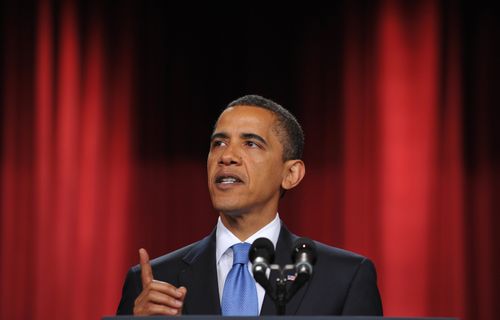
Reading the speech today, I am reminded of why many of us saw this unlikely figure a couple of years ago and concluded that he was uniquely capable of guiding the West – and East – away from a catastrophic conflict that we learned, by bitter experience, could not be won by force of arms alone. Arms remain in Iraq and Afghanistan, but this speech buttressed that hard power with a soft and vital appeal to the masses below – the people who determine whether a global insurgency succeeds or fails. My reader is right: no other figure in global politics could have done this. At its heart, the speech sprang, it seemed to me, a spiritual conviction that human differences, if openly acknowledged, need not remain crippling. It was a deeply Christian – and not Christianist – address; seeking to lead by example and patience rather than seeking to impose from certainty:

I am convinced that in order to move forward, we must say openly the things we hold in our hearts, and that too often are said only behind closed doors. There must be a sustained effort to listen to each other; to learn from each other; to respect one another; and to seek common ground. As the Holy Koran tells us, “Be conscious of God and speak always the truth.” That is what I will try to do – to speak the truth as best I can, humbled by the task before us, and firm in my belief that the interests we share as human beings are far more powerful than the forces that drive us apart.

“Be conscious of God and speak always the truth.” The man has, for a politician, done this more powerfully than any president I have known since Reagan. And his vision is Reagan’s: a world without nuclear weapons, in which our differences are occasions for healthy and human interaction, not terror, torture and mass destruction. To criticize this speech as not tough-minded enough is to miss the point: it is precisely by opening ourselves up, by showing who we really are, by dropping the pretenses and brittleness of cultural conflict and taking up the challenge of our faiths at their best: peace, and respect – that we can win the war against Islamist terror and tyranny. This does not mean going soft on al Qaeda, which remains as evil as it ever was:

I am aware that some question or justify the events of 9/11. But let us be clear: al Qaeda killed nearly 3,000 people on that day. The victims were innocent men, women and children from America and many other nations who had done nothing to harm anybody. And yet Al Qaeda chose to ruthlessly murder these people, claimed credit for the attack, and even now states their determination to kill on a massive scale. They have affiliates in many countries and are trying to expand their reach. These are not opinions to be debated; these are facts to be dealt with.

Taking on the 9/11 conspiracy theories and challenging Islamist anti-Semitism was an integral part of this speech, what makes it a form of truth-telling, not pablum-spreading:

Tomorrow, I will visit Buchenwald, which was part of a network of camps where Jews were enslaved, tortured, shot and gassed to death by the Third Reich. Six million Jews were killed – more than the entire Jewish population of Israel today. Denying that fact is baseless, ignorant, and hateful. Threatening Israel with destruction – or repeating vile stereotypes about Jews – is deeply wrong, and only serves to evoke in the minds of Israelis this most painful of memories while preventing the peace that the people of this region deserve.

By simultaneously expressing empathy for the Palestinians – the “other hand” Hewitt could not tolerate – Obama has single-handedly given the US a chance to return to the even-handedness that is essential if the US is to save Israel from its own understandable fears. Notice too the appeal to the next generation:

I want to particularly say this to young people of every faith, in every country – you, more than anyone, have the ability to remake this world. All of us share this world for but a brief moment in time. The question is whether we spend that time focused on what pushes us apart, or whether we commit ourselves to an effort – a sustained effort – to find common ground, to focus on the future we seek for our children, and to respect the dignity of all human beings.

He was admant on democracy but careful not to be seen dictating a Western version onto a Muslim world; he was clear about women’s rights, without denigrating those who choose a traditional role; above all, he gave a spiritually ecumenical address – concluding with the truth that we all worship the same God because there is only one God. On this all the Abrahamic faiths agree. We need to listen to this God if we are to obey God’s commandment to love one another and seek healing for the world.

At many other times in history, this sentiment might seem sappy or air-headed or unrealistic. Not now. This spiritual appeal is the heart of coldblooded realism in this frighteningly dangerous world. Either we learn to respect one another or we shall perish.

Buddhisms

A reader writes:

Like you, I mainly side with the comments of your readers.  But I can understand those who turn away from Buddhism (at best, I could call myself a philosophical Zen Buddhist today, so I guess I've turned away from it in some respects).
 
Yes, there is much more to Buddhism than living a monastic life among chanting monks, just as there is so much more to Catholicism than the desire to become a priest or Cardinal.  But it doesn't serve anyone well to pretend that many of the things associated with Buddhism aren't caricatures — the reader who thinks searching for true enlightenment is a sham conveniently forgets those who choose the Theravada path toward achieving the status of arhat.  Zen may have gotten the biggest foothold here in the West as being more of a philosophy than a religion, but in its home continent, Buddhism has all the same trappings and dogma as any other faith (for instance, abstaining from alcohol is more like a guideline for lay followers, but it's much closer to a Commandment/rule for a monk in a monastery).

As long as the strict monastic life exists in Buddhism — especially in its birthplace, with the oldest branch practicing it — people will associate some of the more remote religious aspects with the whole (like living as a devout monk practicing abstinence, or the concept of a "self" not existing as it is understood in other faiths).  It works that way with every religion.  Many Catholics are pro-choice and think birth control isn't something to be frowned upon, even if the infallible Pope says otherwise.  Some stay with the religion in spite of disagreements.  Others leave.
 
Steve Hagen was my introduction to Buddhism, and a central point in one of his books is that Buddhism is like a raft.  It gets you somewhere, but when you get to the shore, you don't carry your boat across a continent.  That's a non-dogmatic view within Zen (that at some point, you may even move on from Buddhism itself), which certainly isn't as well-publicized to non-Buddhists as some of Horgan's critiques are.  But there is dogma elsewhere in other noteworthy branches that can turn people away from the Buddha Dharma.  If no quarrels were to be had with any faith, we'd only have one to follow.