The “Faggot’s” Faith

Beliefnet has an engaging interview with John Edwards and his religious faith here. Money quote:

"It’s important to – or at least in my case, to have a personal relationship with the Lord, so that I pray daily and I feel that relationship all the time."

"Allowing time for children [in school] to pray for themselves, to themselves, I think is not only okay, I think it’s a good thing."

"I do believe in the separation of church and state. But, I don’t think separation of church and state means you have to be free from your faith."

I believe all three things. I’m happy to hear a Democrat say it. And notice this isn’t Christianism. He is speaking of his faith, not his politics. And he understands the importance of putting clear sky between the two.

“Authentic Faith”

William_wilberforce

"I fear for the future of authentic faith in our country. We live in a time when the common man in our country is thoroughly influenced by the current climate in which the cultural and educational elite propagates an anti-Christian message… Is it any wonder then that the spiritual condition of our country is of little concern to those who don’t even educate their own children about true Christianity? Their conduct reflects their absence of concern, not only for the state of Christianity in their own country, but also for the need to communicate the message of Christ to those in other parts of the world who have not heard this truth.

Some might say that one’s faith is a private matter and should not be spoken of so publicly. They might assert this in public, but what do they really think in their hearts? The fact is, those who say such things usually don’t even have a concern for faith in the privacy of their interior lives. If you could see their hearts, you would find no trace of authentic faith. God has no place among the sources of hopes, fears, joys or sorrows in their lives. They might be thankful for their health, success, wealth and possessions, but they give no thought to the possibility that these are all signs of God’s provision. If they do give credit to God, it is usually done in some perfunctory way that reveals that their words have no sincerity.

When their conversations get really serious, you will see how little of their Christianity has anything to do with the faith taught by Jesus. Everything becomes subjective. Their conduct is not measured against the standard set by the gospel. They have developed their own philosophies, which they attempt to pawn off as Christianity," – William Wilberforce, "A Practical View of the Prevailing Religious System of Professed Christians in the Higher and Middle Classes of this Country Contrasted with Real Christianity" (1797).

Today is the 200th anniversary of the abolition of the slave trade by Great Britain. It took America a little longer. The Dish will offer up a series of posts in commemmoration today.

The Dangers of Fake Faith

One of the problems of the weakening of traditional religion is the emergence of fake religions. Michael Burleigh’s book on "Sacred Causes" links the rise of pseudo-religions like Soviet Marxism and German Nazism to the vacuum created by declining traditional religious commitment in twentieth century Europe. There’s a useful summary of the book in today’s WSJ. (The book, alas, is not Burleigh’s best.) But this is not, I think, a defense of some of contemporary American evangelicalism, let alone contemporary Wahhabism or Salafism. Some strands of today’s American evangelicalism are as phony and as fake as any atheistic alternative from the last century. The "Prosperity Gospel," for example, is not Christianity. It’s a form of capitalist self-help under-pinned by emotional manipulation, legitimized by the patina of Christian scripture. Similarly, a Christian faith that is primarily about politics and social policy is not authentic faith either: it’s Christianism, not Christianity. That’s one reason, I think, that non-fundamentalist Christians should stay in established traditional churches and resist the fundamentalist onslaught. Institutions matter. Religion matters. A society that severs the two is prone to dangerous bouts of ill-considered zeal and far-too ideological politics. We’re not there yet. But the danger signs are flashing red.

Faith, Science, Franklin

Benfranklin_1

Hitch turned me on to the work of Jerry Weinberger and his ravishingly subversive book on Ben Franklin. If you have a few minutes this holiday Monday, take a look at this essay on Franklin that Weinberger wrote for The New Atlantis. It’s on the very subject that Sam Harris and I have been discussing: whether science can or should supplant religious faith in the conversation of mankind. Weinberger suggests that Franklin was both an unabashed technophile and scientist who yet believed that science would never – and should never – replace the mystery that is at the core of religion. Money quote:

Ultimately, Franklin concluded that rationalistic science could never prove the believers wrong. He also concluded that the rationalists were unlikely to admit to this fact. They turned out to believe in their rationalism as fervently as the believers believed in their miracles, especially the miracle of conscience, or of the voice and spirit of God moving within. Moreover, if one were to push this fact in the rationalists’ faces, they could get just as angry as believers about challenges to their faith. Franklin, it turns out, was a freethinking critic of Enlightenment freethinking.

The conventional and current take on Franklin—that he was a pragmatic moralist and serious Enlightenment Deist and eventually an American patriot—is flat wrong. The recent chorus of Franklin biographers, including academic historians such as Gordon Wood, H. W. Brands, and Edmund Morgan, has been bamboozled by Franklin’s ironic literary style, and tone-deaf to Franklin’s radical, philosophical, deadpan sense of humor.

Franklin was no Deist. He was no pragmatic moralist. And he wasn’t really “The First American.” Franklin was, rather, the first American Baconian. He was also a profound philosopher, deeply skeptical of religion (especially the metaphysical conceits of Deists) and of our everyday moral intuitions. He was also profoundly skeptical of the intellectual foundations of rationalism and the Enlightenment. And he was, to put his politics in a nutshell, a political constructivist and libertarian. Franklin was not as American as apple pie, but he was as American as the corndog.

My kind of guy. Read the whole thing, including an elaborate fart joke from one of America’s founding fathers.

Doubt In Faith

"My own peculiar task in my Church and in my world has been that of the solitary explorer who, instead of jumping on all the latest bandwagons at once, is bound to search the existential depths of faith in its silences, its ambiguities, and in those certainties which lie deeper than the bottom of anxiety. In those depths there are no easy answers, no pat solutions to anything. It is a kind of submarine life in which faith sometimes mysteriously takes on the aspect of doubt, when, in fact, one has to doubt and reject conventional and superstitious surrogates that have taken the place of faith," – Thomas Merton.

Faith and the Universe

Cometdavidlilloafpgetty

I’ve quoted Carl Sagan recently on the intersection of science and faith and there’s a helpful piece on him in the NYT today. What I think he gets – and what my generation perhaps has grown to internalize – is the utter insignificance of this planet, let alone human beings, in the context of what we have come to know about the universe. This knowledge was unknown to those who wrote the Bible; the endless expansion of the cosmos and the infinitesimal speck of it that we represent was beyond their knowledge. Yes, many suspected it or believed it or had myths about it. But we know. And that knowledge alters faith. For me, it pushes me toward deeper appreciation of spiritual mystery, and the understanding that if God exists, then God must be as beyond our human understanding as outer space is beyond our visitation. At the same time, it deepens my conviction in God’s existence. It makes God realer and yet more distant than before – and therefore makes the Incarnation even more astonishing as an event in human history.

The point I’m making, I guess, is the one Sagan made. It is not to pose a crude opposition between science and faith, as Sam Harris does (and my next response is imminent); it is to see the two in a constant interaction in the pursuit of ultimate truth. Sagan grasped that; he saw the "pseudo-religion" of those who shunned scientific knowledge. Denial of evolution, in my view, is a sign of weak faith, not strong faith. It’s a function of terrible fear, not the confidence of a loving God. Which is why some ( but not all) forms of fundamentalism are indeed, in my view, pseudo-religion; and some of what passes for evangelicalism (but not all) is pseudo-Christianity. No faith based on fear is real faith. The first thing Jesus told us is: "Be not afraid." The last thing we should be afraid of is the truth about our world.

(Photo: McNaught comet in Peru last month by David Lillo/AFP/Getty.)

Faith in Faith

Obamajeffhaynesafp

A reader writes:

As a faithless former altar boy, I love your colloquy with Sam Harris. I think it will be a colloquy without resolution, however, as trying to rationally describe the mystery of faith is like trying to unzip fog. In fact, when the expression of faith becomes codified in a liturgy it becomes leaden, earthbound, and encourages rote recitation. It dies a little. Nothing creeps me out like hearing the thoughtless, unfeeling droning of the Nicene Creed at Mass. Beautiful words, rendered dead. I did it myself without thinking for years, until I began to feel like some kind of body-snatched cultist. Like I said, I was once a pious little altar boy, but I no longer believe. But here’s the thing: I find myself living in the limbo of not believing in God, but rather having a fervent belief in faith. I deeply envy faith. Funny world, huh? And no place in the world offers me the solace of a semi-darkened, stain-glassed cathedral, with statuary of saints and a hint of incense.

I was raised to believe that we must believe these things because they have inherent power and meaning, and that is why I eventually fell away, because my faith was too weak to stand up to the challenges of the rational world. What I now believe is the obverse: that because we believe in these things they take on a very real power and meaning. And no less powerful or meaningful than what I believed as a child. The Obama quote you cited yesterday afternoon really resonated with me for that reason, as he entered into his life of faith by choice, and not by revelation.

(Photo: Barack Obama by Jeff Haynes/AFP.)

Longing For Faith

A reader writes:

I have always read your writings about faith with interest, but your debates with Sam, seem about as fruitful as a sighted man trying to get a blind man to ‘see’ orange.  Convicted atheists refuse to believe what they will never see.  Us agnostics, while blind, are willing to concede that there may be such things as color, but have become resigned to the fact that we’ll never see them.

I’ve never had faith, and I’ve always wanted it. My father is a Baptist minister (the liberal New England kind) and I’ve seen the joy that belief has brought to people. I’ve heard stories of ‘miracles’ from people I know and trust. I’ve been through stage 3 cancer and a year of debilitating treatment. I actually thought, at the beginning of my cancer odyssey, that the upside might be some sort of revelation. A brush of death might bring my road to Damascus experience. Instead, I just had a lot of uncomfortable feelings about all the people who told me they were praying for me. I’ve always wanted that peace and sense of security that people who put their trust in God and Christ seem to have.  But it’s never been there. Ever.

Faith and Hats

A reader writes:

Your latest email to Sam reminded of an event in Cambridge years ago, at the Episcopal Theological School. One of the dowager supporters of the school was parked by a potted palm, holding a china cup of tea. She had on an amazing hat. I asked her where she got it – and imperiously she answered, "We ladies in Boston do not "get" our hats. We "have" our hats."

It’s kind of like that with a faith in God that transcends all we do, all that happens to us, and anywhere we are – We can’t say quite where it came from – we simply "have" it. If one "gets" it from being taught it from a book, I fear it is a faith residing in the brain.  When it is "caught" almost like a virus, by seeing someone else’s total trust in God enable them to surmount any ill, it resides in the innards, bones, and moves like blood through one’s being.  But it can only be "caught" by the willing, with humility.

Several friends over the years have enviously asked me how I came by this total trust/faith – I have no answer for them.

Me neither.

Faith Unchosen

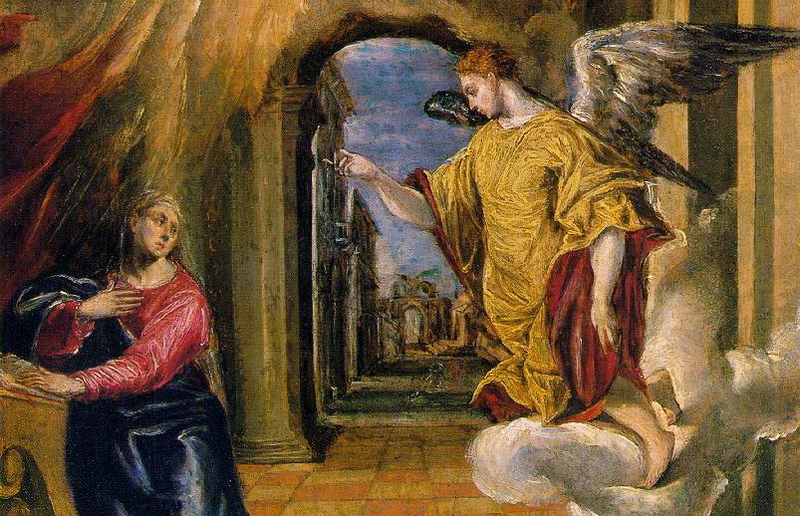
Annunciationelgreco_2

Here’s my latest email in the blogalogue with Sam Harris about faith and reason. The full blogalogue so far can be read here.

Dear Sam

Thanks for waiting for this belated response. As a form of apology, and since some readers have said I’ve ducked some of your specific questions in the past, perhaps I should answer your last question first. It may move things forward a little. You wrote:

"What would constitute "proof" for you that your current beliefs about God are mistaken? (i.e., what would get you to fundamentally doubt the validity of faith in general and of Christianity in particular?)"

It’s a good question. It prompts me to say something I’ve been reluctant to talk about for reasons best expressed by Wittgenstein. But here goes anyway.

I have never doubted the existence of God. Never. My acceptance of God’s existence – of a force beyond everything and the source of everything – goes so far back in my consciousness and memory that I can neither recall "finding" this faith nor being taught it. So when I am asked to justify this belief, as you reasonably do, I am at a loss. At this layer of faith, the first critical layer, the layer that includes all religious people and many who call themselves spiritual rather than religious, I can offer no justification as such. I have just never experienced the ordeal of consciousness without it. It is the air I have always breathed. I meet atheists and am as baffled at their lack of faith – at this level – as you are at my attachment to it. When people ask me how I came to choose this faith, I can only say it chose me. I have no ability to stop believing. Crises in my life – death of loved ones, diagnosis with a fatal illness, emotional loss – have never shaken this faith. In fact, they have all strengthened it. I know of no "proof" that could dissuade me of this, since no "proof" ever persuaded me of it.

I simply grew up from my earliest childhood in complete acceptance of this reality. I have had two serious crises of faith – but neither came close to a loss of faith in God’s existence. The first crisis was the worst. Almost fourteen years ago, it occurred to me not that God didn’t exist – that never occurred to me – but that God might be evil. I wrote about this experience – I remember precisely where and when it happened – in my spiritual memoir/essay, "Love Undetectable." I will not reiterate it here. The "proof" I contemplated for thinking God was evil was the cliched conundrum of human suffering. It was a particularly grim moment in the plague years, when the suffering of good people I loved a lot began to get to my faith. Yes, I know this paradox might (and should) have occurred to me earlier in life. But it’s also human to avoid these things most fully until those closest to you are struck down. So there I was, having my Job moment.

What proof, what argument, what evidence persuaded me that God was actually not evil but good? Nothing that will or should persuade you. The sense that evil was the ultimate victor in the universe, that evil is the fundamental meaning of all of this, that "none of this cares for us," to use Larkin’s simple phrase: this sense pervaded me for a few minutes and then somehow, suddenly, unprompted by any specific thought, just lifted. I can no more explain that – or provide a convincing argument that it was anything more than your own moment of calm in Galilee. But I can say that it represented for me a revelation of God’s love and forgiveness, the improbable notion that the force behind all of this actually loved us, and even loved me. The calm I felt then; and the voice with no words I heard: this was truer than any proof I have ever conceded, any substance I have ever felt with my hands, any object I have seen with my eyes.

You will ask: how do I know this was Jesus? Could it not be that it was a force beyond one, specific Jewish rabbi who lived two millennia ago and was executed by the Roman authorities? Yes, and no. I have lived with the voice of Jesus read to me, read by me, and spoken all around me my entire life – and I heard it that day. If I had been born before Jesus’ birth, would I have realized this? Of course not. If I had been born in Thailand and raised a Buddhist, would I have interpreted this experience as a function of my Buddhist faith rather than Jesus? If I were a pilgrim right now in Iraq, would I attribute this epiphany to Allah? An honest answer has to be: almost certainly.

But I am a contingent human being in a contingent time and place and I heard Jesus. Do I believe that other religious traditions, even those that posit doctrines logically contrary to the doctrines of Jesus, have no access to divine truth? I don’t. If God exists, then God will be larger and greater than our human categories or interpretations. I feel sure that all the great religions – and many minor ones – have been groping toward the same God. I don’t need to tell you of the profound similarities in ethical and spiritual teaching among various faiths, as well as their differences. I believe what I specifically believe – but since the mystery of the divine is so much greater than our human understanding, I am not in the business of claiming exclusive truth, let alone condemning those with different views of the divine as heretics or infidels. We are all restless for the same God, for the intelligence and force greater than all of us, for that realm of being that the human mind senses but cannot achieve, longs for but cannot capture. But I’ve learned in that search that integral and indispensable to it is humility. And such humility requires relinquishing the impulse to force faith on others, to condemn those with different faiths, or to condescend to those who have sincerely concluded that there is no God at all. And when I read the Gospels recounting the sayings and actions of Jesus of Nazareth, I see a man so committed to that humility he was prepared to die under its weight.

I should add that this unchosen belief in God’s existence – the "gift" of faith – does not prompt me to lose all doubt in my faith, or to abandon questioning. I have wrestled with all sorts of questions about any number of doctrines that the hierarchy of the church has insisted upon. As a gay man, I have been forced to do this perhaps more urgently than many others – which is one reason I regard my sexual orientation as a divine gift rather than as a "disorder". For me, faith is a journey that begins with the gift of divine revelation but never rests thereafter. It is nourished by a faith community we call the church, and is sustained by the sacraments, prayer, doubt and the love of friends and family. It is informed by reason, but it cannot end in reason.

I understand that this form of faith would provoke Nietzsche’s contempt and James Dobson’s scorn. But there is a wide expanse between nihilism and fundamentalism. I fear your legitimate concerns (which I share) about the dangers of religious certainty in politics have blinded you to the fertility of this expanse. And I think you’re wrong that we religious moderates are mere enablers of fundamentalist intolerance. I think, rather, we have an important role in talking with atheists about faith and talking with fundamentalists about the political dangers of religious fanaticism, and the pride that can turn faith into absolutism.

In fact, people of faith who are not fundamentalists may be the most important allies you’ve got. Why don’t you want us to help out?

Andrew