What Is Israel’s Plan?

Goldblog asks:

What is Israel's long-term strategy? Short-term, I understand: No state can agree to have its civilians rocketed. But long-term, do Israeli leaders believe that they possess a military solution to their political problem in Gaza? There is no way out of this militarily. Israel is not Russia, Gaza is not Chechnya and Netanyahu isn't Putin. Even if Israel were morally capable of acting like Russia, the world would not allow it. So: Is the goal to empower Hamas? Some right-wingers in Israel would prefer Hamas's empowerment, because they want to kill the idea of a two-state solution. But to those leaders who are at least verbally committed to the idea of partition, what is the plan? How do you marginalize Hamas, which seeks the destruction of Jews and the Jewish state, and empower the more moderate forces that govern the West Bank? 

Janine Zacharia adds:

To be sure, Israel will once again achieve many of its short-term tactical goals, assassinating a handful of Hamas leaders, leveling militant safe houses, and eliminating scores of Hamas military installations or weapon depots. And, in the end, Israel will be no safer, although it will surely be more alone in the world and living in a neighborhood that is less tolerant of its aggressive countermeasures. It’s time to declare Israel’s policy toward Gaza and Hamas a failure. This is not an anti-Israel statement. Rather, it is an honest acknowledgment of the facts, which are simply too numerous to avoid.

Losing The Twitter War

A70rr2nCQAEe047.jpg_large

Michael Koplow criticizes Israel's aggressive social media campaign:

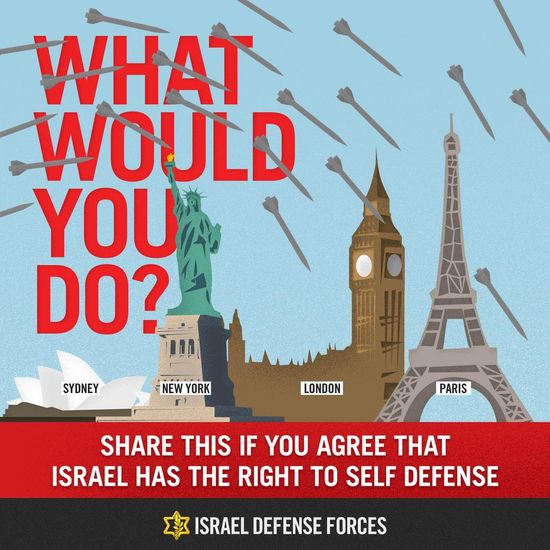
The IDF in this case is trumpeting the killing of an unapologetic terrorist leader, and nobody should shed a tear for Jabari for even a moment, but the fact remains that many people, particularly among the crowd that Israel needs to be courting, are deeply skeptical of Israeli intentions generally and tend not to give Israel the benefit of the doubt. They cast a wary eye on Israeli militarism and martial behavior, and crowing about killing anyone or glorifying Israeli operations in Gaza is a bad public relations strategy insofar as it feeds directly into the fear of Israel run amok with no regard for the collateral damage being caused. Rather than convey a sense that Israel is doing a job that it did not want to have to do as quickly and efficiently as possible, the IDF's Twitter outreach conveys a sense of braggadocio that is going to lead to a host of problems afterward.

The Texts Of War

Gaza text

Above is a mass text apparently being sent to those living in Gaza:

Meanwhile, here is the mass text that Israelis receive:

(Photo from RanaGaza)

The Arab Spring Factor

Egypt_Hamas

Marc Lynch worries that further escalation between Gaza and Israel will have unpredictable results in Arab Spring nations. On Egypt:

Morsi has demonstrated his preference to pursue a pragmatic foreign policy here, offering some sympathetic rhetoric and a visit from his relatively anonymous Prime Minister but thus far avoiding dramatic gestures such as opening the border with Gaza or throwing Camp David on the table. But as much as Morsi values solidifying relations with the U.S. and the international community, and is constrained by the status quo orientation of the Egyptian military and foreign policy apparatus, he may also see real opportunities to gain domestic popularity and assert Egyptian regional leadership.  Morsi's conversations with Erdogan may be implictly focused as much on coordinating to avoid a bidding war over Gaza which pushes both countries towards overly risky moves.  But it is not clear that such a stance can be maintained if the tempo of protests and the human toll of the war escalates.  

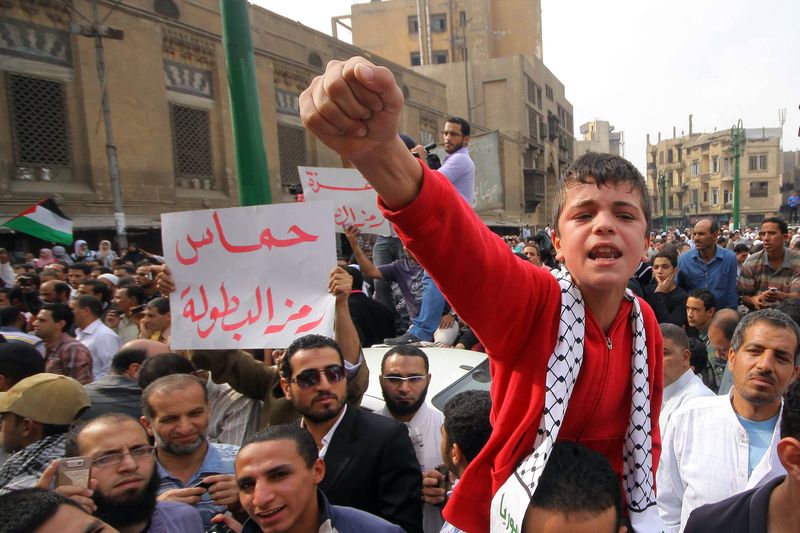
(Photo: Egyptians shout anti-Israeli slogans during a demonstration in front of Al-Azhar mosque after the weekly Friday prayer in Cairo on November 16, 2012. Several thousand people demonstrated outside the Al-Azhar mosque to protest against the Israeli campaign.  Arabic writing on placard reads 'Hamas is the symbol of heroism'. By AFP/Getty Images)

How Will Gaza Impact Syria?

Daniel Levy contemplates, at length, the politics of the fighting between Gaza and Israel. His view of the regional picture:

Egypt’s priority for now is a ceasefire. Other Arab and regional states in good standing with Hamas, notably Qatar (whose Emir Sheikh Hamad bin Khalifa Al-Thani recently visited Gaza with promises of financial assistance and investment) and Turkey (Hamas leader Khaled Mashal gave the key note address at the AK Party conference of Prime Minister Erdoğan) will themselves be keen for this crisis to be over ASAP. Their priority right now is Syria. And this Gazan escalation will already be taking the gloss off their apparent success in re-launching a unified Syrian opposition grouping in Doha last week. They are now in the uncomfortable position of having worked closely on Syria with the same Western powers (notably the U.S., Britain, France, and the EU) who have been rushing to accord legitimacy to Israel’s so-called “self-defense” action against Gaza. They know that this is music to the ears of the Assad regime and that it will be used against them, especially if more Gazan blood is spilled. If this becomes Cast Lead II, then they will be in no position to promote the intervention they desire in Syria while Gaza is burning.

Israel On The Brink, Ctd

156490973

A reader sounds off:

Look, I'm no defender of Israel, by any means.  Their illegal expansion of settlements and what they did to Gaza four years is abhorrent.  But what the hell is Hamas thinking firing rockets at Jerusalem?  Netanyahu has been waiting for an excuse to bomb Gaza City back to the stone age for years now, and it looks like he might have it.  And he has the means to do it.  Besides the humanitarian catastrophe it would be, I fear bombing Gaza would be an excuse for a larger Arab / Iranian – Israeli war.  Here's hoping that cooler heads prevail. 

Agreed on all counts. Another writes:

I understand your distaste, to put it mildly, for the Greater Israel crowd and by the way, I think I am 90% with you on that. What I do not understand is the connection between Greater Israel and the Gaza Strip: Israel left Gaza in 2005. Uprooted thousands of (fanatical) Israelis and handed it back over to the Palestinians. No one has seriously suggested going into Gaza and repopulating it with Israelis. There is no expansionist settlement movement with regard to Gaza. Just Israelis, in Israel proper, running for cover on a constant basis from projectiles falling from the sky.

The only connection this has to the Greater Israel crowd is that by continuously terrorizing the Israeli populace, Hamas justifies and bolsters the Greater Israel argument with regard to the West Bank. If you just ran into a shelter in Jerusalem or Tel Aviv, as many of my friends just did, to avoid rockets from Gaza, how eager would you be to establish a Palestinian state whose rockets would be all the more closer? Where is Abbas loudly condemning this in Arabic, to ease the worries of the Israeli center who are about to vote for a new government in a few months (oh, he's at the UN, seeking condemnation of Israel for its response)?

Greater Israel feeds off this because it validates their point: Palestine cant be trusted. If Israelis feel they can't contain this sort of maniacal pointless terrorism from the sky, Palestine will never happen (which by the way is exactly what Hamas wants).

Exactly. Which is why I have never defended Hamas in any way, or denied its Jihadist nihilism, and support Israel's right to self-defense. What I don't support are the settlements on the West Bank that up the ante even further; and what I don't fully understand is how this kind of war, like the one four years ago, actually advances Israel's national interest in the long run, rather than actually eroding it. Which is this reader's point:

Just some thoughts on Operation Pillar of Defense. I’m not going to address the justice or rightness of either side at this point. Suffice to say that Israel has a right to self-defense and that a rise in rocket fire from Gaza is something they should certainly be concerned about. Right now, I just want to talk about the effectiveness of the Operation, and its future ramifications.

To start with, we can assume that the goal of Pillar of Defense is not to cripple Hamas’s war-making ability through military means.

Operation Cast Lead was a failure in this regard (as this crisis indicates), and the IDF is presumably not stupid enough to launch an attack with an unachievable goal. We can then assume that the goal is retributive – fire rockets at Israel and we’ll blow Gaza to hell. We can assume the message intended to be sent from this is that Israel is "teaching terrorists a lesson", or terrifying them into submission. Considering the social media propaganda aspect of this, the message is quite likely meant to reassure Israeli citizens as much as it is meant to intimidate Palestinians.

However, the message that it sends in actuality is quite different. Israel is once again stating that it considers each Israeli life to be worth far more than a Palestinian’s. Israeli has a long history replying with overwhelming and disproportionate force to any attack. When Operation Pillar of Defense was launched, no Israeli citizens had been killed in this latest flare-up. Now the death toll stands at 3 Israelis, 24 Palestinians. And that gap is actually quite small, historically speaking (2009: 11 Israelis killed, 1034 Palestinians. 2010: 9 Israelis, 82 Palestinians. 2011: 11 Israelis, 118 Palestinians).

Now, if these were, say, battlefield statistics, Israel would be praised for its brilliant strategy.  If they were unintentional but tragic collateral damage that occurred in the process of winning a battle, if might be forgivable. But as we have seen, the military value of this attack on Gaza appears to be negligible. For many, that leaves only two possibilities: callousness or revenge.

Now, let us step back a moment and examine another instant in history. It is Algeria, 1955. The country has been ruled for over a century by the French, who consider it an integral part of their country. The northern parts of the nation have been heavily settled by French citizens, who live in what is for all intents and purposes an outpost of Europe. They live under French civil law, and are highly affluent and economically successful. The other 8 million Muslim Algerians live under military law. Their economic situation is quite the opposite. By now, a pro-independence group called the National Liberation Front (FLN) is leading an insurrection. However, they have had little success in gaining either widespread support or military victory. To remedy this, they would put through a terrifying cold-blooded plan. On August 20th, FLN members enter the seaside town of Philippeville and proceed to massacre the inhabitants. Over a hundred people, mostly Europeans, were brutally tortured and killed. The victims included both babies and grandmothers.

Now, why did the FLN do this? Was it born from their insatiable lust for French blood? No. In fact, until then FLN standing orders had been to avoid killing Europeans. The FLN committed what would become known as the Philippevile Massacre because they knew it would goad the French into a specific action. And they were right. Over the following weeks, French soldiers, police, and settlers would kill hundreds of Algerians in retribution. The death toll might have been as high as 12,000, most who had nothing to do with the Philippevile Massacre. This did more to boost the FLN cause than any propaganda poster or speech they could ever have made. It showed the Algerians that their lives meant nothing to the French authorities, that the life of a European was worth the lives of hundreds of Muslims. The FLN had successfully manipulated the (understandable) horror and outrage of the French into the keys to victory.

Now, obviously, the Philippevile Massacre was not morally or ethically justifiable. In fact, it’s pretty horrific. Similarly, firing rockets into civilian towns is disgusting and reprehensible. And in both cases, the urge to respond, to fight back in some way can be overwhelming. But that way must be something other than indiscriminate reprisals. There are few ways of uniting a population under a despotic or militant regime more successful than convincing them that it is their only hope for survival. Dropping a thousand bombs on Gaza for each rocket fired at the Negev might make Israeli citizens feel more secure, and IDF soldiers more useful, but all it does is provide another tool for Hamas to use to hold onto power.

Sometimes, true strength is learning when not to shoot.

(Photo: A picture taken from the southern Israeli Gaza border shows smoke billowing from a spot targeted by an Israeli air strike inside the Gaza strip on November 16, 2012. Israeli warplanes carried out multiple new air strikes on the Palestinian territory, including several hits on Gaza City, the third day of an intensive campaign which the military has said is aimed at stamping out rocket fire on southern Israel. By Jack Guez/AFP/Getty Images)
The Politics Of Pillar

156499357

Amir Owen thinks the Gaza assault may be meant to show the world that Israel means business, that "the dark cloud in the Gaza skies might serve as an alternative, or preface to, an Iran operation":

In theory, a force which is able to strike against Ahmed Jabari would be able to pinpoint the location of Iranian President Mahmoud Ahmadinejad. And a force that destroyed Fajr rockets would be able to reach their bigger siblings, the Shihabs, as well as Iran's nuclear installations. So as not to leave a shred of doubt, the IDF Spokesman emphasized that "the Gaza Strip has become Iran's frontline base." At first glance, Operation Pillar of Defense seems to be aimed at the Palestinian arena, but in reality it is geared toward Iranian hostility against Israel.

Gregg Carlstrom examines a more domestic angle:

Netanyahu wants to declare victory after a quick military campaign. He wants to address the Israeli public over the next few days and say, we killed the Hamas leader who kidnapped our soldier, Gilad Shalit; we seriously degraded Hamas' ability to strike at Tel Aviv; and we restored deterrence in the Gaza Strip. (Nevermind that, as Gershon Baskin points out, Ahmed Jaabari was Israel's best chance for a long-term cease-fire with Gaza.) Once it's over, Netanyahu gets to play the victorious wartime prime minister.

Carlstrom notes a ground war would likely negate such a plan. Shalom Yerushalmi looks at how the conflict has impacted the upcoming elections:

The ballot box is likely to be dominated now by a security agenda. Israel has entered a state of existential anxiety and concern for its residents, mainly those in the south. At this time, there is no room for opposition, only patriotism. Anything that the left wing might say will be construed as criticism, and any criticism will be interpreted as an anti-national act that undermines the collective morale. Already, yesterday [Nov. 14] the leaders of the left and centrist parties made their way to the TV studios only to express positions in support of the government’s military course of action. None of them dared ask questions that could swing voters away. Silence, a war is on. 

Gershom Gorenberg is unsure about the ultimate political consequences:

The initial response of the Israeli public when the IDF is ordered into a major offensive is to rally around the government, to see the action as essential. Later, after the deaths on both sides, after an ambiguous resolution, neither victory nor defeat, a political hangover often sets in. If regret comes this time, no one knows whether it will take less than two months or more.

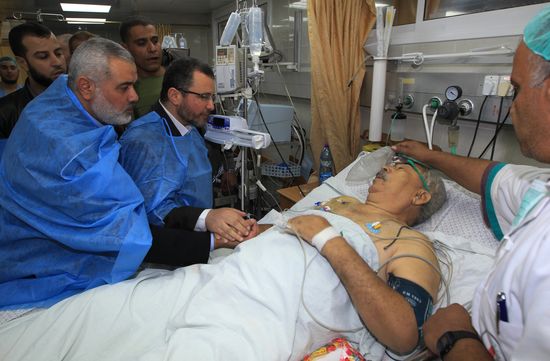
(Photo: Palestinian Hamas leader in the Gaza Strip Ismail Haniya (L) and Egyptian Prime Minister Hisham Qandil (R) visit a person who was wounded in an Israeli air strike on November 16, 2012 at the al-Shifa hospital in Gaza City. By Mahmud Hams/AFP/Getty Images)

Iron Dome Earns Its Keep

The number of Palestinians killed has risen to at least 24, while the Israeli death toll remains at 3. Many more may have been killed if not for Israel’s “Iron Dome” rocket defense system, developed with the US, which seems to have been effective at reducing the hundreds of rockets that have been launched from Gaza, though at significant financial cost. Recent video of Iron Dome at work:

More video here. Allison Deger witnessed an interception:

The defensive shield is a marvel, effectively preventing Israeli casualties, or at least impact in Israel. Earlier this afternoon Phil Weiss, Scott Roth, 972’s Mya Guarnieri and myself experienced it first hand while driving 1.2 kilometers from the militarized border with Gaza. The Iron Dome, high in the sky but directly over our yellow-plated rental car, intercepted three rockets fired by Hamas. The rockets move at an unbelievable speed and I did not see them until they were bursting over our heads.

Yet in Gaza, there is no government funded superhero fighting to save lives against the indiscriminate fire that come from air strikes.

And we know who worked on the Dome for Israel, don’t we? That Israel-loathing president, Barack Obama. And they still would not budge an inch on the settlements.

Israel On The Brink, Ctd

GT GAZAROCKETLAUNCH 20121116

Hamas is apparently now firing rockets at Jerusalem. Michael Koplow analyzes the situation:

Targeting Jerusalem is an enormous escalation and very risky, much more so [than] rockets toward Tel Aviv. Rocketing Tel Aviv to my mind guaranteed an eventual Israeli ground invasion, but attempting to bombard Jerusalem just exacerbates the situation to an exponential degree. Blake Hounshell tweeted earlier that Hamas firing at Jerusalem is the equivalent of scoring on your own goal, and I think that analogy is an apt one. It says to me that Hamas is getting desperate, and I think this move is going to backfire in a big way, both in terms of creating a more ferocious Israeli response and costing Hamas important points in the court of public opinion. Hamas is now acting in ways that could cause large numbers of Palestinian casualties and damage to Muslim holy sites, and I think that there will be consequences for this strategy.

Daniel Byman goes over Hamas' options:

Israel's usual strategy [of holding host governments responsible for the actions of the militants] might not bring about such decisive results this time. Hamas will find it hard to pull itself back from the brink and start stopping others' rocket fire. Jabari's death has infuriated Hamas' military wing, and whoever replaces him will be just as militant, if not more. Such a leader will press for revenge and warn Hamas' governing arm that his troops might well join rival groups if Hamas throws in the towel. After all, Hamas is trying to be both a resistance movement and a government. In many ways, it has succeeded as a government, establishing law and order and delivering basic services in Gaza. But Hamas must take care not to lose credibility among Palestinians for its willingness to fight — and die — in the struggle against Israel. So Hamas has tried to walk a fine line by allowing some attacks — and, at times, even participating in them — to maintain its militant street cred while shying away from an all-out assault that would push Israel to repeat Cast Lead.

Hussein Ibish wrote yesterday that "at least some forces in Gaza evidently have no interest in containing the conflict":

By targeting Israel's main city, militants in Gaza have performed a major escalation of their own, at least as provocative as Israel's assassination of Jabari. Israel, it appears, escalated, but wanted a limited war. Others, it seems, want a major war. Whoever is funding, arming and encouraging the factions in Gaza that are firing missiles at Tel Aviv clearly have no interest in a contained or limited conflict.

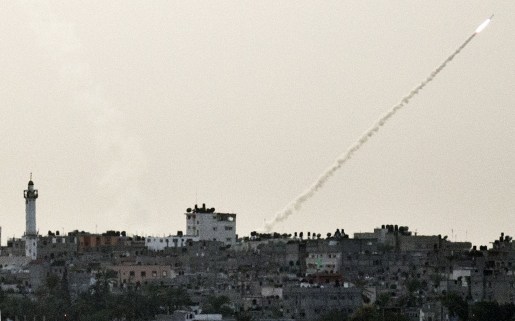
(Photo: A picture taken from the southern Israeli Gaza border shows a rockets being launched from the Gaza strip into Israel on November 16, 2012. Israeli warplanes carried out multiple new air strikes on the Palestinian territory, including several hits on Gaza City, the third day of an intensive campaign which the military has said is aimed at stamping out rocket fire on southern Israel. By Jack Guez/AFP/Getty Images)