Israel On The Brink, Ctd

156513217

First Tel Aviv, now Jerusalem?

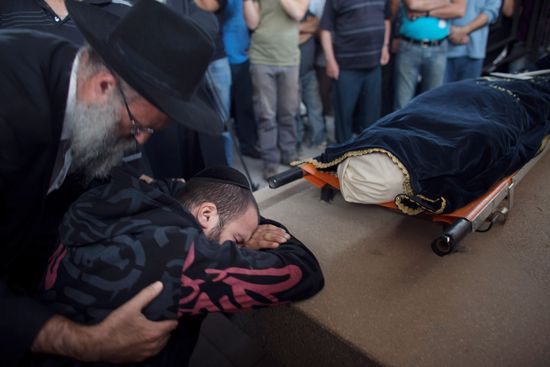
(Photo: A relative grieves during the funeral on November 16 for Itzik Amsalem, 49, one of the three people who died in a rocket attack in Kiryat Malachi, Israel. Three people were killed in Israel on November 15 after a building was hit by a rocket fired from the Hamas-ruled Gaza Strip. Palestinian rocket attacks followed a series aerial strikes on targets in Gaza launched by Israeli Defense Forces (IDF) which killed a top military commander of Hamas. By Uriel Sinai/Getty Images)

Israel On The Brink

156451007

Simon Tisdall sees few barriers to a full war:

Past constraints on Netanyahu’s behaviour are absent this time. There is no discernible peace process, and no active US engagement (after Barack Obama’s first-term efforts were ignominiously rebuffed). The west’s favourite “moderate Arabs” are missing in action, or on the other side of the fence. Egypt’s government has condemned Israeli actions; Jordan, destabilised by the Syria chaos, is in the throes of what could be the next Arab spring uprising. Meanwhile, the imminent bid by Mahmoud Abbas, the Palestinian president, for non-member UN observer status for Palestine, staunchly opposed by Israel and the US, threatens further polarisation inside and outside Palestine.

Elsewhere, about that long-range rocket that was fired at Tel Aviv yesterday:

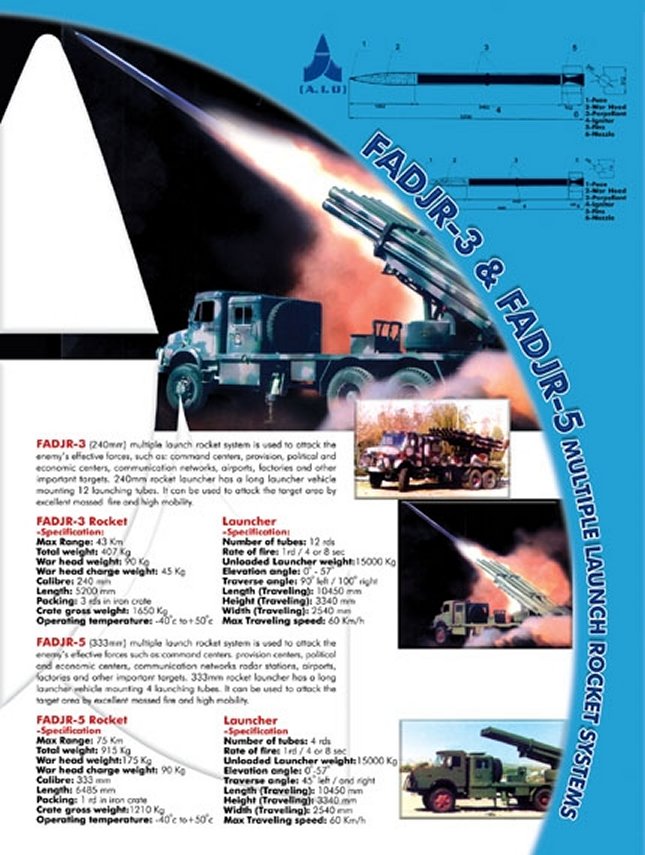
[T]he Fajr-5 rocket [was built] by Iran — possibly with Russian and Chinese help — the rockets were first shipped through Syria to the Hezbollah militant group in 2002. Today, an unknown number are now in the hands of Hamas. (Presumably, that’s thanks in part to a porous border between southern Gaza and the Sinai, now controlled by the new Islamist regime in Egypt.) The rocket is liquid-fueled, has an estimated 45 mile range, and is fired from a mobile launcher. And while it’s more powerful than anything Hamas had before, it’s still unguided and not particularly accurate — the rocket could land anywhere within a one-kilometer radius of its target. But where the Fajr-5 is short on accuracy, it’s a significant boost in destructive power: the rocket can lob up to 200 pounds of high explosives.

The Israeli military claims to have destroyed dozens of the rockets. But as this video uploaded to the Twitter account of Hamas’ al-Qassam Brigades shows, the stockpile hasn’t been exhausted entirely.

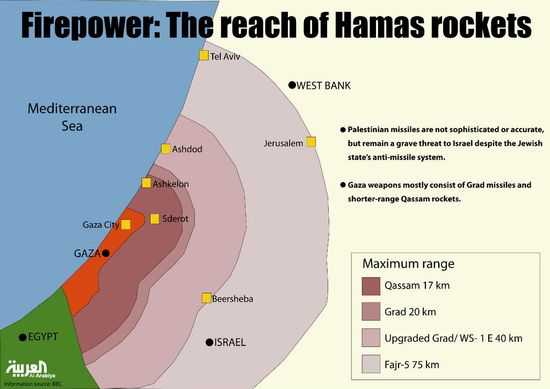
Here’s an infographic made by Al Arabiya showing the range of Hamas’ rockets:

Hamas-rocket-range-al-arabiya

As I wrote yesterday, it is impossible and wrong to blame Israel for self-defense against Hamas rockets with greater range and power, if not much greater accuracy, than the past. There is no defense of Hamas’s use of terrorism. Equally, the kind of ground assault that now looks inevitable is yet another iteration of the same dead end. Except, this time, for Israel, the region is shifting against it. The visit to Gaza by the Egyptian prime minister yesterday – he and Hamas’s leader together beheld the body of a Gazan boy killed by Israeli firepower yesterday – represents a tectonic shift. And the deeper regional and international isolation of Israel is pregnant with foreboding. If we see another civilian bloodbath in Gaza, four years after the last one, the failures of the Israeli government to seize the opportunity Obama offered them four years ago – indeed to treat the United States president with contempt combined with an open attempt to elect his opponent – will haunt the Jewish state. Greater Israel is as unsustainable as it appears to be inevitable. There was, and maybe still is, a ramp off this conflagration. But Netanyahu and Hamas feed off it domestically – a gruesome and ominous fact.

They are radicalizing each other. And while we finance and defend the more democratic one, we are seemingly powerless to shape or influence, let alone, dictate its policies.

(Photo: Palestinian relatives mourn over the body of Hanen Tafish, a 10-month-old girl, at the morgue of the al-Shifa hospital in Gaza City, on November 15, 2012, after she died following an Israeli air strike in the Zeitun neighbourhood.By Mahmud Hams//AFP/Getty Images.)

A New War In Gaza? Ctd

GT PALESTINIANMANBURIEDBYAIRSTRIKE 20121115

Michael Koplow notes that, since Operation Cast Lead in 2008/2009, “no country has been more vocal about the plight of the Palestinians than Turkey.” But, so far, save a basic condemnation, they seem to be steering clear of the new conflict in Gaza. His theory as to why:

Turkey’s problem with PKK terrorism [Kurdish seperatists], combined with the inevitable civilian casualties that occur when fighting terrorist groups embedded amongst the general population, makes it harder this time around for Turkey to angrily denounce Israel as it once did. While I expected Turkey to issue a condemnation of Israeli actions, it is not surprising that it did not have the full force as it has in the past given the uncomfortable parallels that exist between Israel’s actions against Hamas and Turkey’s actions against the PKK.

Eric Trager goes through Egypt’s reaction:

On one hand, Egypt’s diplomatic and security establishments are urging calm. … Yet the Muslim Brotherhood is pulling Morsi in a very different direction. In the wake of Wednesday’s fighting, the Brotherhood called on Morsi to “sever diplomatic and trade relations with this usurper entity,” so that the Egyptian government can “begin to be a role model for Arabs and Muslims who keep relations with this entity.” The Brotherhood will also organize mass protests against Israel on Friday, and prominent Brotherhood leaders have insisted that post-revolutionary Egypt be more supportive of the Palestinians. “The Egyptian people revolted against injustice and will not accept the attack on Gaza,” tweeted Brotherhood political party chairman Saad al-Katatny.

Egypt’s latest tactic:

Al-Jazeera is reporting that Egypt’s prime minister, Hesham Qandil, is to lead an Egyptian delegation into Gaza tomorrow as an act of solidarity with the Palestinians. The Egyptians may have calculated that such a move will necessarily force Israel to pause its air assault on the Gaza Strip, and marks a real break from Mubarak-era policy towards Israel, without being openly hostile.

Previous coverage here, here, here and here.

(Photo: Palestinian rescue teams help a man partially buried in the sand in the garden of his house following an Israeli air strike on Beit Lahia in the northern Gaza Strip on November 15, 2012. By Mohammed Abed/AFP/Getty Images)

A New War In Gaza? Ctd

GT ROCKETATTACKAFTERMATHINISRAEL 20121115

At least 15 people have now been killed in Gaza, including the baby of a BBC cameraman, and 3 people have been killed in Israel. Also, within the past few hours, a rocket targeting Tel Aviv crashed into the sea near the city – the first time it has been under fire since the 1991 Gulf War. Michael Koplow analyzes the situation:

Over 200 rockets were fired out of Gaza yesterday, and the Israeli cabinet has authorized the army to call up any reserve units that it needs, on top of the earlier authorization to call up reservists serving in the Home Front Command, so I am relatively confident that it is only a matter of time before ground forces are ordered into Gaza.

Looking at the Israeli political angles, Lahov Harkov points out that 5 out of the last 7 elections have occurred after IDF operations, but that "recent history shows that such actions hurt a sitting government as often as it helps it get reelected." Brent Sasley doesn't buy the idea that politics led to the response:

Regardless of where blame lies for the violence, no government could afford to do nothing while dozens of rockets struck its civilian population. There is an instinctive element to such decision-making that shouldn’t be downplayed. This doesn’t mean it was a good decision, but that it was the most likely decision in the short-term.

Analyzing the other side of the conflict, Hussein Ibish thinks shifting politics within Hamas, mostly due to external events like the civil war in Syria, contributed to the violence:

The desire to be the tip of the spear against Israel explains why Hamas involved itself in rocket attacks against Israel earlier this year, and has done much less to prevent other groups from launching attacks in recent weeks. The attacks are part of the case for the transfer of paramount leadership away from the exiles and to the Hamas political and military leadership in Gaza, which portrays itself as doing the ruling and the fighting. 

The Guardian and Al Jazeera are live-blogging.

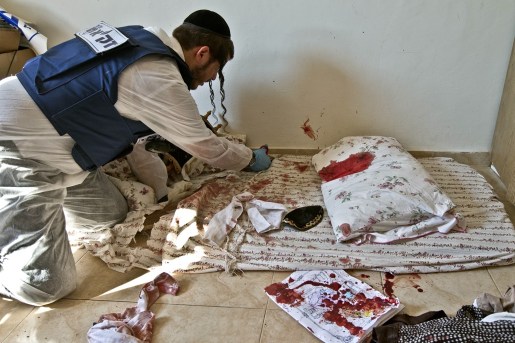
(Photo: Israeli Zaka emergency services volunteers clean human remains from a house hit by a rocket fired by Palestinian militants killing 3 people in southern city of Kiryat Malahi on November 15, 2012. The attack on Kiryat Malachi was claimed by Hamas's armed wing, the Ezzedine al-Qassam Brigades, in a statement on its website as tensions escalated between Israel and Gaza after the Israeli military carried out more than 20 air strikes and sea artillery attacks on the Palestinian territory. By Jack Guez/AFP/Getty Images)

The Tweets Of War

The Israeli military’s use of social media to send chilling messages to Hamas continues:

The IDF’s Twitter account is not without its dissenters:

But apparently, the better translation is “pillar of cloud” or “pillar of smoke”. And there’s this of course, put out by the IDF:

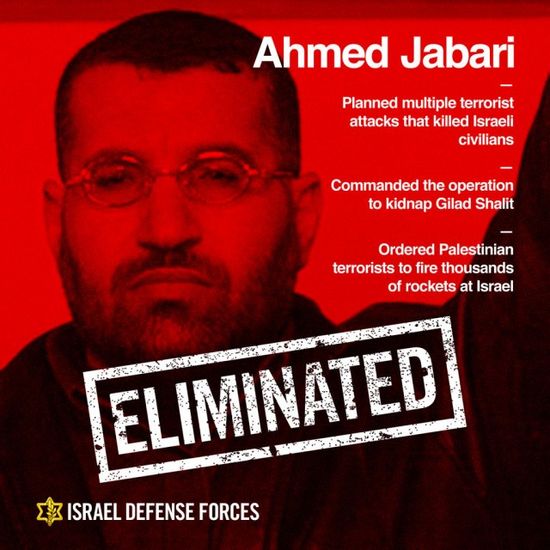
Jabarifb1-640x640

And they posted a video of that assassination, which we embedded here. I think Israel has a right to self-defense against the rockets being randomly fired toward their civilian population. But I do not recognize the Western concepts of just war and self-defense in these macho posturings about war. There is a relish about the use of disproportionate technology and force that I suppose tells us something about what living under siege can do to the psyches of human beings. The dehumanization of the enemy is also helped in part by distant electronic and video monitoring and broadcasting of deaths on the ground, as if this were a video game. It makes me think again about the question of the moral use of drone warfare.

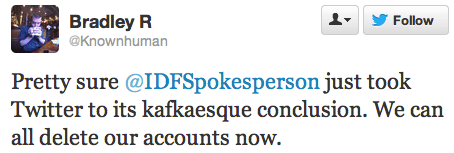
And it’s hard to disagree with this tweeter:

Screen shot 2012-11-15 at 12.33.51 PM

A Twitter hashtag #gazaunderattack has been created as a response. And Mondoweiss is reporting from the area:

If you doubt this is a religious war, fueled in part by religious fundamentalism as well as self-defense, note that the IDF called their operation after a Biblical verse:

This operation is named in reference to a biblical passage in which a pillar of cloud protects the Israelites as they wandered in the desert after leaving bondage in Egypt.

And the Lord went before them by day in a pillar of cloud, to lead them the way; and by night in a pillar of fire, to give them light; that they might go by day and by night. Exodus 13:21

It is unseemly to invoke the protection afforded the Israelites wandering in the desert when Israel is the dominant military power in the region.

Goldblog asks the core question:

What is the strategy? The fact remains that there is no long-term military solution to the challenge posed by Gaza, but the Israeli government doesn’t want to acknowledge this.

There are enough weapons, and enough young men in Gaza ready to use those weapons, to make life miserable for millions of Israelis for years to come, barring a full-scale invasion by the IDF of Gaza that wipes out the entire military structure of Hamas. And good luck with that, by the way — good luck to Bibi getting the world to acquiesce.

Netanyahu’s failure to convince the world that he is serious about compromise (he might have succeeded, given his Palestinian counterpart’s own alternately lackadaisical and obstreperous approach to peace talks, if he wasn’t hell-bent on growing settlements) means that he has no political capital to spend.

Funny, too, isn’t it, that this is the second Gaza war launched after a US presidential election elected Barack Obama. No coincidence, right? Or a deadly message about this Israeli government’s determination to take the fight to its enemies, regardless of long-term strategic goals?

Live-Tweeting A War

Footage of the strike that killed Ahmed al-Jaabari, posted by the Israeli Defense Forces moments after he was killed: The IDF have been running a full-on marketing campaign via Twitter, complete with bluster, hashtags, graphics and videos. Noah Shachtman finds this unusual:

Once “Operation Pillar of Defense” began, the IDF put up a Facebook page, a Flickr feed, and, of course, a stream of Twitter taunts — all relying on the same white-on-red English-language graphics. “Ahmed Jabari: Eliminated,” reads a tweet from 2:21 p.m. Eastern time on Wednesday. This is a very different way of waging the war of opinion online. When an American drone strikes a suspected militant in Afghanistan, that footage is rarely made public — and, if so, only months after the fact. After the raid on Osama bin Laden’s compound, White House and Pentagon aides did start leaking details like mad. But the only live tweets from the operation were from a bystander in Abbottabad who heard the helicopters landing. And the pictures of bin Laden’s corpse were purposely kept from the public.

A few highlights from the IDF Twitter feed:

A New War In Gaza?

GT GAZAAIRSTRIKES 20121114

A new conflict is rapidly escalating in Gaza:

Ahmed al-Jaabari, the head of the Islamist organisation’s military wing, the Izz ad-Din al-Qassam, died when his car was struck in Gaza City by a missile after Israel warned it may step up targeted assassinations, having endured almost a week of intense rocket fire from Gaza. Reports suggested three other Palestinians were also killed. In the hours after the attack on Jaabari, Palestinian witnesses told the Associated Press that air strikes had hit a series of targets across Gaza City.

Goldblog tweeted today: “How many ‘indispensable’ Hamas leaders have been killed already? Have these deaths crippled Hamas? New thinking urgently needed by Israel.” A few days ago he weighed in on the rocket attacks:

There is no military solution to the Gaza conflict, at least not one that Israel could pursue. Gaza isn’t Chechnya and Netanyahu isn’t Putin. Flattening Gaza is not a moral solution, nor a practical solution. Nor, for that matter, is it a politically possible solution. Netanyahu is calling in Western diplomats to explain to them that Israel has no choice but to respond militarily to the rocket fire. What he doesn’t seem to understand is that he doesn’t possess the political capital to ask the West for its understanding. There’s plenty of blame to go around for the collapse of the peace process; his portion is substantial, and his alienation of leaders who might otherwise be friends is a continuing theme of his tenure. 

On Monday, Michael Koplow examined the implications of an Israeli ground campaign. He also considered the political angle for Bibi:

 Netanyahu has been campaigning on security issues pretty much his entire political life, and the current campaign is no different. His focus on security is so strong that Kadima, in what can only be described as a last ditch effort amongst its death throes, has adopted as its campaign slogan “Bibi is endangering us” superimposed against a backdrop of a mushroom cloud. The irony of Netanyahu’s hawkish public persona is that he has never presided over a large military operation during either of his two tenures as prime minister, but as risky as it may be to send ground forces into Gaza right now, he cannot afford to just sit on his hands.

Max Fisher worries about the reactions of Egypt, Turkey, and Iran. Why military action by Israel could stall US talks with Iran:

The New York Times’s Tehran-based Thomas Erdbrink warned on Twitter. “While #Iran and #Hamas have been estranged over Syria, Iran’s leaders will be highly upset over Jabari’s assassination today in Gaza,” he wrote. “Forget ANY #Iran-US talks if conflict in Gaza escalates. … #Iran leaders can never be seen as talking to US, while its ‘eternal’ ally Israel assassinates Iran’s ideological allies.” The Washington Post recently reported that Tehran is “locked in internal debate” over the possible U.S. talks, so anything that weakens Iranian advocates for negotiations and exposes them to greater political risk would seem likely to reduce the odds of those talks taking place.

Nervana Mahmoud doubts Cast Lead II would be effective:

Without controlling the Philadelphia corridor between Sinai and Gaza and preventing arms smuggling, Cast Lead II would end up like Cast Lead I: a temporary break at a hefty price in terms of innocent loss of lives, international isolation, plus the new possibility of Egyptian retaliation, and even perhaps revocation of the Camp David accords.

The Guardian is live-blogging today’s violence.

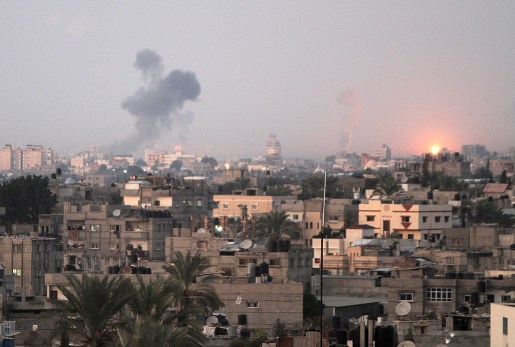
(Photo: Smoke rises following an Israeli air strike in Khan Yunis, southern Gaza Strip, on November 14, 2012. By Said Khatib/AFP/Getty Images)