Running On Empty

Gas_Shortages

Caitlin Dickson reports on the gasoline shortages in NYC and surrounding areas:

[Gas station manager Anan] noted that his company’s other stations in places like Staten Island are suffering from a different problem: they have gas but no power. The blackout across New York City and New Jersey is partially to blame for the gas shortage. The executive director of the New Jersey Gasoline, Convenience, Automotive Association explained that a lack of power is keeping much of the gasoline stored along the New Jersey Turnpike from being distributed to stations. “They can’t get that gasoline into the delivery trucks without power,” he told CNBC.

(Photo: A man fills up jerry cans with gasoline as others wait in line on November 1, 2012 in Hazlet township, New Jersey. United States. By Andrew Burton/Getty Images)

Instant Ruin Porn, Ctd

Mary Elizabeth Williams can relate to the risks taken by amateur disaster-photogs:

In the midst of a crisis, there’s a deep human need to share our stories. We want to see, we want to show. I’ve gasped at the already iconic images from the storm, and been amazed and saddened and relieved by the pictures my friends have posted on their Facebook pages of the scenes from their home fronts. I participated in it too.

I believe – and I still do – in the power of documenting experience. And yes, that includes the ubiquitous jazzed-up Instagram of a flower or a dog or some clouds. I also believe in not being an idiot, and know that possessing an app does not give one invincibility. We have become a world full of self-styled photojournalists and storm chasers and the truth is that most of us are woefully underqualified as both.

She adds, "As a police officer standing outside the park ruefully told me this morning, "Common sense isn’t so common." At least one of the New Yorkers killed by Sandy was in the process of taking photos.

New York’s Poor Weather Friend

Payphone

In the wake of Hurricane Sandy, Ben Cohen notes the sudden importance of pay phones:

On most days, New Yorkers breeze past corner pay phones with nary a glance. The devices are so foreign to many that the city’s official website has a question-and-answer section about pay phones in New York: Does anyone actually use them? “Even though the usage has gone way down,” it says, “the public pay telephones are still used for regular calls and long distance calls.” The last time Leslie Koch picked up a pay-phone receiver was during the 2003 blackout. Since then, she says, “I didn’t even know they were working.” But on Tuesday, old was new again, as her BlackBerry, iPhone, iPad and two laptops were idled. After calling her mother on Long Island from a pay phone, she commemorated the occasion by tweeting a photo of herself from Instagram [seen above].

But it’s not a perfect reunion:

With no electronic contacts at hand, [Oscar] Guzman, 34, had written down the phone numbers he needed on index cards. “It’s a nightmare,” he said. “The audio is awful.”

Jason Gilbert adds:

This is just months after New York announced a pilot program to convert several pay phones around in the city into free WiFi hotspots.

The move was widely praised as a successful effort to transform worthless technology — akin to “pagers, beepers, and busy signals,” as CNN’s Doug Gross put it in July — into something with actual utility. The Disneyland-like waiting lines that have popped up in New York show it might not be time to start uprooting all of those pay phones just yet.

Usually, when we talk about a smartphone becoming obsolete, we mean that a newer version has been released, making the technology available on the current model old-fashioned or quaint in comparison. In this case, however, we’re seeing smartphones become obsolete due to a total lack of utility outside of an oversized wristwatch — and one that, it must be said, cannot tell the time for very long.

The Little Carousel That Could

Janes

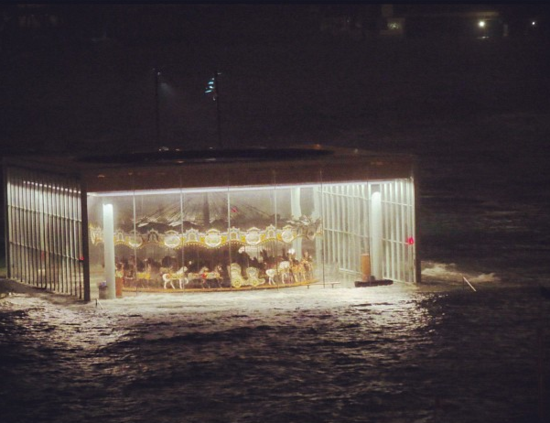
John Seabrook explains the significance of the above image:

Few pictures of Hurricane Sandy captured both the enormity of the disaster and the unquenchable spirit buried deep in the city’s core better than the image of Jane’s Carousel, the glass-enclosed merry-go-round on the waterfront near the Brooklyn Bridge, taken at the height of the storm. The photo shows the dark water lapping at the horses’ hooves, with the eerie blacked-out lower-Manhattan skyline in the background, and the festive riderless ponies twinkling merrily in the bright yellow light. Originally posted on Instagram and picked up by CNN, the picture was seen all around the world; at one point that night it was at the top of Twitter’s trends. 

See a wider shot here. Matthew DeLuca dives into the carousel's history:

The 48 horses and four chariots that make up what’s now called Jane’s Carousel—after [owner Jane] Walentas—brought delight to children at Idora Park in Youngstown, Ohio—then a prospering steel town—in 1922. After the city declined along with the steel industry in the 1970s, a fire consumed the park, but spared the historic carousel—in 1974, it became the first one ever listed on the National Register of Historic Places—which went up for auction in 1984.

After she and her husband purchased the ride, Walentas spent parts of three decades restoring it, and in 2011 they installed it on the waterfront as part of a $3.45 million gift to the park. The good news:

It may take a couple days to pump the water out of the basement, but apart from some warping of the carousel’s floor, the carnival ride looks to have mostly made it through unscathed, Walentas said. If all goes well, she said she might have it up and running again for birthdays in a couple of months.

(Photo by Brian Morrissey, via Ana Andjelic on Instagram)

Endorsing The Fight Against Climate Change

Jonathan Bernstein praises the way Bloomberg used his Obama endorsement:

By linking his endorsement to a specific issue — climate — he does two things. First, he gives a pretty effective issue advertisement on the subject; Bloomberg would likely be able to get the cameras on him at any rate right now, but doing it in the context of a presidential endorsement is more effective than simply repeating what he's said in the past on the issue. Second, he's essentially lobbying the president on this issue.

Remember, votes don't speak for themselves; politicians must interpret what votes mean. In that, they tend to interpret through their own experiences on the campaign trail; that is, if they've been talking about an issue a lot, they tend to believe that those who voted them must have endorsed that position. Most of us can't do much about that, although perhaps more than we think — volunteer for a campaign, or if you have the means donate money, and you'll get at least someone's attention. But if you have a very large megaphone, you can do more, and that's what Bloomberg is accomplishing here.

Ben Smith is in the same ballpark:

It also turns the New York mayor, who had been searching for a next act, on the leading edge of an issue that Sandy had forced the media and political class, whose attention had wandered to the coal-heavy economies of the Midwest, to consider. Bloomberg's foundation has spent years building a climate initiative, and he has spent heavily on a push to shut down coal-fired plants. If Obama wins, the cause will finally have what it had lacked: a victory, and a political story to tell.

Should Sandy Affect Your Vote?

155061375

Frida Ghitis thinks not. Seth Masket differs:

[W]hy dissuade voters from evaluating the candidates at a time like this? This is a moment when action by the federal government is (nearly) universally regarded as being necessary. Is it not appropriate to consider how the president is actually administering it? And what would be better to consider? Debate performance? Likability? "Vision"? I'd say that the economy would be important, and voters actually do consider that, but the president has a far greater direct impact on disaster relief than he does on economic growth.

The issue certainly helped sway Mayor Bloomberg's vote, who, like The Economist, is endorsing the president:

The devastation that Hurricane Sandy brought to New York City and much of the Northeast – in lost lives, lost homes and lost business – brought the stakes of Tuesday’s presidential election into sharp relief. The floods and fires that swept through our city left a path of destruction that will require years of recovery and rebuilding work. And in the short term, our subway system remains partially shut down, and many city residents and businesses still have no power. In just 14 months, two hurricanes have forced us to evacuate neighborhoods – something our city government had never done before. If this is a trend, it is simply not sustainable.

Our climate is changing. And while the increase in extreme weather we have experienced in New York City and around the world may or may not be the result of it, the risk that it might be – given this week’s devastation – should compel all elected leaders to take immediate action.

Here in New York, our comprehensive sustainability plan – PlaNYC – has helped allow us to cut our carbon footprint by 16 percent in just five years, which is the equivalent of eliminating the carbon footprint of a city twice the size of Seattle. Enhanced-buzz-7374-1351797754-1Through the C40 Cities Climate Leadership Group – a partnership among many of the world’s largest cities – local governments are taking action where national governments are not.

But we can’t do it alone. We need leadership from the White House – and over the past four years, President Barack Obama has taken major steps to reduce our carbon consumption, including setting higher fuel-efficiency standards for cars and trucks. His administration also has adopted tighter controls on mercury emissions, which will help to close the dirtiest coal power plants (an effort I have supported through my philanthropy), which are estimated to kill 13,000 Americans a year.

Mitt Romney, too, has a history of tackling climate change. As governor of Massachusetts, he signed on to a regional cap- and-trade plan designed to reduce carbon emissions 10 percent below 1990 levels. "The benefits (of that plan) will be long- lasting and enormous – benefits to our health, our economy, our quality of life, our very landscape. These are actions we can and must take now, if we are to have ‘no regrets’ when we transfer our temporary stewardship of this Earth to the next generation," he wrote at the time.

He couldn’t have been more right. But since then, he has reversed course, abandoning the very cap-and-trade program he once supported. This issue is too important. We need determined leadership at the national level to move the nation and the world forward.

I believe Mitt Romney is a good and decent man, and he would bring valuable business experience to the Oval Office. He understands that America was built on the promise of equal opportunity, not equal results. In the past he has also taken sensible positions on immigration, illegal guns, abortion rights and health care. But he has reversed course on all of them, and is even running against the health-care model he signed into law in Massachusetts.

If the 1994 or 2003 version of Mitt Romney were running for president, I may well have voted for him because, like so many other independents, I have found the past four years to be, in a word, disappointing.

In 2008, Obama ran as a pragmatic problem-solver and consensus-builder. But as president, he devoted little time and effort to developing and sustaining a coalition of centrists, which doomed hope for any real progress on illegal guns, immigration, tax reform, job creation and deficit reduction. And rather than uniting the country around a message of shared sacrifice, he engaged in partisan attacks and has embraced a divisive populist agenda focused more on redistributing income than creating it.

Nevertheless, the president has achieved some important victories on issues that will help define our future. His Race to the Top education program – much of which was opposed by the teachers’ unions, a traditional Democratic Party constituency – has helped drive badly needed reform across the country, giving local districts leverage to strengthen accountability in the classroom and expand charter schools. His health-care law – for all its flaws – will provide insurance coverage to people who need it most and save lives.

When I step into the voting booth, I think about the world I want to leave my two daughters, and the values that are required to guide us there. The two parties’ nominees for president offer different visions of where they want to lead America. One believes a woman’s right to choose should be protected for future generations; one does not. That difference, given the likelihood of Supreme Court vacancies, weighs heavily on my decision. One recognizes marriage equality as consistent with America’s march of freedom; one does not. I want our president to be on the right side of history. One sees climate change as an urgent problem that threatens our planet; one does not. I want our president to place scientific evidence and risk management above electoral politics.

Of course, neither candidate has specified what hard decisions he will make to get our economy back on track while also balancing the budget. But in the end, what matters most isn’t the shape of any particular proposal; it’s the work that must be done to bring members of Congress together to achieve bipartisan solutions. Presidents Bill Clinton and Ronald Reagan both found success while their parties were out of power in Congress – and President Obama can, too. If he listens to people on both sides of the aisle, and builds the trust of moderates, he can fulfill the hope he inspired four years ago and lead our country toward a better future for my children and yours.

And that’s why I will be voting for him.

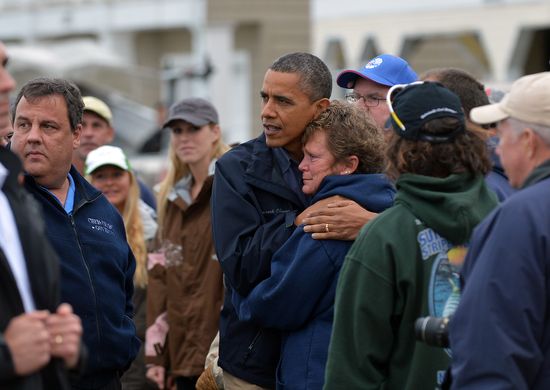
(Photo: US President Barack Obama comforts Hurricane Sandy victim Dana Vanzant as he visits a neighborhood in Brigantine, New Jersey, on October 31, 2012. By Jewel Samad/AFP/Getty Images)

Prevention Isn’t Good Politics

8145159827_37cc9626bc_o

Adam Serwer observes that politicians "get much more credit for their reaction to disasters like Sandy than they do for trying to ensure disasters don't cause so much damage in the first place":

That dynamic sets up some "perverse incentives," according to Stanford professor Neil Malhotra, who co-authored a 2009 study with Loyola Marymount professor Andrew Healy on the politics of natural disasters. "The government might under-invest in preparedness measures and infrastructure development in exchange for paying for disaster relief, since there are no electoral rewards for prevention," says Malhotra. "Since 1988, the amount of money the U.S. spends on disaster relief has increased 13 times while the amount spending on disaster preparedness has been flat."

Post-Storm Poetry

In the wake of Hurricane Sandy, Sasha Weiss revisits the work of Wislawa Szymborska:

Her poems often have a post-apocalyptic flavor—she’s a lone archeologist digging around long after humans have abandoned the planet, whistling to herself as she comes upon artifacts like these: "…plates but no appetite. / And wedding rings, but the requited love / has been gone now for some three hundred years…The crown has outlasted the head. The hand has lost out to the glove” (from "Museum").

And yet, the poems have no use for despair or gloomy thoughts; even when they seem to be written by the last person left on earth, they are purposeful, hilarious, and hopeful. She is always posing the question of how the world might be rebuilt from minimal, coarse materials—"Show me your nothing / that you left behind,” she writes in “Archeology," "and I’ll build from it a forest and a highway, / an airport, baseness, tenderness, / a missing home." In another poem, "Autonomy," she admires a sea creature that splits itself into two when threatened, and regenerates—it can “grow back just what’s needed from what’s left." With an almost uncanny prescience, her poems are instructions for a day like today.