What The Hurricane Exposed

154983735

The wealth gap, argues David Rohde:

Divides between the rich and the poor are nothing new in New York, but the storm brought them vividly to the surface. There were residents like me who could invest all of their time and energy into protecting their families. And there were New Yorkers who could not. Those with a car could flee. Those with wealth could move into a hotel. Those with steady jobs could decline to come into work. But the city’s cooks, doormen, maintenance men, taxi drivers and maids left their loved ones at home.

Zack Beauchamp, meanwhile, points out that income inequality is "the single most important predictor of vulnerability to storm damage." He adds:

Other sorts of related inequalities also make the impact of storms worse. [Three experts at the University of South Carolina] found that black, Hispanic, and Asian communities in the United States were also more at risk from storms, as were communities dependent on one industry (like mining or fishing), ones with high percentages of residents living in mobile homes, and ones with high population density. The most vulnerable place in the country, in their analysis? Manhattan Borough.

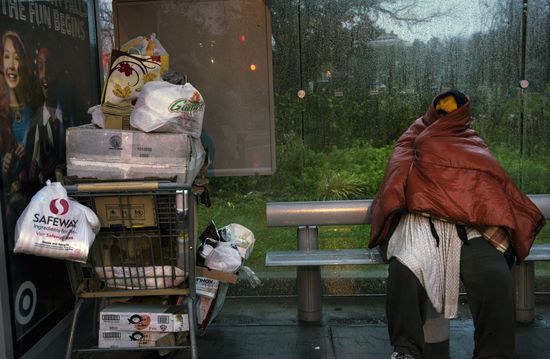
(Photo: John Edgecombe II, who is homeless, takes refuge from the rain and wind at a bus stop on October 29, 2012. By Brendan Smialowski/AFP/Getty Images)

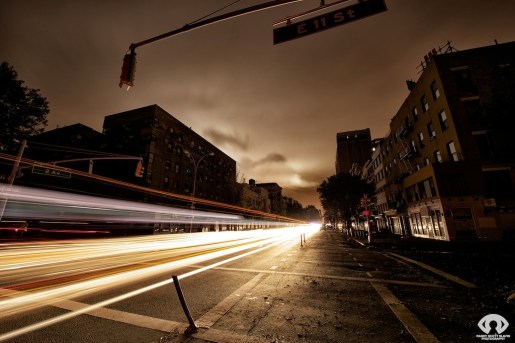
Power To The People

Randy scott slavin nyc unplugged east 11th st

Or at least to Lower Manhattan – soon:

Nearly everyone south of 39th Street in Manhattan has been without power since Monday night. As of 4:30 a.m. this morning, Con Ed had restored electricity to 225,000 customers citywide, but 676,000 remained powerless, including 227,000 in Manhattan. But residents there only need to hang on a little longer now. Governor Andrew Cuomo’s suddenly relevant Twitter account confirmed today that, as initial estimates predicted, the entire borough would rejoin modern civilization by Friday or Saturday at the latest after days of living in the dark ages. In fact, any city residents served by underground power lines will be able to watch Netflix again by Saturday.

(Photo from Randy Scott Slavin‘s new NYC UNPLUGGED series, via Facebook)

Did Sandy Help Obama?

Christie_Obama

Americans are giving Obama hurricane response high marks:

ABC reports that "78 percent rate Obama’s response to the hurricane positively (as excellent or good), while just 8 percent see it negatively. Romney, who naturally has had a far less prominent role in this issue, is rated positively for his response to the hurricane by 44 percent, negatively by 21 percent, with many more, 35 percent, expressing no opinion." Even 63 percent of Republicans approve of Obama's disaster leadership

Margaret Carlson believes that Obama's visit to New Jersey has guaranteed his victory next week:

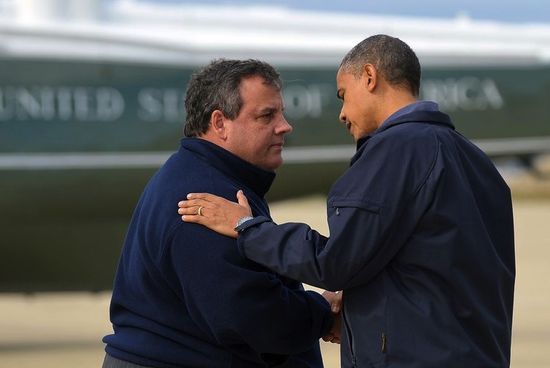
In September my Bloomberg View colleague Josh Barro wrote that Romney lost the election on the day his dismissive remarks about "the 47 percent" were made public. If Obama wins this election, we may look back at today and say this hug in Brigantine, New Jersey, is the moment that sealed it for him. Obama and Christie made the politics of the presidential campaign look small, and reminded us that politicians care about something more than who's ahead in Ohio.

(Photo: US President Barack Obama is greeted by New Jersey Governor Chris Christie upon arriving in Atlantic City, New Jersey, on October 31, 2012 to visit areas hardest hit by the unprecedented cyclone Sandy. By Jewel Samad/AFP/Getty Images)

Why Has Christie Embraced Obama? Ctd

Kevin Drum discounts political calculation on the governor's part:

I sort of give Christie the benefit of the doubt here. Partly this is because he does seem to be a genuinely emotional guy and may simply be reacting to the moment. But the other reason is that I find it hard to believe that Christie truly thinks he has a chance of winning the Republican nomination in 2016 regardless of what he does.

How Galupo understands Christie's recent statements:

Where Dowd and others are mistaken … is to assume that Christie is thinking about positioning himself for 2016. That’s ridiculous. Christie has more immediate fish to fry — namely his own reelection in 2013. Unemployment in the Garden State remains stubbornly high. Atlantic City’s new Revel casino, subsidized by the state and personally promoted by Christie, is struggling to stay on this side of bankruptcy. And he would face a very formidable opponent in Newark Mayor Cory Booker, who is contemplating a run.

I agree with both analyses. We can overthink this. Christie is coping with a disaster. To have the president checking in at midnight and providing all the assistance he has must feel like a burden shared and lessened a touch. Christie's a blowhard, but in so far as I have been able to see any coverage, struck me as completely genuine. Previous Dish coverage here.

New York Not So Shitty

155082292

A reader writes:

You’re in a Starbucks, connected to the Internet. You have a bed to sleep in and your husband and pets are with you. You’re doing pretty well. Think of it this way: You could have moved to Breezy Point.

That much I don’t dispute. We’re fine, and I’m now blogging at Patrick’s way uptown. My only real issue is my CPAP machine, which is trivial compared with goodness knows how many old folks trapped in high-rises, with more vital medical needs. This time I’m not complaining. Last night, the moon came out and the deserted dark streets of the Village were lit just from the sky. It was surreal and serene. At this point, I think of my initiation into New York has a kind of baptism, where they’ve kept me below the surface long enough for me to be extra-grateful when we get, say, electricity. Another:

You said: “Well, it cannot get any worse, can it? Can it?” I grew up in Manhattan and lived there for 25 years of my life.  I never experienced anything close to what New Yorkers are going through now.  There have been blackouts, but nothing sustained like this.  Even 9/11 wasn’t this bad – quality of living-wise. That was obviously deeply, mortally traumatic, but it didn’t involve a lengthy period living in what are essentially third-world conditions. What I’m saying is, this is the worst it has ever been in this city.  I’d love to say that it can’t get any worse, but I didn’t even think it could get this bad!

Another:

I’ve still got a friend in Queens I can’t contact. I hope she’s okay and I don’t really have reason to think otherwise, but worry isn’t always rational. You may already recognize that for many New Yorkers seeing Manhattan hobbled and emergency workers endangering themselves rekindles a collective 9/11 PTSD. But one of the things that makes NY great (I’m from the West Coast but moved here 15 years ago) is the way New Yorkers, for all of their faults and divisions, relate to each other in the midst of disaster. I know how trite this will sound but I must: This great and flawed city is not the problem, Andrew, and the more we confront adversity together the stronger we’ll be. Yeah, sometimes it sucks – a lot – but being able to see the imperfect beauty in each other amidst the filth and rubble is part of what makes life worth living.

Indeed. Several friends have offered us an air mattress uptown, a hot shower, and the little neighborhood restaurant, Moustache, even served dinner by candlelight, since their ovens are all gas-based. The soup was gratis. Outside on a usually busy street, a young man was throwing a lacrosse ball against the walls of a construction site. To wit:

We’re all used to the Hollywood idea of post-apocalyptic America–men in fatigues roaming around with guns, looting and killing. What happened when my little village of Pelham was struck by the worst storm in its history–trees down everywhere, a dozen homes destroyed, vast damage–no power or phones. Although we sit on the water of Long Island Sound, the surge was pretty modest, so no flooding–that was the blessing. So what happened? As soon as the storm subsided, neighbors were coming by: are you okay? was anyone injured? do you need batteries, milk, eggs? Tom down the street has a generator and anybody who needs to recharge phones or laptops can hook up. (Tom set up a charging station for neighbors in front of his garage.) On day two, when a few houses got power back, those who had it were advertising their services to neighbors–come by and take a hot shower! We’ll hold your freezer things. You’re welcome to sit in our living room and read–no flashlight required! That afternoon, the local pharmacy and grocery reopened–handing out bags to customers–put your freezer things in this bag with your name, and we’ll freeze it for you! Phone company, fire, police crews out at once, working hard. People stopping by giving them a thermos of coffee or some fresh baked muffins. Spirits very upbeat. People extraordinarily kind and friendly. Now that’s the America I want to think about. In times of disaster, people share and come together. And that much maligned government? It works, and it’s there for you when you need it.

Another:

Maybe you should go back to D.C. or P-Town.

After weathering the storm here in Harlem with my family (where we, despite some sketchy moments, retained electricity and hot water throughout), I set out downtown to check on my below-ground storefront business, located in the East Village. I was worried about flooding, even though I had prepared. I knew I did not have electricity. I didn’t know what to expect. Before I even left my building, I was greeted by neighbors, asking if I needed anything.

I got into my car and turned on the radio, but sick of NPR and news radio I decided to switch over to Hot 97, the urban/hip-hop station. A tribute to Run-DMC’s slain DJ, Jam Master Jay, was playing (this at about 9am). DJ Enuff, a NYC mainstay since the ’90s, had been DJing for 21 straight hours – none of the other DJs could make it in.

As I drove slowly through Spanish Harlem, the Upper East Side, and down into Midtown, I rolled down my windows and turned the volume all the way up as “Hard Times” blared through the speakers. I nearly wept. This, I felt, was the New York I fell in love with. The DJs, so long a cornerstone of our culture, were still at work. The radio was still on. And as confused tourists wandered the streets, New Yorkers got down to the work of putting their lives back together.

At 39th Street the traffic lights turned dark. I got downtown and parked my car in an illegal spot with a policeman’s blessing. The streets were flooded with people. Everyone was caring and obliging. I checked on a friend in the neighborhood, who I hadn’t heard from since the day before. We had a smoke and decided to walk around. He told me that the night before had been a blast. It seemed like the party was rolling on.

We’ve done this through 9/11, The Blackout, and countless blizzards. This city is at its best in crisis. When life gives us lemons, we make lemonade and spike that bitch.

The fact that you are crouching in your apartment, put upon by events and wed to a Starbucks (of all places!) says to me that you are not cut out to be here. And we do not want you if you do not want us. Love the blog and read it multiple times a day. Just calling as I see it, as my fellow NYers are wont to do.

Another:

I love that you’re blogging from a Starbucks in Midtown. I love how you’re suffering the storm right alongside all the folks who don’t have a world famous blog, even if it’s not a choice. New York is an intense, hyper-competitive, loud, dirty, and difficult place, and the best thing about it is that the guy with the turban, the drag queen, the stockbroker, and the big fat black lady all make it through the daily difficulty alongside each other.  At this moment, my Brooklyn neighbors are handing out Tilapia to trick-or-treaters. So there’s that too. Rich, poor, or in-between, everyone here is crazy.

All of us will bitch every day about the difficulties of the city, but we’ll all end up helping each other at one time or another too.  And helping here is different than helping in other places around the world, because the variety and chaos makes it harder here. It’s harder to help because so much angst and resistance builds inside of us, as New Yorkers. It’s harder to help because we’re often ‘other’ to each other, in a different class or ethnic group, etc. So when the shit hits and it’s everyone in, and you help, there’s no place on earth you’ll feel more connected.  The money, race, lifestyle boundaries come down, the seething hostility is overcome, and god mutherfuckin’ dammit, we are one!

By the way, all your complaining about New York is essentially turning you into a New Yorker. You are not alone, brother. We all hate it and that’s why we all love it.

I think I’m beginning to get it now.

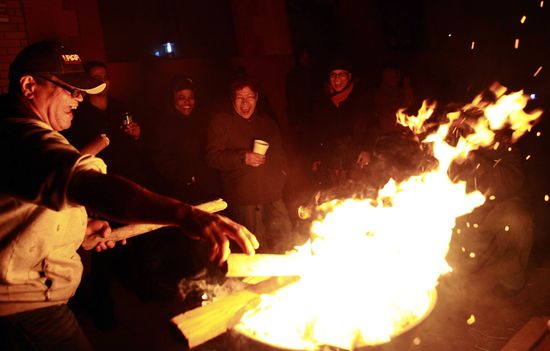
(Photo: East Village residents enjoy a bonfire on October 31, 2012 in New York City. Superstorm Sandy has claimed several dozen lives in the United States and has caused massive flooding across much of the Atlantic seaboard. By Allison Joyce/Getty Images)
Man-Made Natural Disasters, Ctd

Avent joins the growing chorus:

[S]cientists are becoming ever less shy in drawing a line between a higher frequency of “extreme” weather events and a warming climate. Climate shifts the probability distribution of such events, and so global warming may not have “caused” Sandy, but it makes Sandy-like storms more probable. As the ever-less-funny joke goes, 500-year weather events seem to pop up every one or two years these days. Frequency and intensity of storms aside, future hurricanes that hit the east coast will do so atop rising sea levels. Contemplate the images of seawater rushing over Manhattan streets and into subway and highway tunnels. Then consider that sea levels are rising. And then reflect on the fact that New York is very much like a typical megacity in being located on the water; tracing a finger around America’s coastlines leads one past most of the country’s largest and richest cities.

Of course many saw this coming:

Science and its practical consort Engineering mostly come out of this week with enhanced reputations.

For some years now, various researchers have been predicting that such a trauma was not just possible but almost certain, as we raised the temperature and with it the level of the sea—just this past summer, for instance, scientists demonstrated that seas were rising faster near the northeast United States (for reasons having to do with alterations to the Gulf Stream) than almost anyplace on the planet. They had described, in the long run, the loaded gun, right down to a set of documents describing the precise risk to the New York subway system.

As nature pulled the trigger in mid-October, when a tropical wave left Africa and moved into the Atlantic and began to spin, scientists were able to do the short-term work of hurricane forecasting with almost eerie precision. Days before Sandy came ashore we not only knew approximately where it would go, but that its barometric pressure would drop below previous records and hence that its gushing surge would set new marks. The computer models dealt with the weird hybrid nature of the storm—a tropical cyclone hitting a blocking front—with real aplomb; it was a bravura performance.

In so doing, it should shame at least a little those people who argue against the computer modeling of climate change on the grounds that “they can’t even tell the weather three days ahead of time—how can they predict the climate?”

Then again, it could all be caused by “Mars wobbles” – over to you, Fox News.

Bringing Back New Amsterdam

Yglesias thinks Dutch ingenuity might be just what NYC needs:

The idea of essentially damning up New York Harbor sounds extreme, but that’s equivalent to what the Dutch did with the Zuiderzee Works and especially the Delta Works projects undertaken after the 1953 flood. Some of the Dutch works are permanent dijks, but others are open sluices that merely shut when storms are coming to block surges. The idea is to in effect shorten your coastline which makes it easier to defend with high walls.

John McQuaid agrees:

Ultimately, I think something like this is exactly what we’ll see in New York and other coastal cities. It sounds fanciful, but New York is simply too big and important not to protect, and a system of surge barriers and other structures is probably the only way to protect it long-term. Which is exactly the thinking behind the Dutch system.

Elsewhere, Emily Badger lists four additional ways NYC could avoid another Sandy like catastrophe, among them – elevated infrastructure:

There are very few buildings in the entire state of New York built at grade at elevations below sea level. But New York City has constructed one massive piece of infrastructure below that threshold: the subway system. As we saw this week, flooding can devastate an underground network of tunnels, train platforms and corridors. So how do you keep more of that water out? For one thing, elevating subway entrances would help. Bangkok, another low-lying city susceptible to rising tides, has built precisely these kinds of subway entrances. They’re raised a meter off the ground and include built-in floodgates. A subway rider in Bangkok must first walk up a stairway from the sidewalk before heading down into the metro.

Out Of The Holocene

Bill McKibben begrudingly welcomes a new era in climate change:

So far we’ve raised the temperature of the earth about one degree Celsius, and two decades ago it was hard to believe this would be enough to cause huge damage. But it was. We’ve clearly come out of the Holocene and into something else. Forty percent of the summer sea ice in the Arctic is gone; the ocean is 30 percent more acidic. There’s nothing theoretical about any of this any more. Since warm air holds more water vapor than cold, the atmosphere is about 4 percent wetter than it used to be, which has loaded the dice for drought and flood. In my home country, 2011 smashed the record for multibillion-dollar weather disasters—and we were hit nowhere near as badly as some.

While the presidential candidates continue to dither, at least one up-and-comer is getting the message:

Environmental activist Bill McKibben applauded New York’s Governor Andrew Cuomo Wednesday for saying lessons learned from Sandy would include "the recognition that climate change is a reality." … "It’s actual experiences that change people’s minds, or let them really feel what’s going on. One wrecked subway system, I fear, equals a thousand academic studies," said McKibben, founder of the climate advocacy group 350.org.

Previous thoughts from Bill here.

Oh Rats, Ctd

Looks like there won't be a plague after all:

In fact, the flood may end up as a net positive, as far as we people are concerned. "Flooding often displaces rats but also drowns young rats in their burrows and can reduce the rat population," [NYC Department of Health and Mental Hygiene official Sam] Miller says. As for the rats that did escape an untimely, watery death, Miller insists that "no research has demonstrated an increased health risk from flushed rats from underground."

But:

If the flooding happened after dominant rats took to the surface and drove the weaklings underground to die, New York’s rat population may have just gotten stronger.

Happy Halloween.

The Disaster Downtown

Phone_Charging_NYC

Part of Jonathan Maimon's dispatch from a still-dark lower Manhattan:

I did not witness a single Red Cross Truck or FEMA Vehicle or in lower Manhattan. Recall the assistance these agencies provided after 9/11 – this is NOT HAPPENING. There are bound to be hundreds of elderly people, rich and poor, who live on the upper floors of buildings with elevators that are now disabled. IF POWER IS NOT RESTORED, THIS WILL MOVE FROM BEING AN ECONOMIC DISASTER TO A HUMANITARIAN DISASTER.

David Freedlander checked in with NYC food distributors last night.

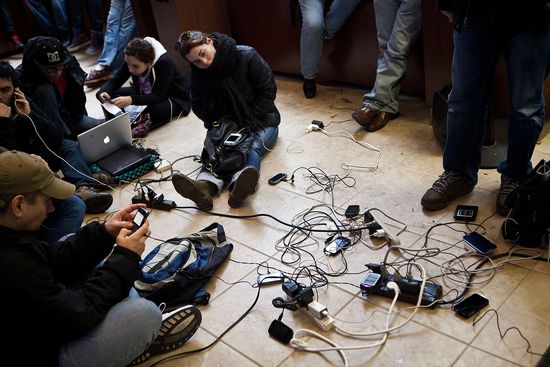
(Photo: People crowd into a Chase Bank ATM kiosk to charge phones and laptops at 40th Street and 3rd Avenue, one block north of where power has gone out, on October 31, 2012 in New York City. 'This is the modern campfire,' one man said. By Andrew Burton/Getty Images)