Romney’s Relief Theater

Kettering

McKay Coppins pulls back the curtain of yesterday’s non-campaign campaign event in Kettering, Ohio:

[T]he last-minute nature of the call for donations left some in the campaign concerned that they would end up with an empty truck. So the night before the event, campaign aides went to a local Wal-Mart and spent $5,000 on granola bars, canned food, and diapers to put on display while they waited for donations to come in, according to one staffer. (The campaign confirmed that it “did donate supplies to the relief effort,” but would not specify how much it spent.)

And then there’s this:

As supporters lined up to greet the candidate, a young volunteer in a Romney/Ryan T-shirt stood near the tables, his hands cupped around his mouth, shouting, “You need a donation to get in line!” Empty-handed supporters pled for entrance, with one woman asking, “What if we dropped off our donations up front?” The volunteer gestured toward a pile of groceries conveniently stacked near the candidate. “Just grab something,” he said. Two teenage boys retrieved a jar of peanut butter each, and got in line. When it was their turn, they handed their “donations” to Romney. He took them, smiled, and offered an earnest “Thank you.”

(Photo by Justin Sullivan/Getty Images)
Sandy Hits The Dish

The hurricane has screwed up email service to the Dish account (andrew@thedailybeast.com), so we haven't been receiving most of the emails sent by Dish readers this week.  If you sent us an email since Monday night, please resend it using the following makeshift address: andrew@dishemail.com. 

On a personal level, my wonderful introduction to New York City continues. We've had no power since Sunday night, and no idea when that might end. Even charged cell-phones south of 29th Street get no service at all (which is a tiny deterioration from AT&T's usual service). There is no hot water. Even better, the front door to our building works on an electric FOB system, which, of course, has failed. So for a while, only one of us could leave the building at any one time. This made life a little difficult. Eventually we found a master key, which allowed me to escape today to get some work done.

I'm blogging today from a midtown Starbucks, where every available electrical outlet is being used by displaced downtowners. The atmosphere around me is probably like rush-hour in Calcutta. I want to thank my colleagues, all of whom have electric power, for doing such an amazing job yesterday and today. And my love to New York City, which has instantly plunged me from the developed world into a pitch black and increasingly cold Halloween. I keep saying to myself: It Gets Better.

Well, it cannot get any worse, can it? Can it?

Shouting Flood In A Crowded Twitter, Ctd

Jeff John Roberts looks into the potential illegality of spreading false information on Twitter:

[T]he government already regulates rumors related to the SEC and the stock market, and courts say they will draw a line at protecting speech that gives rise to “imminent lawless action.” Should there be limits on social network speech in emergencies too? At GigaOM, we’re fond of highlighting Twitter’s role as a source of freedom and public media tool. For now, my instinct is to leave Twitter alone. But future emergencies may test that position.

Shashank “@comfortablysmug” Tripathi has since apologized and resigned from the campaign of a New York congressional candidate. But at least one NYC official is trying to get him prosecuted. Laura Miller zooms out:

[Perhaps] what Shashank Tripathi and other fake-news purveyors intended to do [was simply] to issue dispatches no one was supposed to believe in the first place. But one rushed or irony-impaired retweeter is all it takes to seize on a bogus photo or news item and credulously pass it on. The context gets lost, and each retweeter presumes that the message comes with the considered endorsement of the person they got it from. At the same time, real people go on posting real dispatches (written and photographic) from places where real disaster has struck, dispatches we’d never get from the professional media.

The result is a crazy quilt of the true, the manipulated truth, the false, the truthy (false things that feel true), the flagrantly false (fakes so fake they shed meaningful light on the other fakes) and dozens of permutations in between.

Chart Of The Day

Weather_Deaths

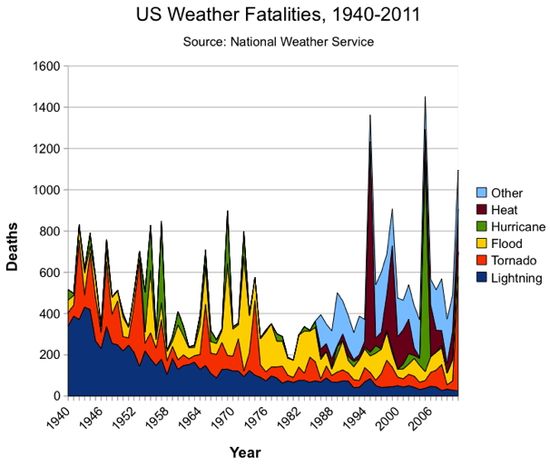
Dylan Matthews tallied weather-related fatalities:

As Wonkblog’s Brad Plumer explained in a Monday post, it’s hard to attribute single weather events to climate change. But clearly something is causing the across-the-board rise in weather-related deaths, and global climate change, which worsens hurricanes and promotes heat waves and tornadoes, may be a prime culprit.

Fallows sees parallels between the global warming debate and the smoking causes cancer debate:

Of course no one can prove that this storm was "caused by" climate change and global warming. But the increasingly frequent occurrence of "unusual," "extreme," and "once per century" weather events — heat, cold, drought, flood — is in keeping with all warnings about the effects of climate change (as explained here). I'm not arguing the entire climate change case now, and don't have special standing to do so anyway. I am saying that this reminds me of the mounting evidence about smoking and health, when I was a kid — the medical conventions my father went to in the early 1960s were full of smokers, those a decade later had practically no smokers — or about environmentalism generally in the 'Silent Spring' era. Denialism continues, until all of a sudden it is irrelevant.

Budgeting For The Next Sandy

Suzy Khimm examines the cuts to FEMA in Obama's budget proposal:

Overall, Obama’s budget would reduce FEMA funding by $453 million — a 3 percent cut from 2012 that would bring the agency’s total funding down to $13.5 billion, according to FEMA’s budget estimates ….  That said, FEMA is still protected from new funding cuts that other agencies now face. Under an agreement from last year’s debt-ceiling deal, FEMA’s Disaster Relief Fund is exempt from the Budget Control Act’s spending caps. And FEMA is also able to carry over unspent money from one year to the next, which boosted its disaster relief coffers from $7.1 billion to $7.8 billion this year.

Naturally, the Romney-Ryan ticket has declined to clarify specific cuts. But Henry Blodget examines Romney's previous comments on the issue:

Romney wanted to cut "disaster relief." Not FEMA. Not other government spending to pay for disaster relief. Just disaster relief. (And, by the way, for those who think what Romney meant was that he wants states and local governments to handle disaster relief, Hurricane Sandy is a perfect example of why this approach is ludicrous and inefficient when dealing with disasters that cross state and local lines. Can you imagine if all the governors of all the states affected by Sandy had to agree with each other and coordinate before they did anything to help each other? The federal government has a place in our society. And disaster relief is part of that place.)

Josh Barro's view:

[A] downward shift of fiscal responsibilities is a key component of Romney's policy agenda, most notably in Medicaid, which he would convert into a slow-growing block grant. Over time, states would be forced to pick up an increasing share of the program's costs. That is a very bad idea: State governments are in a much weaker position to shoulder rising health-care costs than the federal government is. They are also not as well-positioned to pay for disaster relief, an expense which comes in infrequent and quasi-random bursts. But these are the sorts of changes you might make if you were trying to meet an arbitrary cap on federal spending.

Why Has Christie Embraced Obama?

The president is touring New Jersey's wreckage with the governor today. John Cassidy wonders if Christie's praise for Obama – and his blowing-off of Romney – has become a bit excessive:

Right about now, Romney must be feeling like calling him up and giving him the same advice that Clement Attlee, the postwar Labour Prime Minister of Great Britain gave to Harold Laski, the left-wing London School of Economics professor: "A period of silence from you would be welcome."

Michael Shear notes the dramatic change of tune for Christie; the governor before the hurricane had been slamming Obama on the campaign trail "in a way that few of Mr. Romney's surrogates can." Dan Amira speculates:

Some might conclude that Christie is looking out for his own political future (again?), either as a Republican governor running for reelection in a blue state or as a straight-talking Republican presidential candidate hoping to win the support of independents. Or it may be that Christie, as he told Fox & Friends this morning, just doesn't "give a damn about presidential politics" right now. But Romney surely still does, and he probably wouldn't mind if Christie toned it down a bit. 

Among Goldblog's theories:

The first, most benign theory: Christie, in my experience, is a deeply emotional and highly sentimental man, and he is torn-up about the devastation along the Jersey Shore. The support he's received from President Obama — the support he receives from anyone — at such a wrenching moment, makes him inordinately grateful. And President Obama has been extremely attentive.

 Tomasky speculates about Republican criticism of Christie:

Will Limbaugh et al. howl about Judas Christie today? Will they try to downplay it? My guess is the latter. Like it's no big deal. The more typical right-wing response to unpleasant developments is to ignore them and try to shrug them off. So I'd guess that their outrage today will be private.

But here's what will be public. Images of the Republican convention keynote speaker, a man known to be adored by conservatives, standing with the hated Kenyan, probably agreeing with him and maybe even taking the lead as they urge Congress to pass emergency supplemental relief funds. That will air on cable and the nightly news all over the country, and the mere picture will say to people, "Romney doesn't really matter here."

Our Desire For Disaster Porn

Enhanced-buzz-19650-1351691188-2

Shafer explains where it comes from:

What impels us to watch, to hunger for more disaster and mayhem, and to keep on watching long after we’ve learned all there is to know? Wake Forest University English Professor Eric C. Wilson gathers some clues in his new book, Everyone Loves a Good Train Wreck: Why We Can’t Look Away. We never feel more alive than in times of distress, danger, and calamity, Wilson writes, whether we experience it directly or at a televised remove, watch it dramatized in a movie, or read it in a novel. He cites a psychologist to theorize that our morbid curiosity has an evolutionary function: Being well-informed about dangers and potential dangers helps us survive; finding points of empathy through which we can connect with those who have suffered allow us to build lasting bonds.

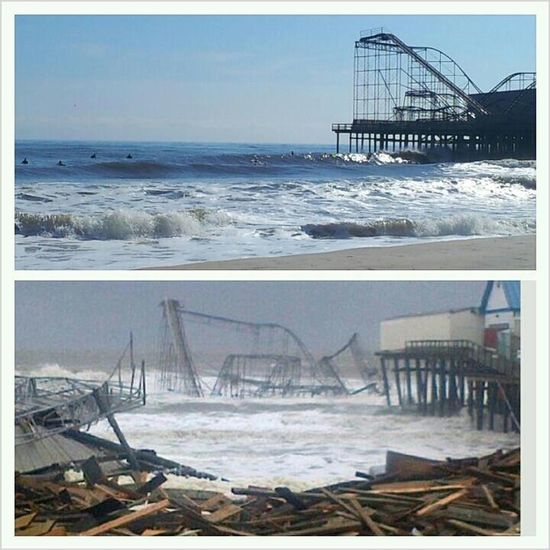
(Image from Buzzfeed's list of "25 Shocking Before & After Photos Of Hurricane Sandy's Destruction)

The Insurer Of Last Resort

Tod Kelly reflects on the role of government and why private insurance alone can't address a disaster like Sandy:

One of the hard lessons one learns in risk management is that no one funds for catastrophic losses unless they are required by an outside agency to do so. In many cases this is because it is not feasible to do so; but even in those cases where it is feasible, no one does.

Were FEMA to be dismantled, for example, there would be no financial resources from which to quickly rebuild from disasters like Hurricane Sandy. Conservatives might argue that private insurers could provide such protection, and this is certainly correct – on paper. However, one of the axioms from my industry is that there is no such thing as an uninsurable risk, there are just risks people aren’t willing to pay enough premium for.

This is absolutely true for natural disasters. If your insurance provider offered you or your business coverage that would protect you from disasters like Sandy, you would not be willing to pay the premium required. You might disagree with that statement, but history shows that it is true. In fact, it is almost universally true. Governmental disaster insurance schemes didn’t appear magically in a vacuum; they were created because prior no one was willing to pay enough money in premiums to allow insurance companies to properly fund for them, and as a result the inevitable losses were uncovered.

A Defense Of Price Gougers, Ctd

Matt Zwolinkski has re-posted his video on the ethics and economics of price gouging:

Obviously, the philosophy and the economics are both more complicated than I’m able to address in a short video like this. So, for those readers willing to dig a bit deeper, I recommend taking a look at my paper, “The Ethics of Price Gouging,” which looks more closely at questions about how gouging ought to be defined, its legal status, and its relation to moral concerns about exploitation. I take up that last issue again, somewhat briefly, in this paper, which responds to a critique of my position by the philosopher Jeremy Snyder.

Earlier Dish on the subject here.

Fighting Over FEMA, Ctd

Room For Debate asks about FEMA's importance. James Pethokoukis wants a bigger role for private companies. But Kathleen Tierney sees complete privatization as unworkable:

Those who would argue for a privatized emergency management system must address a series of questions. Under a profit-motivated private sector system, what would prevent private entities from “cherry-picking” easy emergency management activities while shunning more difficult tasks, like preparing huge, highly diverse cities with large vulnerable populations? What private-sector entities would offer assistance to bankrupt, but still vulnerable, communities, like many California jurisdictions, or communities caught in the vise of the fiscal downturn? Would services be more abundant in communities that are willing and able to pay for them? What would prevent companies from overpromising results and gaming the system, as they have in offering infeasible solutions in the war on terror while racking up large profits?

Earlier Dish on FEMA here.