Weather Patterns

GT KATRINA 121030

Reflecting on hurricanes Katrina and Isaac, Ingrid Norton mulls overs the futility of man-made defenses against nature's fury:

Chronicles of hurricane-prone regions tend to be strange mixtures of nostalgia, war stories, and amnesia. The same dramas are repeated each generation, the plots gradually shifted but not fundamentally altered by the ways residents and institutions adapt to the effects of storms. After Katrina, the Times-Picayune printed a nineteenth-century map of New Orleans next to a map of Katrina flooding: the areas that flooded the most had been sparsely inhabited in the nineteenth century. "I always say, if you learned lessons from Katrina, you didn’t know too much before," Windell Curole, general manager of the South Lafourche levee district, told me. In a 2010 report, he compared the post-Katrina focus on super strong levees to placing a passenger in a tank to protect from a car accident, and presciently noted that communities outside New Orleans were under protected.

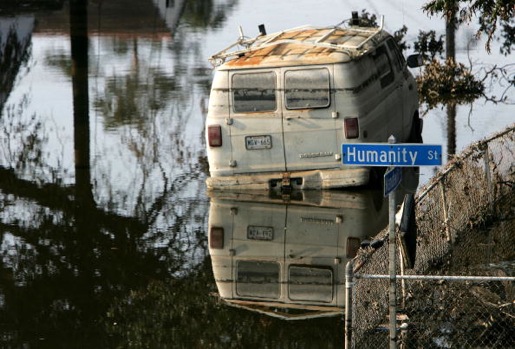
(Photo: A partially submerged van is seen on Humanity Street in New Orleans, Louisiana on September 13, 2005. By Justin Sullivan/Getty Images)

When Will The Power Come Back On? Ctd


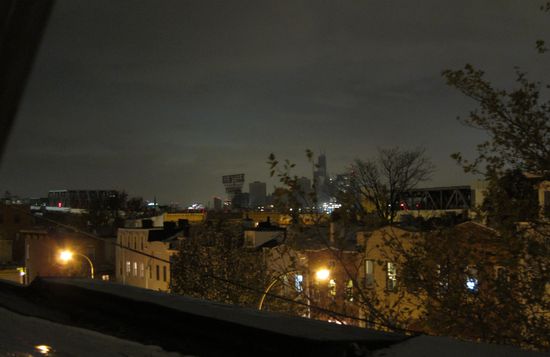
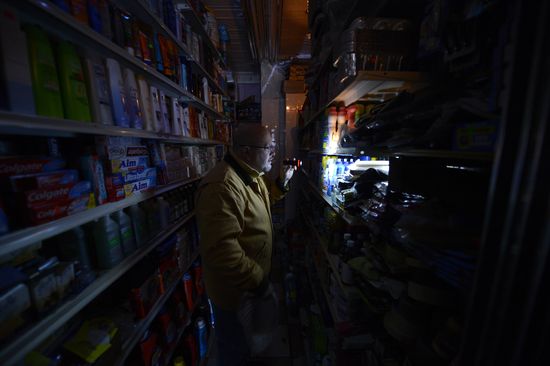
The in-tray has been eerily quiet since last night’s blackout. A reader writes:

This spring, a transformer blew in Boston and 20,000 customers lost power. It was in the heart of Back Bay, one of the few areas in the country that comes anywhere near Manhattan in population density. There was a fire, and it took three or four days to restore power to the area, during which time restaurants were closed and the streets were littered with tractor trailer-sized generators. The weather was fine, and there weren’t any other outages in the area, which had not just been inundated in a 100-year-plus storm.

Good luck.

Oy, thanks.

Assessing Sandy’s Toll

Costs of hurricanes

Serena Dai takes a stab:

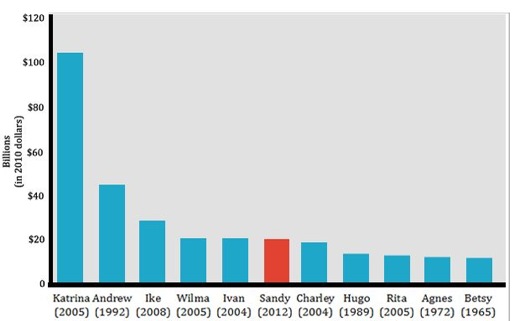
The havoc Sandy is wrecking may cost some $20 billion in economic damage, according to risk firm Eqecat Inc. It's a lot of money—so much, in fact, that the costs places Sandy in the top 10 most expensive hurricanes ever. Comparing Sandy with numbers from the National Hurricane Center's top ten costliest hurricanes list, Sandy places sixth when numbers are adjusted to 2010 dollars. NHC combines insured loss with National Flood Insurance Program figures to calculate its list. Sandy's costs will include repairing the New York subway system and any wind and rain damage to buildings.

Jared Bernstein reframes the analysis:

I’ve seen rough loss estimates of around $20 billion, of which some (half?) will be replaced by insurance payouts. Though retail, as noted, will take a hit, demand for storm-preparedness goods spiked big time before Sandy hit. And many–not all–trips and activities that were cancelled before the storm will now take place afterwards.

And then there’s the difference between gross domestic product and net domestic product. When stuff gets destroyed in a storm, that subtracts from the economy’s net product, but if it’s replaced, it actually adds to gross product. One economist, Diane Swonk, estimates that Sandy will actually "add from two-tenths to half a percentage point to economic growth this quarter."

Fighting Over FEMA

Tomasky puts the debate in perspective:

The only reason FEMA is “controversial” is that it massively effed up one big thing, Katrina. But the reason it screwed that up is that the president at the time didn’t give a crap about the agency and put a guy in charge of it who had no business whatsoever being in that position. And so, logically enough, they screwed it up, and tragically. But now that FEMA is being run by someone who’s actually interested in doing his job well and fulfilling his agency’s mission, there’s basically nothing wrong with the way it works.

Jonathan Cohn argues along the same lines:

States do many things well and, frequently, the most successful federal programs are the ones that let states innovate or take charge in those instances when they are positioned to do so. Emergency management happens to be one of them: Fulgate’s mantra at FEMA is to let states take the lead, with the federal government giving them the tools to do their job.

But even those programs require presidential-level commitment to a vibrant bureaucracy and, yes, serious federal spending. And that’s not something Romney, or his allies, endorse. On the contrary, Romney’s spending proposal would call for massive cuts to domestic spending. And if Romney wanted to add FEMA to the list of programs he’d spare, that’d simply mean more cuts to other programs—from food inspections to health clinics to air traffic control—on which public safety and well-being depend.

Meanwhile:

Shouting Flood In A Crowded Twitter

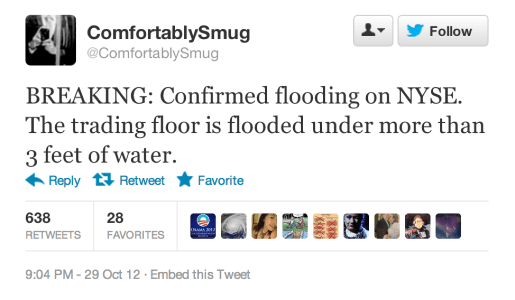
Comfortablysmug nyse tweet When Twitter user @comfortablysmug starting spreading false information last night, Buzzfeed’s Andrew Kaczynski went after him – first by tweet, then by tumblr:

[I]n the chaos around Hurricane Sandy, [@comfortablysmug tried] to trick his media followers, and their followers and readers in turn, with fake news. He reported, falsely, on a total blackout in Manhattan, on a flood on the floor of the New York Stock Exchange, and other things that didn’t happen. Two of his tweets garnered more than 500 retweets. One drew a rebuke from ConEd’s official Twitter account. Twitter’s self-correction mechanism — rebukes and rebuttals from knowledgeable sources — shut down each rumor, but not until at least one, the flood claim, had bled widely into the television media.

Today, Jack Stuef exposed the Internet villian:

What leads a person to do such a thing, which his critics have likened to shouting “fire” in a crowded movie theater? It’s unclear. But perhaps it has something to do with the nature of anonymity. If there are no consequences for posting false “BREAKING” news, there’s an incentive to do it to an accumulate a large audience.

What @comfortablysmug didn’t count on, apparently, was losing that anonymity. Based on photos he censored and posted to the account but I found unedited elsewhere, @comfortablysmug is Shashank Tripathi, a hedge-fund analyst and the campaign manager of Christopher R. Wight, this year’s Republican candidate for the U.S. House from New York’s 12th congressional district. FEC documents show Wight has paid Tripathi thousands of dollars this election cycle as a “consultant.” @comfortablysmug has been a vocal supporter of Mitt Romney and posted tweets suggesting he attended this year’s Republican convention. He’s listed here by a local Republican group coordinating volunteers for a Romney phone bank.

John Herrman considers the debunking of such falsehoods proof that Twitter is trustworthy overall:

Twitter beckons us to join every compressed news cycle, to confront every rumor or falsehood, and to see everything. This is what makes the service so maddening during the meta-obsessed election season, where the stakes are unclear and the consequences abstract. And it’s also what makes is so valuable during fast-moving, decidedly real disasters. Twitter is a fact-processing machine on a grand scale, propagating then destroying rumors at a neck-snapping pace. To dwell on the obnoxiousness of the noise is to miss the result: that we end up with more facts, sooner, with less ambiguity.

… The first draft of the popular history of 9/11 was written on live television by a group of exhausted, horrified and often isolated TV reporters. Misstatements, confusion, and some of the messier stages of live reporting, filtered across the country by phone, email and word of mouth without context. Much of the raw materiel of the “9/11 truth” movement is rooted in sloppy early news reports. Some of most insidious myths about Hurricane Katrina were seeded the same way.
Signing Up A Storm

Gawker calls Lydia Callis, the mayor's sign language translator, "New York City's Hurricane Crush." Joe Coscarelli pinpoints why she's such an Internet sensation (with Tumblr, YouTube and GIF paeans to prove it):

Unlike Bloomberg's own stilted Spanish, another highlight of the updates, Callis's signing is both lightning-fast and emotive, her animated face lighting up and contorting happily as she goes, not unlike a guitarist during a blistering solo.

Caitlin Wood explains why Callis is so expressive:

Facial expressions are a grammatical aspect of the language and can relay more information than the signs themselves. Many hearing people appeared to mistake her animated signing as being theatrical or over the top, when in reality she’s simply conveying the emotional tone of what’s being discussed.

Perhaps it was the juxtaposition of Ms. Callis’ vibrant signing with Bloomberg’s monotone delivery that made her interpreting appear so striking. Or maybe a weary city of millions was looking for any excuse to distract from the mood of impending doom and this particular interpreter was, as so many remarked, "hypnotizing." Or, maybe the majority of hearing Americans just aren’t that familiar with ASL so watching interpreting in real-time seemed incredibly novel. I’d say it’s a likely combination of all of those things.

Recent Dish discussion of signing here. Last year we ran a short thread called "Deafness As Ethnicity" – read it here, here and here.

A Defense Of Price Gougers

Governor Christie has promised to penalize price gougers. Mark Perry takes him to task:

Rising, market-based prices following a disaster are the most effective method possible of allocating scare resources, eliminating shortages, and attracting essential supplies to the areas that need them the most. In fact, market-based prices are also the most effective method possible of allocating scare resources, eliminating shortages, and attracting essential supplies to the areas that need them the most before a disaster – wind and rain don’t change that reality.

Governor Christie and others fail to recognize that the coordinating role of market prices becomes even more important following a disaster, not less important. To prevent the price system from operating following a disaster with price gouging laws will make the situation worse, not better. Thanks to the strict enforcement of their state’s price gouging laws, New Jerseyans should expect possible shortages of fuel, food and generators.

An earlier look at why price gouging often doesn't happen, even without government interference, here.