Is Sandy A Climate Game Changer?

154997607

Phil Plait sees an opening amidst all the “political opportunism with this storm”:

I am not a fan of such parasitism; latching on to an opportunity under the thinnest of pretense to trump a partisan view. However, let me be clear: we just had the world’s biggest metaphor come ashore in the United States. Years of outright climate change denial and faux skepticism will hopefully be shaken by this event. Sea ice melting happens far away; droughts, fires, shifting weather is unpredictable and difficult to grasp; statistical graphs are easily manipulated by special-interest groups and generally difficult to interpret anyway. But a hurricane a thousand miles across doing tens of billions of dollars of damage and causing untold chaos is more than a wake up call. It should be a shot of adrenaline into the heart.

But connecting Sandy directly to climate change is complicated, as Christopher Mims explains:

Is climate change causing Hurricane Sandy? The short answer is, a little bit, and possibly a lot, but we don’t know yet and might never know for sure. The slightly longer answer is, unusually warm seas and elevated sea levels are powering up Sandy so that she’s more devastating than she’d otherwise be, and those warmer seas are in part a result of human-caused climate change. Sandy is a “megastorm cake with climate frosting on top,” not entirely attributable to climate change but enhanced by it.  In addition, record Arctic ice melt might be to blame for Sandy’s leftward turn into the North American continent.

Bill McKibben doesn’t have high hopes for government action:

One reason we make so little progress is that we keep waiting for our political leaders to lead. But in this case, “leader” should be used advisedly. Our two presidential candidates have managed to slog through a summer of campaigning that carried them through the hottest month in U.S. history (July) and across a heartland enduring an epic drought.

As they talked, the Arctic melted at a speed that astonished even the most pessimistic climatologists. But it appeared they somehow hadn’t noticed—it was as if they’d acquired some special weatherproof coating. Mitt Romney talked briefly about climate at the RNC—it was his laugh line, when he mocked President Obama for trying to ‘slow the rise of the oceans.’ (Slightly less ha-ha today). And the president sat down at the kid’s table after all the debates, telling MTV he was “surprised” it hadn’t come up at the debates.

I wasn’t surprised. I would have been shocked if either of them had raised the issue, just as I’ll be shocked if Congress ever—ever—breaks its perfect 20-year bipartisan record of accomplishing nothing on the topic. Let’s be entirely clear about what’s going on. Just as the NRA has terrified politicians of talking sensibly about gun laws, so the fossil fuel industry has imposed an effective muzzle on discussions of carbon.

McKibben’s call to action here.

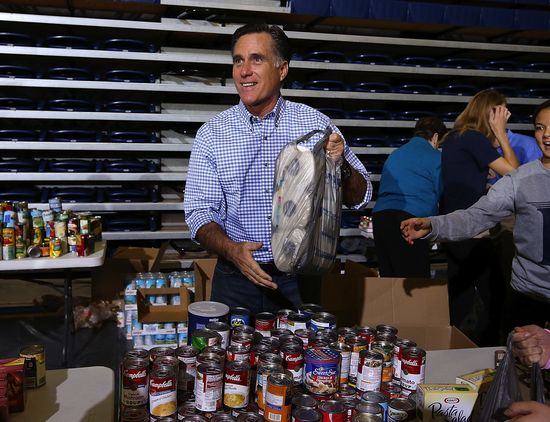
(Photo: Republican presidential candidate Mitt Romney holds a bag of donated paper towels during a Kettering Storm Relief event on October 30, 2012 in Kettering, Ohio. In the wake of Hurricane Sandy, Mitt Romney’s campaign has reduced their campaign schedule and are focusing their attention on disaster relief. By Justin Sullivan/Getty Images)
Oh Rats

They have to go somewhere:

"Rats are incredibly good swimmers," said [disease ecologist Rick] Ostfeld. "And they can climb."

In other words, Sandy is unlikely to knock off [NYC's] resilient rodents, but rather displace them. According to Ostfeld, this could result in increased risk of infectious diseases carried by urban rats, including leptospirosis, hantavirus, typhus, salmonella, and even the plague. "One of things we know can exacerbate disease is massive dispersal," he added. "Rats are highly social individuals and live in a fairly stable social structure. If this storm disturbs that, rats could start infesting areas they never did before." And it's not only the bite of a rat than can transmit disease. Rodent feces and urine can spread hantavirus, for example. Still, Ostfeld suggested that the huge volume of water Sandy is expected to bring should dilute the pathogens and lessen risks to public health.

Hopefully they won't be giant.

Sandy’s Sewage Threat

154993839

In the wake of Sandy, Kent Sepkowitz is most concerned about the integrity of the water supply:

More than email or mass transit or your favorite diner, all of urban life depends on plumbing—defined in practical terms as the effective provision of clean water for drinking and the regular removal of waste to a place nowhere near the source of clean water. The ancient Romans with their Cloaca Maxima were able to rule the world because of their attention (OK, obsession) to this elemental fact. Pliny the Elder considered their plumbing to be the greatest accomplishment of the Roman Empire. Clean in and waste out, in and out, in and out—that’s how civilization grows. Societies that accomplish this flourish while those that cannot generally struggle to move beyond the most rudimentary hand-to-mouth subsistence.

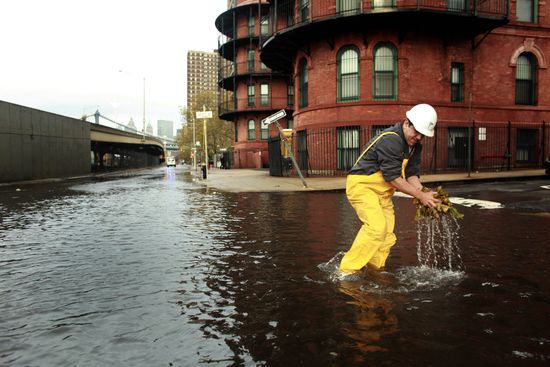
(Photo: A man clears leaves from a sewer drain in lower Manhattan on October 30, 2012. By Allison Joyce/Getty Images)

Instant Ruin Porn

Hurricane_Sandy

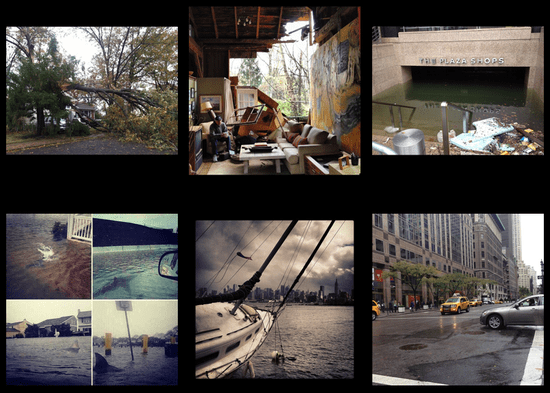
People on Instagram posted some 400,000 photos of the hurricane's impact, uploading 10 #sandy pictures per second as the storm hit land. View the best ones on instacane.com. Sarah Lacy sees the significance:

Hurricane Sandy — or Frankenstorm Apocalpyse as it’s being called on Foursquare — could be Instagram’s big citizen journalism moment. The time when the seemingly frivolous app could get some Arab Spring-style gravitas. … In theory, Instagram has Twitter’s immediacy, and a broader reach, since it pushes notices out via Twitter, Facebook, Instgram’s own network, and email. Clearly images are the best way to tell a story like this, and Instagram’s whole raison d’être is to make people better photographers. Add to that the storm’s target on urban, hipster, we’re-not-scared New Yorkers, and the time seems as good as any for the revolution to be Instagrammed.

Noreen Malone reflects on her discovery that "it turns out the most risk-embracing New Yorkers are the dog owners, closely followed by the smokers, and then the amateur photographers." On the latter group:

Powerhouse Arenas, the neighborhood's bookstore, was completely flooded: the proprietors had packed up the premises as best as possible, but stray paperbacks idled in shallow, scummy water, barely visible through the night-dark glass. The carousel wasn't gettable, but this was a pretty good metaphor too. I zoomed on with my camera to no effect; so did the half dozen or so other adventurers getting in on the ground floor of the ruin porn game. "That's a really cool shot if you had the right lighting for it," said one.

Making The Worst Kind Of History

154995380

Jeff Masters sizes up Sandy:

In a stunning spectacle of atmospheric violence, Superstorm Sandy roared ashore in New Jersey last night with sustained winds of 90 mph and a devastating storm surge that crippled coastal New Jersey and New York. Sandy’s record size allowed the historic storm to bring extreme weather to over 100 million Americans, from Chicago to Maine and from Michigan to Florida. Sandy’s barometric pressure at landfall was 946 mb, tying the Great Long Island Express Hurricane of 1938 as the most powerful storm ever to hit the Northeast U.S. north of Cape Hatteras, NC. New York City experienced its worst hurricane since its founding in 1624, as Sandy’s 9-foot storm surge rode in on top of a high tide to bring water levels to 13.88′ at The Battery, smashing the record 11.2′ water level recorded during the great hurricane of 1821. Damage from Superstorm Sandy will likely be in the tens of billions, making the storm one of the five most expensive disasters in U.S. history.

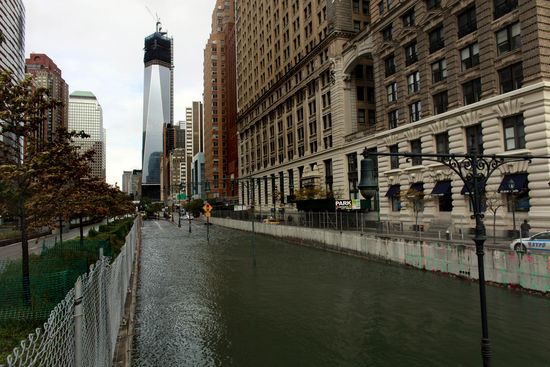
(Photo: The Brooklyn Battery Tunnel is flooded after a tidal surge caused by Hurricane Sandy on October 30, 2012 in Manhattan, New York. The storm has claimed at least 33 lives in the United States and has caused massive flooding across much of the Atlantic seaboard. US President Barack Obama has declared the situation a ‘major disaster’ for large areas of the East Coast. By Allison Joyce/Getty Images)

The Politics Of Disaster

Chait defends the politicization of Sandy:

What you are going to see over the next week is an overt effort by Democrats to politicize the issue of disaster response. They’re right to do it. Conservatives are already complaining about this, but the attempt to wall disaster response off from politics in the aftermath of a disaster is an attempt to insulate Republicans from the consequences of their policies.

Funding for FEMA is something the parties wrangle over, with Republicans pushing to limit the agency’s budget, and Democrats pushing back. FEMA has to fight for its share of a constricted pot of money for domestic non-entitlement spending, a pot of money that the Republicans propose to radically constrict. How radically? Romney’s budget promises require shrinking domestic non-entitlement spending as a share of the economy by about two-thirds.

Yglesias Award Nominee

"The federal government’s response has been great. I was on the phone at midnight again last night with the President, personally, he has expedited the designation of New Jersey as a major disaster area. The President has been outstanding in this and so have the folks at FEMA," – Chris Christie.

In Sandy’s Wake

From a summary of the latest press conference from Mayor Bloomberg:

10 people dead in the city. 80 houses lost in Breezy Point. 750,000 people without power. Public transportation remains closed until further notice. No timeline on return of bus service and subway. Limited bus service may be available later today. 911 services still working, but needs to be reserved for life-threatening emergencies only. Schools will be closed on Wednesday. Stay away from parks, beaches, damaged trees, and downed power lines. He guess it will take 3-4 days to restore power to all customers, and longer to restore full subways service. Drinking water is safe.

The MTA has since announced limited but free bus service back up this evening. JFK will reopen tomorrow but not La Guardia. For all of New York, Long Island might have gotten the worst of the storm. And then there’s New Jersey:

[Governor Chris Christie] called the level of devastation “unthinkable”. “This is beyond anything I ever thought I would see,” he said. He gave a stark description of the problems facing the state. Some 2.4m people are out of power, mass transit is at a standstill, roads and bridges closed amid severe damage, 29 hospitals are running on generators or experiencing power issues. Some 5,500 people are in shelters and the weather is still so bad that it is difficult to assess the full extent of the damage.

All power is out in Newark and Jersey City, and much of the state won’t have electricity for a while. The PATH train will also be down for at least a week. The coast was brutalized:

Search and rescue crews are combing the Jersey Shore looking for survivors. … Lavallette, Ortley Beach and Seaside Park were largely leveled by the storm surge. … Coastal flood levels were staggering during Hurricane Sandy, according to the National Weather Service. Records were shattered up and down the New Jersey coast. In Sandy Hook, water levels had broken the previous record by more than 3 feet before the tidal station was knocked out by the storm. At the time, the water was still rising. “Usually when you set a tidal record, you’re setting it by fractions of a foot,” said Dean Iovino, a meteorologist at the National Weather Service’s Mount Holly office. “To have a tidal record shattered like that is just, wow.”

And Atlantic City:

Even as the first samplings of the storm’s ravages descended on the New Jersey coastline, Atlantic City was already in big trouble. At high tide around 8 a.m., officials said 70 to 80 percent of the city was underwater. Water as much as eight feet deep coursed through some streets, leaving them impassable. Heavy rains and sustained winds of more than 40 miles an hour, with gusts of more than 60 miles an hour, battered the city.

The WSJ notes that Sandy was hitting a city that was already down:

Atlantic City still relies heavily on tourism. A Rutgers University study from May 2010 found the seaside destination drew 34.4 million visitors who spent an estimated $7.5 billion in 2008. Casino resorts were a major draw, with 80% of visitors reporting that gambling was the primary purpose of their trip. But in recent years, the industry has struggled as it has lost ground to a host of regional competitors. By the morning, water had risen in the streets surrounding the new $2.4-billion Revel Casino, which opened this spring amid hopes that it could reignite the industry. But revenues continue to decline overall most months since it opened. In the second quarter nine of the city’s 12 casinos reported losses. Gambling revenue across the city is down 4.8% for the year. On Monday, many of the casinos were boarded up, empty save for a few security personnel and top executives.

In Hoboken:

Alan Taylor is up with a gallery of the devastation. New Jersey live-blog here. Long Island live-blog here. Connecticut live-blog here. Summary information on other states here. For all of the Dish’s hurricane coverage in one place, go here.