Expatriatism

by Jonah Shepp

150823_520563634238_3137000_n

As a child and teenager, I attended one of those New York City magnet schools that you read about from time to time, such as when an alum tentatively proposes to shut them all down. Accordingly, I share an alma mater with some notable individuals. The year I graduated, our commencement ceremony attracted a moderate crowd of local paparazzi on account of our guest speaker: Cynthia Nixon, class of ’84. In terms of pure star power, we had outdone the class of 2002, whose distinguished alumnus had been Elena Kagan, at the time merely the first female dean of Harvard Law School. Yeah, that kind of high school.

But celebrity aside, Nixon’s address to our class was actually more insightful than I, at 17, had expected. After the customary platitudes about lifelong friendships and school pride, she got to the point, which she summed up in four words: “Get out of here.”

Now what she meant by this was that if we lived our entire lives in New York, we’d limit the expansion of our minds much more than we realized. Growing up in an international megacity, it’s easy for native New Yorkers to fool ourselves into thinking that we are citizens of the world simply because the world has moved in down the block. The thrust of Nixon’s address to us was that this was a fallacy, and that if we really wanted to get some perspective on how unusual our metropolitan upbringings had been, we ought to spend some time not just traveling but living outside the city, and if we had the chance, outside the country as well.

Four years later, after finishing college in the opening act of the Great Recession with no prospects or plans for the future, I took advantage of a random opportunity and got out of here. Specifically, I moved to Jordan, where I lived for the better part of the next several years. For those who say you can’t learn anything from Hollywood, let me tell you something: Cynthia Nixon was right.

Living abroad, especially in a milieu so different from that of my childhood, did for me what no amount of formal education could: it challenged me to look at myself, America, and the world, from the standpoint of a foreign Other; and revealed the limits of my ability to inhabit that standpoint. It complicated my narrative of history and showed me how incredibly privileged I was to be an American citizen, starting with the fact that most people can’t just up and decide to move to another country for a while.

Probably the most significant impression Jordan made on me was how it guided the evolution of my views on the Israeli-Palestinian conflict. Jordan bore the brunt of both the 1948 and 1967 Palestinian refugee crises and at least 50-60% of its population is of Palestinian origin (or rather, was; the Syrian crisis has increased Jordan’s population by 10 percent). In any case, a majority of the friends I made in Jordan are of Palestinian descent, and it’s harder to deny people’s rights or historical narratives when you actually know them. I’ve written at length elsewhere about what it was like to live there as an American Jew, and I’ll likely touch on this again in a separate post this week, but the moral of the story is that people’s world views are always and everywhere shaped by experience, and it is always worth considering how someone arrived at an opinion before holding them in judgment over it, even if I don’t share it, and even if I believe it to be objectively incorrect. This is a skill I find lacking in the most polemical of the opining class, and not only in discussions of Israel and Palestine.

I also got a good firsthand look at how incredibly lucky I am to be an American. A US or EU passport remains an object of envy around the world, even among people who care little for American or European culture or values. There’s an awful lot to be said here, most of it obvious, but it bears remembering that the accident of my birth on American soil holds open doors for me that remain shut to the majority of the world. My experience of expatriate life was completely different than those of the vast majority of emigrants, who leave their countries because they have to, not because they want to. And needless to say, living in a country that does not quite have a free press, free speech, or free religion made me all the more appreciative of what America does right. These are privileges worth checking from time to time.

More broadly, I think the experience of living abroad showed me the extent to which the culturally progressive, “when you’re cut, you bleed” attitude toward people of various races and religions—the notion that we are all fundamentally the same—is true, as well as its limits. We are not all the same. Culture matters; it is as much a product of history as anything else that matters. But the human condition is a general state of affairs. A major feature of that condition today is the city, with its attendant poverty, crowding, crime, pollution, and traffic. These problems take a variety of shapes: Amman’s unemployment problem is very different in its origins and expressions than that of Caracas or Harare or Los Angeles, but the problem is fundamentally the same, and endemic to large cities. And global events like the Great Recession really are felt everywhere, in similar ways.

My point is that those who are fortunate enough not to live in failed states or active warzones (and let’s not forget about the millions who are), are worrying from day to day about the same things: rent, bills, food, family disagreements, lovers’ quarrels. When we pay attention to world events, we think of them first and foremost in terms of how they affect us directly. This narrow perspective is a natural result of the parochial concerns that rule our day-to-day lives, but a little appreciation for how universal those concerns are (that is to say, empathy) can go a long way toward broadening the individual perspective, softening prejudices, and healing enmities, which is the only way to permanently end wars.

I arrived at all these insights, such as they are, in the same way: simply by standing in another person’s shoes. That’s why I think my time as an expatriate strengthened my conviction, which I call humanism, that empathy is a sufficient cause for ethical action.

So now I put the question to you, dear Dishheads. I know by the views from your windows that we have readers from Denver to Dushanbe, and I know you didn’t all start out where you ended up, so to those of you who live or have lived outside the country of your birth: what motivated you to do so and how did the experience change you? Perhaps you haven’t lived abroad but have moved from, say, rural Kentucky to San Francisco, or vice-versa: a bigger change of scenery than crossing some international borders. I’d ask you the same question. Migration has always had a significant hand in history; in a global economy, that role is even greater. What has it meant to you? Email me your thoughts at dish@andrewsullivan.com.

(Photo: The view from my window—OK, balcony—in Amman, Jordan, by my roommate Matt, who was slightly better about taking pictures than I was.)

Burning Earth

by Bill McKibben

California Drought Dries Up Bay Area Reservoirs

At Burning Man in the desert, where the proprietor of this blog, and Grover Norquist, and a lot of other people are gathered this week, they had a rare heavy rainfall, which “intensified the misery of people waiting in the will call lines” at the box office. That A similar soaking in the Mojave Desert meant that the area of California under severe drought conditions fell last week from 97.5 to 95.4%, but the effect of the ongoing record aridity keeps magnifying. On the grossest scale, the region has now lost 63 trillion gallons of groundwater, which weighs about 240 billion tons, which has caused the state’s mountains to grow half an inch taller.

But the drought in California is probably not the worst such crisis underway on the planet at the moment, in part because California is rich. In Central America last week Guatemala became the latest country to declare a state of emergency, as the worst drought in decades wreaks havoc with bean and corn crops. According to the AP:

In Guatemala, about 170,000 families lost almost all of their crops, while in El Salvador crops have completely been lost in two-thirds of the country.

In Nicaragua, where the drought has killed more than 2,500 cattle and left 600,000 people in a state of malnutrition, the government is asking international food agencies to help it feed 100,000 families in parched areas.

Gang violence is doubtless sending Central American children north to the border. Doubtless the drought is playing its part too. Drought, being slow-moving and undramatic, tends not to catch our imaginations like flood or storm. But it may be one of the most insidious results of a changing climate. Research has shown drought on the increase as temperatures rise, and a study this spring made it clear that the world was in for more and more drought–none of that should come as a surprise, given the basic physics. But researchers have also found, over and over, that drought helps breed conflict, in places from Sudan to Syria. Given the increasing centrality of the Syrian conflict, it’s worth taking a moment to remember that, as Brad Plumer points out in this Washington Post interview with regional expert Francesco Femia, during the period from 2006-2011 up to 60% of the nation experienced one of the worst droughts in history. Femia:

This drought — combined with the mismanagement of natural resources by [Syrian President Bashar] Assad, who subsidized water-intensive crops like wheat and cotton farming and promoted bad irrigation techniques — led to significant devastation. According to updated numbers, the drought displaced 1.5 million people within Syria.

We found it very interesting that right up to the day before the revolt began in Daraa, many international security analysts were essentially predicting that Syria was immune to the Arab Spring. They concluded it was generally a stable country. What they had missed was that a massive internal migration was happening, mainly on the periphery, from farmers and herders who had lost their livelihoods completely.

So if you want to know why some U.S. military officials call climate change the biggest threat to national security, this is one of the reasons. As Admiral Samuel Locklear, head of US Pacific forces, put it last year:

“We have interjected into our multilateral dialogue – even with China and India – the imperative to kind of get military capabilities aligned [for] when the effects of climate change start to impact these massive populations,” he said. “If it goes bad, you could have hundreds of thousands or millions of people displaced and then security will start to crumble pretty quickly.’’

(Photo: A car sits in dried and cracked earth of what was the bottom of the Almaden Reservoir on January 28, 2014 in San Jose, California. By Justin Sullivan/Getty Images)

Why Oil Companies Are Rogue Actors

by Bill McKibben

A Greenpeace activist holds a banner dur

A reader writes to complain that fossil fuel divestment is a pointless waste of time:

What divestment does do is make people feel good. That they’re “doing something”, without having to do the thing that they actually need to do: use much less fossil fuel. It’s like a room full of chain smokers advocating tobacco divestment.

This is a reasonable complaint, or at least it would be if having individual people decide to use less fossil fuel could actually cure global warming in the time that physics allows us. But it can’t, because the problem is structural: given that the fossil fuel industry is allowed to pour carbon into the atmosphere for free, they have a huge incentive to keep us on the current path. And since they’re the richest industry on earth, they have the means as well as the motive. (Chevron, for instance, offered the largest corporate campaign contribution post-Citizens United two weeks before the last federal election). If we’re going to do anything about carbon, we’re going to have to break the power of the fossil fuel industry first, which is why divestment from high-profile places is so important (just as it was in the South Africa fight). Nelson Mandela journeyed to the University of California shortly after his release to thank students and faculty there, and by extension at 155 other campuses, for pressing the case so effectively.

Here’s an example from the days news of why oil companies are rogues.  You’ll recall that on Monday a leaked draft of a new report from the world’s climate scientists stated that

 companies and governments had identified reserves of these fuels at least four times larger than could safely be burned if global warming is to be kept to a tolerable level. That means if society wants to limit the risks to future generations, it must find the discipline to leave the vast majority of these valuable fuels in the ground, the report said.

So, demonstrating the exact opposite of that discipline, Shell yesterday filed for the right to become the first big driller in the Alaskan Arctic. It’s actually a followup to their first attempt a couple of years ago, which went tragicomically wrong when a drilling rig ran aground in a storm. But forget the myriad local dangers. The real story is, the world already has four times more hydrocarbons than they can use, but Shell (and its brethren) are busy searching for more. This is like nuclear overkill, except that they’re planning to sell every bit of the oil they find. It’s business as usual, and it’s insane–and anyone who invests in it, make no mistake, is profiting from the wrecking of the planet.

“These people are paid to play and not to watch,” said Fadel Gheit, a senior oil company analyst at Oppenheimer & Company. “After all the hiccups and bad luck, the company has decided that the upside potential is greater than the downside risk and its worth another shot.”

All a game, with the only planet we’ve got hanging in the balance. Oh, and Chevron, with its mighty campaign warchest?  Check out this new piece from Rolling Stone if you’d like to see how they play. (Rough).

(Photo. A Greenpeace activist holds a banner during a protest on May 10, 2012. By Michal Cizek/AFP/Getty Images)

Don’t Speak, Memory

by Sue Halpern

Cross-Section

I’ve been reading various reports (like this one) of the success of a research group at MIT in taking the sting out of bad memories by switching the bad ones with good ones:

“In our day to day lives we encounter a variety of events and episodes that give positive or negative impact to our emotions,” said Susuma Tonegawa, Professor of Biology and Neuroscience at the Riken-MIT Centre for Neural Circuit Genetics.

“If you are mugged late at night in a dark alley you are terrified and have a strong fear memory and never want to go back to that alley.

“On the other hand if you have a great vacation, say on a Caribbean island, you also remember it for your lifetime and repeatedly recall that memory to enjoy the experience.

“So emotions are intimately associated with memory of past events. And yet the emotional value of the memory is malleable. Recalling a memory is not like playing a tape recorder. Rather it is like a creative process.

Granted, the experiments are on mice, but mouse models tend to transfer well-enough to humans that the scientists are hopeful that they are on to something useful. But will it be?

I realize this sounds crazy. Given the chance, who wouldn’t want to erase or in some way circumvent the memory of being mugged? And what about PTSD? The MIT group is hopeful that their technique, when applied to humans, will counter the effects of post traumatic stress.

If the MIT group fails, there still may be hope, courtesy of DARPA, the research arm of the Defense Department, which is developing an implantable chip that intended to lessen the effects of post traumatic stress. According to the Washington Post:

It’s part of the Obama administration’s larger “BRAIN Initiative,” which involves the National Institutes of Health, DARPA, the National Science Foundation and the Food and Drug Administration, among other organizations.

Officials say the BRAIN Initiative — which stands for Brain Research through Advancing Innovative Neurotechnologies — includes a related DARPA effort to build new brain chips that will be able to predict moods to help treat post-traumatic stress. It’s known as the SUBNETS program, short for Systems-Based Neurotechnology for Emerging Therapies. Teams at both the University of California, San Francisco, and Massachusetts General Hospital in Boston are involved.

“Instead of relying only on medication, we envision a closed-loop system that would work in concept like a tiny, intelligent pacemaker,” said Doug Weber, the program’s manager. “It would continually assess conditions and provide stimulus patterns tailored to help maintain healthy organ function, helping patients get healthy and stay healthy using their body’s own systems.”

(If I am a little suspicious of this technique, it may be because a few years ago, while writing about the use of virtual reality to help veterans overcome PTSD, I also learned that the military was interested in using the technique in the field, to get psychologically damaged soldiers quickly back into action, which seemed both dangerous and creepy to me.)

We are made of memories and formed by experience. I keep wondering what kind of people we would be, and what kind of world this would be, if when bad things happened we could erase them, or somehow make them sweet. Consider Anna Whiston-Donaldson, author of the just published memoir Rare Bird, whose 12-year-old son died in a freak accident, drowning during a rainstorm. One imagines what she’d wish for is that her son did not die, not that she didn’t remember it, and not, even, that it wasn’t as painful as it was.  Wouldn’t that impair grieving? Wouldn’t it dishonor–for lack of a better word–her son? I am not presuming to know. I don’t know. But I do know that meaning comes from many places.

So here is my question: if you could forget or erase that bad thing that happened to you, whatever it is, would you? Another way of asking this question is this: how has that bad thing made you who you are? Is there value–not in grief, but in grieving?

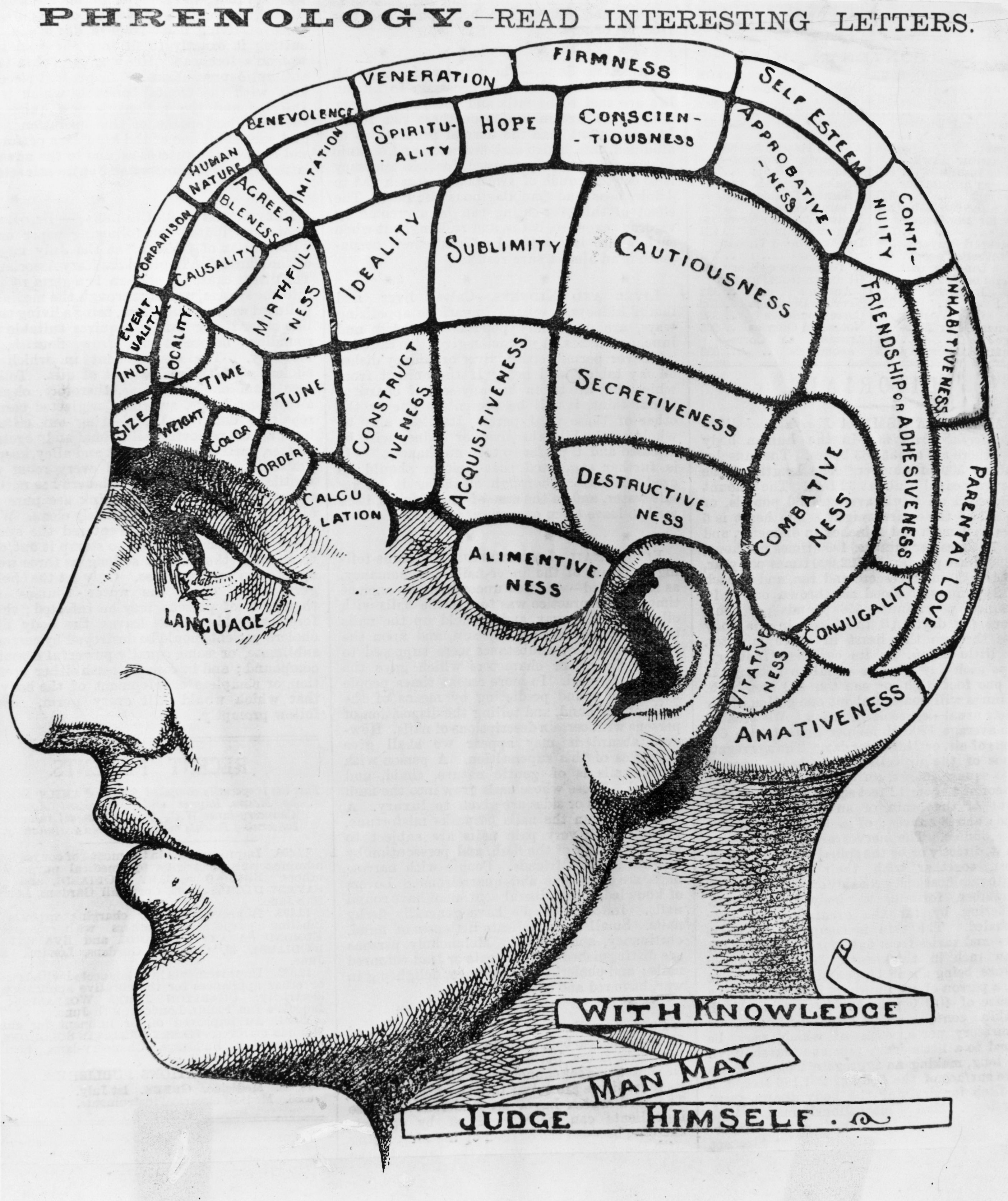
(Photo: circa 1880: A phrenological cross-section of a man’s head, illustrating the idea that the brain processes thoughts in different locations according to their type. By Hulton Archive/Getty Images)


Let Them Build Seawalls

by Bill McKibben

Greeehouse Emissions

As a good Dish reader, I know I’m supposed to take libertarianism seriously, and so I try, even if every time I contemplate Ayn Rand I find myself wishing I’d been born to a different species. It’s possible that my trouble stems from the fact that dealing with climate change is notoriously difficult for libertarians: if you burning the coal in your coal mine raises the sea level around my continent, something’s amiss. So too many theoretically rational and science-minded libertarians have tended towards denying the physics of global warming, just to avoid dealing with the implications for the philosophy. (There are of course honorable exceptions, like Ronald Bailey at Reason).

But this is really rich. Writing from his perch at the Cato Institute, Charles “Chip” Knappenberger explains why the U.S. should avoid taking a leadership role in any climate negotiation: because others have more at stake:

Such information is carefully concealed in Obama Administration reports, such as the one issued recently by the Council of Economic Advisors that predicts escalating costs the longer we delay serious climate change mitigation efforts. Instead of focusing on domestic costs of climate change, the report is built around an estimation of the global cost for carbon dioxide emissions—which, by the Administration’s numbers—is some 4 to 14 times greater on a per ton of emitted CO2 basis than those projected for the U.S.

Translated: climate change is going to be worse for Bangladesh, so let them deal with it. And it is going to be worse–it already is. People are starting to evacuate their island nations as seas rise. It’s true we may lose Miami, but we’re well off enough, perhaps, to take the hit. Asks Knappenberger sweetly:

Why should the President’s rush to restrict U.S. carbon dioxide emissions, which even his own officials say raises concerns about domestic energy costs and grid reliability, be justified upon supposed benefits which will largely accrue to foreign nations?

That would be piggish enough right there–but of course what Knappenberger doesn’t even mention in his column is that we’re the reason that Bangladesh has a problem. They hardly emit any co2–they’re a rounding error in any calculation. Whereas the United States has contributed more by far than any nation to the concentration of greenhouse gases in the atmosphere (China won’t match us even by 2030, and on a per capita basis, we’ll be champs forever).

Knappenberger’s logic will doubtless play well in the GOP as it stymies any nascent Obama administration effort to lead the world in a new direction. But if the libertarian creed is about people taking responsibility for their actions, as opposed to getting away with what they can, this is crass.

(Chart from the PBL Netherlands Environmental Assessment Agency)

The Golden Era of Radio

by Bill McKibben

9345625442_b4e8b267ea_k

I may have mentioned that most of this week is being spent cleaning. That means I’ve had my earbuds in for several hours at a time. And that means, in turn, I’ve been reflecting on just what a golden age of radio, or at least of words spoken magically through the ether, we are lucky enough to live in.

Almost no one ever covers radio, though its reach is astonishing: All Things Considered beats the network tv newscasts (in more ways than one). But ATC and Morning Edition are smooth and dependable but rarely intriguing, provocative, sublime. Those adjectives are better reserved for the various podcasts that have grown up in the wake of This American Life. There’s only one Ira Glass, but there are other wonderful and quirky voices, many of them at the moment allied together in the Radiotopia collective, a kind of Justice League for smart documentarians and sound artists sponsored by the wonderful Public Radio Exchange, one more brainchild of Jay Allison who is the man behind much of the great radio that ever gets made. All seven of the podcasts in the series will draw you in and make you forget you’re washing windows; one of the newest and most intriguing voices belongs to Benjamen Walker, whose Theory of Everything evolved from a show he did on WFMU for years. He specializes in a kind of shaggy dog storytelling that lingers in one’s ear.


Most of these shows are not on most of your radio stations—they largely get listened to on podcasts, because most public radio program directors are about as conservative as it’s possible to be. (There are times when it appears public radio stations are in a contest to see who can achieve the oldest possible demographic).

I don’t promise I won’t write more about some of my favorites this week, in part because it annoys me how little attention gets paid these programs. The Times reviews almost every movie that comes out (I enjoy reading their reviews of part 6 of some slasher series) and even though I’ve never seen Breaking Bad I can tell you pretty much everything about it because of the number of stories I’ve read. Radio not so much—the people who make it do so without much public feedback about what’s working and what isn’t. So plug your favorites via dish@andrewsullivan.com.

Update: Read the follow-up to this post here.

(Photo, which has been cropped, by Johan Larsson)

The Failure Of Diversity

by Sue Halpern

University Of Birmingham Hold Degree Congregations

Over the past few years we’ve read debate after debate about the value of a college degree, about the value of studying the humanities, about the value–not!–of an Ivy League education. We’ve learned that it still pays to go to college since college grads earn more than those who without a degree. We’ve learned that English majors do better than promoters of STEM education might have us believe. We’ve learned that this bit of information has not been shared with some university administrators and legislators, who would like to eliminate such “useless” degree programs. We’ve learned that there aren’t as many STEM jobs as we’ve been lead to think there are, but we’ve also learned that math and computer science graduates make more money than, say, psych majors. We’ve learned from a former Yale professor (though we’ve heard it before) that his colleagues at big, fancy research institutions don’t really value interacting with students. We’ve learned, from students and alumnae at some of those places, that that’s not always the case. (As I learned yesterday from a video posted on this site, “the plural of anecdote is not data.”)

But what may be the most pertinent piece of information has emerged this summer comes from a pair of government studies, reported yesterday in The New York Times, that show that despite all efforts at “diversity,” American colleges and universities have made essentially no gains in opening their doors to the poor and less-well-off. And this despite the fact that the number of high achieving students from poor families has substantially increased.  

Another study, of the most selective colleges in the country, found that

from 2001 to 2009, a period of major increases in financial aid at those schools, enrollment of students from the bottom 40 percent of family incomes increased from just 10 percent to 11 percent.

Education experts offer numerous explanations for this flat line: these are students without role models and without parents who have attended college so they do not know what is possible; these are families who look at the sticker price–now over $60,000 in some cases–and don’t know that financial aid might knock that down to something reasonable; these are schools that don’t do a great job of seeking out the best-and-the brightest from low income backgrounds. According to Cappy Hill, the president of Vassar, a school that has made an effort to enroll these students, and has succeeded, “There has to be a commitment to go out and find them.”

It may be, though, that it is precisely commitment that is lacking:

“A lot of it is just about money, because each additional low-income student you enroll costs you a lot in financial aid,” said Michael N. Bastedo, director of the Center for the Study of Higher and Postsecondary Education at the University of Michigan. “No one is going to talk openly and say, ‘Oh, we’re not making low-income students a priority.’ But enrollment management is so sophisticated that they know pretty clearly how much each student would cost.”

Colleges generally spend 4 percent to 5 percent of their endowments per year on financial aid, prompting some administrators to cite this rough math: Sustaining one poor student who needs $45,000 a year in aid requires $1 million in endowment devoted to that purpose; 100 of them require $100 million. Only the wealthiest schools can do that, and build new laboratories, renovate dining halls, provide small classes and bid for top professors.

The rankings published by U.S. News and World Report, and others, also play a major role. The rankings reward spending on facilities and faculty, but most pay little or no attention to financial aid and diversity.

Here’s a plan: Next time you hear a college with which you are affiliated touting its diversity statistics, dig deeper. Critical Inquiry: the true value of the liberal arts.

(Photo by Christopher Furlong/Getty Images)

News Of The World

by Bill McKibben

Climate Change And Global Pollution To Be Discussed At Copenhagen Summit

Every day there’s something more immediately important happening in the world: ISIS is seizing an airbase this morning, and California is recovering from an earthquake, and Michael Brown is being buried.

But there’s nothing more important that’s happening each and every day than the ongoing deterioration of the planet on which we depend. Though on a geological time scale it’s proceeding at a hopelessly rapid pace, in terms of the news cycle it happens just slowly enough to be mainly invisible. It’s only when a new study emerges, or a shocking new data set, that we pay momentary attention, until the Next New Thing distracts us.

Here’s one installment in this ongoing saga, released this morning by Environmental Health News and National Geographic. It’s about birds, and the fact that across the planet they’re in serious trouble:

In North America’s breadbasket, populations of grassland birds such as sweet-trilling meadowlarks are in a free-fall, along with those everywhere else on the planet. Graceful fliers like swifts and swallows that snap up insects on the wing are showing widespread declines in Europe and North America. Eagles, vultures and other raptors are on the wane throughout Africa. Colonies of sea birds such as murres and puffins on the North Atlantic are vanishing, and so are shorebirds, including red knots in the Western Hemisphere. Sandpipers, spoonbills, pelicans and storks, among the migratory birds dependent on the intertidal flats of Asia’s Yellow Sea, are under threat. Australian and South American parrots are struggling and some of the iconic penguins of Antarctica face starvation.

While birds sing, they also speak. Many of their declines are driven by the loss of places to live and breed – their marshes, rivers, forests and plains – or by diminished food supply. But more and more these days the birds are telling us about new threats to the environment and potentially human health in the coded language of biochemistry. Through analysis of the inner workings of birds’ cells, scientists have been deciphering increasingly urgent signals from ecosystems around the world.

Like the fabled canaries that miners once thrust into coal mines to check for poisonous gases, birds provide the starkest clues in the animal kingdom about whether humans, too, may be harmed by toxic substances. And they prophesy what might happen to us as the load of carbon-based, planet-warming gases in the atmosphere and oceans climbs ever higher.

This news follows by a couple of weeks a study showing that invertebrate numbers–not species, but total numbers–have fallen 45% in the last 35 years. That seemed impossible to me when I first read it, so I checked with a few biologist friends. Yep, they said, for the species that have been studied that seems right. One added, “when I was a boy and we’d go for a drive in the summer, the windshield would be splattered with bugs. That doesn’t happen so much any more.”

Or consider this: Researchers using the incredibly sensitive GPS sensors found that the ongoing western drought had cost the region 63 trillion gallons of lost groundwater since 2013, taking enough weight off the crust of the planet that the Sierras had jumped 0.6 inches skyward.

Can we just review? Forty five percent fewer invertebrates in the last 35 years. We’re talking about a scale of destruction–of habitat, of climate, of cell biology–that staggers the mind. There are some things that could be done, but they are mostly enormous too (above all, stop burning fossil fuel.) Taking those giant steps would first require really paying attention. We have the satellites and sensors and supercomputers that we need to sound the alarm, but mostly we tune out the sound.

(Photo: Residential homes sit in front of the coal fueled Ferrybridge power station as it generates electricity on November 17, 2009 in Ferrybridge, United Kingdom. By Christopher Furlong/Getty Images)

Where Have You Gone, Reinhold Niebuhr?

by Matthew Sitman

Oh how I remember those heady days when everyone was writing about and discussing Reinhold Niebuhr, the American theologian famous for books like The Nature and Destiny of Man and The Irony of American History, the preacher who taught us how to think about the Cold War. As a graduate student immersed in Niebuhr’s work around this time – the “Niebuhr moment” probably peaked in 2007 or 2008, but his specter loomed over many of the arguments about the invasion and occupation of Iraq – I had the rare pleasure of feeling like my labors in the stacks really connected to contemporary debates. For once, a preoccupation with theology was cool. In his 2007 Atlantic essay, “A Man for All Reasons,” Paul Eli aptly summarized the Niebuhr-love that seemed to be everywhere:

[T]he Niebuhr revival has been perplexing, even bizarre, as people with profoundly divergent views of the war have all claimed Niebuhr as their precursor: bellicose neoconservatives, chastened “liberal hawks,” and the stalwarts of the antiwar left. Inevitably, politicians have taken note, and by now a well-turned Niebuhr reference is the speechwriter’s equivalent of a photo op with Bono. In recent months alone, John McCain (in a book) celebrated Niebuhr as a paragon of clarity about the costs of a good war; New York Governor Eliot Spitzer (at the Chautauqua Institution) invoked Niebuhr as a model of the humility lacking in the White House; and Barack Obama (leaving the Senate floor) called Niebuhr “one of [his] favorite philosophers” for his account of “the compelling idea that there’s serious evil in the world.”

Seven years after Elie could compare him to Bono, we seem to be hearing much less about Reinhold Niebuhr, a fact that I was reminded of while reading Dale Coulter’s short essay this week marking sixty years since the publication of Niebuhr’s The Children of Light and the Children of Darkness. Coulter lays out the book’s basics, but there’s no real attempt to connect Niebuhr to present days concerns. That’s not a criticism, but it was telling, given all the previous attempts, noted above, to make Niebuhr a sage for our times. And even more, this was the first time in quite awhile I had read anything at all about Niebuhr aimed at a general audience.

I have a theory about why the Niebuhr moment has passed – and why it matters.

Part of Niebuhr’s post-9/11 popularity, I would argue, was the compelling way he connected Christian theology to modern political problems. He could use original sin to diagnose American democracy, or discuss the coming of a world community as embodying Christ’s love. He wrote about war and peace while drawing on figures ranging from St. Augustine to Abraham Lincoln. Niebuhr was no mere pundit; his writing had a depth and seriousness notable in his own day and even more rare in ours. And when we found ourselves struggling to understand how to make our way in a newly terrifying world, we turned to Niebuhr as both a model and a resource.

But as Elie points out, there were elements of Niebuhr’s thought that seemed to support, or could be wrenched into supporting, nearly every imaginable position regarding the war on terror and, especially, regime change in Iraq. Which is another way of saying we found in Niebuhr what we wanted to find, all while enjoying the heft he gave our own ideas. The way we read him confirmed our preexisting inclinations more than it provoked us to think deeply and creatively – his work should have been, but wasn’t, a mirror in which we were forced to take a long hard look at ourselves and confront our fallibility and pride, to question our assumptions and cherished certainties.

The more I’ve considered Niebuhr’s work the more I’m convinced that’s what he calls us to, and what we resist. Once we had rummaged through his work for polemical purposes, we left him behind, refusing to grapple with the most enduring elements of his thought. Niebuhr saw the self-interest lurking behind every argument, understood self-deception to be perennial, grasped that nothing in this world was pure. He should have been used not to endorse this or that particular position, but turned to as a prophetic figure who calls all of us acknowledge what, in a different time, we’d have called our sinfulness. As he wrote in The Children of Light and the Children of Darkness:

Democracy therefore requires something more than a religious devotion to moral ideals. It requires religious humility. Every absolute devotion to relative political ends (and all political ends are relative) is a threat to communal peace. But religious humility is no simple moral or political achievement. It springs only from the depth of a religion which confronts the individual with a more ultimate majesty and purity than all human majesties and values, and persuades him to confess: “Why callest thou me good? There is none good but one, that is, God.”

Niebuhr asked us to see ourselves as the flawed beings we are not to encourage pessimism, but to brace us for the hard work of engaging political life aware that there are never simple or easy answers. We are called to pursue justice, but there always will be a tragic element to that pursuit. Our “moral ideals” are never unmixed with the narrowness of our own perspective. This is less of a political program than a political sensibility, one perhaps best summarized in these oft-quoted words from The Irony of American History:

There are no simple congruities in life or history. The cult of happiness erroneously assumes them. It is possible to soften the incongruities of life endlessly by the scientific conquest of nature’s caprices, and the social and political triumph over historic injustice. But all such strategies cannot finally overcome the fragmentary character of human existence. The final wisdom of life requires, not the annulment of incongruity but the achievement of serenity within and above it…

Nothing worth doing is completed in our lifetime; therefore, we are saved by hope. Nothing true or beautiful or good makes complete sense in any immediate context of history; therefore, we are saved by faith. Nothing we do, however virtuous, can be accomplished alone; therefore, we are saved by love. No virtuous act is quite as virtuous from the standpoint of our friend or foe as from our own; therefore, we are saved by the final form of love, which is forgiveness.

Niebuhr doesn’t leave us with mere doom and gloom – he is not merely a realist or cynic. He holds out the hope that realizing the ways we all, inevitably, are caught up in a sinful world might prove the precondition for learning to love each other. Humility and repentance can lead to forgiveness. This approach to the problems we face has very few takers in American life. Which is another way of saying that, like all great prophets, he has no honor in his own country.

(Thumbnail image: Reinhold Niebuhr by Ernest Hamlin Baker. Photo by Nostri Imago)

Read Diana Wynne Jones

by Freddie deBoer
Diana Wynne Jones

I did not have a lonely childhood, although sometimes I remember myself as having one, in that way that you make your own childhood more like a story than it was. I had three siblings and lots of friends. But I also had books, and books were a kind of chosen loneliness– an exciting loneliness, sometimes almost an illicit loneliness. Because when I was reading, I was probably reading about magic. Magic was, for me, all the things I wanted and did not believe. It was the vehicle through which I would gain the control that all young people long for, the adventure I yearned for and knew I would never achieve, and in time, religion, the traditional family, and America. I poured all of these superstitions into my belief in magic, and I would clutch books about magic to my chest on the bus to school, counting syllables and thinking about the places I would go if I only had the power. And I believed it all willfully until I found that expenditure of will too much to give, and then one day I didn’t believe anymore.

But before that were my books, and the ones I loved more than any others were by Diana Wynne Jones. Jones should be more well known than she is. She was a favorite and personal friend of fantasy superstar Neil Gaiman; one of her best known books was made into a movie by Hayao Miyazaki; and her stories, filled with wizards and spells and schools, would seem a perfect fit in the post-Harry Potter world. And yet I find she’s still somewhat unknown, even among fans of fantasy and Young Adult.  Google lovingly celebrated her 80th birthday just a couple weeks ago, and yet I think many people responded with confusion. That’s a shame. All these years later, she’s my favorite.

Certainly, the things that are great about Jones’s work are things you might look for in any fantasy author. Her imagination is expansive and individual. With fantasy, it’s not just about the degree of someone’s imagination, but the style, and Jones imagined unlike anyone else. It’s a well-worn notion that the trick in fantasy lies in how to describe the mundane, and at that task, Jones had few peers. Her worlds are lived-in and worn, never terrifying but never quite comfortable, filled with details as familiar as your grandmother’s house but as disconcerting and alien as a dream. Her settings are frequently cold and foreboding, but her characters are warm and familiar, her books filled with knowing, kind, distracted, difficult, smart, flawed, headstrong, clumsy, misunderstanding people. People in Jones’s books are forever hurting each other through their distraction, or through their misunderstanding, or very often, through their genuine desire to help. There is warmth and friendliness in her world, but there is also the real-life condition of the endless harms we pile up on the people we love and do not understand.

I truly believe Jones is one of the greatest chroniclers of childhood we’ve ever had, and it’s because of nothing so much as her utter rejection of romanticizing being a child. The world she describes, for kids, is strange, rule-bound, fickle, and unknowable. Children are hurt, mostly by other children, and they all grow up too fast. I don’t mean to make her work sound impossibly depressing or grim; in fact her books are frequently joyous affairs. But there is an absolute and unwavering commitment to reckoning with the disappointment and confusion of being young, in her work, an honesty that is wonderfully supportive simply in its willingness to confront the way things are when you are young and your life is not yet yours. It’s a rare and valuable message to get as a kid, the recognition of loss by an adult who understands. Throughout all of it, there’s possibility, teeming and inventive, a world of magic and adventure that most children want beyond wanting. Some children, in her books, get that magic and that adventure. But never without a price.

So here’s a few books by her that you could read, or read to your children, although I wish I could tell you about a half dozen others– the bravura sci-fi of A Tale of Time City; the grown-up pleasures of Dogsbody, about a star that takes animal form; the Gothic creepiness of teenagers in Eight Days of Luke; the subtle unease and brilliant consideration of gender in Aunt Maria…. But for now, these will do.

Howl’s Moving CastleThis is often the first book of Jones’s that people read, and it isn’t hard to imagine why. It’s not just that they get pulled in by the Miyazaki movie. (It’s worth saying that Miyazaki has an unusual adaptation style: the first half of the movie is slavishly faithful to the book, the second half, not faithful at all.) The story of how a young woman named Sophie earned the enmity of the Witch of the Wastes and the attention of the wizard Howl, the book is among Jones’s most accessible. It’s filled with familiar fantasy tropes: witches and wizards, curses, magical sidekicks, transformations. But like most of Jones’s work, the story is told slant, every trope and idea delivered just a little differently than you would expect. It’s filled with fun, fully-realized characters, none more satisfying than Sophie. Jones is a master at portraying female characters that are sharp and brave without ever falling into the “strong female character” trap; Sophie is smart but unobservant, kind but judgmental, and forever getting in her own way. There is never a moment when Jones’s characters seem to exist to satisfy or defy a stereotype, which means that there is space for them to exist in wonderful, human imperfection. The book suffers a bit from anti-climax, but it’s a funny, satisfying love story. And while you can read the cracking, joyful, impossibly clever sequel Castle in the Air without having read this one, if you do read Howl’s first, you’ll find that book lands even better.

Archer’s Goon. It seems that this book might be out of print, which has got to be some kind of cosmic crime. If I had to pin one book down as Jones’s masterpiece, this would be the one. It’s funny; like with most of Jones’s books, I got this one from the public library, but I resisted for years, even though it was stacked up next to a bunch of my favorites. That cover was awful. Yes, I judged a book by its cover, and paid for it. Because Archer’s Goon is astonishing, a brilliant, meticulous work of young adult literature that I would feel comfortable recommending to any adult. It’s fantasy, I guess, but it’s hard to name a single traditional trope or convention in it. Howard Sykes’s classic (but not idyllic– Jones’s children endure the real world of childhood indignity and fear) suburban life in England is interrupted by a goon, sent by the wizard Archer, to collect several thousand words of nonsense that Howard’s father owes. This inconvenience leads Howard to learn that Archer is in fact one of seven siblings, who have divided up municipal life– and taxes– in Howard’s town. They are bound, in a strange way, by the words that Howard’s father produces. Jones’s magical worlds are full of strange and arbitrary rules, the sense of which constantly escapes the understanding of her protagonists, perfectly dramatizing the confusion and misunderstanding of childhood. Gradually, Howard learns more about the magical world around him, coming to discover the way in which Archer and his siblings are and are not what they seem. The book is perceptive, funny, moving, and more than anything, genuinely surprising in a way that’s rare in fiction. A gem.

Charmed LifeThis book is part of a larger cycle, and yet as is common with Jones, you can read it separately and lose little. It’s here, with one of her earliest books, that Jones’s unflinching portrayal of childhood loss is presented most completely, and most achingly. It’s a story, ultimately, about unrequited love, about the profound fissure that occurs in every young life when we realize that we can love something completely and receive nothing in return. Cat Chant and his sister, Gwendolen, are orphans, like most young people in fantasy stories. Cat clings to Gwendolen after the death of their parents, adoring her, even while his life is changed again and again by her growing magical powers. There is an exquisite sadness in this novel, a sense of loss that is profound, even when the resolution brings Cat some peace. Jones is not a moralist; her antagonists rarely receive satisfying comeuppance and if you’re looking for that, look elsewhere. But things do have a way of coming together, in the end. Still, as happy as things may end up, there’s no mistaking it: this book is a line in the sand, a message from an author who insisted on telling beautiful fantasy tales about children who learn how sad the world can really be.

Witch WeekI’m not a Harry Potter grump. Hey, Harry Potter’s great, it’s fine. But when I read Witch Week, a little of my disappointment with that series becomes plainer,  because there’s nothing in Rowling’s seven novels about school that are as real, recognizable, and utterly funny as Witch Week. Everyone who has ever known the specific, excruciating indignities of going to school will find much to recognize in this book. What Jones understood, intuitively, was the way in which the major catastrophes and minor losses of dignity mix together in the day-to-day flow of life, how hard it is to separate the true emergencies from the simple problems that nag at you every day. Witch Week, like a lot her work, is about the thin walls between worlds, and the way in which they can get ripped and crossed. Charles, a lonely and angry boy– a genuinely unpleasant protagonist, a risk that Jones was often willing to take– occupies a world where magic is common but forbidden, enforced against with the zeal and terror of an inquisition. Jones works that constant fear of oppression against the shock and glee at discovering real magic among a cast of misfits, trying to survive in the unique social horror of British boarding school. The twists and turns are surprising and darkly comic, and the stakes very real and frequently frightening. Her images are gorgeous, and for the rest of my life I will remember the image of the image on the old hardcover at my library, a young girl soaring above the English countryside on a broom, wrapped in a pink blanket. There’s metaphors to be had here, metaphors for sex and adulthood and freedom, but Jones’s touch is light, and at the center there’s a perceptive, well-crafted, and remarkably funny magic story. Witch Week is, in some ways, a very dark book, and yet I can’t think of many that are more likely to make me smile.

I read all of her work that my library had, as a kid. When I was older, I read them all again, though I had never really stopped picking through them. They were as good as I’d remembered, or better. Many things had changed. I saw them then through the eyes of someone who had learned what we all eventually learn, that fairy godmothers aren’t real, but wicked stepmothers are. But I also connected again with her flawed, human, compassionate characters, and I thought of those I had loved who I would never see again, and about our capacity to make each other a little more comfortable, even if it were just with the power of quiet understanding. And though I felt I had become cynical in a cynical world, I remembered too that once, I believed in magic.

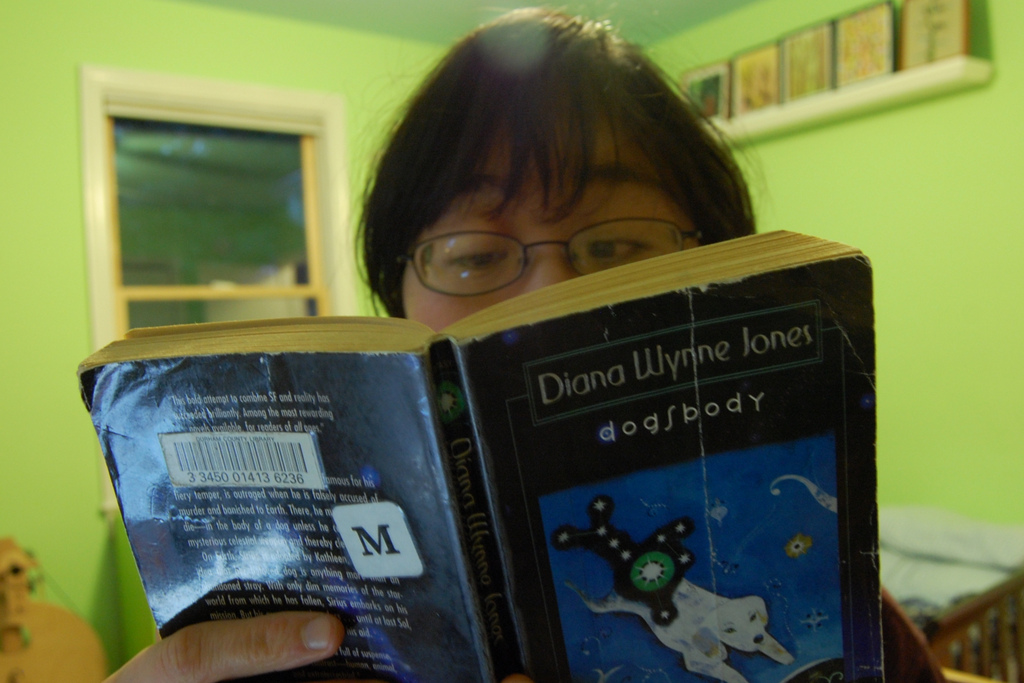
(Photo by Eunice.)