What Is Christianity For?

by Matthew Sitman

Caravaggio_-_Cena_in_Emmaus

That’s the question Rod Dreher asks in a searching reply to my thoughts earlier this week on Christianity and modern life. Some of Rod’s response is a gentle correction to my characterization of the “Benedict Option,” which, in his original essay, he summarizes as “communal withdrawal from the mainstream, for the sake of sheltering one’s faith and family from corrosive modernity and cultivating a more traditional way of life.” To take one example, I described Eagle River, Alaska, as a remote village, while it’s actually in suburban Anchorage – I regret getting that wrong. More importantly, Rod argues that I created something of a straw man, portraying those who pursue the Benedict Option as running for the hills while the world burns. My rhetoric did slip in that direction, and there are nuances to the ways the Benedict Option can be pursued I didn’t capture in my original post. Not all who favor it, and certainly not Rod, argue for “strict separatism” as a response to modern life.

The deeper issue Rod raises, however, goes beyond haggling over this or that detail of the Benedict Option and its various instantiations. Really, arguments about the Benedict Option amount to arguments over the place of, and prospects for, Christianity in the modern world – how Christians should try to live faithfully in our day and age. Here’s the gauntlet Rod throws down:

The way a Christian thinks about sex and sexuality is a very, very good indication of what he thinks about living out the faith in modernity. The reason it is so central is because it reveals, more than any other question now, how a Christian relates to authority and moral order. Matt is a kind and honest interlocutor, and I sincerely appreciate his attention, so please don’t take this in any way snarky or hostile towards him or Christians who share his viewpoint … but the questions have to be put strongly: Where is the evidence for being hopeful about Christianity’s place in modern life? Why should anyone think that the message of Jesus will retain its power in modernity if a Christian experiences little conflict between his faith and the world as it is?

To get to the heart of it: What is Christianity for? 

Those obviously are very big questions, but at least a few points can be made to clarify how I approach these matters.

One reason I reacted the way I did to Rod’s essay is because it’s premised on assumptions about modern life I don’t share. It’s not hard to misconstrue those living out the Benedict Option, taking them to perhaps be more separatist than they are, when descriptions of what they are trying to do are prefaced with references to Alistair MacIntyre and suggestions that we are “living through a Fall of Rome-like catastrophe” or worries about “signs of a possible Dark Age ahead.” I’ve never quite bought this line of thinking, never understood modernity as being a rupture or break from a virtuous past. Instead, the formulation I use is that things are getting better and worse at the same time, all the time. The dazzling achievements of modern life are real but also can have a dark underbelly, which means it’s not always possible to clearly separate out what is “good” from what is “bad.” I resist narratives of decline because they seem to miss this, which means the task of discerning the signs of the times, thinking through them as a Christian, is a complex and difficult task. I reject both optimism and despair about modern life.

It’s worth mentioning here that I never argued for full assimilation into modern life, for Christians to be uncritical of what they see around them. I do experience conflict between my faith and the world as it is. But that tends to take the form of deep sadness at the loneliness so many feel in our society, our callous indifference to suffering, and the rampant materialism and worship of power and wealth characteristic of our times, to name just a few examples. And yet this incomplete list betrays the tension I noted above – were there not real problems with more traditional forms of community that, while largely free of the individualism and mobility that contribute to loneliness and neglect, sometimes were repressive and too averse to change or difference? Isn’t our materialism at least partly a function of an economic system that has pressing problems, but also lifted many out of a life of mere subsistence? I don’t mean for these examples to seem trite or too easy, but they get at why, even when I feel conflicted about modern life, it doesn’t take the form of viewing it as a catastrophe or a new Dark Ages.

I admit, too, that I differ with Rod on the question of homosexuality – I hope that even conservative churches come to bless gay relationships. But as the preceding shows, I don’t think that accounts in full for my attitude toward living as a Christian in the modern world. I see it as one more issue that’s of a piece with the complexity of the world around us. The increasing visibility of gay people is a fact that must be dealt with by the Church, and even many traditionalist Christians, like Rod, would be happy to concede that they are glad gay people face better prospects, in society at large, than they would have decades ago. Sexual modernity has made many people, even traditional Christians, more attentive to the ways in which gay people and women, to take the two most prominent examples, suffered in previous eras. Traditional Christians themselves, even when holding the doctrinal line, often understand these matters in ways quite different than they did just a few decades ago, showing more sympathy and humaneness than in the past. I would go so far as to say that Christians have been taught, through the changes brought by modern life, how to be more genuinely loving and decent in these areas than they have been in the past. That is not to dismiss the deep challenges modern life poses, for traditionalists like Rod, to a conservative sexual ethic – I understand, even if I do not fully share, his concerns. I just can’t view the coming of sexual modernity simply as the triumph of hedonism, if for no other reason than that it has led to grappling with real injustices.

The word that I used to describe my approach to these matters is hopeful, and Rod wonders at my use of that term, at least with regard to Christianity’s place in the modern world. I’ve gone on at length – perhaps too long – explaining how I think about modern life because I believe it goes some way toward suggesting an answer. Living hopefully, in light of this, amounts to patiently, humbly sifting through the complexity I described. It means trying to see the truths revealed by modern life as well as working to restrain it’s excesses and problems. And I’m not sure Christians can best do this by withdrawing from the mainstream, rather than critically engaging it.

When we do engage the modern world, joyfully and without rancor or fear, I still believe Jesus’ message of grace and mercy will resonate. To see the good in modern life is not to deny the need for real, costly love in the world, a love that reaches out to the poor and the lonely and the marginalized, a love that looks with compassion on all who suffer and struggle. What is Christianity for? To teach us how to do that, which sounds awfully pious, I know. And that’s certainly not all that can be said about the Christian faith. But when I look around me, I can’t help but see both the remarkable achievements of modern life and, despite those achievements, a world still fraught with injustice and pain. My hope is that we can sustain and extend the former while struggling to embody Christ’s love in the midst of the latter.

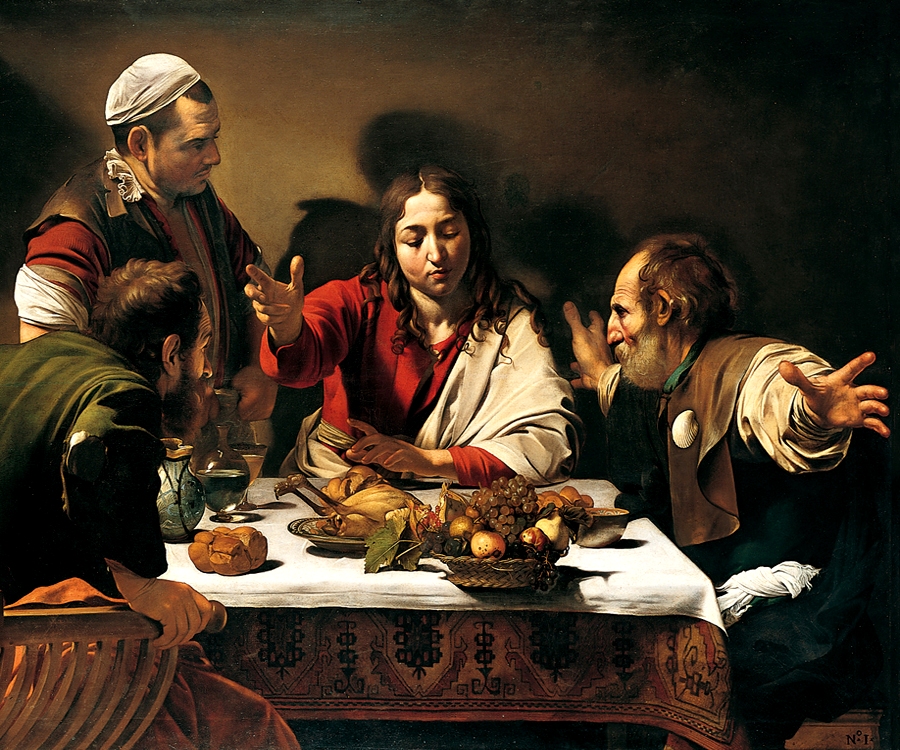
(Caravaggio’s Supper at Emmaus, 1601, via Wikimedia Commons)

I’m Not Sure There’s a Workable Path for Professional Online Writers

by Freddie deBoer

So it won’t surprise anybody to learn that I really, really don’t like Buzzfeed.

Sometimes, when I consider the Buzzfeed phenomenon, I think I’m living in some sort of fictional satirical world where Buzzfeed is a symbol of how far media can fall. It’s like living in a Douglas Copeland novel. Buzzfeed’s particular brand of lowest common denominator clickbait, their “14 Giraffes Who Totally Look  Like Steve Buscemi,” their “25 Things Only People from [Insert Geographical Area Here] Understand,” their “Which of Fat Cat’s Minions from Chip’n’Dale’s Rescue Rangers Are You?” quizzes, their corpsefucking glurge, sitting side-by-side with their “branded content” like “12 Most Crunchtastic TV Moments Brought to You by Frito Lay,” subsidizing imperial stenographer Rosie Gray’s smears of Max Blumenthal (an actual journalist),  powered by an aggregation model that comes pretty close to plagiarism even when it doesn’t devolve into the serial copy-and-pasting of Benny Johnson (thanks BlippoBoppo and CrushingBort), in an environment where they can memory hole 4,000 posts and think they don’t have to say anything in particular about it publicly, all lorded over by dumb-faced Ben Smith’s dumb face…. It’s bleak, man. I mean, I can see somebody getting a job offer from Buzzfeed and trying to rationalize it, telling themselves, “well, they’re not so bad….” Yes, they are. They are exactly that bad.

The thing is, I don’t know if there’s some more ethical path writers these days can walk and still end up being able to support themselves. It’s looking pretty grim out there for our professional online writers.

I’m someone who writes a lot of what I guess you would call media criticism. And that means that I’m frequently in the position of saying some not-very-nice things about people who write professionally online. But I criticize because I think that job is important; I happen to have some old-fashioned, corny ideas about the role that journalism and political commentary have to play in a democracy such as ours. We need professional writers– not just dedicated amateurs– to observe and comment on our society and our government, in order to ensure that both are functioning the way that they should, and to give our people information they need to make rational political choices. The problem is that the basic economics of that work have become so threatened that I don’t know what independent writers are supposed to do. I hate when talented people join up with outfits like Buzzfeed, which I think are genuinely making our country a stupider place. But I don’t see any clear path that people can take to preserve both their integrity and their ability to eat.

I could, if I was feeling masochistic, run down some of the publications that have recently shuttered or dramatically restructured in a way that has trimmed a lot of talented writers from their payrolls. Sports On Earth, for example, was a bright spot in the shouty, gimmicky world of online sports coverage, a place that provided steady work to talented writers like Tomas Rios and Jeb Lund, and which was willing to take a chance on genuinely unique work in a media world growing ever-more homogenous. Or look at the uncertain fate of The American Prospect, for decades an incubator of young liberal writing talent. TAP has prestige and it has a legacy, but you can’t pay the bills with either of those. NSFWCorp was always controversial, but everyone has to recognize that it was a bold attempt at producing real journalism with a new and unique funding model. But that model fell through. For awhile, there was a lot of hype about how hyper-local reporting would be the next wave in web publishing, but AOL’s massive Patch effort crashed and burned. Well, Patch is now a “new, nimble company,” and profitable– thanks in large measure to laying off 85% of its news staff. Even that mild success stems from putting a lot of people out of work.

There are way too many great writers– people like Lund and the brilliant and provocative Yasmin Nair and others– who don’t have a steady, secure gig that can keep them doing what they do best.

The basic economics of all of this are truly discouraging. Many people who are able to scratch out a living as professional writers have to do so with content mill writing, churning out four or five or six or more posts a day, sometimes for as little as $15 a post. Many have their pay tied to performance incentives, based on clicks, essentially mandating that people play the clickbait game if they want to pay the rent. The importance of Search Engine Optimization may be fading but the days of Please Facebook Favor My Post in Your Algorithm are in full bloom, and if anything that master is even less knowable than Google ever was. Freelancers might get $500 or $1000 for a strong, researched, reported story. That might sound like a lot, but when you’ve spot months conceiving, researching, reporting, and writing that piece, the math is dismal. Clearly, getting a job as an editor or staff writer at a deep-pocketed publication is best, and there’s no substitute for that kind of security. But I think people would be amazed at how little those positions sometimes pay, and they often require living in New York, DC, or Los Angeles, three ludicrously expensive places to live. I know people who work for well-known, national magazines, the kind of jobs thousands of young journos and writers want to work for, who still have to work on the side doing copy writing to make ends meet. And they’re the lucky ones.

There are some people who enjoy the blessing of working under a patronage model, where someone or some institution with deep pockets can afford to subsidize work that isn’t meant to pay for itself. But most writers simply have to chase clicks if they want to survive. What that means is that even the most independent writers tend to chase the same stories, writing post after post about Robin Williams or the ALS Ice Bucket Challenge, knowing that those stories can succeed because they have succeeded already. That makes online writing a brutally homogeneous affair. Choire Sicha– who I think has as much integrity as anybody, although I’m sure he’d roll his eyes at that– made the case recently, saying:

I do not read a lot of things anymore. A lot of us don’t, we sort of go where the tide takes us. I feel weird about that. I opened up my Digg reader the other day, because I was on blogging duty at work, and everything was so duplicative of each other. I was like, yeah, okay, there’s that piece of news filtering through all these different websites, all the same things… no wonder I don’t go to them. I need to make a new folder in my Digg reader, I guess, that’s “Things That Are Surprising and Interesting and Maybe Weird.” It’s sort of… it’s not… I don’t know, something’s wrong.

That is hardly an experience unique to him. I posted a photo of a cluster of Slate stories about Robin Williams to my Facebook, a half-dozen different angles from the same website about the same dead celebrity. But I could have done the same thing with any number of other websites.

You probably know the causes by now. Even if you don’t believe in the Peak Ad thesis, you’ve got the essential problem that with so many websites and the ever-growing number of ads on social media like Facebook and Twitter, all competing with the Google behemoth, you’ve got a nearly limitless supply of online advertising, inevitably pushing down the value of ads. Sites have responded by coming up with new and innovative ways to fool readers into thinking ads are legitimate stories. We laughed at the Atlantic Scientology fiasco, but they were just a little ahead of the curve. We’re starting to see more and more attempts at direct monetization, with paywalls and subscription services, which is great. I hope they succeed. But the idea that online content has to be free is so deeply baked into the culture that it’s going to take great effort to get people used to the idea of paying. I think that the widespread mockery of the New York Times Times Select experiment was a major failure by the industry to think long-term. Sure, it was a failed experiment, and there’s nothing wrong with saying so. But the deep mockery of the very idea of a paywall helped contribute to a precedent that is still alive today. I clicked on a Haaretz link yesterday and was deeply annoyed to find that it was paywalled. It took me a little bit to realize that, when I get angered by the idea of a newspaper asking me to pay for its content, I’m part of the problem.

The sad fact is that there may just be too many mouths to feed, right now, and not enough money to go around. But even so, I don’t know how you solve this problem on the supply side. People are either going to be willing to pay for what they read or they aren’t.

I don’t want to sound too pessimistic. There’s lots of great stuff getting written out there. And I’m hoping that a combination of various models and formats can sustain the industry moving forward. Paid, niche-audience newsletters like Michael Brendan Dougherty’s The Slurve, the patronage model of Pierre Omidyar and First Look Media, porous paywalls and gated content like at The New York Times, and hybrid models like this very website– these can all work alongside sites paid for by advertising. There are some great new independent publications out there, like Jacobin Magazine or Rachel Rosenfelt’s The New Inquiry, although I have no idea if they are self-sustaining or close to it. I’ve come to a point where I recognize that universal condemnations of clickbait content simply aren’t fair, if I want to continue to enjoy lots of free stuff to read online. The question becomes what the clickbait is subsidizing, and who, and what the percentages are. Under the steady leadership of Max Read, I think Gawker has done a good job with achieving that kind of balance, for one example, but it’s always going to be a negotiation, and a struggle. And while I admire what Andrew has built here, this is a model that simply can’t be replicated by most people. It’s a functioning, self-sustaining website, but it isn’t a model or a plan.

We’ll have to see where this all goes next. For myself, I am merely trying to be more understanding and less quick to judge, while remaining adamantly opposed to PR and advertising masked as journalism. I used to mock people who spent their lives writing the same “Top Ten Dumbest Things Said on Faux News This Week” piece over and over again, but I don’t anymore. I don’t bring my online life into my day-to-day life; I think a majority of my classmates and professors have no idea I write online. But I still get undergrads who seek me out on campus, who come to me looking for advice on how to break into online writing as a profession. I never  know what to tell them. I have always written from the position of privilege of not needing to write to live. Sometimes I give them advice,  sometimes I put them in touch with editors I’m friendly with. But for their basic questions about how to make it, I don’t really know how to respond. It’s a tough business, and an essential one, and I genuinely don’t know if it’s going to survive.

(And for Christ’s sakes, if you like a site, whitelist it on your AdBlock, OK?)

Where Online Social Liberalism Lost The Script

by Freddie deBoer

I’ve developed something of a reputation as a socially liberal critic of today’s social liberalism. I got an email from a Dish reader who asked me to flesh out where I’m coming from.

I guess what it all comes down to, for me, is that social liberalism was once an alternative that enabled people to pursue whatever types of consensual personal behavior they wanted, and thus was a movement that increased individual freedom and happiness. It was the antidote to Jerry Fallwell telling you that you were going to hell, to Nancy Reagan saying “just say no,” to your conservative parents telling you not to be gay, to Pat Robertson saying don’t have sex, to Tipper Gore telling you that you couldn’t listen to the music you like, to don’t have sex, don’t do drugs, don’t wear those clothes, don’t walk that way, don’t have fun, don’t be yourself. So of course that movement won. It was a positive, joyful, human, freeing alternative to an exhausted, ugly, narrow vision of how human beings should behave.

It seems to me now that the public face of social liberalism has ceased to seem positive, joyful, human, and freeing. I now mostly associate that public face with danger, with an endless list of things that you can’t do or say or think, and with the constant threat of being called an existentially bad person if you say the wrong thing, or if someone decides to misrepresent what you said as saying the wrong thing. There are so many ways to step on a landmine now, so many terms that have become forbidden, so many attitudes that will get you cast out if you even appear to hold them. I’m far from alone in feeling that it’s typically not worth it to engage, given the risks. The hundreds of young people I teach, tutor, and engage with in my academic and professional lives teach me about the way these movements are perceived. I have strict rules about how I engage with students in class, and I never intentionally bring my own beliefs into my pedagogy, but I also don’t steer students away from political issues if they turn the conversation that way. I cannot tell you how common it is for me to talk to 19, 20, 21 year old students, who seem like good people, who discuss liberal and left-wing beliefs as positive ideas, but who shrink from identifying with liberalism and feminism instinctively. Privately, I lament that fact, but it doesn’t surprise me. Of course much of these feelings stem from conservative misrepresentations and slanders of what social liberalism is and means. But it also comes from the perception that, in the online forums where so much political discussion happens these days, the slightest misstep will result in character assassination and vicious condemnation.

Suppose you’re a young college student inclined towards liberal or left-wing ideas. And suppose, like a lot of such college students, you enjoy Stephen Colbert and find him a political inspiration. Now imagine that, during the #CancelColbert fiasco, you defended Colbert on Twitter. If your defense was noticed by the people who police that forum, the consequences were likely to be brutal. People would not have said “here, let me talk you through this.” It wouldn’t have been a matter of friendly and inviting disagreement. Instead, as we all saw, it would have been immediate and unequivocal attack. That’s how the loudest voices on Twitter and Tumblr and Facebook act. The culture is one of attack, rather than of education. And the claims, typically, are existential: not “this thing you said is problematic from the standpoint of race,” but rather “you’re a racist.” Not “I think there’s some gender issues going here that you should think about,” but “you’re a misogynist.” Always. I know that there are kinder voices out there in socially liberal circles on social media, but unfortunately, when these cyclical storms get going, those voices are constantly drowned out.

If you are a young person who is still malleable and subject to having your mind changed, and you decide to engage with socially liberal politics online, what are you going to learn immediately? Everything that you like is problematic. Every musician you like is misogynist. Every movie you like is secretly racist. Every cherished public figure has some deeply disqualifying characteristics.  All of your victories are the product of privilege. Everyone you know and love who does not yet speak with the specialized vocabulary of today’s social justice movement is a bad, bad person. That is no way to build a broader coalition, which we desperately need if we’re going to win.

On matters of substance, I agree with almost everything that the social liberals on Tumblr and Twitter and blogs and websites believe. I believe that racism is embedded in many of our institutions. I believe that sexual violence is common and that we have a culture of misogyny. I believe that privilege is real. I believe all of that. And I understand and respect the need to express rage, which is a legitimate political emotion. But I also believe that there’s no possible way to fix these problems without bringing more people into the coalition. I would like for people who are committed to arguing about social justice online to work on building a culture that is unrelenting in its criticisms of injustice, but that leaves more room for education. People have to be free to make mistakes, even ones that we find offensive. If we turn away from everyone that says or believes something dumb, we will find ourselves lecturing to an empty room. Surely there are ways to preserve righteous anger while being more circumspect about who is targeted by that anger. And I strongly believe that we can, and must, remind the world that social justice is about being happy, being equal, and being free.

(Thumbnail image via Alfred Hermida)

Final Thoughts on Israel and Palestine

by Freddie deBoer

Activists Hold Palestinian Solidarity March And Rally

I want to put my discussion of Israel to bed for the week, as some emailers are complaining that I’m “fixated” on the issue. I’m writing about Israel and Palestine a lot in part because I’m getting the most emails on that question.

Many people who have written wonder, with various degrees of indignation, why I don’t perform the typical preemptive apologetics that so often come with criticism of Israel. Why don’t I take time to balance my complaints about Israel by mentioning all the bad things about Hamas? Where are my explicit denunciations of anti-Semitism? Why don’t I come out and say whether Israel should be wiped off the map? I don’t do these things for two reasons. One, because I think it’s in the best interest of everyone– including those committed to the defense of Israel’s government and policies– to return normalcy to this debate. On what other issue am I expected to explicitly disclaim attitudes that I don’t believe and haven’t mentioned? No, it’s true: I’m not anti-Semitic, I don’t think Jews secretly run the world, I don’t believe in Islamic governance either, and I don’t want Israel “wiped from the map.” But when did I suggest such a thing? Acting as if this issue has to be treated with kid gloves in a way that is wholly unique in American politics does no favors to either side of this debate. I have been counseled many times in my life to avoid this specific issue because of the potential professional consequences. I appreciate that people are talking out of a desire to help, and situations like that of Steven Salaita and Norman Finkelstein demonstrate the sense in this advice. But to not engage out of fear of the  consequences exacerbates the problem, and incidentally plays into the hands of anti-Semitic tropes. My country spends billions of dollars and an enormous amount of diplomatic capital on Israel, that makes Israel my business, so let’s hash it out. We are adults. We are capable of arguing as adults. So let’s just argue the way we usually do.

I also don’t seek balance because I don’t pretend that there is equality of blame in this issue. Many smart, decent people I know treat this issue with a “plague on both houses” attitude, talking about a “cycle of violence,” or “ancient grudges.” They speak as though this issue is so polarized and so complex that we can’t make meaningful judgments. I find that, frankly, bullshit. I’m not usually a big fan of Max Fisher’s work, but he had this perfectly right: the occupation is wrong, it is the problem, and Israel is to blame. Israel has been illegally and immorally occupying the Palestinian territories for almost 50 years. And Israel has the ability to end it. The Israeli government could unilaterally withdraw from the territories and leave the Palestinians to build their own state, or they could fully incorporate Palestinians into a  new unified Israeli-Palestinian state that recognized total and  complete political and social equality between all people. If you find those ideas radical, consider that they are merely what basic liberal democracy requires. I am completely agnostic on the notion of one state or two, but I know that what our most basic political ideals require is a world where we have achieved perfect political equality between Arabs and Jews. Israel is capable of creating such a world. Palestinians are not.

For those who fear Israel’s annihilation, I would say that while your fear is understandable, given the facts, it is not rational. No one disputes that Israel’s military capacity is incredible for such a small nation, and that’s true even setting aside its secret nuclear arsenal. The Western world is totally committed to the defense of the modern Israeli state. The United States would go to war to defend Israel’s right to exist. NATO is committed to Israel and the UN, for all its criticisms of Israel, would support an American defense of Israel. We’re talking about a commitment to defend Israel with nearly limitless military power. Do the Palestinians enjoy any such equivalent protection? Yes, you are entitled to consider the sweep of history when you think about Israel’s future, but you are also required to consider facts. And the facts tell us that the people who should truly fear annihilation are the Palestinians. They are the ones who are existentially threatened. They are a nation of refugees. They are a people without a state. To insist on this reality isn’t extremism. It’s just taking an honest look at the world around you.

What American defenders of Israel must recognize is that it is Israel’s diplomatic isolation that threatens it in the long term, not Hamas’s rockets. And the occupation will always isolate Israel, because the occupation is wrong. Some emailers have suggested that anti-Semitism is behind all of Israel’s international critics. To which I say, really? Criticism of Israel from South America is all anti-Semitism? From Western Europe? From sub-Saharan Africa? Did tens of thousands of South Africans march in protest of Israel’s assault on Gaza because of  anti-Semitism? America’s protection is powerful, but it is not limitless, and its hegemony is slowly crumbling. In the next century, Israel must secure its future not through the blessing of a superpower but by earning the reputation of a moral nation. That cannot occur while Palestine is occupied.

And more than securing Israel’s security, ending the occupation is a matter of securing Israel’s soul. What strikes me most about interacting with Americans on this issue, even political and informed Americans, is how many don’t fully comprehend the rise in ultra-conservatism and ethno-nationalism in Israel. People don’t want to think of Israel as that kind of country, and so they shut their ears to it. Yet the evidence grows every day; Netanyahu’s cabinet is virulently extreme, the fringe right-wing parties grow more powerful, the racism and bigotry of the street protests more and more explicit and unafraid. Look, just today, we learn that the Israeli government is targeting the family of Mohammed Abu Khder, the 16 year old Palestinian who was burned to death by Israeli terrorists. This is the type of ugliness, of nastiness, that is seeping into the firmament of Israeli society. This is what journalists like Gideon Levy and Max Blumenthal have been investigating in their work, and this is why they are considered so dangerous: because they threaten to expose to progressive people the reality of the growing reactionary nature of Israel’s internal politics.

50 years from now, and 100, there will still be Jews and there will still be Palestinians in this region. The question is, what form will their relationship take? Will an independent Palestine have been given complete self-determination and diplomatic recognition, a two state solution? Will it be a unified state that recognizes the complete equality of all of its citizens, regardless of their ethnicity or religion, a one state solution? Or will Israel continue to be an apartheid state, brutalizing a stateless people? The latter is the possibility that most threatens Israel’s future, make no mistake. And so the question is what future we, as a nation that subsidizes the occupation in every way imaginable, are willing to argue for, and how long we are willing to ignore what’s staring us in the face.

(Photo: A demonstrator prepares to march across the Brooklyn Bridge to protest against Israel’s continued military campaign in Gaza on August 20, 2014 in New York City. By Spencer Platt/Getty Images)

To Be A Christian In Modern America

by Matthew Sitman

Benedetto,_Mauro_e_Placido

For awhile now I’ve been intrigued by Rod Dreher’s advocacy of the “Benedict Option” for contemporary Christians, which looks to St. Benedict, founder of a monastic order in the wake of Rome’s collapse, as inspiration for how Christians should respond to the current cultural situation. Here’s a good summary of the Benedict Option from Rod’s essay about it late last year:

Why are medieval monks relevant to our time? Because, says the moral philosopher Alasdair MacIntyre, they show that it is possible to construct “new forms of community within which the moral life could be sustained” in a Dark Age—including, perhaps, an age like our own.

For MacIntyre, we too are living through a Fall of Rome-like catastrophe, one that is concealed by our liberty and prosperity. In his influential 1981 book After Virtue, MacIntyre argued that the Enlightenment’s failure to replace an expiring Christianity caused Western civilization to lose its moral coherence. Like the early medievals, we too have been cut off from our roots, and a shadow of cultural amnesia is falling across the land.

Rod goes onto describe various communities – in places like Eagle Creek, Alaska and Clear Creek Abbey, Oklahoma – living out their faith in traditional ways, largely set apart from modern American culture. In the midst of our cultural catastrophe, the Benedict Option is a way for Christians to live virtuous lives uncorrupted by what’s around them, resisting any kind of assimilation into mainstream society.

Last week Samuel Goldman argued for an alternative, the “Jeremiah Option,” drawing on the experience of the Jews exiled in Babylon, and pitched as a corrective to Dreher’s ideas:

Without being rigorously separatist, these [Benedict Option] communities do aim to be separate. Some merely avoid morally subversive cultural influences, while others seek physical distance from mainstream society in rural isolation.

But a neo-Benedictine way of life involves risks. Communal withdrawal can construct a barrier against the worst facets of modern life—the intertwined commodification of personal relationships, loss of meaningful work to bureaucratic management, and pornographic popular culture—yet it can also lead to isolation from the stimulating opposition that all traditions need to avoid stagnation.

I think those hesitations are largely right, and as a Christian, I’d add that I have to wonder what these kinds of communities do to reach out to the poor, the sick, and the lonely in the world around them. I’m not sure hunkering down is what Jesus called us to, and when, for example, a member of the Alaska community I mentioned says that “If you isolate yourself, you will become weird,” I wonder how living in a remote Alaska village is not isolation. Christians are given the Great Commission, not the Great Retreat. I’m not trying to demean the people Rod profiled, but rather express that I can’t quite understand Christianity in the same way. Jesus always seemed to wandering around, telling strange stories, mingling with the kind of people Benedict Option types might prefer to avoid.

Given the above, you won’t be surprised that I nod along when Goldman elaborates on what distinguishes the Jeremiah Option from the Benedict Option:

The Benedict Option is not the only means of spiritual and cultural survival, however. As a Catholic, MacIntyre searches for models in the history of Western Christendom. The Hebrew Bible and Jewish history suggest a different strategy, according to which exiles plant roots within and work for the improvement of the society in which they live, even if they never fully join it.

This strategy lacks the historical drama attached to the Benedict Option. It promises no triumphant restoration of virtue, in which values preserved like treasures can be restored to their original public role. But the Jews know a lot about balancing alienation from the mainstream with participation in the broader society. Perhaps they can offer inspiration not only to Christians in the ruins of Christendom but also to a secular society that draws strength from the participation of religiously committed people and communities.

Goldman gets at something important here when he notes that adherents to the Benedict Option look forward to “a triumphant restoration of virtue,” rather than the simpler and more humble desire to help the society in which they live. I certainly harbor no longings for Christendom. There’s no golden age I’m trying to restore. While not being uncritical of modern life, I’m not in rebellion against it – and thus don’t seek to escape it. I also resist the notion that Christianity is fundamentally about morality, at least not in the ultimate sense. Christianity is premised on our inability to be moral, and it’s most important idea is that of grace, or God’s one-way love for us, which isn’t premised on how much we have our acts together. So I’m suspicious of religious movements that value purity above all else, which, in a way, I think the Benedict Option does. Withdrawal from mainstream culture can only mean that a desire for purity has trumped the risks of engagement.

But most of all, Christianity teaches us that God is love, that God loved the world and so should we – a notion that I find difficult to square with retreating into a remote community waiting for the world to burn. I actually am hopeful about Christianity’s place in modern life, and seeing the brutality, violence, and indifference to suffering all around us, I can’t help but think the message of Jesus will retain it’s power. But that hope is premised on living in the world, not apart from it, while also letting go of apocalyptic rhetoric and the acute sense of persecution so many Christians feel. One of my favorite passages comes from a letter written by the novelist and playwright Thornton Wilder, where he argued that “The revival in religion will be a rhetorical problem — new persuasive words for defaced or degraded ones.” I’m far more interested in that project, in finding ways to think and talk about Christianity, as well as live it, that avoid the well-worn tropes of American religious life, than I am in waiting out the supposed new Dark Ages.

(St. Benedict orders Saint Maurus to the rescue of Saint Placidus, by Fra Filippo Lippi, 1445, via Wikimedia Commons)

How We Turned Our Cops Into Soldiers, Ctd

by Dish Staff

A reader with more than two decades of experience in law enforcement offers his perspective on police militarization:

For the record, I’m a supervisor with a medium-sized police department in Midwest who has also worked in a small town. I’ve been a patrol officer, a detective, and now a supervisor. At heart, I’m an old fashioned beat cop who enjoys walking down a main street and talking to people. I’ve never served in my department’s tactical team, nor am I a veteran.

I’ve seen a lot of changes in my career so far. One of the biggest is the nature of the threat that we face on the street. When I was in the police academy, we prepared for criminals who had cheap handguns and little training. The types of weapons that we face have changed dramatically; the police have simply evolved to meet those threats. I’ll give you a couple of examples:

Iexplore111 (1)During the 1997 North Hollywood shootout, bank robbers armed with illegally modified fully automatic weapons exchanged more than 2,000 rounds with responding LAPD officers. The robbers, who wore ballistic vests, were killed after a 44-minute exchange of gunfire. Seventeen LAPD officers and seven civilians were injured in the battle. The after-action review led to changes in the weapons carried by LAPD officers as well as departments around the country. The agencies moved away from shotguns in squad cars and toward military-style assault rifles that could penetrate body armor. Those rifles aren’t cheap – they often cost more than $2,500 each, plus $500 to $1,000 for the equipment to keep them secured inside of the squad car. If I were the head of a cash-strapped police department, I know I would love to get those weapons from a program that transitions D.O.D equipment to local law enforcement.

The second incident that changed law enforcement profoundly was the 1999 Columbine school shooting. Previously, law enforcement dealt with situations like this by sealing off the area and waiting for special tactical teams to arrive. At Columbine, law enforcement realized that it’s not enough to simply lock down the area; rather it’s necessary to go in, find the killer or killers, and neutralize them before they kill any more. Since 1999, I and countless other police officers have undergone days and days of training in “active shooter response.” I won’t bore you with the details, but suffice it to say that the training involved would seem quite militaristic to the public. The skills and tactics we use are very different from what I learned in the academy, and along with that, we have specialized tools. For example, there is an M-4 assault rifle in each of my agencies’ squad cars.

I get that this is militaristic. Going through a school or mall looking for a shooter utilizes tactics any soldier would recognize from operations in Iraq or Afghanistan. We use them and the equipment because it works. The problem that we face in our field is that these tactics often creep into all aspects of our work. The more you become comfortable with the new reality, the more you need to recognize that it’s a reality you only rarely face.

This leads me to my biggest point regarding the Ferguson police department: We need to stop looking at the officers and start looking at the leaders. Everyone above sergeant has set the tone in this organization. They have done the hiring, and they were leading the efforts to deal with the protesters. There may very well be rogue officers causing issues, and if so, it should likely be no shock to the administration. Problem persons in law enforcement agencies fester for years because it can be challenging to fire an officer, especially if he or she is a military veteran. The one constant in every agency that I’ve been a part of is that the chief of police down to the lieutenants set the tone and direction of the department. The sergeants get the message out to the patrol officers and enforce the message. We haven’t heard the police chief of Ferguson say his officers are out of control – because they are doing what he wants them to do.

More Dish on the war zone that is Ferguson, Missouri, here.

(Image of a illegally modified automatic AR-15 used in the North Hollywood shootout via Wikipedia user YEPPOON)

Palestinians Live What Israelis Fear

by Freddie deBoer

Funeral of eight Palestinians from the al-Louh family in Gaza

The emails filling my box about Israel function as a remarkable document. They are a record of seemingly reasonable people who have completely lost track of basic moral reasoning. And that represents itself nowhere more consistently or powerfully than here: treating what could possibly happen to Israelis as more important than what already is happening to Palestinians. It’s such a profoundly bizarre way to think, that only this maddening issue could bring it about.

“Hamas denies Israel’s right to exist!”

Indeed– and Israel not only denies Palestine’s right to exist, it has achieved the denial of a Palestinian state in fact. What kind of broken moral calculus could cause someone to think that being told your existing state should not exist is the same as not having a state of your own?

“Israelis will become second class citizens!”

Arab Israelis already are second class citizens, and Palestinians in the territories no citizens at all. They are denied freedom of movement, freedom of the press, freedom of assembly. They are systematically discriminated against for jobs, especially in government. They lack adequate representation in government. Their leaders are kicked out of Knesset meetings for questioning the IDF. Racist, ultra-nationalist mobs marched through their streets, chanting “death to Arabs!” Their weddings to Jews are the subject of vicious protests. They live side-by-side with racist teenagers who unashamedly trumpet ethnic warfare. They must live in a society where men like Avigdor Lieberman, an explicit racist and literal fascist, serves in a position of power and prominence. Where Meir Kahane is memorialized by groups receiving state funds, where the JDL’s thugs march, where Lehava preaches against miscegenation. A society where the Deputy Speaker of the Knesset openly calls for ethnic cleansing. Palestinians live in a society where a tiny fraction of government funding is spent on their communities or their people. Where human rights organizations like B’Tselem are oppressed by the state. Where they have to endure Kafkaesque application processes to prevent their homes from being bulldozed, if they are given that opportunity at all. Where they live under fear of reactionary, fundamentalist Orthodox settlers who call for death to the Palestinian race.

“Israel is diplomatically isolated unfairly!”

Palestine is diplomatically isolated in a way Israel cannot imagine. The United States uses its veto power to unilaterally deny even the possibility of full membership status for Palestine in the United Nations. The US has used its foreign aid programs and incredible diplomatic leverage to marginalize Palestine and protect Israel. Israel enjoys the protection of the most diplomatically powerful country on earth; Palestine cannot even claw out formal recognition of its borders.

“Israelis will be rounded up and put into camps!”

Palestinians are already in camps, open-air prison camps like Gaza, tiny, beleaguered cantons that lack access to drinkable water or transportation infrastructure, blockaded from receiving food and essential supplies, prevented from fishing their own waters, their movements harshly restricted, forced to go through humiliating and threatening checkpoints to get to work. They travel in segregated buses. They are frequently denied access to Eastern Jerusalem, the center of Palestinian commercial and cultural  life. They endure constant calls for “Greater Israel,” the call for ethnic cleansing to establish a unitary ethno-nationalist state. They live in unrecognized villages in the Negev and the North which the Israel state provides no services for. They, unlike Israeli Jews, have no “right to return.” They endured the Nakba.

“Israelis will be killed by terrorist violence!”

Palestinians are killed by terrorist violence. They are subject to spasms of outrageous violence, as the IDF kills them by the hundreds with bombs, tanks, and guns. The vast majority are civilians, many children. Their homes are destroyed, their neighborhoods demolished, their entire villages wiped out. Their hospitals and schools and universities and places of worship are bombed by Israel. Palestinians are subject to routine violence and degradation from IDF troops, who make light of this fact on social media. They are at risk from right-wing Israeli mobs who attack them at their protests and deny them their rights to protest. Their nonviolent protesters are thrown into prison. Their homes are bulldozed out of revenge.

Do I need to go on?

Everything that defenders of Israel insist will happen if Palestinians gain power, Palestinians are now enduring, or worse. Every humanitarian disaster that you imagine will occur with the creation of a Palestinian state is happening now. It’s just happening to the people of Palestine. And so this is the question for my many, many critical emailers: why do you shed more tears for what you imagine might happen to Israel than for what is happening to Palestinians?

Israel is one of the safest countries in the Middle East. Its people enjoy prosperity and security. The most powerful country on earth protects and enables it no matter what its behavior. In every meaningful sense– in terms of  physical security, in terms of functioning government and democracy, in terms of human and political rights, in terms of economics and employment, in terms of respect and protection for culture and religion, in terms of life expectancy and health, in terms of education and happiness, in terms of pure self-determination– Israel is one of the most well-off nations on earth, and Palestine, one of the most beleaguered. So then why calls for the defense of Israel so outnumber calls for the defense of Palestine? The only answer that makes sense is this: the belief, whether subconscious or knowing, that an Israeli life is worth more than a Palestinian life. That is the enduring, tacit, obvious belief that underlies this entire discussion, the thing people think but do not say.

(Photo: Palestinians stand over the bodies of eight Palestinians from the al-Louh family, who were killed when an Israeli airstrike hit their house, during a funeral in Deir al-Balah town of Gaza City on August 20, 2014. Eight members of the same family, including three young brothers and a pregnant woman, were killed early Wednesday by an Israeli strike in the town of Deir al-Balah, in the central Gaza Strip. By Mohammed Talatene/Anadolu Agency/Getty Images)

Southland Tales: An Unappreciated Masterpiece

by Freddie deBoer

Since Andrew and the Dish team gave me carte blanche to write about what I want, I’m going to go ahead and abuse the privilege by writing a defense of a largely-forgotten, eight-year-old movie, Richard Kelly’s Southland Tales. Because when it isn’t being ignored, it’s usually being reviled, which is a crime. Southland Tales is a masterpiece.

Explaining the plot of the movie could take up thousands of words—and in fact, already has. I’ll leave it to others to explore the complex web of plot lines, references, digressions, and symbols. Suffice is to say for now that Southland Tales is the story of America in the age of terror, an America where a nuclear terrorist attack on Texas leads to a massive surveillance infrastructure, a nascent resistance movement, and the desperate search for an alternative energy source in a world where the Middle East is on fire. While American wars rage in Syria and North Korea, the sprawling USIDENT surveillance system keeps tabs on us through both sophisticated electronic means and more old fashioned, soldiers-with-telescopes techniques. Meanwhile, a genius scientist has discovered Fluid Karma, seemingly a source of unlimited free energy, drawn from the endless churn of the oceans. When we enter the scene, Dwayne Johnson’s character Boxer Santeros, a Schwarzenegger-style movie star and fiancee of a powerful Senator’s daughter, has gone missing, having lost his memory in a mysterious event in the desert. During his disappearance, he’s shacked up with Krista Now, a porn star who wants to start a new life, and sees Santeros as her ticket out. The story really gets rolling when Santeros goes on an ill-fated ride along, ostensibly to research a movie role, with a cop named Roland Taverner—or is it Ronald? Then there’s the question of Santeros and Now’s screenplay, The Power, which keeps mimicking real life….

But, well, there I go, getting into the plot without really meaning to. The movie’s like that.

You won’t understand everything happening in the movie the first time you watch it, and you aren’t really meant to. Among its many references and influences are the great film noirs of the past, and like those films Southland Tales is usually experienced in a state of mild confusion, comprehension always lagging just behind the progression of the Byzantine plot. But you don’t need to understand all of what’s going on for the themes to resonate, or to enjoy the many fantastic set pieces, which are sometimes hilarious and sometimes gorgeous. The characters are pulled into these moments in surprising ways. All of them are portrayed as at least partially comic, and yet all are allowed to entertain grandiose schemes and levels of self-importance. Wallace Shawn’s mad scientist wears the haircut of a synth player from some 80s Euro band; Cheri Oteri’s witless revolutionary/con woman makes up for her bad plans with a talent for violence; Zelda Rubinstein, the diminutive actress from the Poltergeist movies, quotes T.S. Eliot. Kelly arranges them in carefully choreographed moments that play out almost as skits within the larger narrative, and it’s here that they are allowed to achieve some sort of dignity, or at least self-determination. A staged domestic disturbance between Amy Poehler and Wood Harris from the Wire turned real shooting bleeds out into a paranoid escape across the foggy, overgrown lawns of suburban LA, set to The Pixies. The Rock, Mandy Moore, and Buffy the Vampire Slayer dance to Moby in a scene right out of your senior prom. A hallucinating Justin Timberlake, shirt covered in blood, lip syncs to the Killers in a psychedelic arcade. Gorgeous, every frame.

Like Who Framed Roger Rabbit?, Southland Tales is one of the handful of greatest LA movies without being recognized as such. It’s cliched to say that a city is a character in a film, so perhaps I’ll just say that Los Angeles is a ubiquitous presence in Southland Tales. The city is at once a central concern of the film and a subtle one. There’s little about the plot, as plot, that necessitates it being shot in LA, and yet there’s no way it could have been made anywhere else. The city is alluded to in the (excellent) soundtrack and in the voiceover narration, but it reveals itself especially in the movie’s geographic expansiveness, the way it lazily stretches out across its setting. Donnie Darko, the film that made Kelly’s reputation, is a claustrophobic movie, its suburban cul-de-sacs a metaphor for a time line looped back on itself. Southland Tales, in sharp contrast, spreads out across its setting like it’s in no particular rush to get anywhere, mimicking the expansive interconnectedness it dramatizes, as vast and inescapable as the surveillance network that is at the center of both its plot and its themes. In its centerless sprawl and wide boulevards, LA works for this movie in a way that a more cramped city like New York never would.

Though it’s a 9/11 movie and a War on Terror movie and a political movie, show business is at the heart of its themes. The movie is about Hollywood the culture and Hollywood the industry, if not so much Hollywood the place (In its aesthetics, Southland Tales is much more Venice Beach than Hollywood and Vine.) In The Power, Santeros’s name is “Jericho Kane,” a reference to the Arnold Schwarzenegger schlockfest End of Days. That movie, while one of the worst Arnold ever made, is peak meta-Schwarzenegger, the dopiest and most self-important of his blockbuster career, a symbol of overstuffed action movies with overmuscled action stars. And it was the beginning of the end for Schwarzenegger as unironic action star, a relative box office dud from an actor who was once the most reliable draw in Hollywood. Kelly is interested in Hollywood people on the down swing; he’s interested in value in Hollywood, how it’s perceived and what it means. The cast is filled with actors who were seen as Grade C-types even at the time—Oteri, Jon Lovitz, John Laroquette, the guy from Highlander. I’ve heard people suggest that this means that Kelly couldn’t get bigger names in his movie, but that’s wrong; coming off of Darko, his career would have been at peak buzz. Instead, I think Kelly intentionally sought out actors who were perceived as washed up or in some sense ridiculous, like pre-Renaissance Johnson. In his movie, Kelly is working through the idea of who is allowed to be taken seriously. Sarah Michelle Gellar’s porn star character, for example, is underestimated and dismissed, despite taking part in a complex conspiracy that drags in some of the most powerful people in the world. Two feminist neo-Marxist radicals fight for revolution and respect from government officials who underestimate them. A character who fulfills one of the most reviled stereotypes we have—the rich white kid who dresses and talks like a character from a rap video, complete with ridiculous doo-rag—is given respect and compassion, playing a key role in the bravura climax, one of the most indelible visuals I’ve ever seen on screen.

All of this, I’m sure, makes the film sound deeply pretentious. If so, that’s appropriate; it’s a pretentious movie, in the best sense. The rampant fear of pretension has been one of the great mistakes of our current aesthetic era. It’s led to lots of perfectly crafted, perfectly unambitious, perfectly safe movies, the type Manohla Dargis aptly summarized, in her positive review of Southland Tales, as “elegantly art-direct murder.” We’re in an artistic age where the omnipresence of critical judgment has led so many creators to create from a defensive crouch. It’s an age of recappers and social media chatterers and Rotten Tomatoes, and so the response has been the rise of artwork designed to appease them rather than to take the kinds of risks that, sometimes, lead to transcendence. It’s the Era of the Critic Proof, the age of celebrating the perfectly fine. True Detective, Drive, Haim—I enjoy each of these, sometimes a great deal, and I’m happy they exist. But none moves me like the big shaggy mess that is Southland Tales, and in their workshopped perfection, they sand away the natural impurities that are the source of character. It’s kind of a dismal feeling, to perceive so much competence and so little risk, but in a world of towering fan entitlement and an entire industry of nitpickers, it’s probably inevitable. Here’s to the messes, and to Southland Tales.

Can Double-Blind Peer Review Be Reformed?

by Freddie deBoer

Peer review, the vetting of academic writing by subject-matter experts, is an essential element of academic progress. But the peer review process is also dysfunctional, sometimes out-and-out broken– and that brokenness stems from the well-meaning ideals peer review is meant to protect.

Gabriel Rossman wrote a fantastic piece illustrating the difficulties with peer review, and I highly urge you to read it if you are at all interested. I think Rossman is perfectly right in arguing that it’s the self-same people who complain about peer review as authors who often turn around and exemplify its worst tendencies when reviewing. As a peer reviewer myself, I try to always place myself in the position of the author, and in particular, I try never to review an article by thinking about what I would have done differently, but rather to ask if there are glaring theoretical holes, methodological errors, or problems with presentation. Far, far too much peer review becomes a matter of reviewers telling you what you should have done rather than making the work you did write better. As Rossman writes,

Rather, fixing peer review has to begin with you, the reviewer, telling yourself “maybe I would have done it another way myself, but it’s not my paper.” You need to adopt a mentality of “is it good how the author did it” rather than “how could this paper be made better” (read: how would I have done it). That is the whole of being a good reviewer, the rest is commentary.

But the particular problems with how peer review happens are less important than the basic structural problem. The fundamental issue is this. Peer review, at the vast majority of credible journals, is built on a double blind system. In order to ensure that a big name academic’s big name doesn’t get inferior work published, and so that reviewers can respond honestly without fear of retribution from people with disciplinary and institutional power, neither author nor reviewer knows the other’s name. That’s a sound idea, but it has a perverse effect, particularly given how important publishing is to an academic career. Reviewers and editors have enormous power to make or break careers; one major journal article could mean the difference between launching a professional career and having that career die on the vine. And with no knowledge of who exactly is responsible, we’re left with unaccountable power, which is never a good idea even when people are trying their best and mean well.

Though I’m talking about peer review, it’s also worth saying that this can apply to the whole academic publishing process. You might know the names of the editors you’re working with, but going public with complaints, in the event those complaints are fair and warranted, could be disastrous if you aren’t established or tenured.

For the better part of a year, I’ve been wrestling with an onerous, deeply unpleasant review process at an established journal. All editing, of course, is to some degree an unhappy business. But I’ve gotten peer reviews, even for rejections, that have been smart, fair, sympathetic, and constructive. This is not one of those times. The initial reviews were actually quite positive, though they came months after submission. I made those changes without complaint. Since then, there have been additional requests for changes again and again, each time separated by a period of months. I’ve made those changes to the best of my ability, but the requests have sometimes been unclear, rude, or worse.  These changes have been, at times, plainly contradictory of previous requests, in the most direct and unambiguous sense. It’s frequently unclear what requests for changes are coming from the peer reviewers and which are coming from the editors, or if the peer reviewers are even still involved in the process at all. At some point it became clear that I was being edited by several different editors and that these editors were not communicating with each other. I would receive questions, answer them, and get the same questions again, months later. And so on.

Is it possible that I’m just wrong, about everything, and they’re just right? Sure. But the fact is that if I was right even hypothetically, there would be no way for me to fix the problem. I don’t know who the reviewers are, so there’s no way to expect individual accountability. And as someone who lacks the benefit of employment, tenure, or prestige, speaking out publicly about the journal by name would be professional suicide. Even this missive, in and of itself, is likely to be seen as violating proper academic decorum, even though there’s no way to tell what journal I’m talking about. Under those conditions, how could we expect fairness or accountability? I think a lot of peer reviewers do a great job, and for no money. So do most journal editors, who if they are paid, are paid a pittance in most fields. It’s a lot of work. But I don’t know how to deal with problems with peer review and editing when the professional stakes are so high, the personal accountability so low, and when notions of collegiality and respect prevent people from making complaints like this one.

What makes all of this worse is that the double blind system was designed as a bulwark against the corrosive effects of power imbalances. The whole idea is that an unknown graduate student should have the same chance to publish in the biggest journals as the most respected academic celebrity. But that tenured prof can write books, publish research on his or her own web site, and be sure to receive respect and fair process from editors. Younger academics need to have their work vetted if they want to build a career, and they have to do so without complaining. The right to register grievance when grievance is warranted should be available to everyone, but the current structure of academic publishing makes that right unavailable to the most vulnerable.

I’m still plugging away on the article, but the communication has become so acrimonious that I’ve never represented the article on any of my professional documents and have essentially written off ever seeing the piece get published. Which is a shame, because I think it’s a good piece, as the reviewers did, to say nothing of the dozens of hours I’ve spent over the past year writing, researching, and revising the piece. That time represents a major opportunity cost at a critical juncture in my work and my life. And with the review process at many journals being so slow, it’s not reasonable to expect that I could withdraw the piece, get it published elsewhere, and get appropriate credit for it in time for it to help me on the job market.

Are you an academic who’s been caught in review hell? Are you a peer reviewer or editor who thinks your role is misunderstood? Or am I just full of it? Write in to dish@andrewsullivan.com and let the Dish know.

(Thumbnail Photo by Nic McPhee)

To Bind Up The Nation’s Wounds

by Matthew Sitman

US-CRIME-RACE-POLICE-SHOOTING

I noted in my introduction earlier today that I don’t usually write about politics, that I prefer, especially when things get bad, to retreat into literature and poetry. This was my impulse when news of what happened in Ferguson first flickered across my screen – to my shame, I just wanted to avert my gaze. And I managed to do just that for a day or two, until it couldn’t be ignored, and it shifted from a “local story” to the topic that completely dominated my Twitter feed and Facebook page, almost to the exclusion of everything else. Ferguson, Missouri, was “just a place,” as the New York Times put it, until, suddenly, it wasn’t. That phrase gets more chilling every time I read it.

In what I’ve read about the killing of Michael Brown and its aftermath, certain issues have been front-and-center, with the widespread evils of entrenched racism and the militarization of the police being the most prominent. But I’ve also noticed something else going on, which is that more and more people seem to believe that Ferguson reveals something quite damning about America itself, that it points to deeper, systemic issues that go far beyond one killing in one town – that the disregard for black lives in America is a sin that undermines so much about what we like to believe about our country, and our hopes for its future. James Poulos gets at this well:

Americans—in and out of my Twitter feed—have begun to grasp that hideous possibility: that America has manufactured a violent and predominantly black permanent underclass, subjected to our malignant paranoia about crime, living slow-motion death sentences in ghettos from which no amount of presidential hope, change, or lecturing can release them.

Even more important, Americans have begun to understand that the scourge-ification of this underclass is inseparable from the realization of our worst collective nightmare—the scourging of America itself, the ruin of the promise of America that still strikes us in our gut as providential. The widespread belief, still largely subconscious or at least unspoken, that America is breaking, and that we deserve the suffering ahead.

He then turns to Lincoln to further develop this thought:

“Fondly do we hope,” Lincoln said in his Second Inaugural, “fervently do we pray, that this mighty scourge of war may speedily pass away. Yet, if God wills that it continue until all the wealth piled by the bondsman’s two hundred and fifty years of unrequited toil shall be sunk, and until every drop of blood drawn with the lash shall be paid by another drawn with the sword, as was said three thousand years ago, so still it must be said ‘the judgments of the Lord are true and righteous altogether.’”

We do not want this to be true. This is what we fear: that America, despite its brilliance and its progress, is inescapably complicit in the sin of slavery and racism, bearing a moral debt that cannot be repaid but in suffering and blood—as such debts are paid so routinely around the world which we pride ourselves, however rationally, on standing so far above.

I think it has to be clear by now that we do bear that moral debt and are complicit in the ongoing sin of racism and white supremacy, even if too few of us are willing to admit it, and what I found compelling about Poulos’ essay is that he points beyond policy questions to the deeper moral issues involved. I certainly hope the killing in Ferguson leads to policy changes, especially when it comes to the militarization of our police forces. With Freddie, I also hope that the protests in Ferguson are the first stirrings of “dragging the police back under community control.” But these reforms won’t really be enough, even if they do help. Ferguson is about more than a few police officers with big guns behaving badly.

What we need, in other words, is what Ta-Nehisi Coates described in his recent essay on reparations:

What I’m talking about is more than recompense for past injustices—more than a handout, a payoff, hush money, or a reluctant bribe. What I’m talking about is a national reckoning that would lead to spiritual renewal. Reparations would mean the end of scarfing hot dogs on the Fourth of July while denying the facts of our heritage. Reparations would mean the end of yelling “patriotism” while waving a Confederate flag. Reparations would mean a revolution of the American consciousness, a reconciling of our self-image as the great democratizer with the facts of our history.

Beyond policy fixes is the necessity of a “national reckoning” with the reality of racial injustice in this country. More white people like myself should care about the criminalization of black men apart from when it’s trendy to mention it on Twitter. What I am concerned about is what happens after the situation in Ferguson is “resolved.” And I don’t see how we can really have that national reckoning apart from the ways Coates lays out in his essay, addressing the full breadth of the way blacks have been marginalized, punished, and plundered throughout our history. We can take away the police’s military equipment, but we also need “a revolution of the American consciousness.” The question we face is not just “Why do the police in Ferguson have that equipment?” but “Why did they turn those arms against black people?” Beneath policy debates lurks the problems of the human heart, and the hate and indifference residing there.

All this is another way of saying we need repentance, real repentance. I do not accept that the only way forward is through “suffering and blood.” To invoke the prophetic tradition both Lincoln and Poulos are leaning on, repentance can forestall the anger of the Lord. As the writer of the book of Jonah proclaimed, “When God saw what they did and how they turned from their evil ways, he relented and did not bring on them the destruction he had threatened.” And so if we’re going to revisit Lincoln, it’s worth mentioning the call that closed his second Inaugural address:

With malice toward none, with charity for all, with firmness in the right as God gives us to see the right, let us strive on to finish the work we are in, to bind up the nation’s wounds, to care for him who shall have borne the battle and for his widow and his orphan, to do all which may achieve and cherish a just and lasting peace among ourselves and with all nations.

Let us turn from our evil ways and repent, and bind up the nation’s wounds as best we can. Read Ta-Nehisi Coates’ essay, if you haven’t already, and consider, as TNC suggests, supporting John Conyer’s congressional bill, H.R. 40. Keep tweeting about Ferguson, sure, but when your social media feed reverts to pictures of cats and snarky one-liners, remember what we saw and felt this last week. And one other thing: I want to hear from Dish readers about concrete ways they hope to “finish the work we are in” in the weeks, months, and years ahead. Write to me at dish@andrewsullivan.com with ideas and suggestions about how to do this, how you plan on being more than a spectator who simply waits to tweet about the next killing and the next protest.

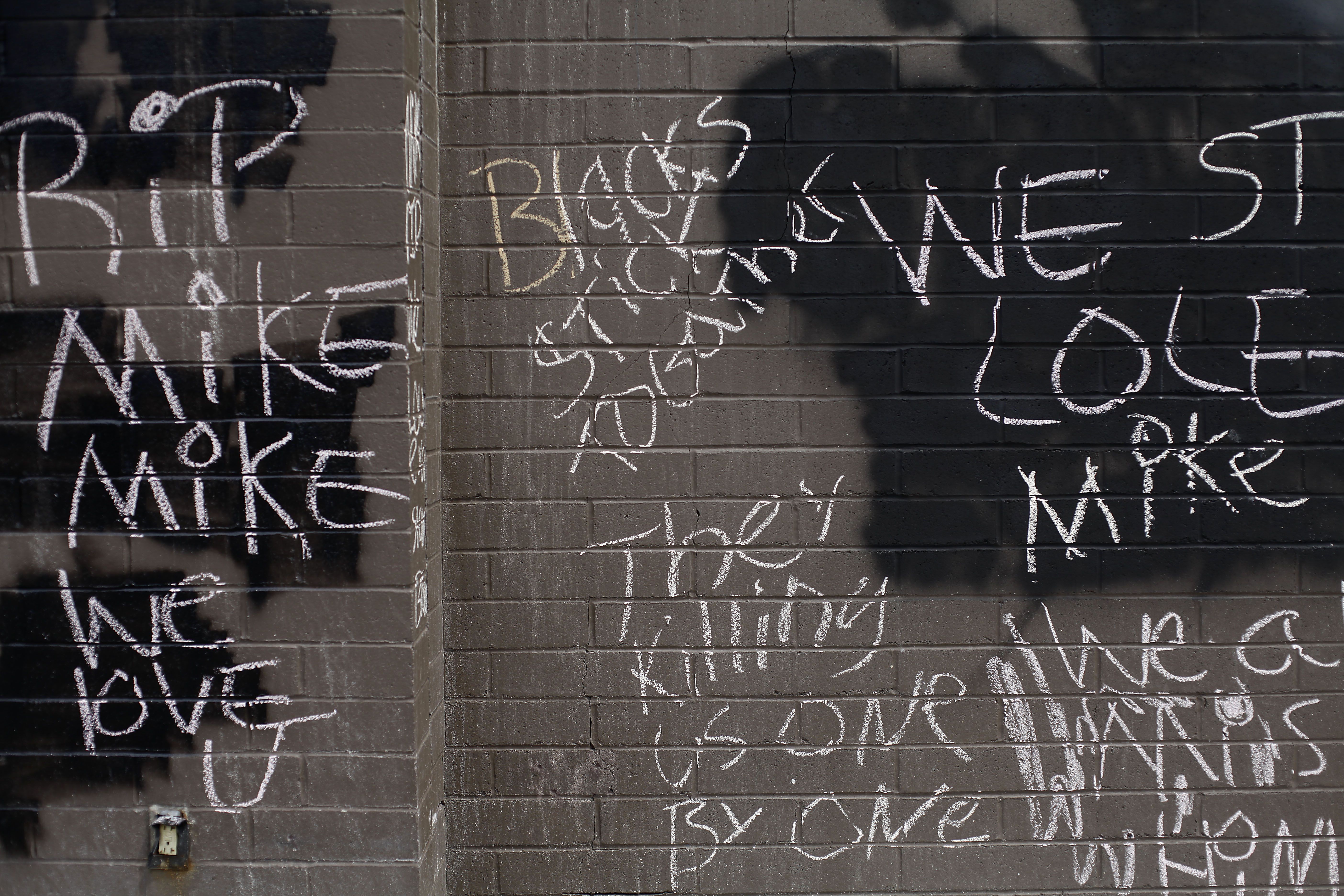
(Photo: Demonstrators wrote messages while protesting on August 15, 2014, the shooting death of 18-year-old Michael Brown in Ferguson, Missouri. By Joshua Lott/AFP/Getty Images)