Playing The Prostitution Shame Game, With A Little Help From Hyperbole And Fear

by Elizabeth Nolan Brown

FRANCE -PROSTITUTION-POLITICS-LAW-RIGHTS

Comedian Jim Norton admits that he “cannot even fathom a guess as to how much money” he has spent on paid sex in the past few decades. He isn’t ashamed of his habit, and he doesn’t think other johns should be either. But he does worry that the criminal status of sex work invites violence:

By keeping prostitution illegal because we find it “morally objectionable,” we allow (or, more accurately, you allow) sex workers to constantly be put into dangerous situations. Studies have shown that rapes and STDs dropped drastically between 2003 and 2009 in Rhode Island after the state accidentally legalized it. The American Journal of Epidemiology showed that the homicide rate for prostitutes is 50 times higher than the next most dangerous job for a woman, working in a liquor store. You don’t need a Masters in sociology to understand it would be much safer for sex workers if they were permitted to work in places that provided adequate security. Legalizing prostitution would also alleviate the fear a sex worker may have about reporting the abusive behavior of a john out of fear of arrest.

…. By keeping prostitution illegal and demonizing all of its parties, we (you) are empowering pimps and human traffickers and anyone else who wants to victimize sex workers because they feel helpless under the law.

These are all arguments I make frequently (as do organizations like Amnesty International, the United Nations Development Programme, and Open Society Foundations). Criminalizing consensual sex between adults not only harms the sex workers and johns engaged in it but also the actual victims of sex trafficking, from whom resources are being diverted in order to conduct large, interstate stings on men like Norton. Dan Savage recently criticized such tactics, in response to an organization called Seattle Against Slavery and its Men’s March to End Demand:

The Men’s March organizers said in an e-mail that they hoped to get 75 men (and women and families) at the Men’s March to End Demand. But even if 75,000 men (and women and families) marched tomorrow—even if 750,000 men, women, and families marched—men (and some women) will continue to buy for sex from women (and some men). There have always been sex workers and there always will be sex workers. Sex workers have always had clients and they always will. Marching to “end the demand” for sex work is like marching to end the demand for illegal drugs. Marchers may burn a few calories, and they may leave feeling as if they’ve done something, but people will go right on paying for sex and using drugs.

393px-Have_You_A_Girl_to_Spare_-_The_Great_War_on_White_SlaverySeattle Against Slavery subscribes to the popular, delusional conception that all prostitution is “sex trafficking.” This delusion was recently promulgated by journalist Charlotte Alter in response to Norton’s anti- john-shaming essay. After telling Norton and everyone else they “should be ashamed” to pay for sex – after all, men aren’t “entitled to sex, but women are entitled to human dignity” – Alter asserts:

No amount of rationalization can get around the basic principle of market economics: if people like you didn’t buy girls, they wouldn’t be sold, and if they couldn’t be sold, they wouldn’t be trafficked and abused.

If Norton had said he pays girls for sex, I could see Alter’s point. But he didn’t. Norton wrote about paying for consensual sex with adult women working in the sex industry. Alter responded by accusing him of raping abused girls.

This is a popular tactic from the anti-sex work crowd. It can be hard to convince Americans, with their strong support of individual liberties, that the whys and hows of private adult sex is a proper matter of state concern. But if you can tie adult prostitution to the criminal trafficking of teens and children, more people’s ears start to perk up. And Alter tries her darndest, letting unsubstantiated allegations and spurious statistics fly:

Did you ever consider, Jim, whether these girls … might have slept with you only because they would get beaten if they didn’t make a certain amount of money that night. And if you thought they enjoyed it, they were probably faking, because that’s exactly what you pay them to do. Sure, some woman do choose this line of work, and sex-workers unions argue that prostitution can be a freely made choice, but that’s not the case for the vast majority: U.S. State Department estimates that 80% of the 600,000 to 800,000 people trafficked across international borders every year are trafficked for sex.

This statistic is false. To substantiate it, Alter links not to actual State Department statistics but to a page from the advocacy organization Half the Sky – and even that doesn’t say what Alter says it does:

The U.S. State Department … estimates that between 600,000 and 800,000 people are trafficked across international borders each year. Eighty percent of those trafficked are women and girls, mostly for sexual exploitation.

Half the Sky doesn’t provide any links or citations to back up these claims, either. According to a 2014 report from the State Department, however, only 44,758 victims of any sort of human trafficking were identified worldwide in 2013. Obviously not all or even most of those who are trafficked are identified by global governments, but I do wonder how we leap from less than 50,000 identified victims to an annual estimate of 600,000 and 800,000 victims, not including those who don’t cross country lines.

Of the identified victims, there were people who had been sold into prostitution, domestic labor, farm labor, military subscription, and a number of sectors. While the state department data doesn’t break it down, the International Labor Organization estimates that about 3 times as many people are trafficked into labor as are trafficked into the sex trade, and less if you include those trafficked by state or rebel groups and not just private individuals or enterprises. Women and girls make up a little more than half of total human trafficking victims.

Perhaps Half the Sky’s claim that trafficking is mostly girls and women being sexually exploited comes from the Bureau of Justice, which says that 80 percent of trafficking victims identified by U.S. federal investigations in 2008-2010 were sex trafficking victims. But it would be dangerous to assume the amount identified here reflects the trafficking population as a whole, since U.S. law enforcement puts much more effort into fighting the sex trade (especially these days) than it does cracking down on, say, forced domestic labor.

People like Alter ignore non-sexual trafficking victims in service of their anti-prostitution agenda, then have the audacity to question the motives of men like Norton who want to decriminalize sex work. Writes Alter:

Norton claims that legalizing prostitution would help solve (violence against sex workers), but what he really means is that it would be easier for him to buy sex without his pesky conscience getting in the way of his peskier penis. Because even though there are valid arguments for the legalization of prostitution, I’m finding it hard to believe that Norton really has the best interests of sex workers in mind.

While it’s neat that Alter thinks she can read minds, I guess, there’s nothing in Norton’s text to support her interpretation. He states that he feels no shame about paying for sex, doesn’t think anyone should feel ashamed about it, does not feel bothered by its illegality, and would not buy more sex if it was legal. I don’t see why we have any reason to think that Norton’s stated reason – making the whole business safer, especially for sex workers themselves – is suspect. That is unless, like Allen, you can’t conceive of a world in which anyone could purchase sexual services from someone and still respect their humanity.

(Photo: A demonstrator holds a placard reading ‘yes to the freedom to prostitute oneself’ on November 29, 2013 in Paris during a protest against a bill that would punish clients of prostitutes. By Joel Saget/AFP/Getty Images)


The Myth Of Pretext-Free Anti-Semitism

by Phoebe Maltz Bovy

Protests on Al-Quds Day in Berlin

Alongside the coverage of Gaza, on the Dish and beyond, has been a steady stream of coverage of a kind of shadow issue: European anti-Semitism. Writes Jon Henley:

Across Europe, the conflict in Gaza is breathing new life into some very old, and very ugly, demons. This is not unusual; police and Jewish civil rights organisations have long observed a noticeable spike in antisemitic incidents each time the Israeli-Palestinian conflict flares. During the three weeks of Israel’s Operation Cast Lead in late 2008 and early 2009, France recorded 66 antisemitic incidents, including attacks on Jewish-owned restaurants and synagogues and a sharp increase in anti-Jewish graffiti. But according to academics and Jewish leaders, this time it is different. More than simply a reaction to the conflict, they say, the threats, hate speech and violent attacks feel like the expression of a much deeper and more widespread antisemitism, fuelled by a wide range of factors, that has been growing now for more than a decade.

“These are the worst times since the Nazi era,” Dieter Graumann, president of Germany’s Central Council of Jews, told the Guardian. “On the streets, you hear things like ‘the Jews should be gassed’, ‘the Jews should be burned’ – we haven’t had that in Germany for decades. Anyone saying those slogans isn’t criticising Israeli politics, it’s just pure hatred against Jews: nothing else. And it’s not just a German phenomenon. It’s an outbreak of hatred against Jews so intense that it’s very clear indeed.”

Observers who don’t happen to be Jewish may see this and think, hmm. At a time when there are all these people being killed by Jews, is anti-Semitism really worth discussing? Indeed, it’s quite possible to be Jewish and to share this entirely understandable sentiment. (I’m Jewish and don’t share it, but more on that in a moment.) While right-thinking people balk when anti-Zionism crosses the line, it can seem just… odd, as if one is conflating the armchair bigotry Jews are experiencing on the continent that, yes, yes, hosted a genocide against them, but ages ago, when right now, there are dead Palestinian children. When Hadley Freeman, who normally writes about fashion, took on this issue, writing, “Clearly, a film festival being cancelled is not on a par with civilian deaths,” while I didn’t share the Guardian commenters’ collective eye-roll, I did understand it.

Yet anti-Semitism is intricately tied up with the situation in the Middle East, just not in quite the ways people seem to think.

Here’s what the popular conception of anti-Semitism gets wrong: The assumption seems to be that once upon a time – Nazi Germany, the Spanish Inquisition – Jew-hatred existed absent any particular justification. It was religious bigotry! Racial pseudoscience! Or, if the Jews in question were poor immigrants, hatred of the underdog! It was, people imagine, just this kind of generic bad, like racism, sexism, and homophobia, with innocent victims of ignorance. Whereas now, well, we can’t possibly be witnessing any anti-Semitism, because… look at Israel!

We see a version of this in Owen Jones’s intervention on the topic. Jones acknowledges that there are occasional snippets of anti-Semitism posing as anti-Zionism, but is dismissive of those, insisting, “The vast majority of pro-Palestinian sentiment is driven by a sense of solidarity with an oppressed people subjected to occupation, siege and a brutal military onslaught.” The real anti-Semitism comes from… basically anywhere other than the Western European left:

Take Greece, where the neo-Nazi Golden Dawn has thrived amid economic trauma. Back in May, 16% of Athenian voters opted for the Golden Dawn candidate for the city’s mayor. According to a recent study, 69% of Greeks had antisemitic views; in Poland – despite suffering some of the Nazis’ worst horrors – it was 48%, Spain 53%. In Hungary the antisemitic party Jobbik won a fifth of the vote in April’s parliamentary elections. Like most of Europe’s far right, France’s Front National focuses its bile against Muslims, but the party’s roots are deep in antisemitism; and a few months ago it topped the country’s European parliamentary elections.

While my knowledge of Jobbik’s exact platform is limited, I suspect that Hungarian anti-Semites don’t hate Jews for the heck of it, but that they, like other anti-Semites (including those whose interest in the ‘Palestinian cause’ far outweighs any interest in the Palestinian cause), have their reasons. Such as… well what do you know?

Anti-Semitism has always been about the notion of Jews having too much power. This has nothing specifically to do with Israel, let alone with anything this particular Israeli government has done. I’m quite sure the 1840s French writers holding forth about the Rothschilds weren’t reacting to anything the not-yet-existent Israel would do more than a century later. And it typically points – selectively – to real instances of Jews behaving badly. No, the deal with anti-Semitism is, it’s about highlighting Jews’ bad behavior; seeing only that; inventing some more; while at the same time ignoring good Jewish behavior as well as bad behavior on the part of non-Jews. We all know the refrain: Not all criticism of Israel is anti-Semitism. But the presence of legitimate criticisms often hangs out within a broader ideology that puts The Jew at the center of absolutely everything terrible that’s ever happened.

Palestinians’ actual enemies thus overlap substantially with anti-Semites’ imagined ones, but this doesn’t make Palestinians who fight for their own cause anti-Semites. If you’re Palestinian, and you have objections to Israeli policies, chances are this is not because of some ambient anti-Jewish sentiment you’ve absorbed, but rather because you don’t enjoy occupation, bombing, and discrimination. (For exact ratios of how much one is to blame Israel, how much Hamas, one or two other people have addressed the topic; I’ll pass.) If you’re not convinced by ‘there are greater tragedies in the world’ arguments, it’s not because you’re putting Israel at the center of everything. It’s because Israel is rather central to your own situation.

At the same time, there’s this preexisting set of people who aren’t Palestinian, who may have nothing to do with any Jews, Israeli or otherwise, but who imagine Jews are responsible for everything that’s gone wrong in their lives, and who sit waiting for their aha! moment. For the moment when Jew-bashing and nodding approvingly and synagogue-vandalizing becomes acceptable in polite society.

All of this, then, puts Palestinians in a bind. They honest-to-goodness are being oppressed in a Jewish state. And they have this built-in base of support in anti-Semites the world over. Those who call Hamas “anti-Semitic” sort of miss the point. It’s not that Hamas hasn’t embraced whichever tropes, playing at the above-mentioned audience. But the more relevant issue is that the Palestinian cause needs to be truly separated from the ‘Palestinian cause’ for real progress to occur.

(Photo: Members of the German riot police allegedly confiscated an Israeli flag while it was waved to protest against a demonstration for Al-Quds Day, an event intended to express solidarity with the Palestinian people, on July 25, 2014 in Berlin, Germany. By Carsten Koall/Getty Images)

It’s OK Not To Feel Anything When A Celebrity Dies

by Elizabeth Nolan Brown

Yesterday Robin Williams died, seemingly from suicide. Scrolling through Facebook a few hours after the news broke, I found myself in a sea of RIP and this is so sad! and other, lengthier expressions of mourning for the beloved actor. One update stood out, from a friend of a friend. After acknowledging that it may sound cold, she wrote:

I just want to put it out there that it is also ok not to have any feelings when something bad happens to a celebrity.

This was met with initial, emphatic approval from a few, quickly followed by admonitions. Didn’t she get the memo that we were all supposed to be using this as a PSA about mental health? They bet she wouldn’t be singing this tune if she or someone she knew had suffered from depression!Las Vegas Hosts International Consumer Electronics Show

Now there’s nothing wrong with using the surprising (apparent) suicide of a surface-happy comedian as a catalyst for discussing mental health issues. But how absurd to suggest it’s wrong not to. Maybe some people would prefer to remember the man’s life and work rather than his demons. Maybe some people who are intimately aware of the toll depression can take (or the pain a loved one’s suicide can cause) are loathe to latch their very personal pain to online discussions of a stranger with strangers. Maybe not everybody has to react in the same emotional tones.

But then why say something at all? That was another criticism hurled at this Facebook poster. Why couldn’t she have just kept her big non-mourning mouth shut?

Permit me a brief digression. As a college theater major, I once auditioned for a play that would be directed by a visiting Nigerian professor, Esiaba Irobi. For this play, Professor Irobi decided to eschew traditional callbacks and instead gather us all together and watch while we engaged in various games and activities. Near the end of the audition, we were all invited in a circular procession around the room, repeating after Irobi as he sung out some sort of call-and-response funeral dirge.

We were explicitly told not to act—this wasn’t an exercise to see how well we could feign grief. The professor said he wanted to see how we moved. There were drums. And there were quickly tears, all around me. Not just soft, subtle tears dotting my classmates’ cheeks but big, loud, hearty sobs. It confused the hell out of me. We weren’t actually at a funeral. We didn’t even have a fictional backstory for this procession, nor could we understood a word Irobi sang. Sure, his voice could carry emotion well, but I felt skeptical that the crying crew, which made up about half the room of auditioners, weren’t putting on a bit of a show.

Later, I brought this up with my then-boyfriend, who had also been at the auditions. He assured me his grief and that of those he’d talked to had been genuine. Then he told me it was sad that I was so closed off from my emotions that I couldn’t experience what they had. He felt sorry for me.

Because I was young, it genuinely stung and worried me. I am far from an emotionally repressed person, nor a non-demonstrative one. I’ve been known to cry at country songs and Law & Order episodes. So why couldn’t I feel sad over this imaginary scenario that had so tugged at my classmates’ heartstrings? What was wrong with my emotional response?

Nothing, is obviously the answer. There is no correct way to grieve. There is no correct way to mourn those you love, or to mourn acquaintances, or to mourn celebrities and strangers. And trying to conjure an inauthentic emotional response will only make you feel worse. But even knowing this, I admit—when popular public figures die, there’s always a moment in which I feel just like I did in that audition. Why does everyone seem so much more upset than I am? Why am I not reacting the same way? 

This is why I’m glad my Facebook friend didn’t keep her mouth shut. There is nothing wrong with feeling genuine sadness over the passing of an entertainer you enjoy and admire. There is nothing wrong with being stung by the way Williams seems to have went. There is nothing wrong with posting Mrs. Doubtfire stills to Instagram and heartfelt missives on your Twitter timeline in response, if the spirit moves you. And the “normalcy” of these responses is shown in the likes and retweets and expressions of solidarity with which they’re met. Collective catharsis exerts a powerful pull.

But in the age of all this public emoting—some no doubt genuine, some signaling—it can be very easy to forget that not everyone is “deeply saddened” by the news of Williams’ death. Some aren’t even moderately saddened. And that’s okay, too.


Update: Readers responded to this post here. You can also view all the Dish’s coverage of Robin William’s death here.

(Photo by Ethan Miller/Getty Images)

What Everyone Misunderstands About the ‘Libertarian Moment’

by Elizabeth Nolan Brown

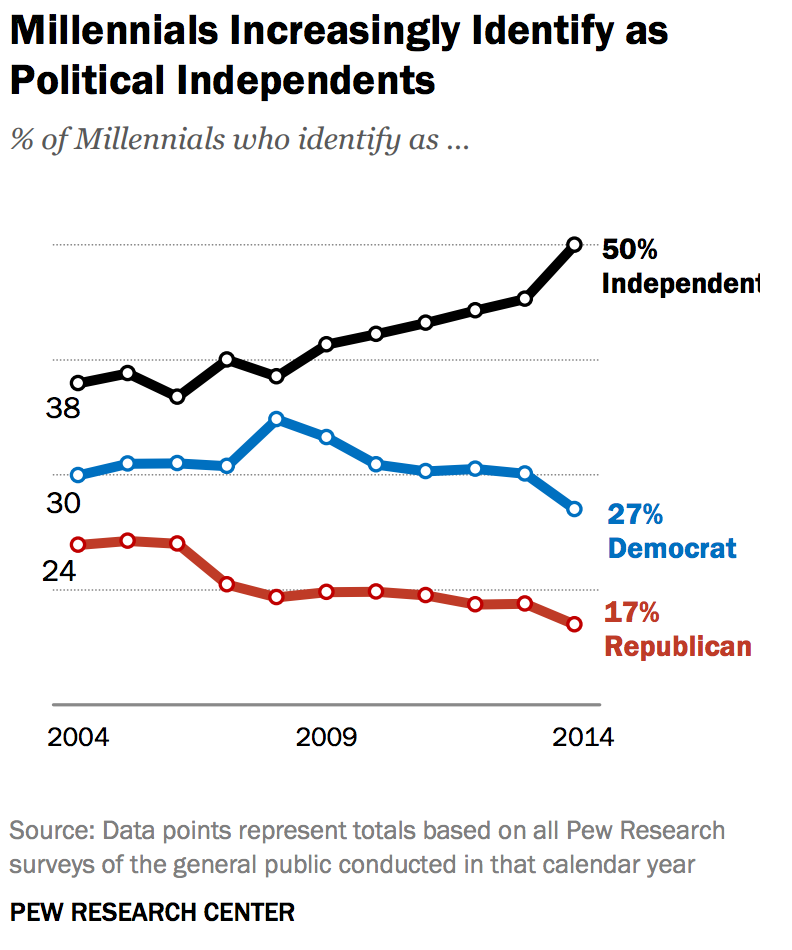
Pew Millenials

David Frum – shock – doesn’t think the “libertarian moment” has arrived:

Despite the self-flattering claims of libertarians, the Republicans’ post-2009 libertarian turn is not a response to voter demand. The areas where the voting public has moved furthest and fastest in a libertarian direction—gay rights, for example—have been the areas where Republicans have moved slowest and most reluctantly. The areas where the voting public most resists libertarian ideas—such as social benefits—are precisely the areas where the GOP has swung furthest and fastest in a libertarian direction.

This, of course, entirely misses the point of Robert Draper’s recent New York Times Magazine piece on libertarians. For all the Ron and Rand Paul mania, there’s little evidence the GOP has taken much of a “post-2009 libertarian turn” at all. So Frum is right that Republicans haven’t been ushering in some sort of libertarian era, I’m just not sure who’s arguing they have.

Draper’s piece—and those quoted in it, including Reason.com editor-in-chief (and my boss) Nick Gillespie—mostly suggests that, with rare exceptions, Republicans are stubbornly resisting embracing more libertarian ideals, despite the fact that it’s pretty much killing the party. “The Republicans will definitely have to move to the left on social issues,” my colleague Emily Ekins, polling guru for the Reason Foundation, says in Draper’s article. “They just don’t have the numbers otherwise.”

More than ever before, young people are defining themselves as politically independent, according to Pew Research Center and just about everyone else who polls them. But millennials identify as Democrats in similar proportions to older generations; it’s the GOP that’s bleeding young voters into the independent ether.

When libertarians talk about this generation’s potential, it’s not that we’re counting all these independent millennials as libertarian (as some have suggested). Nor do we think that most would identify as libertarian if only they read more about it on Wikipedia. Sure, I think libertarianism might have a bit more appeal to a generation raised on the seemingly endless and indistinguishable Bush/Clinton empire, but I’m not expecting young people to start adopting the libertarian label in droves.

Yet there is possibility for new consensuses, many of which would be appealing from a libertarian standpoint. In an electorate that doesn’t necessarily subscribe to old party divides, there’s potential to rally young liberals and conservatives together on issues like same-sex marriage, privacy, drug policy, and criminal justice reform, to name just a few. These aren’t “libertarian issues”—we’re not trying to own them (as critics also suggest)—but they are areas we’ve been keen on addressing, and it’s great to have allies of whatever stripe.

Frum snidely suggests that “the ‘libertarian moment’ will last as long as, and no longer than, it takes conservatives to win a presidential election again.” And if we’re talking about mainstream modern Republicans dressing themselves up in the label, no doubt. But again, that seems to be something only Frum is talking about. The “libertarian moment”, in so far as any of us think it exists, is about looking beyond party lines. It’s about working and coming together in new ways.

“I have no idea who will be the next president of the United States,” wrote Gillespie Sunday, but it “will matter far less than the broad currents in American society”:

That’s one of the main trends that Reason picked up in its poll of Millennials—not some self-congratulatory discovery that the kids today are junior-varsity libertarians—and folks who don’t want to grapple with that and all its implications will have less and less relevant to say about politics, culture, and ideas.

Or, as Jack Hunter wrote at Rare: “There is a significant difference between trying to make every American a libertarian and making America more libertarian. The former is impossible. The latter is happening.”

How Sexually Fluid Are Women Really?

by Phoebe Maltz Bovy

I’ve long had my doubts on the question. What I doubt, to be clear, isn’t that some women are bisexual. Just that all women are, which is essentially what one is saying if one declares female sexuality fluid. I doubt this in part for personal-thus-anecdotal reasons (I’m female, and my orientation hasn’t budged since it first encountered photos of a then-young Keanu Reeves close to 20 years ago), but also because there are other explanations, not related to wiring, that could account for the appearance of fluidity one witnesses.

What it comes down to is, it remains much more controversial for men than women to have same-sex relationships or encounters. But at the same time, it’s much more taboo for women than men to be without a partner of the opposite sex.

This sounds contradictory, I realize, but let me explain: There’s a stigma, for women, on being boyfriend-less, husband-less. But the stigma isn’t based on fears that the woman might be a lesbian, but rather, that she might be unable to get a man. Being found desirable by men continues to be important to women’s power in the world in a way that’s independent of how attractive that woman may or not find these – or indeed any – men. There are also financial advantages to pairing off with someone of the gender that tends to earn more.

How does any of this relate to women’s alleged sexual fluidity? Men are under greater pressure than women to seem not-gay, so there’s less same-sex fooling around among the merely curious, or it’s less openly discussed, making male sexuality seem less fluid than might be the case. But men are under less pressure than women to pair off (and what pressure there is starts so much later in life), so there may be fewer gay men than lesbians in opposite-sex relationships.

I came up with this grand (and thus far mostly unsubstantiated) theory while listening to a recent Savage Lovecast. (Update: listen to the relevant clip below, sent to us by the tech-savvy at-risk youth:


A 25-year-old woman called the show (starts at 8:13) to say that she’s a serial monogamist who’s only ever dated men. But! She can’t stop thinking about women. She’s openly bisexual, has known this since she was 14, which her current boyfriend knows, but he doesn’t want an open relationship. And so on, but what jumped out at me was the part where she mentioned that “90% of the time” when she’s having sex with her boyfriend, she’s fantasizing about women. 90%!

Imagine, if you will, ladies, if you learned that your boyfriend or husband fantasized about men 90% of the time he was with you. You’d probably come to the conclusion that your guy was gay. Not because male bisexuality doesn’t exist, but because of how close 90% is to 100%.

Presumably Dan Savage would make this same assumption if the genders were reversed. He doesn’t. This is ostensibly because the caller identifies as bisexual, but may also have just a bit to do with the fact that she’s a woman, and women, so fluid! Savage, in his response, likens her persistent desire to be with women to kinks and fetishes people try to repress over the years (he mentions foot fetishes), and it’s like, gah, this woman is a lesbian! That’s not a kink, it’s a sexual orientation! This isn’t about monogamy being constraining (as much as Savage tried to fit it into that box), but about being with someone of the wrong gender posing certain fairly obvious obstacles to happiness. What this woman needs to do isn’t – as Savage advises – renegotiate her heterosexual relationship to allow for some women on the side. She needs to lose the boyfriend and get herself a girlfriend.

Why, then, is a lesbian dating dude after dude after dude? What comes through in her call isn’t the slightest glimmer of desire for her boyfriend (“I love him a lot” and “I really care about him” – sweet, but sort of tepid for “25” and “boyfriend”) or indeed any of the other men on the planet. She’s afraid of not being in a relationship with a man: “The thought of losing that someone I have thought about spending the rest of my life with is devastating.” She’s afraid of giving up the possibility of Husband. Which is… a totally legitimate fear in our society, but hardly evidence that she’s straight or bi.

If Savage’s alarm bells don’t go off at this call, perhaps it’s because he has been socialized to believe that female heterosexuality is this softer, more reactive version of its male counterpart. That it’s basically about wanting stability, a husband, a man who’ll find you attractive. No one expects women – even heterosexual women – to lust after men. (Many of us do. But we’re socialized to be discreet about it.) So it doesn’t immediately read as “lesbian” when a woman expresses intense interest in other women, but sounds sort of lukewarm about men.

Update: Phoebe responds to some criticism of her piece here.

The Empire Is Striking Back

The Obama administration is now facing a real test of its resolve in Iraq. The depressing but utterly predictable resurgence of Sunni Jihadism in a country broken in 2003 and never put back together again by the “surge” has been so successful and the Iraqi government so weak that even Kurdistan is now at risk. The policy now is to do enough – but no more – to keep the Kurds in the game, keep the Yazidis on planet earth and push the Iraqis in Baghdad to get real. I felt queasy when the president announced this intervention and feel queasier two Hillary Clinton Awarded The 2013 Lantos Human Rights Prizedays later. Even though attempted genocide creates a uniquely grave crisis, as soon as the US is committed militarily to an open-ended endeavor in that country, and is in any way dependent on the Iraqis to take the lead, then we are at the mercy of that country’s profound dysfunction once again. It is quicksand. One foot in and you start sinking.

Or you can think of Iraq as perhaps the least reformable of all welfare dependents. Chronically divided, disintegrating yet again at a particularly explosive moment in Middle Eastern madness, it will always seem on the brink of some disaster or other. The temptation to go in again – especially since we gave it tens of thousands of corpses and years of trauma to add to its chaotic polity – is great. And Obama’s signature achievement so far has been his steadiness in resisting that vortex, in defusing Jihadism rather than giving it yet more reason to be inflamed, in being that rare president capable of internalizing what most Americans want – rather than what Sunday talk show blowhards demand.

He still has a chance to do that – but it will be much, much tougher now. Give the hegemonists some blood in the water, and they will soon swarm, demanding more war, and more meddling. You can see that dynamic in the idiotic ravings of John McCain who wants a full-scale war against ISIL – or in the classic scare tactics of Butters, with the inane idea that we have to fight them over there or they will come here. It is madness as strategy – madness that already created catastrophe. But no one responsible for that catastrophe in Washington was ever held mccainmariotamagetty.jpgaccountable – they’re doing their damndest right now to make sure war criminals are white-washed as well  – and so their ability to snap back right to 2003 is intact.

And the greatest throwback to 2003 in this respect is Hillary Clinton. So far as one can tell from her interview with Jeffrey Goldberg, there is no daylight between her and John McCain or even Benjamin Netanyahu – but a hell of a lot of space between her and Barack Obama. The interview confirms my view that she remains neoconservatism’s best bet to come back with bells on. It appears, for example, that her boomer-era pabulum about foreign policy on the Jon Stewart show – “We need to love America again! –  was not an aberration. She actually means it. And once we believe in ourselves again – don’t look at that torture report! – it will be back to the barricades for another American century of American global hegemony. And why not start in Syria and Iraq? I mean: she’s already hepped up about the threat of Jihadism –  and what could possibly go wrong this time? If only we believe in America!

You know, when you’re down on yourself, and when you are hunkering down and pulling back, you’re not going to make any better decisions than when you were aggressively, belligerently putting yourself forward. One issue is that we don’t even tell our own story very well these days.

Just forget that this country destroyed its military deterrence and its moral authority by the war that Clinton favored and has never fully expressed remorse for. Forget the trillions wasted and the tens of thousands of lives lost and the brutal torture we authorized and the hapless occupation that helped galvanize Jhadism, let’s just feel good about ourselves! And do it all again!

And so try and find a real difference between John McCain and Hillary Clinton on these topics. It’s certainly the same “fight them over there so we don’t fight them over here” fear-mongering:

One of the reasons why I worry about what’s happening in the Middle East right now is because of the breakout capacity of jihadist groups that can affect Europe, can affect the United States. Jihadist groups are governing territory. They will never stay there, though. They are driven to expand. Their raison d’etre is to be against the West, against the Crusaders, against the fill-in-the-blank—and we all fit into one of these categories. How do we try to contain that? I’m thinking a lot about containment, deterrence, and defeat.

Well, actually, their raison d’etre is not to be against the West. Right now and for the foreseeable future, it is about defeating the apostates of Shia Islam and wimpy Sunni Islam. It’s about forcing other Muslims to submit to their medieval authority – with weapons left behind from the last American interventionist project. The West for these Jihadis is a long, long way away. But not for Clinton or for McCain who see Benjamin Netanyahu Chairs Weekly Israeli Cabinet Meetingevery struggle anywhere as involving the US because … America! And that’s when you realize how fresh Obama was and how vital he has been – and how in foreign policy, a Clinton presidency is such a contrast to his.

Among those most eager for a return of the past is, of course, Benjamin Netanyahu. And you see in the interview with Goldberg how closely Clinton’s views mirror his. She hits every single neocon talking point: the Israelis have no responsibility for the killing of hundreds of children because “there’s no doubt in my mind that Hamas initiated this conflict … So the ultimate responsibility has to rest on Hamas and the decisions it made.” That’s almost a paraphrase of the Israeli prime minister or Joan Rivers (take your pick of the nuance artists). And Clinton even backs Netanyahu’s recent dismissal of a two-state solution! Yep: she’s not just running to succeed Barack Obama, there are times in the interview when it seems she’s running against him:

“If I were the prime minister of Israel, you’re damn right I would expect to have control over [West Bank] security, because even if I’m dealing with [Palestinian Authority President Mahmoud] Abbas, who is 79 years old, and other members of Fatah, who are enjoying a better lifestyle and making money on all kinds of things, that does not protect Israel from the influx of Hamas or cross-border attacks from anywhere else. With Syria and Iraq, it is all one big threat. So Netanyahu could not do this in good conscience.”

Again, you see how fresh Obama was. And what more could the entire neocons wish for? Oh wait: yes! They can also get their most cherished of dreams – a new war on Iran! Listen to Clinton parrot every AIPAC trope:

“I’ve always been in the camp that held that they did not have a right to enrichment,” Clinton said. “Contrary to their claim, there is no such thing as a right to enrich. This is absolutely unfounded. There is no such right. I am well aware that I am not at the negotiating table anymore, but I think it’s important to send a signal to everybody who is there that there cannot be a deal unless there is a clear set of restrictions on Iran. The preference would be no enrichment. The potential fallback position would be such little enrichment that they could not break out.” When I asked her if the demands of Israel, and of America’s Arab allies, that Iran not be allowed any uranium-enrichment capability whatsoever were militant or unrealistic, she said, “I think it’s important that they stake out that position.”

Clinton’s position is Netanyahu’s. And that’s important to understand. If you want a United States with no daylight between it and any Israeli government, whatever that government may do, vote for Clinton. If you want someone who believes the Libya intervention was the right thing to do, vote for Clinton. If you think America’s problem is not torture or drones or destabilizing occupations or debt but that we don’t tell the world how great we are enough, then vote for Clinton. If you really long for 2003 again, vote for Clinton.

She may be the only option – if the GOP nominates a full-bore pro-torture neocon. But isn’t it amazing that after the catastrophes of the Bush-Cheney era, both parties could effectively be running neocons for the presidency in 2016! Welcome to Washington – where the past is always present, amnesia is a lubricant, and the leading Democrat is running as a neocon. That change you could believe in? Not if Washington has the final say.

Listening To The President

Amid the impending flurry of opinions, ideas, regrets, conclusions and arguments that you will greet today, it’s well worth eight minutes of our time simply to listen to what president Obama said last night about the US intervention in Kurdistan yesterday. Here’s what he obviously wants in descending order of importance: security for US personnel in Erbil; no genocide of the Yazidis; and a functional, multi-sectarian coalition government in Baghdad. The first two are achievable in the short term; the last is subject to the profound vicissitudes of the broken state of “Iraq”. Which is to say: we can see no long term clearly right now.

Like most decisions that come down to the president alone, this is a very, very tough one. The reasons to resist being pulled back into any conflict in Iraq are too obvious and manifold to state. But let me note one massive irony: one reason why ISIS appears to have made so much progress is because they are armed with American military equipment, abandoned by the Iraqi army. And the only reason ISIS exists at all in Iraq – and al Qaeda before them – is that the United States so thoroughly broke that country from 2003 on. So the proximate reasons for this American intervention are the unintended consequences of previous American interventions. You can see how global hegemony eventually provides endless reasons for its own perpetuation – and why some of us want to restrain and temper its ambitions.

Another obvious conclusion: the speech last night was very similar to the reasoning behind the ill-fated rescue of Misrata in the Libyan uprising. Again: an allegedly imminent slaughter of civilians. Again: the need to act expeditiously because of fast-moving events on the ground. And we saw how that intervention ended  – in chaos and disorder that has only enabled more slaughter and unrest. If we thought Libya had persuaded Obama that he should not act when he can to save thousands of innocent civilians threatened by murderous religious fanatics, then we misjudged his moral core.

Do I reject that moral core? Of course not. I would not want even the toughest realist in the White House to be unmoved by a possibly imminent mass execution of civilians. And this is not merely a possible mass execution. It’s attempted genocide. That distinction matters to me, and should matter to America. ISIS has now slaughtered countless innocents, as has the government of Assad in Syria. But the possible genocidal attempt to wipe out the entire, ancient Yazidi population makes this more than yet another grotesque incident in someone else’s civil war. Non-interventionism meets its toughest test when it comes to atrocities like these.

Then there is the issue of the Kurds, a feisty, stateless people whose sanity stands in stark contrast to some of their neighbors. They too have endured genocidal attacks in the past  – from Saddam Hussein. They have been staunch American allies for decades and critical to what’s left of any decent future in that part of the world. They are not active participants in the Sunni-Shiite Arab Iraq-Syria civil war. They have played a largely defensive game, with some opportunistic land grabs, while developing their own region in a manner Baghdad seems incapable of more broadly. If Erbil were to fall for lack of ammunition in the short term – because they are being targeted by US-made military equipment – then equalizing that imbalance in the short term seems to the least we can do.

Nonetheless, I remain troubled by this – as I think the president is as well.

The danger of getting sucked into the Iraqi vortex is great. What if air-strikes are not enough? What if ISIS manages to invade Kurdistan – or does unspeakable damage to the dam now under its control? We are talking about a Jihadist force born of a fanatical fusion of a depraved version of Islam with brutality and violence of unlimited scope. What we are now signaling, in other words, is that there are limits to what the United States will tolerate with respect to ISIS’ dominance and power projection. That means we could find ourselves forced to intervene again and again on these lines and for these reasons. Only the president’s fortitude and restraint – or willingness to retreat from the goals he has just set out – can save us. At that point, if the immediate need to save the Yazidis and Kurdistan is behind us, it is absolutely imperative that any further military action be authorized by the Congress. An expeditious act of executive authority is one thing. Another risk of war is something else entirely. And such a decision should not be a president’s anyway. It should be a decision by the American people, through their elected representatives.

My main fear of the intervention is that it might convey to Iraq’s terrible leadership that the US once again will do their hard work for them – and thereby relieve them of the task of constructing a new government, capable of rallying Sunnis, Shiites and Kurds to restrain ISIS. Perhaps the danger is now so great the dysfunction in Baghdad could break – and with indirect American support, a new and more widely legitimate Iraqi government can begin to roll back or at least cauterize the Jihadist onslaught. That’s the optimistic scenario.

But when has an optimistic scenario ever been borne out in Iraq? That is the question. As Barry Ritholtz put it today:

Each time I think I have finally put George W. Bush’s misadventures out of my mind, something comes about to remind us how utterly bereft of reason or intelligence the decision to invade Iraq was. It is likely to haunt the U.S. even longer than the disastrous Vietnam War.

End Of Gay Culture Watch

A reader flags this report:

New research finds that traditionally gay neighbourhoods are becoming increasingly “straight” places, and could be at risk of losing their distinct cultural identity. Fewer same-sex couples reside in historically gay neighbourhoods compared to 10 years ago, according to one of the largest studies of sexuality in the U.S. Led by University of British Columbia sociologist Amin Ghaziani, the study found the number of gay men who live in gay enclaves has declined eight per cent while the number of lesbians has dropped 13 per cent. Ghaziani’s research, which is collected in his new book There Goes the Gayborhood, suggests that San Francisco’s Castro district, New York’s Chelsea, Chicago’s Boystown and other “gayborhoods” are changing as growing numbers of heterosexual households join or replace gays and lesbians. He offers several reasons for the shift, including gentrification, changing attitudes among gays and lesbians, and growing acceptance of same-sex couples.

This season in Provincetown has been very striking. It’s nearly a decade since I wrote  The End Of Gay Culture for TNR, but only now that the small drip-drip-drip of change seems to have reached a tipping point. The Ptown I came to in the late 1980s is gone forever. Back then, the crowds that thronged here – far larger than today – were dominated by gay men of all ages. On big holiday weekends, there were long lines outside several bars and the entire street was a virtual club. The crowd at Spiritus Pizza at 1 am would stretch for blocks and last for a couple hours. Cruising was everywhere – on the streets, the beaches and the docks – all amid the somewhat dilapidated houses and sea-shacks where groups of gays would crash for night after night. It felt like an alternative reality – an oasis at the end of the world, a place where some of us had come to die but so many more had come to live for the first time.

It’s utterly different today. The gay male crowds are much smaller; the straight influx far larger. Children are everywhere – of gay and straight parents. The super-wealthy have moved in – and real estate prices have all but prevented most regular gays from being able to live or rent here. Instead of legions of young homos working as busboys and waiters – exiled from their homes, or seeking a new life, or just killing time in a beautiful spot – we now have hundreds of young Bulgarian work-study exchange students brought in every summer and housed collectively. And many of the gay men here are like me – older now, and married, and spending more time in the garden than in the bars.

Don’t get me wrong: it’s still an unabashedly gay-friendly town. You wouldn’t mistake its vivid tableau of street life or its scootering drag queens for, say, Chatham. But when dozens of bachelorette parties invade the gay bars, when children are building sand-castles where gay men used to cruise, it has a very different vibe.

You begin to see the depth of the social transformation that the debates over the military ban and marriage have wrought.

The happy, integrative truth is: gay men can now go on vacation to many different places in America and feel safe and secure. They don’t need to be in Ptown any more. A middle-class gay couple in Boston can go anywhere on the Cape or the North Shore. Or anywhere in Europe. Ptown has competition all over the world in a way that just wasn’t true ten or twenty years ago.

Then there’s the extraordinary impact of technology. One of the attractions of Ptown back in the day – when I tied an onion to my belt, which was the style at the time – was that you could get laid almost as easily as you could get sub-burnt. It was so amazingly convenient – everyone within a few blocks over a couple of miles. But that convenience is now enjoyed in countless places in America, because of hook-up and dating apps. Every urban neighborhood has a virtual Ptown readily available all the time.

There has also, of course, been a slow transformation of gay culture in the last decade or so – including the first big generation since AIDS of middle-aged gay men. Hence the bears. But hence also the shift toward coffee shops over bars, indie cinema over drag queens, or events like the Tennessee Williams festival in September or the Film Fest in June. I’m not saying the old Ptown doesn’t still exist – in Bear Week or Carnival Week or July 4, you can still catch a strong whiff of it (among other things) – but it’s a lot less visible and complemented by a much more integrated and diverse summer population.

Do I feel some pangs of nostalgia? Of course I do. I do think there’s space for different sub-cultural oases in a fast homogenizing culture. Regret? I miss going to a gay club and not having to fight my way past a phalanx of twenty-something bachelorettes, taking selfies surrounded by “the gays.” Some of the straight love can feel a little like being in a zoo for their amusement. We sure don’t scare them like we used to. At the same time, this shift is a function of far greater freedom and integration than gays have ever experienced in America or the world. It is a new dawn for the vast majority – but a gathering dusk for something else more distinct, more edgy, more alienated and more exhilarating.

(Thumbnail image: Provincetown, MA by Ted Eytan. Note: photo has been cropped.)

The Last And First Temptation Of Israel

Palestinian Dina in difficulty opening her eyes

What is one to make of the fact that the deputy speaker of the Knesset has called for ethnic cleansing in Gaza?

He’s not an obscure blogger for the Times of Israel. He is a luminary of the Likud – a man who got 23 percent of the vote in a contest for the Likud Party leadership. He was appointed to his current high position by Benjamin Netanyahu. And this is his proposal for Gaza:

a) The IDF [Israeli army] shall designate certain open areas on the Sinai border, adjacent to the sea, in which the civilian population will be concentrated, far from the built-up areas that are used for launches and tunneling. In these areas, tent encampments will be established, until relevant emigration destinations are determined. The supply of electricity and water to the formerly populated areas will be disconnected.

b) The formerly populated areas will be shelled with maximum fire power. The entire civilian and military infrastructure of Hamas, its means of communication and of logistics, will be destroyed entirely, down to their foundations.

c) The IDF will divide the Gaza Strip laterally and crosswise, significantly expand the corridors, occupy commanding positions, and exterminate nests of resistance, in the event that any should remain.

You read that right. There will be temporary “camps” where the Gaza population will be “concentrated”; they will be expelled with subsidies; basic supplies of water and electricity will be cut off for those who remain. The war-time ethics he recommends are: “Woe to the evildoer, and woe to his neighbor.” He backs the “annihiliation” of Hamas and all their supporters. His strategic goal is to “turn Gaza into Jaffa, a flourishing Israeli city with a minimum number of hostile civilians.” (Modern Jaffa, of course, was built on the ethnic cleansing of most of its Palestinian inhabitants in 1948.)

The usual response to this kind of thing among the lockstep pro-Israel community is that it is a tiny fringe opinion. And I can only hope they’re right. But what concerns me is that this racist, genocidal bigot was appointed deputy speaker of the Knesset by the current prime minister. What concerns me are the statements of Ayelet Shaked, the telegenic young protege of Naftali Bennett, who is touted as a future prime minister. This is from a Facebook post she wrote the day before the gruesome lynching of an Arab teen who was forced to drink gasoline and then burned to death by Jewish extremists. Note that her call for war came before any Hamas rocket was fired:

Behind every terrorist stand dozens of men and women, without whom he could not engage in terrorism. They are all enemy combatants, and their blood shall be on all their heads. Now this also includes the mothers of the martyrs, who send them to hell with flowers and kisses. They should follow their sons, nothing would be more just. They should go, as should the physical homes in which they raised the snakes. Otherwise, more little snakes will be raised there.

Again, she and Feiglin dispense with the distinction between civilians and militants in Gaza. So too did the president of the New York Board of Rabbis, David-Seth Kirshner, at a recent 10,000 strong rally for Israel in New York. Kirshner’s precise words?

When you are part of an election process that asks for a terrorist organization which proclaims in word and in deed that their primary objective is to destroy their neighboring country and not to build schools or commerce or jobs, you are complicit and you are not a civilian casualty.

In Israel, this theme is intensifying:

The statements of Ovadia Yosef, whose recent passing was met with flattering memorials both in Israel and the US, are legendary. The former Chief Rabbi of Israel and spiritual leader of many Middle Eastern Jews, said, among other things, that Palestinians “should perish from the world” and that “it is forbidden to be merciful to them”; of non-Jews in general, he declared that “Goyim were born only to serve us.” Despite comments like these, his funeral last October was the largest in the country’s history, with 800,000 Israelis attending.

In the past month, Rabbi Noam Perel, head of Bnei Akiva, the largest Jewish religious youth group in the world, called for the mass-murder of Palestinians and for their foreskins to be scalped and brought back as trophies, alluding to an episode in the Book of Samuel; and a Jerusalem city councillor, in charge of security, encouraged a crowd to mimic the Biblical character of Phineas (Pinchas in Hebrew), who murdered a fellow Israelite and his Midianite lover for the “crime” of miscegenation…

One local chief rabbi ruled that bombing Palestinian civilians is permissible, while another, considered a “liberal” by Israeli standards, declared the assault on Gaza to be a holy war mandated by the Torah–one which must be merciless.

Today, the former head of Israel’s National Security Council, Giora Eiland, called for treating all Gazans, including women, as enemy combatants:

We are seeing now that despite the IDF’s impressive fighting, despite the absolute military supremacy, we are in a sort of “strategic tie.” What would have been the right thing to do? We should have declared war against the state of Gaza (rather than against the Hamas organization), and in a war as in a war. The moment it begins, the right thing to do is to shut down the crossings, prevent the entry of any goods, including food, and definitely prevent the supply of gas and electricity … why should Gaza’s residents suffer? Well, they are to blame for this situation just like Germany’s residents were to blame for electing Hitler as their leader and paid a heavy price for that, and rightfully so.

I suppose someone will claim that the deputy speaker of the Knesset, and the former head of the National Security Council or the former chief  rabbi in Israel or the head of the largest Jewish youth group in the world are fringe figures. But I note that, so far as I have been able to find, there have been no consequences for their statements for any of them. And I have to ask a simple question: which leader of another American ally has appointed a man who favors genocide and ethnic cleansing as the deputy speaker of the legislature? Which other democracy has legitimate political parties in the governing coalition calling for permanent occupation of a neighboring state – and deliberate social engineering to create a new demographic ethnic reality in that conquered land? Putin’s Russia has not sunk that low.

And we are not merely talking about a hypothetical situation. The grotesque death toll from Gaza is a distillation of this mindset – revealing at best a chilling contempt for Arab life and at worst, with the shelling of schools and shelters, a policy of indiscriminate hatred and revenge. Yes, killing women and children in shelters is about as low as you can get in wartime. As the State Department, in a rare moment of public candor, noted, it is appalling and disgraceful.

To see in front of one’s nose is a constant struggle. But I see evil in front of noses here – and evil that is gaining strength because of willful American blindness.

(Photo:  9-year-old Dina wounded when shrapnel pieces hit her eyes in an Israeli strike in Gaza, is treated at the Shifa Hospital in Gaza city on August 5, 2014. Palestinian Dina has difficulty in opening her eyes due to the flames and poisoned gas she has exposed in the strike. Update: She’s apparently doing much better. By Mohammed Talatene/Anadolu Agency/Getty Images.)

We Tortured. It Was Wrong. Never Mind.

I’ve wondered for quite a while what Barack Obama thinks about torture. We now know a little more:

Even before I came into office I was very clear that in the immediate aftermath of 9/11 we did some things that were wrong.  We did a whole lot of things that were right, but we tortured some folks.  We did some things that were contrary to our values.

torturefoia_page3_full.gifI understand why it happened.  I think it’s important when we look back to recall how afraid people were after the Twin Towers fell and the Pentagon had been hit and the plane in Pennsylvania had fallen, and people did not know whether more attacks were imminent, and there was enormous pressure on our law enforcement and our national security teams to try to deal with this.  And it’s important for us not to feel too sanctimonious in retrospect about the tough job that those folks had.  And a lot of those folks were working hard under enormous pressure and are real patriots.

But having said all that, we did some things that were wrong.  And that’s what that report reflects.  And that’s the reason why, after I took office, one of the first things I did was to ban some of the extraordinary interrogation techniques that are the subject of that report.

And my hope is, is that this report reminds us once again that the character of our country has to be measured in part not by what we do when things are easy, but what we do when things are hard.  And when we engaged in some of these enhanced interrogation techniques, techniques that I believe and I think any fair-minded person would believe were torture, we crossed a line.  And that needs to be — that needs to be understood and accepted.  And we have to, as a country, take responsibility for that so that, hopefully, we don’t do it again in the future.

What to make of this?

I don’t think it’s that big a deal that he used the English language to describe what was done, in any fair-minded person’s judgment. He’s said that before now. And his general position hasn’t changed. Let me paraphrase: We tortured. It was wrong. Never mind. So he tells the most basic version of the truth – that the US government authorized and conducted war crimes – and hedges it with an important caveat: We must understand the terribly fearful circumstances in which this evil was authorized. But equally, he argues that the caveat does not excuse the crime: “the character of our country has to be measured in part not by what we do when things are easy, but what we do when things are hard.”

This latter point is integral to the laws against torture – but completely guts his first point. As I noted with the UN Convention, the prohibition is absolute:

No exceptional circumstances whatsoever, whether a state of war or a threat of war, internal political instability or any other public emergency, may be invoked as a justification of torture.

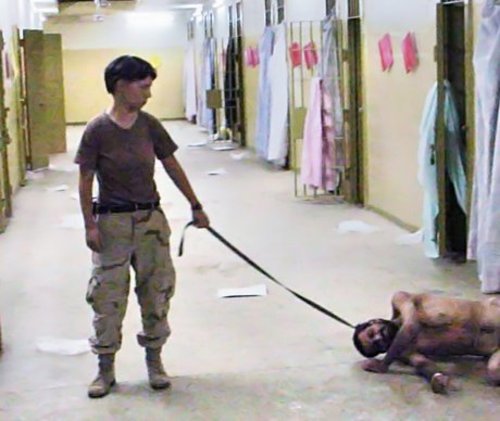
Cheney, Bush, Tenet, and Rumsfeld all knew this from the get-go. That’s why they got their supine OLC to provide specious justifications for the legally prohibited. That’s why they won’t use the word “torture,” instead inventing an Orwellian euphemism. And, of course, the president’s excuse for them – that “in the immediate aftermath of 9/11,” we did wrong things – is deeply misleading. This went on for years abughraibleash.jpgacross every theater of combat. What about what Abu Ghraib revealed about the scope of torture in the battlefield much later on? What about 2005 when they secretly re-booted the torture program? This was a carefully orchestrated criminal conspiracy at the heart of the government by people who knew full well they were breaking the law. It cannot be legally or morally excused by any contingency. It cannot be treated as if all we require is an apology they will never provide.

Yet that’s what the president’s acts – as opposed to his words – imply. And that’s what unsettles me. It is not as if the entire country has come to the conclusion that these war crimes must never happen again. The GOP ran a pro-torture candidate in 2012; they may well run a pro-torture candidate in 2016. This evil – which destroys the truth as surely as it destroys the human soul – is still with us. And all Obama recommends for trying to prevent it happening again is a wistful aspiration: “hopefully, we don’t do it again in the future.” Hopefully?

Then there’s the not-so-small matter of the rule of law.

Call me crazy but I do not believe that the executive branch can simply allow heinous crimes to go unpunished just because they were committed … by the executive branch. It seems to me, to paraphrase the president on agabuse.jpgFriday, that the rule of law “has to be measured in part not by what we do when things are easy, but what we do when things are hard.” How many times does the United States government preach about international law and Western values? On what conceivable grounds can we do so when our own government can commit torture on a grand and brutal scale for years on end – and get away with it completely?

Either the rule of law applies to the CIA or it doesn’t. And it’s now absolutely clear that it doesn’t. The agency can lie to the public; it can spy on the Senate; it can destroy the evidence of its war crimes; it can lie to its superiors about its torture techniques; it can lie about the results of those techniques. No one will ever be held to account. It is inconceivable that the United States would take this permissive position on torture with any other country or regime. Inconceivable. And so the giant and massive hypocrisy of this country on core human rights is now exposed for good and all. The Bush administration set the precedent for the authorization of torture. The Obama administration has set the precedent for its complete impunity.

America has killed the Geneva Conventions just as surely as America made them.

(Photo: a page on enhanced interrogation techniques via a FOIA request.)