Why Hasn’t John Brennan Resigned?

CIA Director John Brennan Speaks At The Council On Foreign Relations

I offer you a simple set of facts: under the Bush administration, the CIA set up a program that indisputably contained torture techniques; in due course, the Senate Intelligence Committee investigated the program in order to get some clarity as to its intent, its techniques, its authorization and its results; as the Committee was doing its work, the CIA hacked its computers in order to craft its own defense and suss out what the Committee had discovered. When Senator Feinstein publicly accused the CIA of this grotesque interference in its affairs, and assault on the constitutional separation of powers, the CIA chief, John Brennan said:

As far as the allegations of, you know, CIA hacking into, you know, Senate computers, nothing could be further from the truth. I mean, we wouldn’t do that. I mean, that’s—that’s just beyond the—you know, the scope of reason in terms of what we would do.

At the time I wrote: “Either Brennan or Feinstein isn’t telling the truth. ” We now know it was Brennan who wasn’t telling the truth, as the CIA itself has now acknowledged in its own internal report that it did exactly that – something “beyond the scope of reason”. Indeed it is beyond the scope of reason. It was also beyond the scope of reason that the CIA would import the torture and brain-washing techniques of Communist China in order to glean intelligence from captured enemy combatants. And yet they did that as well. But the attempt to obstruct justice by hacking into the Senate’s computers adds something else to the original crime. Let’s recall what DiFi said back in March:

Here’s her conclusion:

I have grave concerns that the CIA’s search may well have violated the separation of powers principles embodied in the United States Constitution, including the speech and debate clause. It may have undermined the constitutional framework essential to effective congressional oversight of intelligence activities or any other government function. … The CIA’s search may also have violated the Fourth Amendment, the Computer Fraud and Abuse Act as well as Executive Order 120003, which prohibits the CIA from conducting domestic searches or surveillance.

This is not a minor matter – it is a hugely important matter in terms of the constitution and the rule of law. We’re talking here about crimes and deception. How are we supposed to believe another word that comes out of Brennan’s mouth? And how desperate must the CIA have been to cover up its crimes that it took this extraordinary step of spying on the Senate that oversees it?

I submit that either Brennan knew nothing of what was going on and had no grip on his own agency; or he knew full well and was brazenly lying in public. In either case, under his watch, the CIA tried to subvert a critical Congressional report on its own criminal history.

I’m with David Corn:

Brennan owes the nation an explanation for his own actions. Why did he put out a false cover story? Was he bamboozled by his own squad? Was he trying to stonewall?

The CIA conducts much of its business in secrecy; and most of Congress’ vetting of the CIA likewise occurs out of public view. Effective oversight requires trust and cooperation between the two—and there must be that trust and cooperation for the public to have confidence that the oversight system works. But there also has to be public trust in those who lead the CIA. Brennan’s initial public statements about this scandal severely undermine his credibility. He owes the public a full accounting. If he remains in the job, President Barack Obama will owe the public an explanation for why he retained an intelligence chief who misled the public about CIA misconduct.

(Photo: Central Intelligence Agency Director John Brennan takes questions from the audience after addressing the Council on Foreign Relations in in Washington, DC on March 11, 2014. Brennan denied accusations by U.S. senators who claim the CIA conducted unauthorized searches of computers used by Senate Select Committee on Intelligence staff members in an effort to learn how the committee gained access to the agency’s own 2009 internal review of its detention and interrogation program, undermining Congress oversight of the spy agency. By Chip Somodevilla/Getty Images.)

Andrew Asks Anything: Rich Juzwiak

juzwiak-banner

If you ever read Gawker, you know who Rich Juzwiak is. Yesterday he came out with a new piece revealing how he’s not just taking Truvada again; he thinks almost every gay man should be on it too:

In my first piece on Truvada, I said that I thought most sexually active gay men should at least consider going on it. That was not strong enough: All sexually active gay men who are negative should go on it, at least those who are in the highly populated gray area that I find myself in—guys who either have casual condomless sex from time to time or who are “always safe” but still burdened by the fear of HIV.

If you know that you don’t need Truvada, I trust your judgment. If there’s a shred of uncertainty, just take the fucking pill.

I try to be as nonjudgmental as possible when it comes to the behavior of other gay men (though I cannot refrain from judging those who judge). We are all in different places in life; we all enjoy different things. That variety is, in fact, what makes gay culture so vibrant. The choices at the disposal of those who are privileged enough to live in areas where gay is OK and where same-sex marriage is legal—these are part what make being gay so wonderful. But if you cannot deal with taking a single pill every day, you need to get a grip and reevaluate your life. After you do that, then just take the fucking pill.

Rich and I sat down a little while ago to talk about sex and love and gay men’s lives today. The resulting podcast can be a little racy and provocative at times. Hey, it was a real conversation. We actually talk about the sexual adventurism of gay men – a subculture where no women restrain sexual desire – as an often wonderful thing, regardless of the judgment that so many, including gay men, have made about it. There may be a measure of mutual respect, friendship, democracy and brotherhood in a sexually liberated gay male world – that is perhaps unavailable to heterosexuals:


The whole conversation is up on Deep Dish now for subscribers only. Check it out. If you haven’t subscribed yet, do so here – you only need to spend $1.99 to download the whole thing. And you’ll also get access to my unfiltered conversations with Dan Savage and Hitchens, among many others.

Why Sam Harris Won’t Criticize Israel

Israeli attack kills Palestinian kid in Jabalia Camp

It’s a very long piece – or, rather, a speech annotated with qualifications – an interesting way to put your thoughts down on a screen. And it’s well worth your while. The gist of it is that because Hamas is an almost text-book example of nihilist theocracy and Israel isn’t, Israel is on the right side of the defining struggle of our times – and so not a country Harris will criticize. A related, central point is that the use of human shields by Hamas puts them in an utterly different moral universe than the IDF, in whose interests it is not to kill Palestinian civilians.

This is a crude summary – for there are qualifications on so many points that the piece is almost an explosion of nuance. So, for example, in Sam’s view, Israel cannot be absolved from war crimes either; and should not even exist as a Jewish state. That last point is a pretty huge one – and it comes at the very start of the piece. But if Israel should not exist as a Jewish state, it should not exist at all. This is its core justification – and one of the issues the Israeli government has put at the center of any possible two-state solution. Get rid of the Jewishness of Israel … and you will soon have a Middle Eastern state pretty evenly divided between Jew and Arab and in which future immigration ISRAEL-PALESTINIAN-CONFLICT-GAZAwould easily tip the demographic balance toward Islam. And this is where, I’d argue, Sam’s argument begins to unravel almost as soon as it begins: because it is overwhelmingly an abstract statement of abstract principles which fails to account for history in all its particular twists and turns. So he ends up refusing to criticize a state he really doesn’t believe should exist and yet then goes on to criticize it quite potently. You can call that original if you want. But you might also call it incoherent.

Still, Sam is unquestionably right about the theocratic extremism and despicable anti-Semitism of Hamas and its allies. It is much more extreme and central to Hamas than theocracy and anti-Arab racism is to Israel. He’s right that Hamas’ preference for building underground tunnels for war rather than underground bomb shelters for civilians makes them complicit (though far from solely responsible) in the horrifying carnage of the last few weeks. He’s also right about the difference between what Israelis would do if they had all the power and what Hamas would do in the same boat. Israel, with overwhelming power, gives many Arab citizens political rights even as it has penned a huge number into segregated bantustans, curtailed their travel, blockaded them (in Gaza), and surrounded them with theocratic Jewish settlements in the West Bank. Hamas would, in contrast, just kill every Jew it could find as soon as it could. That is an important difference.

But that’s why I absolutely do not support Hamas, and never have. Nor is there any excuse for their war crimes. But the issue here is not one of a choice between Israel and Hamas; it’s between the possibility of a two-state solution and the Israeli government’s refusal to take any of the off-ramps toward it if they would curtail the bid to settle and annex the West Bank. Much of Sam’s argument would hold water if the Israelis had been in earnest about peace, and in earnest in supporting moderate Palestinian forces on the West Bank, and in earnest about taking Obama’s proposals seriously this past decade. But they haven’t been. Settlements are much more important to them than peace. And the settlements are motivated by exactly the kind of theocratic zeal that Sam normally opposes.

But the settlements – themselves a standing war crime under Geneva – do not figure prominently in Sam’s account. And when they do, he offers an unconvincing defense:

What would the Israelis do if they could do what they want? They would live in peace with their neighbors, if they had neighbors who would live in peace with them. They would simply continue to build out their high tech sector and thrive. [Note: Some might argue that they would do more than this—e.g. steal more Palestinian land. But apart from the influence of Jewish extremism (which I condemn), Israel’s continued appropriation of land has more than a little to do with her security concerns. Absent Palestinian terrorism and Muslim anti-Semitism, we could be talking about a “one-state solution,” and the settlements would be moot.]

This is delusional. It’s not just Palestinian terrorism and Muslim anti-Semitism that makes a one-state solution moot; it is embedded in the very meaning of Zionism. If Israel requires a Jewish majority to survive as a Jewish state, a one-state solution is anathema to it. And if all Israel wanted to do was have its tech sector thrive within (roughly) the 1967 borders, and embrace serious, US-backed security arrangements vis-a-vis Jordan, I’d be backing it to the hilt.

Instead, as Palestinian terrorism from the West Bank has declined drastically – the Israelis have intensified their theft of Palestinian land. Those settlements deeply hurt, rather than help, Israel’s security – because they alienate most of her allies, exacerbate bitterness and suspicion, and make the possibility of a two-state solution moot. You could secure the West Bank by military outposts if you wanted. But Israel is committed to engineering the demography of the place by settlements of religious fanatics of the sort Sam would usually excoriate. Netanyahu, we now know, would rather release hundreds of prisoners convicted of murdering Jews than remove a single brick from the West Bank settlements. It’s really not about security at all. It’s about race and religion in their ugliest zero-sum manifestations. Just because it isn’t as bad as Hamas doesn’t excuse it.

Then there is a really important point:

What do groups like ISIS and al-Qaeda and even Hamas want? They want to impose their religious views on the rest of humanity. They want to stifle every freedom that decent, educated, secular people care about. This is not a trivial difference. And yet judging from the level of condemnation that Israel now receives, you would think the difference ran the other way.

This kind of confusion puts all of us in danger. This is the great story of our time. For the rest of our lives, and the lives of our children, we are going to be confronted by people who don’t want to live peacefully in a secular, pluralistic world, because they are desperate to get to Paradise, and they are willing to destroy the very possibility of human happiness along the way. The truth is, we are all living in Israel. It’s just that some of us haven’t realized it yet.

Again, the abstractions obscure rather than clarify. We are not all living in Israel. Nor should any sane person want to be. In America, we are surrounded by two vast oceans and two unthreatening neighbors – about as different from Israel as it is possible to conceive. We have more space and land to accommodate religious, racial and cultural diversity than Israel could even dream of. We are not defined by one race or religion – but defined rather by a radical separation of church and state. In so far as we face Jihadist terror, we do so from a vastly more secure vantage point – and its victims since 9/11 have been mercifully sparse, suggesting a threat more manageable within our existing laws and arrangements than I, for one, ever thought possible.

And we have a real debate about how to confront Jihadist terror. In the Cheney years, we adopted the Netanyahu “shock and awe” approach – bomb, invade, terrorize and detain. Since then, we have adopted smarter, more surgical and political initiatives to help defuse it. One way to defuse it would be to resolve the Israel-Arab conflict along the only two-state lines that can work. The Israel-Palestine dispute is not the only thing galvanizing Jihadism, of course. But it remains one area where we have some leverage to effect change, and it is one area where our alleged ally has done all it can to prevent us.

I oppose Jihadism, in other words, as much as Sam. But what Israel is doing in the West Bank and the horrors it is inflicting on Gaza are almost designed to inflame, give credence to, and empower Jihadism in ways that will not only affect the Israelis. We are not all living in Israel. But if Sam gets his way, and ever more salt is rubbed into an ever rawer wound, we could be.

(Photos: Palestinian girl Ansam says goodbye to her little brother Sameh Junaid, killed in an Israeli cannon shot in the morning of Eid al-Fitr at Jabalia Refugee Camp as he was playing in the garden of his house on July 28, 2014 in Gaza City, Gaza. By Ali Hasan/Anadolu Agency/Getty Images; An Israeli soldier carries a shell as he and his comrades prepare their Merkava tanks stationed at an army deployment area along the border between Israel and the Hamas-controlled Gaza Strip on July 31, 2014. By Jack Guez/AFP/Getty Images.)

Why Am I Moving Left?

crashing-elephant-thumb

Tom Ricks penned a mini-manifesto of sorts yesterday on why he finds himself moving to the left. He’s always thought of himself as a centrist, but now finds himself drifting further away from American conservatism and Republicanism. Money quote:

I am puzzled by this late-middle-age politicization. During the time I was a newspaper reporter, I didn’t participate in elections, because I didn’t want to vote for, or against, the people I covered. Mentally, I was a detached centrist. Today I remain oriented to the free market and in favor of a strong national defense, so I have hardly become a radical socialist.

But since leaving newspapers, I have again and again found myself shifting to the left in major areas such as foreign policy and domestic economic policy. I wonder whether others of my generation are similarly pausing, poking up their heads from their workplaces and wondering just what happened to this country over the last 15 years, and what do to about it.

Good question, Tom. Like Ricks, I don’t believe my general inclinations politically have changed that much over the years. I prefer smaller government in general; I too believe in a robust defense; I have few issues with the free market; I think marriage and family are critical social institutions; I’m still a believing Christian; I have deep qualms about abortion and abhor affirmative action; I’m a fiscal conservative; want radical tax reform, cuts in unfunded entitlements, and culturally, I’m a libertarian, with a traditionalist streak alongside radical tendencies (so, for example, I both love the Latin Mass and intend to go to Burning Man next month). I haven’t renounced my precocious devotion to Thatcher and Reagan, even as I have out-grown them, as the world has as well.

But I am now regarded as a leftist by much of the right and to some extent, they’re right. In today’s polarized political climate, I have few qualms in backing president Obama over almost anyone in the opposition, and am genuinely insulted these days when some people call me a Republican. Tom laid out several critical issues which have now placed him on the left rather than the right in today’s environment. They’re well worth reading through. Here are my critical reasons, as of now, for wanting the Republicans defeated in any forthcoming elections.

The defense of torture.  As disturbing as the deployment of torture by the Bush-Cheney administration was, the continuing refusal of anyone on the right to cop to it and make amends for it is a clear and present danger to our core decency. Calling it something else doesn’t cut it. Violating the sacred honor of the United States and a founding principle of Western civilization because of one man’s panic and extremism cannot be put aside. Today’s conservatism – in stark contrast to Reagan and Eisenhower and every civilized nation on earth – is now intertwined with barbarism. Until they revoke this and become fully accountable for it, I cannot in good conscience be a member of the “right.”

Political brinksmanship. The conduct of the GOP during the Obama administration has been a nihilist disgrace. In 2009, Obama inherited crises on every front: an economy in terrifying free-fall, a bankrupted Treasury, an even more morally bankrupt foreign policy, and two failed wars. He deserved some measure of cooperation in that hour of extreme national peril and need. He got none. From the get-go, they were clearly prepared to destroy the country if it also meant they could destroy him.

In fact, from that first stimulus vote on, Obama faced a unanimous and relentless nullification Congress. If he favored something, they opposed it. Despite Obama’s exemplary family life, public grace and composure, and willingness to compromise, they decided to cast him as a tyrant, a radical, a traitor and an incompetent. Their demonization of a decent, pragmatic man simply disgusts me to the core. And, sorry, if you do not smell any whiff of racism in all of this, you’re a better person than I am.

Ideological blindness. Any party that can respond to the fact of yawning economic inequality in the 21st Century by blaming the 99 percent for not working hard enough has put ideology before reality. Any party that even now thinks slashing taxes below their current historically low levels will cure our economic ills is utterly delusional. Any party that is unconcerned with the social dangers of an economic system that increasingly rewards only the very very rich cannot be trusted with government. There has to be a pragmatic element to any conservatism and an ability too adjust to new circumstances and new problems. There are some hopeful signs among reformocons, but the tenor of the discourse remains absurdly doctrinaire, treating Reagan as some kind of god and compromise as the ultimate evil. Over the last decade, the GOP has seemed like a church rather than a political party, with dogma rather than policies, and beset by heresy-hunts rather than genuine debate.

Race, gender, sexual orientation. Yes, it’s hard to support a political party that harbors deep discomfort with racial and sexual minorities and many women. I’m a debater but I’m also a human being. I’ve enjoyed the back-and-forth over the last two decades on marriage equality – but to say I haven’t been affected by some of the rank bigotry displayed in that whole enterprise would be untrue. Listening to Republicans on race has also made me feel sick. The anger, the loathing, the condescension and the frustration are not things I want to associate with in any way, even though, for example, I’m sympathetic to many right-of-center positions – such as opposition to hate crimes or affirmative action. And the way in which women’s lives and sexuality are treated by the current right – the tone as much as the substance – repels me.

Anti-Intellectualism. I came of age when the right was bristling with new ideas and the left was pretty much exhausted. More important, the quality and civility of the conservative intellectual discourse encouraged eggheads like me to believe in a conservative future that was intelligent, reasoned and nimble. But it’s a long, long way from the heady days of Policy Review to the fulminations of the Daily Caller, a steep slope from Allan Bloom to Mark Levin, and a free-fall from the John McCain of the 1990s to the nomination of Sarah Palin as vice-presidential timber. Skepticism of a kind of liberal intellectual rationalism is one thing; scorn for the entire intellectual and academic exercise is quite another.

This is a rough and ready and short list. Longtime readers may be familiar with much more. The party of Lincoln, of Eisenhower and of Reagan still appeals. Which is why the party of Cheney, of Hannity and of Adelson so appalls.

The Worrying Vacuity Of Hillary Clinton

Hillary Rodham Clinton Book Presentation

I’ve tried to avoid the Clinton book tour bullshit this past month or so. Not good for my blood pressure. When I checked in occasionally, it was to discover that nothing much has changed. The Clintons are still self-pitying money-grubbers – $12 million in speaking fees since she left the State Department? – and now their offspring, exploiting her nepotistic advantage with all the scrupulous ethics of her parents, is continuing the grift. If you ask of Clinton what she’s fighting for, what she believes in, if you want to get her to disagree with you on something, good luck. Any actual politics right now would tarnish the inevitability of a resume-led coronation. That the resume has little of any substance in her four years as secretary of state does not concern her. She was making “hard choices”, and if we cannot appreciate that, tant pis.

I’d like to find a reason to believe she’s a political force who stands for something in an era when there is a real appetite for serious change. She could, after all, decide to campaign vociferously in favor of the ACA this summer and fall (universal healthcare is, after all, one of her positions), but that might siphon money away from her foundation and candidacy. She could get out there and start framing a foreign policy vision. But, again, too risky. I see nothing that suggests a real passion for getting on with the fight – just the usual presumptions of a super-elite, super-rich and super-cocooned politician of the gilded age.

So I did watch the Daily Show interview last week,  and was not surprised. As in most of her softball media appearances, she was both unctuous and vapid. But even I was aghast at the sheer emptiness and datedness of her one attempt to articulate a future for American foreign policy. She actually said that our main problem is that we haven’t been celebrating America enough, that we “have not been telling our story very well” and that if we just “get back to telling” that story about how America stands for freedom and opportunity, we can rebuild our diminished international stature. One obvious retort: wasn’t she, as secretary of state, you know, responsible for telling that tale – so isn’t she actually criticizing herself?

Next up: could she say something more vacuous and anodyne? Or something more out of tune with a post-Iraq, post-torture, post- Afghanistan world? Peter Beinart had the same reaction: “As a vision for America’s relations with the world,” he wrote, “this isn’t just unconvincing. It’s downright disturbing”:

It’s true that young people overseas don’t remember the Cold War. But even if they did, they still wouldn’t be inspired by America’s “great story about [promoting] human freedom, human rights, human opportunity.” That’s because in the developing world—where most of humanity lives—barely anyone believes that American foreign policy during the Cold War actually promoted those things. What they mostly remember is that in anticommunism’s name, from Pakistan to Guatemala to Iran to Congo, America funded dictators and fueled civil wars.

Larison piles on:

Changing the substance of policies is never seriously considered, because there is little or no recognition that these policies need correction or reversal. This takes for granted that opposition to U.S. policies is mostly the product of misunderstanding or miscommunication rather than an expression of genuinely divergent interests and grievances. I don’t know that Clinton is naive or oblivious enough to believe this (I doubt it), but it’s instructive that she thinks this is a good argument to make publicly. She is more or less saying that there is nothing wrong with U.S. foreign policy that can’t be fixed by better marketing and salesmanship, and that’s just profoundly wrong. It’s also what we should expect from someone as conventionally hawkish and “centrist” on foreign policy as Clinton is.

My fear is that she doesn’t actually mean any of this. She just needed to say something, and so came out with a stream of consciousness that is completely platitudinous and immune to Fox News attacks. It’s a defensive crouch that is always her first instinct. Think of the Terry Gross interview – and her discomfort in grappling with actual disagreement, from her own base that time. Her goal is always safety. And safety won’t cut it in a populist age.

So if she runs, my guess is she’ll wrap herself tightly in the maximalist concept of American exceptionalism and make this her appeal as a post-Obama presidency. See? she’ll say to the same voting groups she went for last time. I’m a real American, and I believe in America. And yay America!

Maybe this is merely a function that she isn’t running yet (and still may not). Why stir the pot if your goal at this point is merely selling books and raking in more corporate, Goldman Sacks dough? But when, I wonder, has she been otherwise? She remains scarred by the 1990s, understandably so. But the country has moved on in a way she seems to find hard to comprehend.

(Photo: Hillary Rodham Clinton, former United States Secretary of State, U.S. Senator, and First Lady of the United States, speaks during the presentation of the German translation of her book ‘Hard Choices’ (‘Entscheidungen’ in German) at the Staatsoper in the Schiller Theater on July 6, 2014 in Berlin, Germany. By Adam Berry/Getty Images.)

What Putin And Netanyahu Have In Common

Meeting of Vladimir Putin with Benjamin Netanyahu in Kremlin

Both have been riding nationalist waves of xenophobia – and have done their best to inflame it some more; both believe that military force is the first resort when challenged; both have contempt for the United States under its current president; both regard Europeans as pathetic weaklings and moral squishes; both use a pliant mass media to instill the tropes of paranoia, wounded pride and revenge; both target “infiltrators” in their midst, whether it be African immigrants and Palestinians or gays and Westerners; and both have invaded and threatened their neighbors. Perhaps most important of all: both have lost control to the even more enraged extremists to their right.

Check out the thoughts of  Gleb Pavlovsky as told to David Remnick:

The nightly television broadcasts from Ukraine, so full of wild exaggeration about Ukrainian “fascists” and mass carnage, are a Kremlin-produced “spectacle,” [Pavlovsky] said, expertly crafted by the heads of the main state networks. “Now this has become a problem for Putin, because this system cannot be wholly managed,” Pavlovsky said. The news programs have “overheated” public opinion and the collective political imagination.

“How can Putin really manage this?” Pavlovsky went on. “You’d need to be an amazing conductor. Stalin was an amazing conductor in this way. Putin can’t quite pull off this trick. The audience is warmed up and ready to go; it is wound up and waiting for more and more conflict. You can’t just say, ‘Calm down.’ It’s a dangerous moment. Today, forty per cent of Russia wants real war with Ukraine. Putin himself doesn’t want war with Ukraine. But people are responding to this media machine. Putin needs to lower the temperature.”

Now consider the vigilantes who poured gasoline down the throat of a young Palestinian and burned him alive. Do you think they come out of a vacuum? Or the horrifying tweets of young Israelis proudly urging genocide of Arabs. Or the cheers from the hilltops outside Sderot as Israelis celebrate the slaughter of civilians in Gaza. Or the fact that Netanyahu’s endless provocations have led to a cabinet even more hawkish than he and a country ever further away from any reconciliation with the people whose land it took decades ago.

Both men have the supreme self-confidence of fools; and the political instincts of geopolitical arsonists. Our only hope in restraining them is to watch them slowly hoist by their own canards. The problem is that hundreds of civilians in an airplane and in the crowded streets of Gaza keep becoming the collateral victims of their posturing.

(Photo: Israeli Prime Minister Benjamin Netanyahu and Russian president Vladimir Putin appear during the Security Council meeting in the Kremlin on November 20, 2013 in Moscow, Russia. Netanyahu was on a one-day visit to Russia. By Dmitri Azarov/Kommersant via Getty Images.)

The Astonishing Actual History Of The Gay Rights Movement

AIDS project

[Re-posted from earlier today]

I don’t care for the “right side of history” argument with respect to gay rights for a few reasons. It’s horribly condescending to people who have a sincere view against gay equality; it presupposes some sort of inevitability where there isn’t any; and it fails to understand the nature of history. History is never as dull as the concept of “progress” would have you believe. It is always, as Oscar Wilde once put it, crowded with incident.

In no case is this truer than for gay America. Our story, if presented as a Hollywood screenplay, would be dismissed as too outlandish, too melodramatic and implausible, to be taken seriously. And yet it happened, and remains with us – so close it is hard to see it, and with several sharp twists and turns.

ONE-1963.06From the extraordinary repression of the 1950s – the McCarthyite era when all gay people were threats to the republic – to the liberation of the 1960s and the frenzied libertinism of the 1970s, you had one powerful narrative. After centuries – no, millennia – of brutal sanctions against the love of one man for another, an unprecedented, ebullient flowering took place. In small enclaves, an openly gay culture began to thrive and express itself with all the understandable abandon of the suddenly free. It was still very much a subcurrent, among so many other social shifts in that era, and was surrounded by hostility and discrimination and stigma. But the sense of outsiderdom partly intensified the joy and the solidarity. The gay ghettoes of the 1970s and early 1980s did not much care about the world beyond them for a while. Freedom – even in one, small place – was exhilarating enough.

And then the plague. It is, quite simply, impossible to conceive of a more dramatic reversal. If gay men had finally struggled free from the internalized notion that they were sick, or enemies of God, or all but asking for divine retribution for their sins, that paradigm closed in with terrible, ironic ferocity. What else could explain a plague of that brutality and specificity but the wages of Satanic perversion? Jerry Falwell could not have dreamed of a more perfect scenario. Pat Buchanan, with his usual flair, intoned that the gays had declared war on nature and nature had therefore declared war on them. And in some dark way, many of us were tempted to believe it.

It would be absolutely understandable if gay men had simply collapsed under the weight of this paradigm. Some quietly did, their deaths hastened by shame and self-loathing and anger. “Tell my mother I hate her,” was one of my dying friend’s last wishes, as he languished alone in his hospital bed. My closest friend at the time both showed extraordinary courage in the face of his physical disintegration and yet also 400px-Aids_Quiltpainted on his naked back the words “Diseased Faggot.” The horror of the disease was compounded a million times by stigma. But the plague was also simply terrifying and terrorizing. No one knew what medieval bacteria would suddenly destroy his brain or liver or digestive system. No one knew who would be next.

I remember the intensified Provincetown summers of the early 1990s, where I had come to learn how to die. Each year, the band of infected brothers would come together and talk medications, buyers’ clubs, and drug trials, and care for the sick and mourn the dying and go to countless memorial services for the steadily mounting dead. (I suspect I will never go to as many memorial services in my seventies, if I last that long, as I did in my early thirties.) Some of us were intermittently crippled by the huge doses of experimental drugs we were then taking to keep the terror at bay. But we got past the nausea and the night sweats and the diarrhea to try and live before we died. We had a ramshackle night club in an abandoned house on Shank Painter Road, which we called the “Love Shack.” And every time you danced there with someone, you lost yourself in the eternal present, acutely aware that they might not come back next year, or you might not. It gave everything an intensity, a vividness, and an astonishingly fearful mindfulness.

Yes, medical progress was there, if tantalizingly distant for more than a decade. But in a perverse twist, as the medical gains fitfully continued, the deaths mounted. The worst year for deaths from AIDS was 1995 in a plague that had begun fifteen years before. And then, just as it seemed it couldn’t get worse, came the bewildering news of the breakthrough in treatments, the joy of those suddenly become Lazarus, and the deeper grief we had put off until the emergency was over. I sank into a deep depression that I subsequently came to understand as survivor guilt. Others – given a new lease on life but utterly bewildered about what to do with it – turned to drugs and sex and oblivion. Someone once observed that the members of ACT-UP after 1996 had three fates: they were either dead, crystal meth addicts or professional AIDS activists. What we had experienced during our most formative years simply made living hard, terribly hard, in the wake of survival.

Walter Armstrong has a wonderfully perceptive piece about this phenomenon that I recommend highly. The sexual oblivion of meth had its greatest appeal and took its greatest toll on the survivors:

Crystal methamphetamine took hold in urban gay communities in the late 1990s, soon after the first effective HIV drugs converted many death sentences and restored our generation to so-called normal life. Caring for the sick, burying friends and lovers, mourning the loss of entire sexual and social networks, and protesting in the streets had consumed much of our youth. Investment in the future, career building, saving money and all the other rigmarole of a middle-class US life had been jettisoned. The end of the crisis also meant an end to the intense sense of purpose and solidarity. Normal life could not compete.

As with other populations struggling with PTSD, a minority was collectively committing suicide, after surviving a war.

All of this was understandable, even predictable, given the powerful pressures crashing in on gay life. What was entirely not predictable is that the survivors also did something astonishing. Using the institutions and self-knowledge and smarts that had somehow defeated the plague, gay men charted a future when nothing like this would happen again, when gay men would never be parted from their spouses on their death beds, when gay men’s physical and psychological health would never be treated as insignificant, when gay men would never suffer the indignity that so many endured in front of our eyes. And so we built the case for marriage equality and for open military service as a recognition of the self-worth our survival had given some of us, and to pay some kind of tribute to those who had fallen.

We went, in other words, from about the deepest hole you can imagine to a determination not just to get out of it, but to see the mountaintop in our lifetimes. I do not know exactly where this act of will came from. It was not inevitable. It was, in fact, highly improbable. A few generations of licking of wounds would have been understandable. So would a collective in-turning in grief and pain and memory. But it didn’t happen. And today, we look out at that mountaintop … and may be forgiven for feeling vertigo.

Within the next few years, it is perfectly possible to conceive of an America in which marriage equality exists in every state and in which HIV is on a fast track to disappearance. If I had told my best friend before he died that this would happen in twenty years, his eyes would have widened into saucers. And we talk so much about how this has changed America, that we don’t often examine how it has impacted gay men themselves – how it is possible psychologically and emotionally to have come from such depths to such heights in so short a period of time, and stay sane and balanced and happy.

The younger gay generations know nothing of it, of course.

Because gay kids do not have gay parents, by and large, they have not been told stories of the dark days of courage and cowardice, and of unspeakable devastation and trauma. The average gay 22 votingyear-old today simply assumes that marriage is his civil right, and has only passing interest in how it came about. As for the AIDS years, he is about as informed as the average straight guy. And this is not a bad thing as such. The whole goal of all this ordeal was to create a world with only the trace of a robust equality, and not of lingering and persistent pain.

And yet the trauma of plague still reverberates in our heads – and that includes the young as well as the old. Sex for most of us has always been synonymous with fear – and that fear has had remarkable resilience over the decades, even as the reasons for it have waned. In another new must-read, Tim Murphy shows how this overhang is still with us, even for those who never went through the trauma of the worst years:

Over coffee and pie at the Blue Stove in Williamsburg not long ago, Adam, 33, a writer and filmmaker I know, mentions that he is exactly the same age as the pandemic. “The terror was at its height when I was coming of age, postpuberty,” he says. “The message from TV shows that was drummed into us as gay boys was that we could get this disease and die and make our parents very sad. I developed this intense fear when I was having sex with someone and not even doing anything risky. I’d still freak out the next day.”

And, of course this did not just make all sex fraught with anxiety on both sides, it also divided us into two camps, the positive and the negative. For a while, I vowed never to date someone negative, and sought sex partners online via HIV-positive sites. And within the HIV world, I often left condoms behind, as impediments to the full sexual intimacy I craved and to the HIV solidarity rubber-free sex generated. And then I was famously dragged out in public and shamed for this by HIV-negative activists who opposed my politics. It was a sign that the negative-positive divide was still deep and US-JUSTICE-GAY-MILITARYoccasionally vicious. It still is. On the hook-up and dating apps, you see the following phrases all the time: “Drug/Disease-Free For Same”; “Clean”; “Negative for Same”. Since no one has tangible instant proof of being HIV-negative, it’s not particularly effective in HIV prevention. But it instills the divide that has stalked gay men during the plague and after.

But that too is now collapsing. The revolution of the last couple of years is a Rubicon. We now know that any HIV-positive man on meds is no more infectious than someone who is HIV-negative. We also know that an HIV-negative man who is on Truvada cannot get infected. This means that there is no more HIV divide in the gay world – or rather that its empirical basis has just been completely erased. Which means, quite simply, that gay men for the first time since 1981 can live without fear of HIV if they so wish.

And this of course is just one more bewilderment. As we adjust to marriage equality and all that comes with it, we are suddenly offered the chance for an infinitely less anxious and less dangerous sex life as well. Men whose entire sexual identities have been wrapped, literally, in rubber, now have to navigate an entirely new world. Of course there is resistance:

Another HIV longtimer—a Chelsea store manager named Steve, 58, diagnosed in 1996—tells me frankly that, though he supports Truvada usage in theory, it mostly just pisses him off on a visceral level.

“I was at the Eagle a couple months ago,” he says, referring to the West Chelsea leather bar, “and this hot little muscly Latin guy told me that he was on PrEP and that I could fuck him raw. Boom, he just said it so easily.” Steve has lost many people he loved to AIDS. He finds even the effervescent celebrations of Gay Pride tough to witness. “I want people to understand why they’re able to take this right now,” he says. “It’s on the backs of people who have died and suffered. All that needs to be learned and honored.”

It does indeed. But I have no doubt that the beleaguered gay men of the early 1990s would be amazed and thrilled that we have come this far. They did not die hoping that their legacy would be sustaining fear in future generations for ever.

But bewilderment is not out of place. I think of the year I arrived here, and had to sign a box in my immigration form denying that I was a “communist”, “criminal” or a “homosexual”. In that year, 1984, the AIDS epidemic was just beginning to stalk the land, culling, by the time it US-JUSTICE-GAY-MARRIAGEwas finally stymied, five times as many young men as died in the Vietnam War in roughly the same amount of time. I remember the exhilaration of coming out in the 1980s and the terror of watching men my own age die horrible, humiliating deaths in front of me. I remember finding out that I was HIV-positive and immediately knowing that, for that reason, I could be deported instantly, and living in America in that limbo for twenty more years, with no guarantee of success. I remember the deaths of my friends and lovers; and the shift in 1996 as long-term survival seemed possible for the first time. And I remember the countless speeches I would give to gay audiences about marriage equality, and the glassy-eyed, incredulous stares that came back at me. I remember my military friends, in constant fear and trepidation, fired at will, struggling to square their often conservative dispositions with a sexual identity that labeled them “queer.”

I remember … and I forget. I forget because in many ways, forgetting is the only way I can actually live with some measure of freedom from a past that will never let go of me and a future that still blinds with the abundance and clarity of its light. I am not alone. We are on this mountaintop together, even as so many dead lie round.

(Photos: The cover of One Magazine, June 1963; Dr. Richard DiGioia goes to George Washington Hospital to check on his patient, Tom Kane, on September 25, 1992. Kane is deaf. Dr. DiGioia hugs Kane before leaving. By James A. Parcell/The Washington Post via Getty Images; Thousands of people gather to view the AIDS Memorial Quilt on display on the Washington Monument grounds 10 October, 1992 in Washington, DC. By Renaud Giroux/AFP/Getty Images;  A couple participates in a symbolic group commitment ceremony for same-sex couples to kick off National Gay Pride Month at The Abbey bar and restaurant on June 4, 2008 in West Hollywood, California. By David McNew/Getty Images; Seth Keel, center, is consolded by his boyfriend Ian Chambers, left, and his mother Jill Hinton, during a concession speech during an Amendment One opposition party on Tuesday, May 8, 2012, at The Stockroom in downtown Raleigh, North Carolina. Amendment One, which would ban gay marriage in the state, was well ahead at the polls. By Travis Long/Raleigh News & Observer/MCT via Getty Images; Former US Army Lt. Dan Choi (L), a gay rights activist and opponent of “Don’t ask Don’t Tell”, arrives at the E. Barrett Prettyman Federal Courthouse March 28, 2013 in Washington, DC. By Brendan Smialowski/AFP/Getty Images; Michael Knaapen and his husband John Becker react outside the US Supreme Court in Washington DC on June 26, 2013. By Mladen Antonov/AFP/Getty Images.)


Understanding The Permanence Of Greater Israel

Israeli air strikes on Gaza

My old sparring partner, Jeffrey Goldberg, has been busy pondering why Hamas has sent hundreds of rockets – with no fatalities – into Israel. He argues that it does this in order to kill Palestinians. It’s an arresting idea, and it helps perpetuate the notion that there are no depths to which these Islamist fanatics and war criminals will not sink.

It also helps distract from the fact that Hamas itself did not kill the three Israeli teens which was the casus belli for the latest Israeli swoop through the West Bank; that Netanyahu had called for generalized revenge in the wake of the killings, while concealing the fact that the teens had been murdered almost as soon as they had been captured; and that Israeli public hysteria, tapping into the Gilad-like trauma of captivity, then began to spawn increasingly ugly, sectarian and racist acts of revenge and brutality. It also side-steps the rather awful fact that this nihilist and futile war crime is all that Hamas has really got left.

Yes, they conceal armaments and rockets and weapons in civilian areas – and that undoubtedly increases civilian deaths. But what alternative do they have exactly, if they wish to have any military capacity at all? Should they build clearly demarcated camps and barracks and munitions stores, where the IDF could just destroy them at will? As for the argument that no democratic society could tolerate terrorist attacks without responding with this kind of disproportionate force, what about the country I grew up in, where pubs and department stores in the mainland were blown up, where the prime minister and her entire cabinet were bombed and some killed in a hotel? I don’t recall aerial bombing of Catholic areas in Belfast, do you? Or fatality numbers approaching 200 – 0? Democratic countries are marked by this kind of restraint – not by calls for revenge and bombardment of a densely populated urban area, where civilian casualties, even with the best precision targeting and warnings, are inevitable.

And there is, for all the talk of aggression on both sides, no serious equivalence in capabilities between Hamas and the IDF. The IDF has the firepower to level Gaza to the ground if it really wants to. Hamas, if it’s lucky, might get a rocket near a town or city. I suppose Israel’s reluctance just to raze Gaza for good and all is why John McCain marveled that in a war where one side has had more than 170 fatalities, 1,200 casualties, 80 percent of whom are civilians, and the other side has no fatalities and a handful of injuries, Israel has somehow practiced restraint. One wonders what no restraint would mean.

And look at the image above. Part of our skewed perspective is revealed by it. Imagine for a second that Hamas had leveled a synagogue. Can you imagine what Israel would feel justified in doing as a response? Or imagine if a Jewish extended family of 18 had been massacred by Hamas, including children? Would we not be in a major international crisis? At some point the lightness with which we treat Palestinian suffering compared with Jewish suffering needs to be addressed as an urgent moral matter. The United States is committed to human rights, not rights scaled to one’s religious heritage or race.

But this morning, as if to balance Hamas’s blame for every single death in the conflict, Goldblog feels the need to chide the Israeli prime minister for his “mistake” in having utter contempt for any two-state solution. “Mistake” is an interesting word to use.

It implies a relatively minor slip-up, a miscalculation, a foolish divergence from sanity. But it is perfectly clear to anyone not always finding excuses for the Israeli government that Netanyahu wasn’t making a mistake. He was simply reiterating his longstanding view that Israel will never, ever allow a sovereign Palestinian state to co-exist as a neighbor. And unless you understand that, nothing he has done since taking office makes any sense at all. Everything he has said and done presupposes permanent Greater Israel. And he is not some outlier. Israel’s entire political center of gravity is now firmly where Netanyahu is. The rank failure of the peace process simply underlines this fact. As do half a million Jewish settlers and religious fanatics on the West Bank. Which means that US policy is completely incoherent. Since the whole idea of a two-state solution is as dead as the infamous parrot, why on earth are Americans still pursuing it?

I think because many want Israel to be other than what it plainly is. They understand that this project of a bi-national state with Jim Crow segregation and disenfranchisement is a horrible fate. Jeffrey is as eloquent on this today as he has ever been:

If Netanyahu has convinced himself that a Palestinian state is an impossibility, then he has no choice but to accept the idea that the status quo eventually brings him to binationalism, either in its Jim Crow form—Palestinians absorbed into Israel, except without full voting rights—or its end-of-Israel-as-a-Jewish-state form, in which the two warring populations, Jewish and Arab, are combined into a single political entity, with chaos to predictably ensue.

But this is clearly the reality. The Obama administration was the last hope for some kind of agreement, and the Israelis have told the president to go fuck himself on so many occasions the very thought of accommodation is preposterous. With the acceleration of the settlements, and the ever-rising racism and religious fundamentalism in Israel itself, this is what Israel now is. And what it will always be. Anyone still assuming that a two-state solution is actually in the minds of the leaders of Israel is therefore whistling in the wind. One wonders simply how many Palestinians have to die and how much largess we must keep sending to Israel before that whistling eventually stops.

A reader adds:

This is what really put Israel’s occupation and settlement of the West Bank in perspective for me: Israel has possessed the West Bank for almost precisely the same proportion of its national existence as the United States has possessed Texas and California. About seven-tenths.  That is, Israel has occupied the West Bank for 71 percent of the time since national independence in 1948; the United States has possessed Texas and California for 69 percent of the time since national independence in 1776.

Imagine an American claiming that possession of Texas and California was not in some way fundamental to the character of the nation. Imagine if American border politics was predicated on the claim that possession of Texas and California was temporary and both would someday be returned to Mexican sovereignty. Preposterous! A United States without Texas and California would not be the United States anymore. Though it might keep its name, it would be a fundamentally different nation. Even more, the United States would first have to become an existentially different nation before it would even consider peaceably permitting California and Texas to leave the union.

Just so with Israel. Despite protestations otherwise, possession of the West Bank has become a fundamental and existential part of the character of Israeli nationhood. Possession of the West Bank is not temporary, it is not contingent, and it is not an exception to the general rule of the character of Israeli nationhood. Occupation and settlement are as central to the Israeli nation, its politics and culture, as burritos, Hollywood, and Sunbelt conservatism are to American politics, culture, and national identity.

And this was the vision of many of the Jewish state’s founders. To see what is in front of one’s nose …


For more of our ongoing coverage of this latest Israel/Gaza conflict, go here.

(Photo:  A Palestinian boy inspects the Al-Noor Mosque destroyed in air attacks staged by Israel army within the scope of “Operation Protective Edge” on July 14, 2014 in Deir Al-Balah district of Gaza City, Gaza. By Belal Khaled/Anadolu Agency/Getty Images.)

Genes And Our Politics

There’s a lot of truth to the old joke that liberals believe nothing is genetic except homosexuality and conservatives believe everything is genetic except homosexuality. On that spectrum, I remain broadly conservative (I think sexual orientation is almost certainly affected by some genes). I think a huge amount of what we fight over as cultural is much more linked to genes than we want to believe. And so I remain of the view that homo sapiens is not a separate and unique species of animal on planet earth, and has evolved and will continue to evolve in classic response to natural selection.

Mitt Romney Attends Tea Party Rally In New HampshireThat’s why it has always struck me as pretty obvious that there will be genetic differences between various geographic sub-populations in particular regions where humans have evolved and interbred for millennia. This does not translate to our concepts of “race” which are often artificial and crude and unscientific; but that doesn’t mean there isn’t some overlap or that the core underlying argument – that human populations can differ genetically across the planet, just as every single other species on earth differs – is somehow empirically suspect. And that’s the fundamental insight I took away from Nicholas Wade’s flawed recent book on race and genetics: forget the conjecture that takes up more than half the book; forget the arguments about “race” and genetics; and just re-imagine ourselves as very advanced apes with a long evolutionary history on planet earth, with lots of minor, regional variations, like so many other species. It’s a mind-expanding thought experiment.

In some discrete respects, we accept this as unexceptional. So, for example, no one is up in arms about the discovery of a recent and powerful genetic factoid that we covered yesterday: 87 percent of Tibetans have a mutation in a gene called EPAS1, which enables better breathing at very high altitudes. Only 9 percent of Han Chinese have this mutation, and yet the two populations have only been separated for less than three millennia. As proof of principle, that’s hard to beat: dramatic genetic variation just for the last 3,000 years of the roughly 200,000 we’ve been evolving and wandering across the globe in so many starkly different environments with profoundly different genetic US-JUSTICE-GAY-MARRIAGEimplications.

Our extreme intelligence in the animal kingdom means that our evolution has also been one in which culture and genes have intermingled in bewildering ways; and to miss culture as a core factor in our differences is to be just as blind to reality. But to see us as merely cultural beings, or walking blank slate brains, or completely interchangeable across the globe and all sub-populations is to miss the true drama of human history and pre-history. It robs the human story of its depth and richness in pursuit of an ideal – utter equality – that would have struck almost every human generation before three hundred years ago as bizarre.

Which is a very long-winded way (but hey, it’s good to get that off my chest) to say that it was refreshing to see Tom Edsall this week penning a bracing argument that genes may also lie beneath our political dispositions. In other words, a huge amount of what you’re born with may determine or at least strongly influence your liberalism or conservatism:

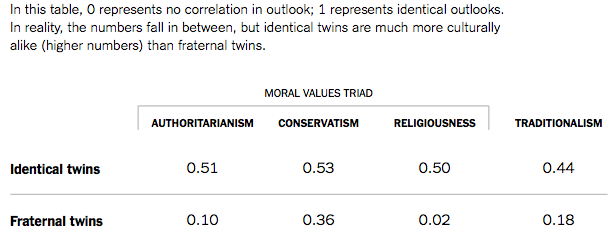
In “Obedience to Traditional Authority: A heritable factor underlying authoritarianism, conservatism and religiousness,” published by the journal Personality and Individual Differences in 2013, three psychologists write that “authoritarianism, religiousness and conservatism,” which they call the “traditional moral values triad,” are “substantially influenced by genetic factors.” According to the authors — Steven Ludeke of Colgate, Thomas J. Bouchard of the University of Minnesota, and Wendy Johnson of the University of Edinburgh — all three traits are reflections of “a single, underlying tendency,” previously described in one word by Bouchard in a 2006 paper as “traditionalism.”

This somewhat acts as a confirmation of Jonathan Haidt’s notions of the values that predominate in conservatives and liberals. And here’s the data from sets of fraternal and biological twins:

Screen Shot 2014-07-10 at 12.11.34 PM

The religiousness differential is particularly stark, followed sharply by authoritarianism. And Edsall is right to note this may help explain why, in a polity riven by core cultural questions, the ability to compromise, or even understand the other side, is in short supply. When it comes to economic questions, the divide is much less stark. There is, in other words, nothing the matter with Kansas. Kansans’ social and cultural value system outweighs in intensity and durability any economic arguments – and it’s our genes in part that facilitates that. Edsall’s conclusion?

Perhaps the most important rationale for research into the heritability of temperamental and personality traits as they apply to political decision making is that such research can enhance our understanding of the larger framework within which public discourse and debate shape key outcomes.

Why are we afraid of genetic research? To reject or demonize it, especially when exceptional advances in related fields are occurring at an accelerating rate, is to resort to a know-nothing defense. A clear majority of those involved in the study of genetics, neuroscience and evolutionary biology are acutely aware of the tarnished research that produced racist, sexist and xenophobic results in the past. But as the probability of a repetition of abuses like these diminishes, restrictions on intellectual freedom, even if they consist only of psychological barriers, will prove counterproductive. We need every tool available to increase our understanding of our systems of self-governance and of how we came to be the political animals that we are.

And we have nothing to be afraid of but the truth.

The Revenge Doctrine, Ctd

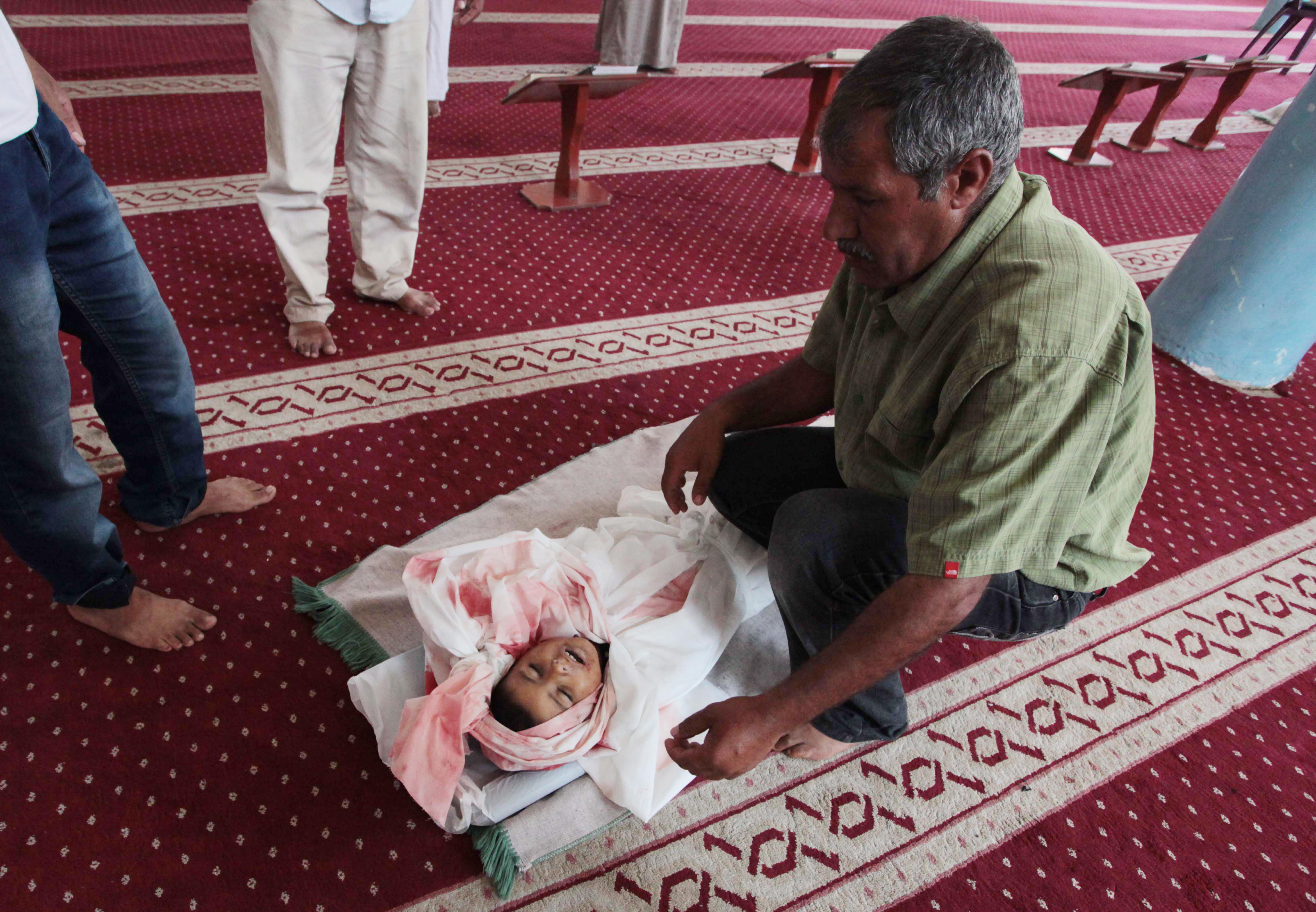
Funeral of a five-year-old child in Gaza

J.J. Goldberg reveals that the official story of what happened after those three Israeli yeshiva students were kidnapped is more hasbara than fact:

Once the boys’ disappearance was known, troops began a massive, 18-day search-and-rescue operation, entering thousands of homes, arresting and interrogating hundreds of individuals, racing against the clock. Only on July 1, after the boys’ bodies were found, did the truth come out: The government had known almost from the beginning that the boys were dead. It maintained the fiction that it hoped to find them alive as a pretext to dismantle Hamas’ West Bank operations.

What more do you need to know about the bigotry, callousness and hubris of Netanyahu? Well, this, maybe:

It was clear from the beginning that the kidnappers weren’t acting on orders from Hamas leadership in Gaza or Damascus. Hamas’ Hebron branch — more a crime family than a clandestine organization — had a history of acting without the leaders’ knowledge, sometimes against their interests. Yet Netanyahu repeatedly insisted Hamas was responsible for the crime and would pay for it.

So Netanyahu knew that the kidnapping wasn’t by Hamas proper, insisted that it was anyway, withheld the truth about the boys’ deaths in order to sustain a massive process of collective punishment of Palestinians in the West Bank, and then unleashed yet another brutal, lop-sided pulverization of Gaza. This is not a rational regime; and it is not a civilized government. J.J. Goldberg notes the Israeli military’s profound ambivalence about where Netanyahu is taking the country, along with the religious fanatics and racist haters who propel him forward.

And yes, yes, and yes again to the notion that Hamas should not be firing rockets into Israel at all, let alone at civilians directly, even though they have incurred no casualties and have bounced off the Iron Dome when they encroached too far into Israel proper. But in this instance, there is no equivalence. One side deliberately and deceptively instigated absolutely unjustified collective punishment of an entire population, and pre-meditatedly whipped up nationalistic and racist elements to back them up. They then went on to bombard Gaza – and many civilians – into another submission – after a period of relative calm and peace. The result is another disproportionate slaughter: around 100 Palestinians dead so far, and no Israelis. If you see nothing wrong with this, your moral compass is out of whack.

Meanwhile,  Obama and other world leaders have offered to broker a ceasefire, but Netanyahu has made it clear he’s not interested. An unnamed Israeli official tells Raphael Ahren that the goal of the bombardment this time is to permanently dismantle Hamas’s ability to strike Israel (didn’t they say the same thing last time?):

“It is quite possible that Hamas would agree to an immediate ceasefire — we’re hitting them hard, they want the situation to cool down,” the senior official told The Times of Israel, speaking on condition of anonymity. Brokering a ceasefire with Hamas would have been possible a week or a two ago, but an agreement that would leave in place the group’s offensive capacities not what Israel wants, the official said.

“Today, we’re not interested in a Band-Aid. We don’t want to give Hamas just a timeout to rest, regroup and recharge batteries, and then next week or in two weeks they start again to shoot rockets at Israel. Such a quick-fix solution is not something we’re interested in.” While refusing to discuss concrete steps the Israel Defense Forces plan to take in the coming hours and days, the official said that the government is discussing a ground invasion of Gaza “very seriously.”

Robert Naiman wants more US pressure on Israel to end the escalation:

The United States government has many levers on Netanyahu. Of course the U.S. gives Netanyahu billions of U.S. taxpayers’ dollars a year, but while it would be politically difficult (to put it mildly) to cut off U.S. military aid – the Obama Administration could not bring itself to cut off military aid to the Egyptian military coup, even when clearly required to do so by U.S. law – the Administration has many other, more subtle levers on Netanyahu that it could deploy without giving AIPAC, the ADL and their allies a convenient target for counterattack. The Administration could raise the volume of its public criticism of Netanyahu. The Administration could let it be known that it might refrain from vetoing a U.N. resolution that condemned Netanyahu. The Administration could “leak” that it is deepening efforts to engage Hamas politically, then issue a non-denial denial when these efforts are criticized. The Administration knows full well that it has all these levers and more. All it lacks is sufficient public political pressure to use them to force an end to the killing.

Au contraire. Most of the political pressure will come from those defending this latest slaughter built on a knowingly false pretext. Know despair.

Update from a reader:

I’m an American currently spending the month in West Jerusalem with my family.  Look: I’m no fan of Netanyahu or the current right-wing coalition here. I’m still trying to understand the implications of the government’s withholding of the information that the three teenagers were likely killed immediately after abduction. But when you say that the rocket fire from Gaza has caused “no casualties” in Israel, this is untrue. For example:

Following a barrage of rocket fire targeting southern Israeli cities, a rocket launched from Gaza hit a fuel tank near a gas station in Ashdod, causing severe damage and a fire. One person was critically injured by the strike, while seven other Israelis were lightly injured, according to Magen David Adom.

Granted the level of casualties is far lower than what we’re seeing on the Palestinian side, but it’s not “no casualties” on the Israeli side.

And when you say that rockets “bounced off the Iron Dome”, you are wrong both figuratively and literally.  Iron Dome only intercepts rockets bound for populated areas; all the rest it lets go. It has an astonishing 90% success rate at interceptions, but even so that means 10% are getting through to cause damage.

Even when the rockets fall harmlessly, they trigger sirens and send thousands of civilians running for cover.  We see relatively few rockets launched toward Jerusalem, but I’ve had to drop everything and run with my family to shelter several times in the past week.  It’s nerve-wracking.  I can’t imagine how bad life is for civilians in Gaza right now.

(Photo: A Palestinian man sits next to the body of five-year-old Abdallah Abu Ghazal killed in an Israeli air strike, during his funeral at a mosque in Beit Lahiya, in the northern Gaza Strip, on July 10, 2014. By Ashraf Amra/Anadolu Agency/Getty Images.)